Ella Andrew Nunn of Albany, Kentucky authored two books at the age of 91. “Pioneer Days in the Foothills of the Cumberland" was written for her children. It covered what she remembered of olden times, and what her mother and father had handed down. It dealt with the events of the entire area. “Things I Remember About Clinton County," her most sought-after book, was about people and events in Clinton County and Mrs. Nunn's memories of her life here. Written in 1982, it was an excellent history of the county, from the 1880s through the early 1900's, and contained many rare and early photographs depicting various historical figures, buildings and happenings from that era. It was her legacy, other than her family. The books have been out of print and unavailable for a while now, but so cherished that it isn't often you see one for sale, a wonderful testament to not only a great writer, but a great local historian.
In 1981, Byron Crawford, columnist for the Louisville Courier-Journal, wrote that Ella Nunn, who was born on Oct. 28, 1889 at Seventy Six, was an authority on firsts in Clinton County. He called her the "First Lady." If you wanted to know who had the first washing machine in Clinton County, ask Ella Nunn, he said, and if you wanted to know who owned the first automobile in the county, Mrs. Nunn could tell you that, too. It was such factual trivia like that brings history to life, he had said. "Yet, much of it is forever lost, simply because no one thought it worth remembering." Crawford said Mrs. Nunn might never have preserved her recollections of the past had her son, Bill, not pushed her into it. After she died in 1984, Bill donated his mother’s books to the public library.
In 1934, Ella Nunn became the first woman to be elected to the Clinton County Board of Education and for a while after her second husband, W.H. Nunn, passed away in 1942, she was the publisher and editor of two newspapers, The New Era in Albany and the Pickett County Gazette in Byrdstown. Along with being the mother of seven children, she did other things too, like president of the American Legion Auxiliary, first Worthy Matron of Albany Eastern Star #429, president of the Homemakers Club, a school teacher and she taught Sunday School.
She would later write, "all of this is material and doesn't amount to much. What counts is having a mother who took us to church when we were young. She always had our clothes starched and ironed for Sunday school and church. I began to teach a Sunday school class in my early teens (14). One night during a revival, something came over me. I saw some of my friends giving themselves to the Lord; Mary Guthrie, Dorothy Thomas and others. It was then that I knew that I needed God. When I went home, I couldn't sleep. The next day, after dinner, I went out into a field under an old chestnut tree. It was January and very cold, and there I gave my heart to God. I remember I was crying and praying. All at once I looked up, and there, alone with God, I said, "Dear Lord, I give myself away. It's all that I can do." I was so happy. Now I know that He was waiting for me to surrender my whole life to Him. That was the happiest day of my life. I joined the church that night and was baptized the next day in a creek that had ice flakes in the water and snow was falling. I owe much to Him and my parents and friends that I love."
Byron Crawford was right. Nancy Lou Ellen "Ella" Andrew Nunn really was the First Lady. Next January will be 40 years since she passed away at the age of 94. True to what her obituary said, she is today remembered for her rich store of memories about Clinton County, her contributions to home, church and community and, most of all, her love of Clinton County and its people. In a letter she wrote on May 13, 1909, seven months before her first marriage to Blaine Campbell, she wrote "I do feel proud of my friends. I feel like I have a host of them. If I have an enemy in the whole wide world I do not know it. I would be really sorry if I knew I had some. I am not as pure and good as I ought to be but I try to be kind to all. For what pleasure would life be without friends and someone to love? It would not be worth living."
Mrs. Nunn's granddaughter, Nancy Speck, said, "I never knew anyone who did not love her and to this day when I see elderly people in my home town they always say "You're Mrs. Ella's granddaughter?" I am always proud to say, Yes I am!"
Thursday, July 27, 2023
Wednesday, July 26, 2023
Some Hopkins Family History
Jimmy Boles, the great grandson of Cyrus Booher Parrigin, and my second cousin once removed, who was born in New Castle, Indiana but raised in Clinton County, Kentucky, once wrote that his great aunt, Elizabeth Jane Mackey Hopkins, was a woman of great fortitude and courage, undaunted when faced with superior forces. During the Civil War, with her husband, George Washington Hopkins away from home serving with the home guard, Champ Ferguson and his men rode up to the Hopkins homestead, which was located near Mountain View Park. Already known for robbing and looting at will, Champ was in the process of stealing a horse and was unhitching it from a plow when Elizabeth, came out of the house with a gun and fired one shot, which hit the beam of the plow. She then ordered Champ Ferguson and his men to leave the property. Overwhelmed by a brave and determined woman, Champ retreated as ordered, without the horse or any other property belonging to the Hopkins family. Washington's tombstone says he was a member of Seventy Six Church for 58 years. His grandfather, Elijah, was the first deacon there.
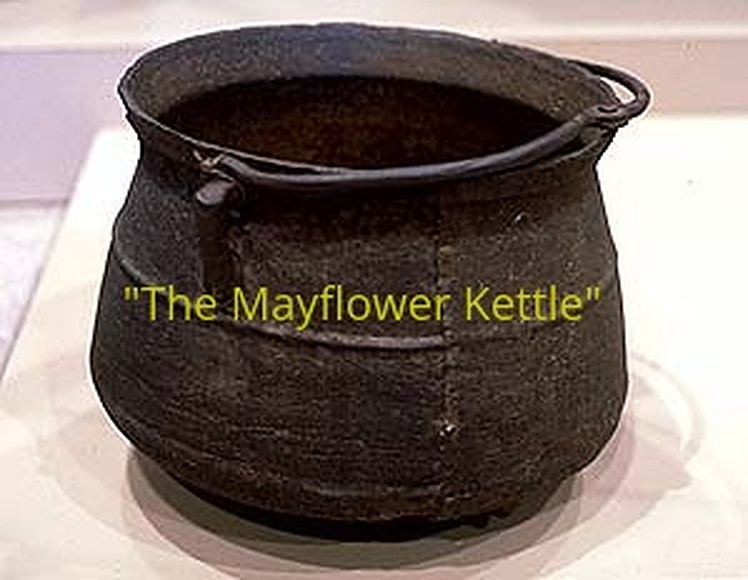
"THE MAYFLOWER KETTLE"
Speaking of property belonging to the Hopkins family, both Ella Nunn, in her book, "Things I Remember About Clinton County," and Jack Ferguson, in his book, "Early Times in Clinton County," both wrote that a Hopkins ancestor, Stephen Hopkins, was a passenger on the Mayflower when it departed for the new world in 1620. When it landed in America, Stephen carried with him an iron kettle that had been used as a churn on the voyage to America. When the Pilgrims celebrated their Thanksgiving it was used to help cook the first Thanksgiving dinner in America.
Supposedly, the kettle remained in the Hopkins family and was handed down to the oldest son from generation to generation and was eventually inherited by John R. Hopkins, who lived in Clinton County and is buried at Albany Cemetery. It is said that Scott W. Dowell, clerk at Clear Fork Baptist Church, certified on paper that he knew John R. Hopkins when he was a member of the church, and had heard him talk about the kettle. Boles wrote that when John died the kettle was passed on to a Bob Hopkins, who lived in Texas and that Ammazoo Hopkins of Midwest City, Oklahoma had relayed this story to him. Another story Boles said was that an old kettle that sat in the old Albany Bank in the 1920's was the kettle that came from the Mayflower.
The photo is only a representation of a kettle brought over on the Mayflower.
"THE MAYFLOWER KETTLE"
Speaking of property belonging to the Hopkins family, both Ella Nunn, in her book, "Things I Remember About Clinton County," and Jack Ferguson, in his book, "Early Times in Clinton County," both wrote that a Hopkins ancestor, Stephen Hopkins, was a passenger on the Mayflower when it departed for the new world in 1620. When it landed in America, Stephen carried with him an iron kettle that had been used as a churn on the voyage to America. When the Pilgrims celebrated their Thanksgiving it was used to help cook the first Thanksgiving dinner in America.
Supposedly, the kettle remained in the Hopkins family and was handed down to the oldest son from generation to generation and was eventually inherited by John R. Hopkins, who lived in Clinton County and is buried at Albany Cemetery. It is said that Scott W. Dowell, clerk at Clear Fork Baptist Church, certified on paper that he knew John R. Hopkins when he was a member of the church, and had heard him talk about the kettle. Boles wrote that when John died the kettle was passed on to a Bob Hopkins, who lived in Texas and that Ammazoo Hopkins of Midwest City, Oklahoma had relayed this story to him. Another story Boles said was that an old kettle that sat in the old Albany Bank in the 1920's was the kettle that came from the Mayflower.
The photo is only a representation of a kettle brought over on the Mayflower.
Thursday, July 20, 2023
Seventy Six, Kentucky
One of the most beautiful spots in Clinton County, Kentucky is Seventy Six Falls, located six miles north of Albany on beautiful Lake Cumberland. It is not known positively who the first white man was that discovered the falls, but it may have been the first families, namely Smith, Stockton or Wood, who settled at Stockton Valley after 1795 that ventured as far north as the falls.
During Clinton County's sesquicentennial celebration in 1986, Jim Deforest wrote in the Mountain Echo newspaper that, contrary to popular belief, Seventy-Six Falls was never 76 feet high, and it did not get its name from its height. The falls, he said, were between 83 and 84 feet high until the formation of Lake Cumberland in 1950, which reduced it to its present height of about 44 feet.
In his book, "Early Times in Clinton County," Jack Ferguson wrote that the name was derived from the station number in the original survey, where the members of the surveying party had built a shop and lodging quarters near the top of the precipice.
The water that pours over the falls is known as Indian Creek. This spot has been the scene of recreation ever since the horse and buggy days. Back then, there was a croquet court above the falls. On Sunday afternoons youth from all over the county gathered there to play croquet or sit around and watch others play.
As early as 1806, John Semple originally purchased the land near the falls and laid it off into 116 city lots, hoping to start the town, but his dream didn't come true for himself, as he died in 1824. While a town never materialized, there was a village. According to Ella Nunn, who was born at Seventy Six, in 1864, John C. Andrews, Frethias Andrews and Cyrus Wells would later buy the land around the falls, enlarge a gristmill that was already there and add a sawmill, a blacksmith shop and other improvements. Dr. Add Aaron operated a general store a little farther up the creek. The village flourished very well for over half a century as people came from all around to have their lumber sawed and wheat and corn ground, as there was no other gristmill around closer than Albany. Eventually, though, the village faded away.
The most notable person from Seventy Six was Edgar Paul Warinner, who served in the Kentucky state senate from 1951 to 1959. "Ed P" was born at Seventy Six on Aug. 18, 1909. Among his titles was farmer, railroad clerk and owner of a motel, service station, boat dock and grocery. He was born at Seventy-Six on August 18, 1909 and died on June 20, 1959. He is buried at Albany Cemetery.
Lake Cumberland was originally impounded from the Cumberland River in 1952 with the building of Wolf Creek Dam. A year later, James H. McKinley wrote, "when I was a teenager and used to climb the steep grade from the foot of the Seventy-Six Falls, I didn't know that some day I'd go to the top of these falls in a boat. When I used to swim in the seven-foot swimming hole on Indian Creek I didn't know that some day it would be a 77-foot swimming hole. No one could have ever made me believe that some day I would catch a fish 100 feet above aunt Ann Ellen Grider's chimney.
The village, mill and all of the buildings are long gone, but the beauty of Seventy Six Falls still remains.
During Clinton County's sesquicentennial celebration in 1986, Jim Deforest wrote in the Mountain Echo newspaper that, contrary to popular belief, Seventy-Six Falls was never 76 feet high, and it did not get its name from its height. The falls, he said, were between 83 and 84 feet high until the formation of Lake Cumberland in 1950, which reduced it to its present height of about 44 feet.
In his book, "Early Times in Clinton County," Jack Ferguson wrote that the name was derived from the station number in the original survey, where the members of the surveying party had built a shop and lodging quarters near the top of the precipice.
The water that pours over the falls is known as Indian Creek. This spot has been the scene of recreation ever since the horse and buggy days. Back then, there was a croquet court above the falls. On Sunday afternoons youth from all over the county gathered there to play croquet or sit around and watch others play.
As early as 1806, John Semple originally purchased the land near the falls and laid it off into 116 city lots, hoping to start the town, but his dream didn't come true for himself, as he died in 1824. While a town never materialized, there was a village. According to Ella Nunn, who was born at Seventy Six, in 1864, John C. Andrews, Frethias Andrews and Cyrus Wells would later buy the land around the falls, enlarge a gristmill that was already there and add a sawmill, a blacksmith shop and other improvements. Dr. Add Aaron operated a general store a little farther up the creek. The village flourished very well for over half a century as people came from all around to have their lumber sawed and wheat and corn ground, as there was no other gristmill around closer than Albany. Eventually, though, the village faded away.
The most notable person from Seventy Six was Edgar Paul Warinner, who served in the Kentucky state senate from 1951 to 1959. "Ed P" was born at Seventy Six on Aug. 18, 1909. Among his titles was farmer, railroad clerk and owner of a motel, service station, boat dock and grocery. He was born at Seventy-Six on August 18, 1909 and died on June 20, 1959. He is buried at Albany Cemetery.
Lake Cumberland was originally impounded from the Cumberland River in 1952 with the building of Wolf Creek Dam. A year later, James H. McKinley wrote, "when I was a teenager and used to climb the steep grade from the foot of the Seventy-Six Falls, I didn't know that some day I'd go to the top of these falls in a boat. When I used to swim in the seven-foot swimming hole on Indian Creek I didn't know that some day it would be a 77-foot swimming hole. No one could have ever made me believe that some day I would catch a fish 100 feet above aunt Ann Ellen Grider's chimney.
The village, mill and all of the buildings are long gone, but the beauty of Seventy Six Falls still remains.
Monday, July 3, 2023
America (My Country Tis of Thee)
In 1984, years before he was posthumously awarded the Congressional Medal of Honor, 1st Lt Garlin Murl Conner of Albany, Kentucky was honored at a July 4th commemoration at Camargo Church of God in Mount Sterling for being one of the highest decorated military veterans in Kentucky. The war hero spoke to a crowd of about 365 people. There was a flag ceremony, the presentation of the colors, the Pledge of Allegiance and the congregation sang "The Star Spangled Banner," “America, the Beautiful” and “America (My Country Tis of Thee)."
Did you know that ''The Star Spangled Banner'' wasn't adopted as the official national anthem of the United States until 1931? Before that, the nation had a few de facto national anthems, and ''The Star Spangled Banner'' wasn't even the most popular. That honor goes to ''America (My Country, 'Tis of Thee)." For a century, this was the most beloved 'unofficial' anthem of the nation.
The hymn was written In 1831 by Samuel Francis Smith, a student at the Andover, Massachusetts Theological Seminary, who had been asked to translate the lyrics in some German school songbooks into English. The "God Save the Queen" melody caught his attention, but rather than translate those lyrics, he was moved deeply by the desire to create a national hymn that would allow the American people to offer praise to God for our wonderful land. And so, in just thirty minutes, "America (My Country, 'Tis of Thee)" was born. The song was first performed on July 4, 1831, by a children’s choir in Boston.
All four stanzas of "America (My Country, 'Tis of Thee)," glorify freedom and liberty. God is the author of liberty. The hymn acknowledges no limits on freedom. The first three verses encourage and invoke national pride, while the last verse is a petition to God for His continued favor and protection of the United States of America. "Long may our land be bright with freedom’s holy light," 2 Corinthians 3:17 says “Where the Spirit of the Lord is, there is liberty (aka freedom)," which is to say Christ is where true freedom is found. It is a freedom that lasts for an eternity, not anything temporary. The kind of freedom we will never have to worry about being stolen or taken away. All four stanzas glorify freedom and liberty. God is “author of liberty” and unlike “America” the poem acknowledges no limits on freedom.
My country, 'tis of thee
sweet land of liberty
of thee I sing
land where my fathers died
land of the pilgrims' pride
from every mountainside
let freedom ring!
Click here to read more about 1st Lt. Garlin Murl Conner
Did you know that ''The Star Spangled Banner'' wasn't adopted as the official national anthem of the United States until 1931? Before that, the nation had a few de facto national anthems, and ''The Star Spangled Banner'' wasn't even the most popular. That honor goes to ''America (My Country, 'Tis of Thee)." For a century, this was the most beloved 'unofficial' anthem of the nation.
The hymn was written In 1831 by Samuel Francis Smith, a student at the Andover, Massachusetts Theological Seminary, who had been asked to translate the lyrics in some German school songbooks into English. The "God Save the Queen" melody caught his attention, but rather than translate those lyrics, he was moved deeply by the desire to create a national hymn that would allow the American people to offer praise to God for our wonderful land. And so, in just thirty minutes, "America (My Country, 'Tis of Thee)" was born. The song was first performed on July 4, 1831, by a children’s choir in Boston.
All four stanzas of "America (My Country, 'Tis of Thee)," glorify freedom and liberty. God is the author of liberty. The hymn acknowledges no limits on freedom. The first three verses encourage and invoke national pride, while the last verse is a petition to God for His continued favor and protection of the United States of America. "Long may our land be bright with freedom’s holy light," 2 Corinthians 3:17 says “Where the Spirit of the Lord is, there is liberty (aka freedom)," which is to say Christ is where true freedom is found. It is a freedom that lasts for an eternity, not anything temporary. The kind of freedom we will never have to worry about being stolen or taken away. All four stanzas glorify freedom and liberty. God is “author of liberty” and unlike “America” the poem acknowledges no limits on freedom.
sweet land of liberty
of thee I sing
land where my fathers died
land of the pilgrims' pride
from every mountainside
let freedom ring!
Click here to read more about 1st Lt. Garlin Murl Conner
Thursday, June 29, 2023
Unifying America on Independence Day
On the 4th day of July 1861, nearly a thousand men, women and children met at Dr. Johnathan Hale’s mill, just south of the Kentucky-Tenneessee state line, and celebrated the day as had been the custom in former years. They raised a hickory pole, on which was hoisted the old flag. Dr. Hale’s daughters sang the “Star Spangles Banner.” Mrs. Hale read the Declaration of Independence, and the whole concourse of people partook of a bountiful repast prepared by the women, every one of whom opposed revolution in every shape.
The Civil War had begun twenty-two days earlier. Our ancestors had thought this area was too remote to be included in any war, but it came nearly three months later, on Sept. 29, 1861 in the Affair at Travisville in nearby Pickett County, and then almost four months later at the Battle of Mill Springs on Jan. 19, 1862. The war coming here was inevitable. By its end, over 10,000 battles, engagements and other military actions had occurred in 23 different states, including nearly 50 major battles and about 100 others that had major significance. The remainder were skirmishes, reconnaissances, naval engagements, sieges, bombardments, etc. Over 650,000 deaths resulted. An estimated 814 casualties occurred at Logan's Crossroads, 814 on the Union side and 552 on the Confederate side, including General Felix Zollicoffer.
J.D. Hale, who had been born in Stoddard, MA in 1817, began to erect his two-story mill, store and post office in October of 1845. This 100-acre property on Wolf River was in the area where the Farmhouse Restaurant was located on Highway 111 in Pickett County. Hale served as postmaster. It was said that he also operated a manufacturing facility there, producing wagons and furniture. When the Civil War started, he and his family declared for the Union. As a matter of fact, he was among the first to denounce and expose session. The U. S. Army appointed him Captain and Chief of Scouts of the Army of the Cumberlands under General George Thomas, who had led the Union army at Mill Springs. Not only did Hale report on the activities of Confederate leaders Morgan, Forrest and Wheeler, he also recruited area men for the Union army.
The Consequence...
The massive July 4th celebration that had taken place at Hale's Mill, coupled with Hale's expressions of loyalty to the United States, infuriated Confederate sympathizers. He and his family were forced to flee to Albany for safety. Three days after the July 4th celebration, all of Hale's property was destroyed by fire. $20,000 worth of buildings and materials were burned, including his home and two other houses, a large library in Hale’s house, worker's cabins, a barn, stable, store, still house, kitchen, grist mill and saw mill, 1000 bushels of corn, planning machine, mortising machine, running lathe, circular saws, tolls, lumber, wagons, and furniture. In 1864, a military commission would award him $25,000 in an assessment levied against those accused of burning his property.
When the Civil War officially ended on May 9, 1865, the 4th of July celebrations across America were unlike any other in the nation’s history. An uneasy mix of joy, relief, resentment and unhealed wounds was reported as America sought reasons for celebration after a war that nearly tore the country apart.
Following the assassination of President Lincoln, an untested Andrew Johnson was trying to find his way forward as commander-in-chief. He looked to the 4th of July as a launching point to reunify not just the states, but also the hearts and minds of their inhabitants...
“Of all the anniversaries of the Declaration of Independence, none has been more important and significant than that upon which you assemble,” he proclaimed. “Let us trust that each recurring 4th of July shall find our nation stronger in number, stronger in wealth, stronger in the harmony of the citizens, stronger in its devotion to nationality and freedom.”
For the first time in more than four years, Independence Day 1865 had dawned without Americans on the battlefield trying to kill other Americans. Contemporary accounts and newspaper stories depicted a subdued, at times somber celebration in a country struggling to recover a sense of normalcy. In some places, the holiday was barely observed at all. But, on July 4, 1865, a group once again gathered at the Hale's Mill site to celebrate Independence Day, as well as the outcome of the war. They hoisted the 'old flag' and attendants fired a 34-gun salute. Hale’s daughters again sang the Star Spangled Banner and this time it was Hale who read the Declaration of Independence.
By 1871, the Hale family had left this area for New Hampshire. Jonathan died of old age in 1896. In 2011, Tennessee honored him by erecting a historical marker near the site of Hale's Mill. It is located just before Wolf River Bridge, where the Farmhouse Restaurant stood.
J.D. Hale, left, and Tinker Dave Beaty
The Civil War had begun twenty-two days earlier. Our ancestors had thought this area was too remote to be included in any war, but it came nearly three months later, on Sept. 29, 1861 in the Affair at Travisville in nearby Pickett County, and then almost four months later at the Battle of Mill Springs on Jan. 19, 1862. The war coming here was inevitable. By its end, over 10,000 battles, engagements and other military actions had occurred in 23 different states, including nearly 50 major battles and about 100 others that had major significance. The remainder were skirmishes, reconnaissances, naval engagements, sieges, bombardments, etc. Over 650,000 deaths resulted. An estimated 814 casualties occurred at Logan's Crossroads, 814 on the Union side and 552 on the Confederate side, including General Felix Zollicoffer.
J.D. Hale, who had been born in Stoddard, MA in 1817, began to erect his two-story mill, store and post office in October of 1845. This 100-acre property on Wolf River was in the area where the Farmhouse Restaurant was located on Highway 111 in Pickett County. Hale served as postmaster. It was said that he also operated a manufacturing facility there, producing wagons and furniture. When the Civil War started, he and his family declared for the Union. As a matter of fact, he was among the first to denounce and expose session. The U. S. Army appointed him Captain and Chief of Scouts of the Army of the Cumberlands under General George Thomas, who had led the Union army at Mill Springs. Not only did Hale report on the activities of Confederate leaders Morgan, Forrest and Wheeler, he also recruited area men for the Union army.
The Consequence...
The massive July 4th celebration that had taken place at Hale's Mill, coupled with Hale's expressions of loyalty to the United States, infuriated Confederate sympathizers. He and his family were forced to flee to Albany for safety. Three days after the July 4th celebration, all of Hale's property was destroyed by fire. $20,000 worth of buildings and materials were burned, including his home and two other houses, a large library in Hale’s house, worker's cabins, a barn, stable, store, still house, kitchen, grist mill and saw mill, 1000 bushels of corn, planning machine, mortising machine, running lathe, circular saws, tolls, lumber, wagons, and furniture. In 1864, a military commission would award him $25,000 in an assessment levied against those accused of burning his property.
When the Civil War officially ended on May 9, 1865, the 4th of July celebrations across America were unlike any other in the nation’s history. An uneasy mix of joy, relief, resentment and unhealed wounds was reported as America sought reasons for celebration after a war that nearly tore the country apart.
Following the assassination of President Lincoln, an untested Andrew Johnson was trying to find his way forward as commander-in-chief. He looked to the 4th of July as a launching point to reunify not just the states, but also the hearts and minds of their inhabitants...
“Of all the anniversaries of the Declaration of Independence, none has been more important and significant than that upon which you assemble,” he proclaimed. “Let us trust that each recurring 4th of July shall find our nation stronger in number, stronger in wealth, stronger in the harmony of the citizens, stronger in its devotion to nationality and freedom.”
For the first time in more than four years, Independence Day 1865 had dawned without Americans on the battlefield trying to kill other Americans. Contemporary accounts and newspaper stories depicted a subdued, at times somber celebration in a country struggling to recover a sense of normalcy. In some places, the holiday was barely observed at all. But, on July 4, 1865, a group once again gathered at the Hale's Mill site to celebrate Independence Day, as well as the outcome of the war. They hoisted the 'old flag' and attendants fired a 34-gun salute. Hale’s daughters again sang the Star Spangled Banner and this time it was Hale who read the Declaration of Independence.
By 1871, the Hale family had left this area for New Hampshire. Jonathan died of old age in 1896. In 2011, Tennessee honored him by erecting a historical marker near the site of Hale's Mill. It is located just before Wolf River Bridge, where the Farmhouse Restaurant stood.
Wednesday, June 14, 2023
Love, Honor and Respect for our Flag
June 14th
Today is Flag Day to remember when the Continental Congress introduced our country's first flag as the official American flag on June 14, 1777. In honor of this, I present a very beautiful piece written over 50 years ago by our Louis O. Brummett of Albany, Kentucky.
"We should display our flag and fly it proudly," he said, "in homage to those great Americans who died that we might live and that "Government of the people, for the people and by the people, should not perish from the earth."
"God hasten the day when we will regain those attitudes of love, honor, respect and enthusiasm for our flag and country that caused our fore fathers to bow their heads in humble gratitude to the God they loved and served and say, 'Almighty God, we thank Thee for our country and its flag; and what it stands for. As we gaze upon its radiance, may Thy holy light spread over us and bring to our hearts renewed devotion to God and country and love for our flag. Amen.'"
Mr. Brummett served as a Corporal in the U.S. Army during World War II. He was also a member of the American Legion, and it was on behalf of this group that he wrote these words on Flag Day in 1969.
I pledge Allegiance to the flag
of the United States of America
And to the Republic for which it stands,
One nation under God, indivisible,
With Liberty and Justice for all
Today is Flag Day to remember when the Continental Congress introduced our country's first flag as the official American flag on June 14, 1777. In honor of this, I present a very beautiful piece written over 50 years ago by our Louis O. Brummett of Albany, Kentucky.
"We should display our flag and fly it proudly," he said, "in homage to those great Americans who died that we might live and that "Government of the people, for the people and by the people, should not perish from the earth."
"God hasten the day when we will regain those attitudes of love, honor, respect and enthusiasm for our flag and country that caused our fore fathers to bow their heads in humble gratitude to the God they loved and served and say, 'Almighty God, we thank Thee for our country and its flag; and what it stands for. As we gaze upon its radiance, may Thy holy light spread over us and bring to our hearts renewed devotion to God and country and love for our flag. Amen.'"
Mr. Brummett served as a Corporal in the U.S. Army during World War II. He was also a member of the American Legion, and it was on behalf of this group that he wrote these words on Flag Day in 1969.
of the United States of America
And to the Republic for which it stands,
One nation under God, indivisible,
With Liberty and Justice for all
Friday, June 9, 2023
The Monticello Doughboy's Spirit will Never Die
Nearly 500 Wayne Countians served in WWI. Almost half as many actually engaged in combat. Ten were killed in action. Thirteen died in service related events and forty-five were wounded in action. The names of those sixty-eight men are engraved on a plaque at the base of the Doughboy.
Here's the way it all started: On April 28, 1919, hundreds of people gathered at the Monticello public square for a Victory Day celebration in honor of the veterans of the great war. It was reported that the patriots of Monticello and Wayne County wanted something more, a daily reminder of the bravery of her soldiers. Three and a half years later, at the conclusion of the American Legion Armistice Day celebration ceremony on November 16, 1922, Rose Shearer, mother of 1st Sgt Lee Shearer, the first Wayne County boy killed in action (July 19, 1918), broke ground for the new Legion Memorial Park. A month later, the Legionnaires decided to place 'The Spirit of the American Doughboy' in the new park with the pedestal bearing the names of all the men from Wayne County were killed in action, died in service or wounded in action.
At the 80th anniversary celebration of the Doughboy Memorial on April 8, 2003, Bro. Harlan Ogle said, "For 80 years the people of Monticello and Wayne County have passed this magnificent memorial. Some have passed giving no thought whatsoever to the sacrifice of the over 480 men who served their country in WWI. That is in sharp contrast to the thoughts in the hearts and minds of those who passed by it when it was first erected. Believe me when I tell you that many a mother and dad, brother and sister, and other relatives and friends have passed this memorial and shed a tear as they were reminded of the lives that were lost and the sacrifices that were made by their loved ones as they fought to preserve a free America. It is my conviction, and evidently the conviction of many of you, that the sacrifice these brave heroes made will never be forgotten."
This year marks the 100th anniversary of the Doughboy Memorial being on the square in Monticello.A celebration took place on April 6th. Joyful noise was made by the Waynetonians. "Amazing speakers spoke of history and heartful memories. There was even a moment of silence followed with a 21-gun salute and Taps being played. It was a day that made folks not only proud to be a Wayne countian, but proud to be an American," according to a post on the City of Monticello Facebook page.
Now, there is talk, again, of moving the statue for improved traffic reasons, an issue that has come up numerous times over the years. No matter what happens, the 'Spirit of the American Doughboy' is still very much alive and will always be. In the words of Bro. Ogle, "that is because the Doughboy of yesterday passed on to his descendents a love of country, for God and for family."
Here's the way it all started: On April 28, 1919, hundreds of people gathered at the Monticello public square for a Victory Day celebration in honor of the veterans of the great war. It was reported that the patriots of Monticello and Wayne County wanted something more, a daily reminder of the bravery of her soldiers. Three and a half years later, at the conclusion of the American Legion Armistice Day celebration ceremony on November 16, 1922, Rose Shearer, mother of 1st Sgt Lee Shearer, the first Wayne County boy killed in action (July 19, 1918), broke ground for the new Legion Memorial Park. A month later, the Legionnaires decided to place 'The Spirit of the American Doughboy' in the new park with the pedestal bearing the names of all the men from Wayne County were killed in action, died in service or wounded in action.
At the 80th anniversary celebration of the Doughboy Memorial on April 8, 2003, Bro. Harlan Ogle said, "For 80 years the people of Monticello and Wayne County have passed this magnificent memorial. Some have passed giving no thought whatsoever to the sacrifice of the over 480 men who served their country in WWI. That is in sharp contrast to the thoughts in the hearts and minds of those who passed by it when it was first erected. Believe me when I tell you that many a mother and dad, brother and sister, and other relatives and friends have passed this memorial and shed a tear as they were reminded of the lives that were lost and the sacrifices that were made by their loved ones as they fought to preserve a free America. It is my conviction, and evidently the conviction of many of you, that the sacrifice these brave heroes made will never be forgotten."
This year marks the 100th anniversary of the Doughboy Memorial being on the square in Monticello.A celebration took place on April 6th. Joyful noise was made by the Waynetonians. "Amazing speakers spoke of history and heartful memories. There was even a moment of silence followed with a 21-gun salute and Taps being played. It was a day that made folks not only proud to be a Wayne countian, but proud to be an American," according to a post on the City of Monticello Facebook page.
Now, there is talk, again, of moving the statue for improved traffic reasons, an issue that has come up numerous times over the years. No matter what happens, the 'Spirit of the American Doughboy' is still very much alive and will always be. In the words of Bro. Ogle, "that is because the Doughboy of yesterday passed on to his descendents a love of country, for God and for family."
Thursday, June 1, 2023
Battle Hymn of the Republic
My 106-year-old recording of "Battle Hymn of the Republic" by singer Thomas Chalmers was recorded on May 29, 1917 at Thomas Edison's recording studio in Manhattan. The recording is registered with the Library of Congress. Chalmers, who lived from 1881 to 1966, was a baritone soloist with the Boston Opera Company and the Metropolitan Opera from 1913 to 1921. He eventually became a popular stage and film actor.
"Battle Hymn of the Republic" first gained popularity around Charleston, South Carolina. It became known as "John Brown's Body," following the insurrection at Harper's Ferry, led by Abolitionist John Brown, whose actions, trial and subsequent execution made him a martyr.
"John Brown's body
lies a-mouldering in the grave
His soul is marching on"
By the time of the Civil War, the song had become a popular marching song with Union Army regiments. It was when Julia Ward Howe visited Washington, DC on November 18, 1861 that "Battle Hymn of the Republic" was first born.
Howe and her husband were active abolitionists, who had experienced first-hand a skirmish between Confederate and Union troops in nearby Virginia, and heard the troops go into battle singing "John Brown's Body." That evening in the nation's capital, Howe was inspired to write a poem that better fit the music. It began "Mine eyes have seen the glory of the coming of the Lord."
Here are the words to Battle Hymn of the Republic
A photo of Julia Ward Howe made in 1908
"Battle Hymn of the Republic" first gained popularity around Charleston, South Carolina. It became known as "John Brown's Body," following the insurrection at Harper's Ferry, led by Abolitionist John Brown, whose actions, trial and subsequent execution made him a martyr.
lies a-mouldering in the grave
His soul is marching on"
By the time of the Civil War, the song had become a popular marching song with Union Army regiments. It was when Julia Ward Howe visited Washington, DC on November 18, 1861 that "Battle Hymn of the Republic" was first born.
Howe and her husband were active abolitionists, who had experienced first-hand a skirmish between Confederate and Union troops in nearby Virginia, and heard the troops go into battle singing "John Brown's Body." That evening in the nation's capital, Howe was inspired to write a poem that better fit the music. It began "Mine eyes have seen the glory of the coming of the Lord."
Here are the words to Battle Hymn of the Republic
Saturday, May 6, 2023
About the Coronation Bible and Oil
As I watched the coronation of King Charles III and Camilla, the queen consort, the one thing I quickly wanted to know about was the bible used by King Charles as he recited the oath. Turns out, it was a specially commissioned King James Bible like new monarchs have been presented with since the coronation of William III and Mary II in 1689. The archbishop of Canterbury, Justin Welby, said the bible, made by Oxford University Press, is a reminder to the king that Scripture is at the heart of Christian life.”
I also learned that the coronation oil was created using olives that were harvested from groves at the Monastery of Mary Magdalene and the Monastery of the Ascension monasteries at the Mount of Olives, where Jesus prayed on the day before his crucifixion. The olives were pressed into oil just outside Bethlehem, the birthplace of Jesus and the oil was declared holy in a special ceremony at the Church of the Holy Sepulchre in Jerusalem, which stands on the site where Jesus was crucified.
Tuesday, April 25, 2023
Capt. Tuttle
In her book, "A Century of Wayne County, Kentucky, 1800-1900, copyright 1939, Augusta Phillips Johnson included extracts from the diary of attorney John William Tuttle of Mill Springs, who served as Captain of the 3rd KY Vol. Inf; Co. G during the Civil War.
Capt. Tuttle was thinking about enlisting in the civil war when he attended a rally on June 17, 1861 at Parmleysville. He said, "I could not rid myself of the idea that those whose views do not coincide with mine on the great question are either fools or traitors."
On Saturday, July 27, 1861, he wrote "We arrived at Albany about 10. The first thing we saw upon arriving at the top of the hill overlooking the town were the Stars and Stripes gaily fluttering to the breeze above the tops of the houses. Upon entering town we met a procession with thirty-four ladies in front on horseback, one of whom carried a National Banner followed by about 60 cavalry and 500 infantry. They presented quite an imposing appearance.
About two thousand people were in town. After dinner a procession was formed which marched out about a half a mile from town where they were addressed by the Hon. Thomas E. Bramlette in a speech of something more than three hours duration. He made a most thrilling appeal on behalf of the Union and called upon the loyal citizens of Clinton County to join a regiment he is raising for the purpose of aiding the Union men of East Tennessee.
About thirty men enlisted in the service under him and 87 cavalry, to compose a part of a regiment destined for the same service, now being raised by Frank Woolford of Casey County. The feeling for the Union here is very strong and the most intense enthusiasm prevails."
At its dedication on April 8, 1923, the Monticello Doughboy was unveiled by a then 86-year-old Capt. Tuttle. His diary is on file at the University of Kentucky. It spans his life before, during and after the war. He and his wife, Mollie, are buried at Elk Spring Cemetery in Monticello.
Capt. Tuttle was thinking about enlisting in the civil war when he attended a rally on June 17, 1861 at Parmleysville. He said, "I could not rid myself of the idea that those whose views do not coincide with mine on the great question are either fools or traitors."
On Saturday, July 27, 1861, he wrote "We arrived at Albany about 10. The first thing we saw upon arriving at the top of the hill overlooking the town were the Stars and Stripes gaily fluttering to the breeze above the tops of the houses. Upon entering town we met a procession with thirty-four ladies in front on horseback, one of whom carried a National Banner followed by about 60 cavalry and 500 infantry. They presented quite an imposing appearance.
About two thousand people were in town. After dinner a procession was formed which marched out about a half a mile from town where they were addressed by the Hon. Thomas E. Bramlette in a speech of something more than three hours duration. He made a most thrilling appeal on behalf of the Union and called upon the loyal citizens of Clinton County to join a regiment he is raising for the purpose of aiding the Union men of East Tennessee.
About thirty men enlisted in the service under him and 87 cavalry, to compose a part of a regiment destined for the same service, now being raised by Frank Woolford of Casey County. The feeling for the Union here is very strong and the most intense enthusiasm prevails."
At its dedication on April 8, 1923, the Monticello Doughboy was unveiled by a then 86-year-old Capt. Tuttle. His diary is on file at the University of Kentucky. It spans his life before, during and after the war. He and his wife, Mollie, are buried at Elk Spring Cemetery in Monticello.
Sunday, April 23, 2023
Poet Ella Wheeler Wilcox
Ella Wheeler Wilcox (1850-1919) was an American author and poet. Her best-known work was Poems of Passion (1883), and her autobiography, "The Worlds and I," which was published in 1918 shortly before her death. She started writing poetry at a very early age, and was well known as a poet in her own state of Wisconsin by the time she graduated from high school. Her works, filled with positivism, became very popular. By 1915 her booklet, "What I Know About New Thought," had a distribution of 50,000 copies.
In "The Man Worth While" she wrote:
"It is easy enough to be pleasant
When life flows by like a song
But the man worth while is one who will smile
When everything goes dead wrong"
Her poem "Solitude" has her most famous line, one you are probably familiar with...
"Laugh and the world laughs with you
Weep, and you weep alone"
In "The Winds of Fate" she wrote...
"One ship drives east and another drives west
With the self-same winds that blow
'Tis the set of the sails And Not the gales
That tells us the way to go
Like the winds of the sea are the ways of fate
As we voyage along through life
'Tis the set of a soul That decides its goal"
And not the calm or the strife"
Her 1917 poem, "Optimism" is among my favorites:
"I'm no reformer; for I see more light
Than darkness in the world
Mine eyes are quick to catch
The first dim radiance of the dawn
And slow to note the cloud that threatens storm
The fragrance and the beauty of the rose
Delight me so; slight thought I give its thorn
And the sweet music of the lark's clear song
Stays longer with me than the night hawk's cry
And e'en in this great throe of pain called Life
I find a rapture linked with each despair
Well worth the price of Anguish
I detect more good than evil in humanity
Love lights more fires than hate extinguishes
And men grow better as the world grows old"
She once made an appearance during WWI in France, reciting her poem, "The Stevedores" ,while visiting a camp of 9,000 US Army stevedores, (men who provided movement of supplies through ports in support of the American Expeditionary Forces).
"We are the army stevedores
Lusty and virile and strong
We are given the hardest work of the war
And the hours are long
We handle the heavy boxes
And shovel the dirty coal
While soldiers and sailors work in the light
We burrow below like a mole
But somebody has to do this work
Or the soldiers could not fight
And whatever work is given a man
Is good if he does it right"
About the photo: Ella Wheeler Wilcox's poem plaque near the City Lights Bookstore in San Francisco Chinatown's Jack Kerouac Alley.
In "The Man Worth While" she wrote:
"It is easy enough to be pleasant
When life flows by like a song
But the man worth while is one who will smile
When everything goes dead wrong"
Her poem "Solitude" has her most famous line, one you are probably familiar with...
"Laugh and the world laughs with you
Weep, and you weep alone"
In "The Winds of Fate" she wrote...
"One ship drives east and another drives west
With the self-same winds that blow
'Tis the set of the sails And Not the gales
That tells us the way to go
Like the winds of the sea are the ways of fate
As we voyage along through life
'Tis the set of a soul That decides its goal"
And not the calm or the strife"
Her 1917 poem, "Optimism" is among my favorites:
"I'm no reformer; for I see more light
Than darkness in the world
Mine eyes are quick to catch
The first dim radiance of the dawn
And slow to note the cloud that threatens storm
The fragrance and the beauty of the rose
Delight me so; slight thought I give its thorn
And the sweet music of the lark's clear song
Stays longer with me than the night hawk's cry
And e'en in this great throe of pain called Life
I find a rapture linked with each despair
Well worth the price of Anguish
I detect more good than evil in humanity
Love lights more fires than hate extinguishes
And men grow better as the world grows old"
She once made an appearance during WWI in France, reciting her poem, "The Stevedores" ,while visiting a camp of 9,000 US Army stevedores, (men who provided movement of supplies through ports in support of the American Expeditionary Forces).
"We are the army stevedores
Lusty and virile and strong
We are given the hardest work of the war
And the hours are long
We handle the heavy boxes
And shovel the dirty coal
While soldiers and sailors work in the light
We burrow below like a mole
But somebody has to do this work
Or the soldiers could not fight
And whatever work is given a man
Is good if he does it right"
About the photo: Ella Wheeler Wilcox's poem plaque near the City Lights Bookstore in San Francisco Chinatown's Jack Kerouac Alley.
Subscribe to:
Posts (Atom)
In Times Like These
Ruth Caye Jones was a pastor’s wife and a mother of five living in Pennsylvania. Late in 1943, the realities of the war were weighing heavil...
-
(This photo was made in the 1950's as the Goat Man passed through my town) Charles McCartney was born on July 6, 1901. In 1915, at age ...
-
The Roanoke Colony was an enterprise financed and organized by Sir Walter Raleigh in the late 16th century to establish a permanent English ...