"The Farewell Song" was first printed in the songbook, "Songs Sung by R. D. Burnett," a blind man from Monticello, Kentucky, in 1913. You might know the song as "Man of Constant Sorrow," from the 2000 movie, "O Brother Where Art Thou." The film's soundtrack was more successful than the film. "Man of Constant Sorrow," sung in the movie by Dan Tyminski of Alison Krauss and Union Station, won the 2001 CMA award for best single as well as a Grammy Award for best Country Collaboration with Vocals. It was also named Song of the Year by the International Bluegrass Music Association in 2001.
Dick Burnett is generally considered the author of the song, although he himself wasn't so sure about it. In a 1973 interview, he said, "I think I got it from somebody...I dunno, it may be my song." The composition year is most likely the same as the songbooks' publication year, 1913, judging from the line: "Oh, six long years I've been blind, friends." You see, Burnett was left blind from a gunshot wound in 1907. He was walking home from his job at a barbershop at Stearns one evening, when he was robbed at gunpoint. Rather than lose his money, he rushed the robber and was struck in the face by a shotgun blast.
Burnett, who was born at Elk Springs Valley in 1883, had learned how to play several stringed instruments at an early age; dulcimer, fiddle, banjo, guitar, etc. Unable to work anymore, he decided to become a musician to earn money for his wife and small child. He began traveling from town to town, playing on the street for nickels and dimes with a tin cup tied to his leg (see photo). Usually, he was accompanied by his musical sidekick Leonard Rutherford, who came to live with the Burnett family when only a small boy.
Burnett was willing to teach Rutherford how to play the fiddle if he would help him get around. As Rutherford improved, it became profitable for the two men to branch out, traveling first by horse, bus and railroad. Eventually, Burnett bought a car and Rutherford learned to drive it. In Burnett's words, they travelled "from Cincinnati to Chattanooga, playing every town this side of Nashville."
But, life was hard for them. For that reason, in 1929, Burnett's wife, Georgia, ran for jailer of Wayne County. "I wish to announce myself as a candidate for jailor," she wrote in the Wayne County Outlook. "My husband is a blind man and his only way of supporting his family is by playing music, in which he has found it very difficult to do. For this cause, I am asking the support of all the voters of Wayne County." She did not win.
Burnett and Rutherford recorded several songs for Columbia Records between 1926 and 1928. They recorded "The Farewell Song" in 1927, but the recording was not released and for some reason the master recording was destroyed. Although the song is in his 1913 catalog, it's too bad, he didn't copyright it as his. Imagine how much money could have been earned in his name.
In 2003, “Man of Constant Sorrow” was voted the 20th greatest song of all time in CMT’s 100 Greatest Songs in Country Music.
"I am a man of constant sorrow
I've seen trouble all of my days
I'll bid farewell to old Kentucky
The place where I was born and raised"
Showing posts with label Cincinnati. Show all posts
Monday, January 23, 2023
Tuesday, April 7, 2020
J.E. Morrison was Clinton County, Ky's Most-Decorated Korean War Soldier
"A Clinton County, Kentucky warrior, breaded and grimy, is resting today, back from the rugged fighting on mountainous Heartbreak Ridge in Korea," wrote Robert Schakne, Korean War Correspondent for WLW Radio in Cincinnati on Oct. 4, 1951. "The soldier is James E. Morrison of Seminary, Kentucky. He is enjoying some well-earned rest, along with a hot shower and hot food."
The writer got it right. James Earl Morrison was a warrior. He accepted the challenge of leading his unit from Co. C of the 23rd Infantry, 2nd Division, when no one else there on Heartbreak Ridge would. And, in doing so, he displayed exceptional valor on more than one occasion, rising to the rank of Master Sargeant.
While you may prefer to call it by it's formal name, Korean Conflict, Mr. Morrison preferred to call it a war.
On Sept. 2, 1951, while running across a field during an enemy attack on Heartbreak Ridge, he picked up a wounded soldier, slung him across his back and ran as fast as he could toward a first aid station. Along the way, they were hit by a grenade, which severely injured J.E.'s leg. It was his ticket home from a war where not much hope for survival could be seen. But J.E. refused to leave his troops behind and, with unfathomable valor I can't begin to comprehend, led his men through violent enemy fire, while being completely surrounded, until the Marines were able to break through one of the lines and rescue them two weeks later.
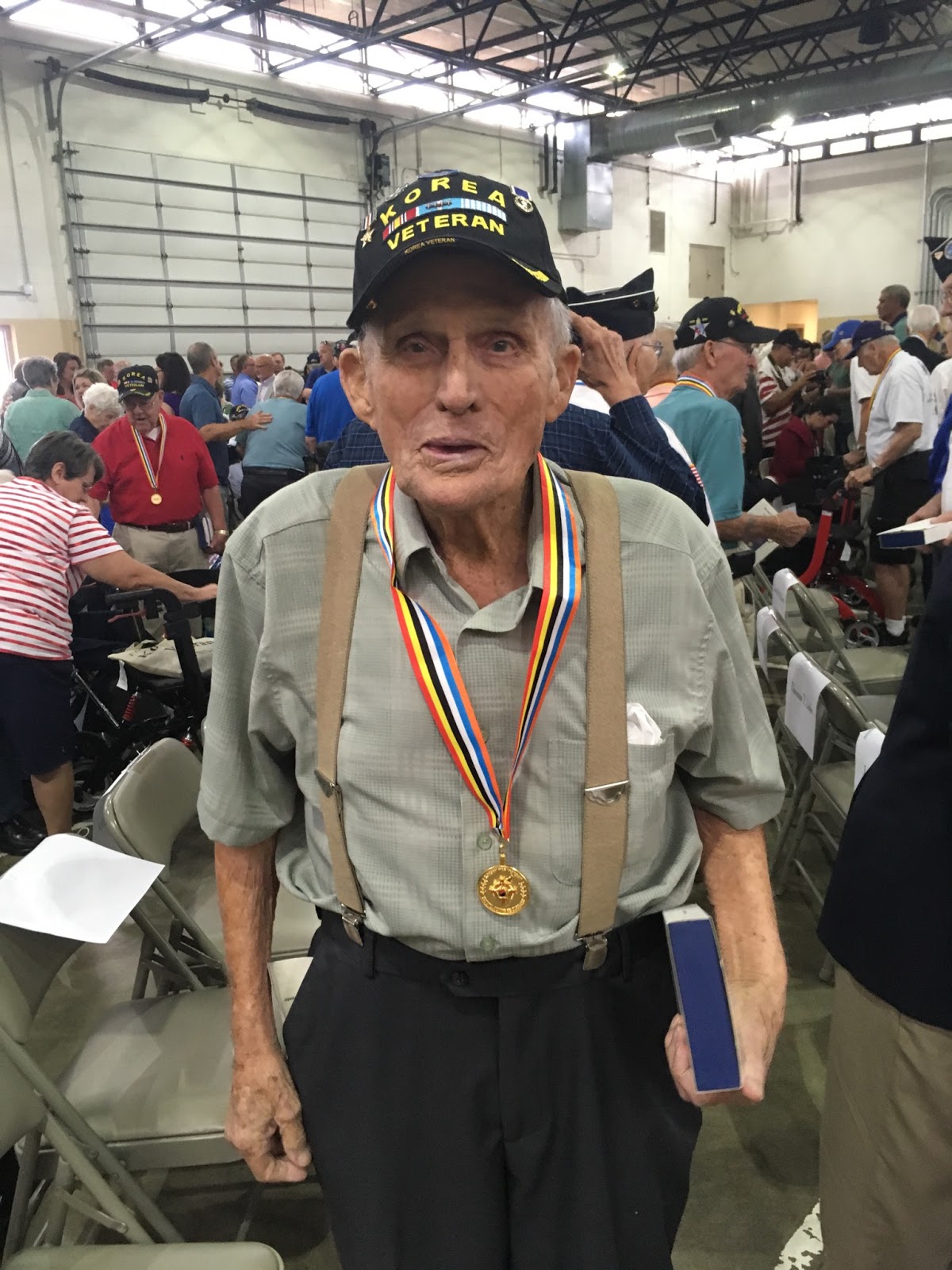
As the years went by, J.E. rarely spoke of the war. Most people who knew him were not aware of his heroism until the remains of Pvt. Joe Elmore were brought back home a couple of years ago, 68 years after he had been declared MIA, and J.E. began to talk about his tour of duty in North Korea. Many of you probably saw the photo of him at Pvt. Elmore's casket, standing at attention, saluting. His son David got him the cap you see in the photo. He was so proud of it.
Last year, when artist Norma Anderson unveiled her portrait of him, someone remarked what a great honor it was for him. As he began to reply, his voice became weakened with emotion. Pointing at the portrait he said, "I didn't do what I did for that."
After he fell and broke his hip in the latter part of January, the doctors and hospital staff were amazed with his grit and determination as he fought his way back during rehabilitation. But, it made sense to me. He was, after all, a warrior and the path of the Warrior is lifelong, and the mastery of it is often simply staying on the path, and that he did.
J.E. Morrison died last night at the age of 91. Our warrior is fully at rest now. Although his sun has set, its light shall linger round us yet, Bright, Radiant, Blest.
He was my friend.
The writer got it right. James Earl Morrison was a warrior. He accepted the challenge of leading his unit from Co. C of the 23rd Infantry, 2nd Division, when no one else there on Heartbreak Ridge would. And, in doing so, he displayed exceptional valor on more than one occasion, rising to the rank of Master Sargeant.
While you may prefer to call it by it's formal name, Korean Conflict, Mr. Morrison preferred to call it a war.
On Sept. 2, 1951, while running across a field during an enemy attack on Heartbreak Ridge, he picked up a wounded soldier, slung him across his back and ran as fast as he could toward a first aid station. Along the way, they were hit by a grenade, which severely injured J.E.'s leg. It was his ticket home from a war where not much hope for survival could be seen. But J.E. refused to leave his troops behind and, with unfathomable valor I can't begin to comprehend, led his men through violent enemy fire, while being completely surrounded, until the Marines were able to break through one of the lines and rescue them two weeks later.
As the years went by, J.E. rarely spoke of the war. Most people who knew him were not aware of his heroism until the remains of Pvt. Joe Elmore were brought back home a couple of years ago, 68 years after he had been declared MIA, and J.E. began to talk about his tour of duty in North Korea. Many of you probably saw the photo of him at Pvt. Elmore's casket, standing at attention, saluting. His son David got him the cap you see in the photo. He was so proud of it.
Last year, when artist Norma Anderson unveiled her portrait of him, someone remarked what a great honor it was for him. As he began to reply, his voice became weakened with emotion. Pointing at the portrait he said, "I didn't do what I did for that."
After he fell and broke his hip in the latter part of January, the doctors and hospital staff were amazed with his grit and determination as he fought his way back during rehabilitation. But, it made sense to me. He was, after all, a warrior and the path of the Warrior is lifelong, and the mastery of it is often simply staying on the path, and that he did.
J.E. Morrison died last night at the age of 91. Our warrior is fully at rest now. Although his sun has set, its light shall linger round us yet, Bright, Radiant, Blest.
He was my friend.
Subscribe to:
Posts (Atom)
The Story of Reuben Coffey, an American Revolutionary War Soldier
In Augusta Phillips Johnson's book, "A Century of Wayne County Kentucky 1800-1900," originally published in 1939, she used W...
-
The Roanoke Colony was an enterprise financed and organized by Sir Walter Raleigh in the late 16th century to establish a permanent English ...
-
When I think of the 70's, I think of the greatest rock and roll music ever. It is now included in a music genre that is known today a...