Showing posts with label Christian. Show all posts

Saturday, December 20, 2025

Hymns of Hope: Fanny Crosby

Fanny Crosby, the prolific hymn writer, wrote several Christmas-themed songs. Though she's more famous for hymns like "Blessed Assurance" and "Pass Me Not, O Gentle Savior," which she wrote after hearing the cry of a prison inmate, some of her notable Christmas works include "Christmas Carol (Cheerily Hail the Christmas Morn)," a joyful carol celebrating the birth of Jesus....

"Merrily now the bells we hear
Chiming in chorus sweet and clear
Gather and sing, gather and sing
Welcome the children's King"


Another one, "Sing Hallelujah," encourages praise for the infant Redeemer....

"Come to the feet of our infant Redeemer
Come where today in a manger He lies
Lift up our hearts in a song of devotion
Let our hosannas with gladness arise"


I encourage you to find and listen to her Christmas hymns. At six weeks old, Fanny developed an eye infection, and a doctor applied the wrong medication, which causing permanent blindness. Later, she would say that she believed it was God's plan, and that she would thank the doctor if she met him, as it led to her profound spiritual life and prolific writing.

While attending a Christian camp near Lake Erie, she said to Pastor John Sweney, “Do you know that if at birth I had been able to make one petition to my Creator, it would have been that I should be born blind?” When he asked why, she said “Because, when I get to heaven, the first face that shall ever gladden my sight will be that of my Savior.”

In her diary, she wrote, "It seemed intended by the blessed Providence of God that I should be blind all my life. I could not have written thousands of hymns if I had been hindered by the distractions of seeing all the interesting and beautiful objects ther would have been presented to my notice."

Fanny Jane Crosb - mission worker, poet, lyricist, composer, prolific hymnist - lived from 1820 to 1915. By the end of the 19th century, she had become a household name.

Sunday, November 23, 2025

Jesus: Precious Name, Oh How Sweet

Lydia Odell Baxter was born in Petersburg, New York, 1809. A couple of decades later, she and her husband moved to New York City and operated a home that became known as a gathering place for ministers, evangelists and Christian workers; a lighthouse in the big city, offering respite to those spreading the gospel.

But God had a different path for Lydia – one that would take her through the valley of suffering. She developed a serious chronic illness that would confine her to bed for most of her remaining life – nearly three decades. While many would have grown bitter from such an affliction, Lydia maintained a cheerful and patient disposition that inspired everyone around her. Friends who came to offer comfort left having received it instead.

Lydia filled her days and nights with intensive Bible study and writing. She had a particular fascination with Biblical names and their meanings. Among those names, the one she found most precious was, "Jesus." Her outlook was positive. When asked how that could be in light of her suffering, she would say, “I have a very special armor. I have the name of Jesus.

Invoking Jesus’ name as spiritual protection became the inspiration for her most famous hymn, “Take the Name of Jesus with You,” written in 1870, just four years before her death. Writing it was not merely a creative outlet during her illness, but a ministry, a way of sharing the comfort she had found in Jesus’ name, with anyone who would read or sing her words.

"Take the name of Jesus with you
Child of sorrow and of woe
It will joy and comfort give you
Take it then, where’er you go"

(Taken from hymcharts.com by Don Chapman)

Friday, August 19, 2022

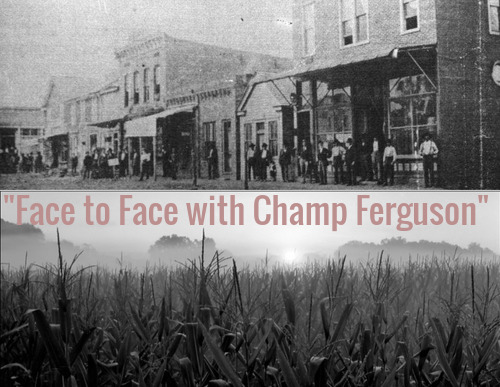
Face to Face With Champ Ferguson

John Garner had only been enrolled in school at Albany, Ky about six months when the civil war broke out, and had just recently left school and en­listed as a Union soldier the day he stood face to face with the infamous Champ Ferguson. It would be an encounter he would never forget.

After enlisting on New Years Day in 1863, two weeks shy of his 20th birthday, John had become concerned about his younger brother, Henderson, whom he had left behind in Clinton County, which was being terrorized by Confederate guerillas, including Ferguson, whom he described as a notorious human demon. Ferguson's killing spree lasted most of the war, from November 1861 to April 1865. Some of the killings were brutal and all were without mercy, with the victim usually face-to-face with him.

Determined to get his brother out of Clinton County, John dressed in civilian clothes and made his way on foot from Liberty to Somerset, and then to Albany, avoiding all public roads. His aunt, Betsy, lived in town, and his intention was to quietly slip into her home and stay hidden until she could fetch his brother for him. At the end of a wooded area in town, there was a cornfield which led up to his aunts garden. He could see her home from there, and noticed a few people were walking further down the street, but no one was near the home. Quietly, he ventured into the cornfield. Once he reached the garden, he stopped again to survey of the town. Seeing no danger, he crossed a fence and stepped into the back door of the house.

Upon seeing her nephew, Betsy threw up both hands and exclaimed, “The Lord have mercy, John what are you doing here?” He replied, "I am after Henderson. Where is he?” ‘'Gone and joined the army long ago,” she replied. “Which army?” he asked. “The Union Army,” she said. As Betsy John something to eat, suddenly there was gunfire and the clatter of horses feet, which seemed to be within very close range. John ran out on the porch, intending to get the house between him and town so he could make his getaway back into the cornfield. Suddenly, he was standing face to face with Champ Ferguson, whose pistol was drawn and pointed at him.

Champ: “What are you running for?"
John: ‘I am not run­ning, sir.”
Champ: “Where were you going?”
John: “I heard the clatter of horses feet and stepp­ed out here to see what was going on."
Champ: “Let me catch you running and you're a dead man."
John: “All right, if you catch me running, fire away.”

Betsy watched from inside the house as Ferguson whisked his horse and dashed back up the street. Both she and John were shaken up by what had just taken place, but now wasn't the time to talk about it. As Champ turned out of sight, John said goodbye to his aunt and began making his way through the tall green corn and into the woods. He remembered seeing at least a half dozen of Ferguson's men waiting in the street as he spoke to their captain. He realized any one of them might have recognized him as being a member of Col. Frank Wolford's Calvary had they come in­to the yard. He also realized how close he came to having his life taken from him, because he had heard that Ferguson took no prisoners, but cruelly murdered them.

After reaching the woods, John stopped and looked back toward town. He saw several people dashing about. Some were firing shots into the air. Feeling that he was now safe, he made his way to Rowena, where he boarded a steamboat bound for Burnside. A year later, John found his brother, Freeman, serving with the 6th Kentucky Cavalry.

When the war ended, John W. Garner became a minister in the Church of Christ faith and married Mary Freels of Wartburg, TN, a second cousin to Abraham Lincoln's mother, Nancy. They moved to Beloit, Kansas, but by 1895 were living in Perkins, Oklahoma, where John established a church and pastored there a few years before becoming an evangelist. John died in 1937 when he was 94 years old. His brother, Henderson, had also migrated west after the war. He died in Washington State in 1926. They were the sons of Freeman and Rachel Garner, who are buried at Tateville Baptist Church Cemetery in Pulaski County, Ky.

Wednesday, April 22, 2020

Hymns of Hope: There is a Redeemer

(Photo by Kelly Latham)

I am always fascinated by the stories behind the writing of hymns, especially the great old ones. Although it sounds old, "There Is a Redeemer" is a praise and worship song written by Melody Green in 1977 and popularized by her husband, contemporary Christian musician Keith Green, on his 1982 album, "Songs for the Shepherd," the last album to be released before a plane crash on July 28, 1982 claimed the lives of Keith, 28, and two of his children, ages 2 and 3. Nine others were also onboard and perished. They were visiting church planters, John and Dede Smalley and their six children. The Robertson STOL-modified Cessna 414 leased by Last Days Ministries crashed after takeoff from a private airstrip located on the LDM property. Melody was left with a one year old and expecting their fourth child at the time of the accident. The final verse was added by Keith. The song appears in numerous hymnals and has been described as a classic. We sing it quite often at my church. Like "How Deep The Father's Love For Us," this is another one of those hymns that sounds old, bit it isn't. The lyrics and the melody are beautiful.


There is a redeemer
Jesus, God's own son
Precious lamb of God, Messiah
Holy one

Chorus:
Thank you oh my father
For giving us your son
And leaving your spirit
'til the work on earth is done

Jesus my redeemer
Name above all names
Precious lamb of God, Messiah
Oh, for sinners slain

When I stand in glory
I will see his face
And there I'll serve my king forever
In that holy place

Today, Melody Green operates Last Days Ministries online where all of her husband's writings are free and his music can be found. She also maintains the Keith Green Facebook page to honor Keith.

Friday, April 10, 2020

On a Hill Far Away Stood an Old Rugged Cross


Evangelist George Bennard wrote the first verse to "The Old Rugged Cross" after being heckled by several youth at a revival meeting in Albion, Michigan in the fall of 1912. Troubled by their disregard for the gospel, he was reflecting on the work of Christ on the cross when he wrote,

"On a hill far away stood an old rugged cross, the emblem of suffering and shame."

He finished the hymn during a revival in Sturgeon Bay, Wisconsin that began in late December that year. The song was popularized in Billy Sunday's evangelistic campaigns by singers Homer Rodeheaver and Virginia Asher. They were the first to record it in 1921.

On a hill far away stood an old rugged cross
The emblem of suffering and shame
And I love that old cross where the dearest and best
For a world of lost sinners was slain

So I'll cherish the old rugged cross
Till my trophies at last I lay down
I will cling to the old rugged cross
And exchange it some day for a crown

O that old rugged cross so despised by the world
Has a wondrous attraction for me
For the dear Lamb of God left his glory above
To bear it to dark Calvary

In that old rugged cross stained with blood so divine
A wondrous beauty I see
For 'twas on that old cross Jesus suffered and died
To pardon and sanctify me

To that old rugged cross I will ever be true
Its shame and reproach gladly bear
Then he'll call me some day to my home far away
Where his glory forever I'll share


Now, more than ever, we need to cling to the cross. We haven't been living in the world the Lord intended for us to live in. So, now that He has gotten our attention, we need to change. Pray for change, pray for each other. Instead of putting down our leaders, pray for them, and yes, even the President. After this pandemic is over, if we go back to the way things were we will have lost the lesson. We must rise up and do better. I can't think of a better place to start than by clinging to the old rugged cross.

Tuesday, October 8, 2019

Sgt. York was a Symbol of American Courage and Sacrifice

On this day in 1918, then Cpl. Alvin C. York and sixteen other soldiers under the command of Sergeant Bernard Early were dispatched before sunrise to take command of the Decauville railroad behind Hill 223 in the Chatel-Chehery area of the Meuse-Argonne sector in Northeast France.

The seventeen men, due to a misreading of their map (which was in French not English) mistakenly wound up behind enemy lines. A brief fire fight ensued which resulted in the confusion and the unexpected surrender of a superior German force to the seventeen soldiers. Once the Germans realized that the American contingent was limited, machine gunners on the hill overlooking the scene turned the gun away from the front and toward their own troops.

After ordering the German soldiers to lie down, the machine gun opened fire resulting in the deaths of nine Americans, including York's best friend in the outfit, Murray Savage. Sergeant Early received seventeen bullet wounds and turned the command over to corporals Harry Parsons and William Cutting, who ordered York to silence the machine gun.

Fearlessly leading the seven remaining soldiers, York charged with great daring a machine gun nest which was pouring deadly and incessant fire upon his platoon. When the smoke cleared, he had taken the machine gun nest, killing twenty and singlehandedly capturing 132 German soldiers, including four officers, and several guns.

Alvin York's actions that day are recognized as one of the most significant combat feats by a single Soldier during WWI. For his exceptional heroism in the face of danger, he was awarded the Medal of Honor.

Lauded by The New York Times as “the war’s biggest hero," upon his death in 1964, President Lyndon Johnson called him alvin“a symbol of American courage and sacrifice” who epitomized the gallantry of American fighting men and their sacrifices on behalf of freedom.”

For an in-depth look into the heroics of Sgt. Alvin C. York visit:

Alvin C. York and the Meuse Argonne Offensive

To read about Sgt. York's struggle with being a soldier and having to fight in a war and how he finally found peace in it, go to:

How To Wrestle with a Difficult D,ecision - Advice From Sergeant Alvin C. York


Saturday, September 23, 2017

"Faith Unfeigned (A Tribute to Joseph Denton)

"Now the end of the commandment is charity out of a pure heart, and of a good conscience, and of faith unfeigned" - 1 Timothy 1:5

Joseph Crouch Denton died 130 years ago this year. He was the fourth pastor of Clear Fork Baptist Church in Albany, Kentucky, serving 32 years and 11 months, from October 1854 to his death on September 29, 1887.

The son of the first pastor, Isaac Denton, Joseph was born on May 5, 1811. He got saved and joined the church on December 22, 1838, was chosen as a Deacon on March 26, 1842, appointed Church Trustee on June 22, 1844 and preached his first sermon on June 22, 1850. He was ordained into the ministry on October 24, 1853.

In his obituary recorded in the Church minutes, clerk John Hopkins wrote, "The silent boatman has dipped his oars into the dark river and stealthily moored his vessel to earthly shore for a few moments and removed one of our beloved and trusted sentinels from his high place in Zion."

It was noted that the combined pastorates of Isaac and Joseph Denton of almost eighty years was attended with great blessings. Many revivals succeeded and the Church exercised a large influence. Through the Denton's, the Church received its lessons in principles of doctrines of Christ and rose to clossal proportions, exhibiting the teachings of both its pastors, especially Joseph Denton, not only in his labors in the ministry, but in his every day walk of life.

His obituary states that he "shone with intarnished luster in deeds of mercy and unselfishness among his neighbors and brethren and in his family. His feelings were as tender as a babe, yet he stood with the firmness of a granite cliff when bible principles were at issue. He planted himself only on the truth with breast bare to the storm, and amidst the tempest rose higher and shined still brighter, possessing charity and broad liberality for all."

In confusion of the Civil War, when strong men trembled with fear and all men's hearts failed them, Joseph Denton exhibited the same unfailing confidence, the same calmness, the same encouragement to all, as in time of profound peace, faithful to gently reprove the faults of a friend or to apologize for an enemy. His sweet temper possessed a magnetism to attract the attention of the disinfected and gave to him almost a resistless influence in reconciling differences between brethren or neighbors.

Joseph was a man of faith unfeigned, living a life of prayer, from hence he drew his greatest strength and influence. Clerk John Hopkins wrote, "In prayer, he seemed to obtain a neatness to the Throne, seldom given to man, then he seemed to breathe the atmosphere of Heaven and his heart to glow with a warmness of love that encircled the entire number of fallen men. In the pulpit he possessed a native elegance that entitled him to be called a "Sweet Tongued Denton." His theme was the cross of Christ, the cleansing blood of Jesus. With these, he sought to win sinners to the Saviour's love and which seldom left the hearts of his hearers unmoved."

The church record states that for a number of years, Joseph Denton was afflicted, but bore his sufferings with Christian fortitude, patiently waiting for the Redeemer to call him home. Almost at death's door, he prayed, "May the Lord bless and save you all is my prayer, amen."

Joseph Denton died without a struggle on the 29th day of September, 1887, aged 76 years, four months and 24 days. His body was buried near his parents at the Clear Fork Burying Ground, within a few steps of the church house, where he had held membership for almost 49 years, to, as the record states, "await the Resurrection morn."

There were 414 additions to the Clear Fork Baptist Church during Joseph Denton's pastorate.

Joseph Crouch Denton
"May His Example Be Followed
By Those He Left"


Thinking about the Pickup Man

Mary Ellis, who writes for the Wayne Weekly, recently forwarded a copy of her recent story, "Remembering Pickup Man: Howard Perdew....