Ralph Cundiff had just begun what was expected to be a bright and promising career in agriculture until World War II came along. Born in 1911 and raised in the Faubush community of Pulaski County, he graduated from Berea college with a degree in agriculture in 1938. Later that year he became the assistant county agent in Wayne County, serving until March of 1939, at which time he was appointed county agent of Clinton County. A prominent and highly respected citizen, he was a Deacon at Albany First Baptist Church and was a leading member of the Albany Lions Club. He had married Hazel Dalton, daughter of Walter Dalton.
Then came his induction into the U.S. Army in October 1942. He was assigned to Unit I Company, 330th Infantry Regiment of the 83rd Division, commanded by Major General Robert C. Macon. News correspondents nicknamed the 83rd "The Rag-Tag Circus" due to the resourcefulness of Major General Macon, who would order the supplementing of the division's transport with anything that moved with an attitude of "no questions asked."
The 83rd arrived in England on April 16, 1944 with its first divisional headquarters at Keele Hall in Staffordshire. After training in Wales, the division, took part in the Allied invasion of Normandy, landing at Omaha Beach on June 18th 1944. Nine days later they entered the hedgerow struggle south of Carentan.
"Mrs. Ralph Cundiff has been notified by the War Department of the death of her husband, SSgt. Ralph Cundiff, on July 6, 1944 in France."
He was 33.
The Allied forces' hard-won foothold on the bloody beaches of Normandy on D-Day was only the beginning of what would become a costly, foot-slogging effort to retake, field by field, town by town and house by house, all French ground the Germans had occupied since 1940. By the beginning of July the Allied invasion of Normandy, was not progressing as rapidly as anticipated.
The British Second Army had yet to secure one of its primary objectives, the pivotal crossroads city of Caen, effectively halting its advance on Paris before it began. To block the advancement the Germans deployed a staggering force of tanks and armored fighting vehicles along a tight 20-mile front. The most formidable obstruction was the countryside itself, dotted with small farms or orchards, each bordered by thick hedgerows that ranged anywhere from 4 to 15 feet in height. The Germans did not defend every hedgerow, but no one knew without stepping out into the spotlight which ones he did defend. As GIs emerged from the rows they became easy targets for German artillery and nested machine guns. The fighting continued for two days, ending with the Germans in retreat, but the battle was costly, as there were more than 15,000 American casualties.
Six other soldiers from Cundiff's company were also killed that day. He was awarded a Purple Heart, the WWII Victory Medal and a Combat Infantryman Badge. He is buried at Normandy American Cemetery and Memorial in France. His widow later married John Dorris Jr. She died in 1975 and is buried at Goodlettsville. Ralph Cundiff's name is on two monuments, the War Veterans Monument located outside the Clinton County Courthouse and on a monument outside the Pulaski County Courthouse.
By the way, Cundiff's replacement as Clinton County Agricultural Extension Agent was D.E. Salisbury, who moved from assistant county agent in Wayne County to county agent in Clinton County at the beginning of 1943.
Showing posts with label Army. Show all posts
Friday, December 8, 2023
Wednesday, October 25, 2023
Thomas Stephens was at Valley Forge
My ancestor, Thomas Stephens, who lived in Fentress County, Tennessee, was a Corporal in the Virginia Continental Line during the American Revolution. He served at Valley Forge and is noted on their muster roll.
Valley Forge was the location of the 1777-1778 winter encampment of the Continental Army under General George Washington. The British were occupying Philadelphia and Valley Forge was only a day’s march away and it was where the Army could train and recoup from the year’s battles and keep an eye on the British and prevent them from foraging in the countryside for the food they needed. On the down side, while the winter weather stopped the fighting, it proved to be a great trial for the 11,000 American soldiers stationed there.
As Washington's men camped in crude log cabins and endured the cold conditions, the Redcoats warmed themselves in colonial homes. There were shortages of everything from food to clothing to medicine. Hundreds died from scurvy, smallpox and dysentery.
It was written that one out of every six soldiers that marched into Valley Forge in December did not march back out in June, but the suffering troops that remained were held together by loyalty to the Patriot cause and to General Washington, who refused to leave his men.
That winter camp provided the foundation for what would later become the modern United States Army. While no battle was fought there, it was considered the turning point of the Revolutionary War. By June of 1778, the weary troops emerged with a rejuvenated spirit and confidence as a well-trained fighting force.
Thomas Stephens was my 5th great-grandfather through his daughter, Jennetta, wife of Jesse Cobb. Then through his grandson, David Smith, his daughter, Deborah, wife of George Boles, then Hige and on down to me. Thomas was born between 1745 and 1750, possibly in Richmond County, VA. By 1833, he was living in Fentress County, where he died in 1850, He and his wife, Sarah, are buried at Albertson Cemetery near where Glenoby Road and Livingston Highway meet in Fentress County, Tennessee. Note the Revolutionary War medallion on his grave marker.
Valley Forge was the location of the 1777-1778 winter encampment of the Continental Army under General George Washington. The British were occupying Philadelphia and Valley Forge was only a day’s march away and it was where the Army could train and recoup from the year’s battles and keep an eye on the British and prevent them from foraging in the countryside for the food they needed. On the down side, while the winter weather stopped the fighting, it proved to be a great trial for the 11,000 American soldiers stationed there.
As Washington's men camped in crude log cabins and endured the cold conditions, the Redcoats warmed themselves in colonial homes. There were shortages of everything from food to clothing to medicine. Hundreds died from scurvy, smallpox and dysentery.
It was written that one out of every six soldiers that marched into Valley Forge in December did not march back out in June, but the suffering troops that remained were held together by loyalty to the Patriot cause and to General Washington, who refused to leave his men.
That winter camp provided the foundation for what would later become the modern United States Army. While no battle was fought there, it was considered the turning point of the Revolutionary War. By June of 1778, the weary troops emerged with a rejuvenated spirit and confidence as a well-trained fighting force.
Thomas Stephens was my 5th great-grandfather through his daughter, Jennetta, wife of Jesse Cobb. Then through his grandson, David Smith, his daughter, Deborah, wife of George Boles, then Hige and on down to me. Thomas was born between 1745 and 1750, possibly in Richmond County, VA. By 1833, he was living in Fentress County, where he died in 1850, He and his wife, Sarah, are buried at Albertson Cemetery near where Glenoby Road and Livingston Highway meet in Fentress County, Tennessee. Note the Revolutionary War medallion on his grave marker.
Wednesday, June 14, 2023
Love, Honor and Respect for our Flag
June 14th
Today is Flag Day to remember when the Continental Congress introduced our country's first flag as the official American flag on June 14, 1777. In honor of this, I present a very beautiful piece written over 50 years ago by our Louis O. Brummett of Albany, Kentucky.
"We should display our flag and fly it proudly," he said, "in homage to those great Americans who died that we might live and that "Government of the people, for the people and by the people, should not perish from the earth."
"God hasten the day when we will regain those attitudes of love, honor, respect and enthusiasm for our flag and country that caused our fore fathers to bow their heads in humble gratitude to the God they loved and served and say, 'Almighty God, we thank Thee for our country and its flag; and what it stands for. As we gaze upon its radiance, may Thy holy light spread over us and bring to our hearts renewed devotion to God and country and love for our flag. Amen.'"
Mr. Brummett served as a Corporal in the U.S. Army during World War II. He was also a member of the American Legion, and it was on behalf of this group that he wrote these words on Flag Day in 1969.
I pledge Allegiance to the flag
of the United States of America
And to the Republic for which it stands,
One nation under God, indivisible,
With Liberty and Justice for all
Today is Flag Day to remember when the Continental Congress introduced our country's first flag as the official American flag on June 14, 1777. In honor of this, I present a very beautiful piece written over 50 years ago by our Louis O. Brummett of Albany, Kentucky.
"We should display our flag and fly it proudly," he said, "in homage to those great Americans who died that we might live and that "Government of the people, for the people and by the people, should not perish from the earth."
"God hasten the day when we will regain those attitudes of love, honor, respect and enthusiasm for our flag and country that caused our fore fathers to bow their heads in humble gratitude to the God they loved and served and say, 'Almighty God, we thank Thee for our country and its flag; and what it stands for. As we gaze upon its radiance, may Thy holy light spread over us and bring to our hearts renewed devotion to God and country and love for our flag. Amen.'"
Mr. Brummett served as a Corporal in the U.S. Army during World War II. He was also a member of the American Legion, and it was on behalf of this group that he wrote these words on Flag Day in 1969.
of the United States of America
And to the Republic for which it stands,
One nation under God, indivisible,
With Liberty and Justice for all
Wednesday, January 18, 2023
Bookout
On April 16, 1953 the New Era reported that 29 men had gone to Louisville for Armed Forces physical examinations. Among them was Robinson Elvin Angel. He was one month shy of celebrating his 20th birthday when Uncle Sam called. He and seven others left for Louisville and induction into the U.S. Army on July 7th. The others were James Cook, Haden Dicken, Arthur Stockton, Freddie Boils, Buford Bowlin, John Nuszbaum and Lowell Davis. It was during the Korean War and Elvin was in the army for two years. For 18 months he was stationed in Alaska.
Hershell Key tells a story about Elvin's sergeant ordering him to clean a rifle. It wasn't his rifle, so Ervin said no. The sergeant repeated his command, "I said to clean that rifle!" Elvin replied, "I ain't gonna do it!" So, Hershell said, Elvin was sent to Alaska.That may or not be the exact reason, but it's funny to hear Hershell tell it that way.
When he returned home, Elvin joined the class of 1957 during their sophomore year. In the local newspaper column, Senior Class News, someone wrote "Elvin has been an asset to the class and we are proud to have this veteran among the members of our class." Elvin was 24 years old when he graduated from CCHS.
Elvin's nickname was Bookout. A couple of his friends I spoke with did not know how he got that name. One of his close friends, Harvey Aaron, said he once asked Elvin how he got it, but he couldn't remember.
By all accounts, Bookout was a great baseball and softball player. I read where, in 1957, he was a member of a softball team sponsored by Conner Motel, along with the likes of John B. Smith, Page Cook and James Brown. Another teammate and classmate, Gene Latham, said Bookout was a great pitcher. He played softball for several years.
Gene tells this story: "Bookout stood 5 feet and 5 inches tall and for the U.S. Army, the minimum weight requirement for his heighth was 116 pounds. Bookout weighed 117 pounds when he went for his physical examination. He said if he had known the minimum weight requirement was 116 pounds, he would have weighed 116 pounds!"
Robinson Elvin Angel was born on May 28, 1933, the son of the William Albert & Lula Mae Daniels Angel. His wife, Brenda Gibbons Angel, preceded him in death. Bookout was known by many. We will miss seeing him walking around town. He always walked.
Thanks to Harvey Aaron for the photo.
Hershell Key tells a story about Elvin's sergeant ordering him to clean a rifle. It wasn't his rifle, so Ervin said no. The sergeant repeated his command, "I said to clean that rifle!" Elvin replied, "I ain't gonna do it!" So, Hershell said, Elvin was sent to Alaska.That may or not be the exact reason, but it's funny to hear Hershell tell it that way.
When he returned home, Elvin joined the class of 1957 during their sophomore year. In the local newspaper column, Senior Class News, someone wrote "Elvin has been an asset to the class and we are proud to have this veteran among the members of our class." Elvin was 24 years old when he graduated from CCHS.
Elvin's nickname was Bookout. A couple of his friends I spoke with did not know how he got that name. One of his close friends, Harvey Aaron, said he once asked Elvin how he got it, but he couldn't remember.
By all accounts, Bookout was a great baseball and softball player. I read where, in 1957, he was a member of a softball team sponsored by Conner Motel, along with the likes of John B. Smith, Page Cook and James Brown. Another teammate and classmate, Gene Latham, said Bookout was a great pitcher. He played softball for several years.
Gene tells this story: "Bookout stood 5 feet and 5 inches tall and for the U.S. Army, the minimum weight requirement for his heighth was 116 pounds. Bookout weighed 117 pounds when he went for his physical examination. He said if he had known the minimum weight requirement was 116 pounds, he would have weighed 116 pounds!"
Robinson Elvin Angel was born on May 28, 1933, the son of the William Albert & Lula Mae Daniels Angel. His wife, Brenda Gibbons Angel, preceded him in death. Bookout was known by many. We will miss seeing him walking around town. He always walked.
Thanks to Harvey Aaron for the photo.
Saturday, January 7, 2023
The Big Five Were Small in Stature, Big of Heart
The date was Nov. 17, 1942. It was the middle of WWII. The basketball team at Albany High School had won four games and lost three and with only a handful of games left to play before district tournament first year head coach Raymond Reneau left the team, and Albany, for the U.S. Army and the war in Europe. Principal L.H. Robinson would have to coach the team the rest of the way.
Prof was no stranger to this challenge. While principal of Ewing High School in Fleming County, before coming here, he had also coached basketball. In fact, he coached the first team from Ewing to ever win a regional basketball tournament. So he took control of the Bulldogs team. They won the last three regular season games on the schedule and in the 38th district tournament, the Bulldogs swept past their two opponents, Marrowbone and Burkesville, and for the first time in the history of the school, a basketball had won the district tournament.
Marrowbone had a very strong team but they just couldn't do anything with the Bulldogs. The game started off with every spectator on his feet. Both teams played evenly in the first quarter, but it didn't take long for the Bulldogs to realize what the game meant to them. From then on, Marrowbone could only watch as the Albany boys went to town. The score was never again close. It was 9-to-6 at the end of the first quarter, 19 to 8 at halftime, 32 to 12 at the end of the third quarter and the final score was 41-to-21.
The Albany boys were a little tired at the start of the game against Burkesville, but they wound up playing very good ball, winning the game 49-to-23. Two players, Randolph Smith and Russell Long, were named to the all-tournament team and each received a gold basketball. The captain of the Bulldogs, Robert Chilton, received a very beautiful trophy on behalf of the team. Albany should feel proud that they have such a splendid basketball team.
The New Era newspaper wrote, "The team played exceptionally good ball, but they couldn't have played so good if it hadn't been for their very good coach, L.H. Robinson. Due respect should be paid Coach Robinson for his marvelous work with the boys." Coach Robinson referred to his team as 'the big five.' "They were small in stature, but big of heart and had the will to win," he said. The five starters were Smith at center, Gordon Armstrong and Paul Jones were the forwards and Chilton and Long were the guards. "Those boys ran set plays to perfection and their defense simply smothered the opposition," Coach Robinson said."
Albany lost to Tompkinsville by one point in the 5th region tournament at Glasgow. The following year, 1944, the Bulldogs repeated as champions of the 38th District, again under the leadership of L.H. Robinson. In his three seasons as head coach, Robinson's teams won 24 games and lost 13, two back to back district tournament championships and a district runner-up trophy in the third year.
Coach Reneau returned to the sidelines for the 1945-46 season, guiding his team to a runner-up title in the newly aligned 20th district. He would be head coach for the remainder of the 1940's, winning 82 games and losing 43. His 1948-49 team was the school's first ever team to win twenty games (20-5).
Prof was no stranger to this challenge. While principal of Ewing High School in Fleming County, before coming here, he had also coached basketball. In fact, he coached the first team from Ewing to ever win a regional basketball tournament. So he took control of the Bulldogs team. They won the last three regular season games on the schedule and in the 38th district tournament, the Bulldogs swept past their two opponents, Marrowbone and Burkesville, and for the first time in the history of the school, a basketball had won the district tournament.
Marrowbone had a very strong team but they just couldn't do anything with the Bulldogs. The game started off with every spectator on his feet. Both teams played evenly in the first quarter, but it didn't take long for the Bulldogs to realize what the game meant to them. From then on, Marrowbone could only watch as the Albany boys went to town. The score was never again close. It was 9-to-6 at the end of the first quarter, 19 to 8 at halftime, 32 to 12 at the end of the third quarter and the final score was 41-to-21.
The Albany boys were a little tired at the start of the game against Burkesville, but they wound up playing very good ball, winning the game 49-to-23. Two players, Randolph Smith and Russell Long, were named to the all-tournament team and each received a gold basketball. The captain of the Bulldogs, Robert Chilton, received a very beautiful trophy on behalf of the team. Albany should feel proud that they have such a splendid basketball team.
The New Era newspaper wrote, "The team played exceptionally good ball, but they couldn't have played so good if it hadn't been for their very good coach, L.H. Robinson. Due respect should be paid Coach Robinson for his marvelous work with the boys." Coach Robinson referred to his team as 'the big five.' "They were small in stature, but big of heart and had the will to win," he said. The five starters were Smith at center, Gordon Armstrong and Paul Jones were the forwards and Chilton and Long were the guards. "Those boys ran set plays to perfection and their defense simply smothered the opposition," Coach Robinson said."
Albany lost to Tompkinsville by one point in the 5th region tournament at Glasgow. The following year, 1944, the Bulldogs repeated as champions of the 38th District, again under the leadership of L.H. Robinson. In his three seasons as head coach, Robinson's teams won 24 games and lost 13, two back to back district tournament championships and a district runner-up trophy in the third year.
Coach Reneau returned to the sidelines for the 1945-46 season, guiding his team to a runner-up title in the newly aligned 20th district. He would be head coach for the remainder of the 1940's, winning 82 games and losing 43. His 1948-49 team was the school's first ever team to win twenty games (20-5).
Wednesday, June 1, 2022
Edison Records: Battle Hymn of the Republic
My 105-year-old recording of "Battle Hymn of the Republic," by singer Thomas Chalmers, was recorded May 29, 1917 at Thomas Edison's recording studio in Manhattan. The recording is registered with the Library of Congress.
"Battle Hymn of the Republic" first gained popularity around Charleston, South Carolina. It became known as "John Brown's Body," following the insurrection at Harper's Ferry, led by Abolitionist John Brown, whose actions, trial and subsequent execution made him a martyr.
lies a-mouldering in the grave
His soul is marching on"
By the time of the Civil War, the song had become a popular marching song with Union Army regiments. It was when Julia Ward Howe visited Washington, DC on November 18, 1861 that "Battle Hymn of the Republic" was first born. Howe and her husband were active abolitionists, who had experienced first-hand a skirmish between Confederate and Union troops in nearby Virginia, and heard the troops go into battle singing "John Brown's Body." That evening in the nation's capital, Howe was inspired to write a poem that better fit the music. It began "Mine eyes have seen the glory of the coming of the Lord."
Saturday, May 28, 2022
A Forgotten Man
The lingering mournful notes of taps sounded that day in 1950, when an unsung hero of WW1, a man who had fought with Sgt. York in the action that had thrilled a nation, was laid to rest in Pennsylvania. An invalid from wounds he recieved in a subsequent battle, George H. BosIey had been a member of Company G, 328th Infantry the day Sgt. York used a machine gun to pick off Germans who were annihilating his company and then marched 132 prisoners back to American lines, earning the Pall Mall, Tennessee man the adulation of a nation, a Congressional Medal of Honor, some financial reward and, in 1941, a motion picture about his life.
Bosley always said that Alvin C. York earned all he ever got through his coolness and heroism in that 'No Mans Land battle,' but he never stood for a movement in the limelight, himself. All he would ever say was, "I was there, I saw it happen." But sadly, as fate would have it, on Oct. 14, 1918, six days after Sgt. York's heroic deed, shrapnel pierced Bosley's helmet, taking out his left eye and part of his head, and making him an invalid for the rest of his life. He woke up in an Army hospital five weeks later. By the time he was shipped home, heroes were plentiful, so he quietly took up life in the small Pennsylvania town of West Newton and that day with Sgt. York became just a memory. Unable to work steadily, a small pension helped him rear his family.
After Warner Brothers decided to film it's Sgt. York movie, efforts were made to find all of the men who had been with the heroic sharpshooter in the fight against the enemy. They found all but one - George Bosley. Yet, in one of the scenes in the movie, a prisoner throws a hand grenade that wounds one of Sgt. York's companions. That companion was Bosley. The grenade wounded him on the nose and cheek. For his heroism, this forgotten man of a great incident of American battle history was awarded the Distinguished Service Cross, the Croix de Guerre and a Purple Heart.
Bosley always said that Alvin C. York earned all he ever got through his coolness and heroism in that 'No Mans Land battle,' but he never stood for a movement in the limelight, himself. All he would ever say was, "I was there, I saw it happen." But sadly, as fate would have it, on Oct. 14, 1918, six days after Sgt. York's heroic deed, shrapnel pierced Bosley's helmet, taking out his left eye and part of his head, and making him an invalid for the rest of his life. He woke up in an Army hospital five weeks later. By the time he was shipped home, heroes were plentiful, so he quietly took up life in the small Pennsylvania town of West Newton and that day with Sgt. York became just a memory. Unable to work steadily, a small pension helped him rear his family.
After Warner Brothers decided to film it's Sgt. York movie, efforts were made to find all of the men who had been with the heroic sharpshooter in the fight against the enemy. They found all but one - George Bosley. Yet, in one of the scenes in the movie, a prisoner throws a hand grenade that wounds one of Sgt. York's companions. That companion was Bosley. The grenade wounded him on the nose and cheek. For his heroism, this forgotten man of a great incident of American battle history was awarded the Distinguished Service Cross, the Croix de Guerre and a Purple Heart.
Thursday, January 6, 2022
Clinton County's First Bronze Star Recepient in Vietnam was the son of Teral the Mystic
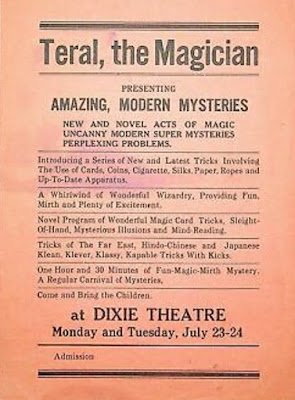
Teral Garrett became interested in magic at the age of twelve and gave his first public performance one day in english class at Albany High School. In the 1930's he performed as "Teral The Mystic" with a variety group called the Rozelle Players and became a well-known act. He was also editor of three magazines, including Psycho-Gizmo, which was in print from 1951 to 1965, and for several years, he also operated a mail order magicians supply house out of Albany, filling orders from all over the world.
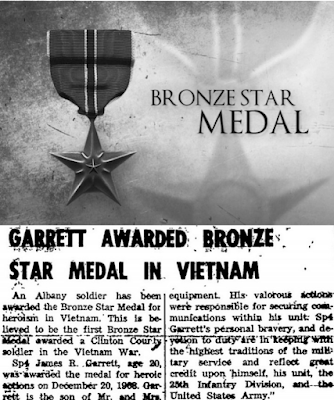
Teral broke his neck at an early age, which kept him from jobs that required any exertion of great physical energy. It also exempted him from serving in the armed forces during WWII. While he may have been unable to serve in the military, his son, James, was an Army Specialist Four with the 7th infantry division in Korea and with the 29th infantry in Vietnam, where he became what was believed to be the first Clinton County soldier to be awarded the Bronze Star Medal in the Vietnam war.
On Dec. 20, 1968, while his unit was sweeping through a suspected enemy command post, they came under deadly automatic weapons fire. Seeing the platoon leader had been wounded and the communications equipment destroyed, James left his vehicle and ran through enemy fire to another vehicle for the needed equipment, securing communications within his unit.
Both Teral and James died at a young age. Teral was 56 when he passed away on Nov. 7, 1970, after suffering a heart attack about a week earlier. James was 57 when he died on May 2, 2005. Among their survivors was their son, and brother, Pace Garrett.
Wednesday, May 26, 2021
The Killing of Joseph Beck
Around 9:00 a.m. on or about August 27, 1862, Champ Ferguson and his men returned to the home of my third great-grandfather, Elisha Koger, whom they had brutally murdered almost thirteen weeks earlier, on June 1st. Ferguson called out from beyond the fence that surrounded the home. No doubt, hearing his voice terrified Elisha's widow, Nancy. After all, Ferguson and his men had shot her husband more than thirty times. His body was a bloody mess by the time the shooting stopped. He took his last breath lying in the arms of his daughter, Sarah, who was covered in his blood.
Nancy sent her sister, Jane, to the door. Ferguson wanted to know if any other armed men had passed by that way that morning. Jane replied she had seen no one. As he turned to leave, Ferguson told her he and his band had killed a man near there. "I don't know him myself, but some of the men say it is Joe Beck," he said. Ferguson told her that Beck's hat and coat were lying in a little drain beside the road and his body was lying about thirty yards from there. He also said he had taken a Colt rifle from Beck after his death. The location was about a mile from the Koger home in the Oak Grove Community of Clinton County, Ky near the top of Poplar Mountain. Nancy, Jane and a young man who was at the Koger home, Marion Purcell, walked up the road and found the body just as Ferguson had described. Nancy would soon deliver the news to his wife, Elizabeth.
During Ferguson's trial at the end of the Civil War, both Nancy and Jane recounted what they saw when they found Beck's body, but no one outside the victim, Ferguson and his men witnessed the event. Even after his conviction, in interviews with reporters where he gave details about all of his killings, reporters forgot to ask about the killing of Joseph Beck, and Ferguson did not offer any details.
In his book, "Cumberland Blood: Champ Ferguson's Civil War" (2008), Thomas D. Mays claims that Beck had been a daring Union soldier who had dogged Colonel John Hunt Morgan's command and showed no fear of Ferguson or his men, who were part of the forces under Morgan, but that his luck had run out when he was surprised on the road that day. I wonder about that because there is nothing known about his military stance or activities (at least I haven't seen anything), except that the army ruled that Joseph was killed in the line of duty, which qualified his widow, Elizabeth, for a pension. Beck, who was born in Wayne County in 1817, had enlisted at Camp Hoskins in Pulaski County on Oct. 15, 1861 and was assigned to Capt. Payne's company G, 12th regiment of the Kentucky Infantry.
Joseph Beck's brother-in-law, Jesse Rector, and his wife, Nancy, were the parents of Daniel Webster Clay Rector, whose wife, Laura, was the sister of my great grandmother, Hettie Huffaker Frost.
Nancy sent her sister, Jane, to the door. Ferguson wanted to know if any other armed men had passed by that way that morning. Jane replied she had seen no one. As he turned to leave, Ferguson told her he and his band had killed a man near there. "I don't know him myself, but some of the men say it is Joe Beck," he said. Ferguson told her that Beck's hat and coat were lying in a little drain beside the road and his body was lying about thirty yards from there. He also said he had taken a Colt rifle from Beck after his death. The location was about a mile from the Koger home in the Oak Grove Community of Clinton County, Ky near the top of Poplar Mountain. Nancy, Jane and a young man who was at the Koger home, Marion Purcell, walked up the road and found the body just as Ferguson had described. Nancy would soon deliver the news to his wife, Elizabeth.
During Ferguson's trial at the end of the Civil War, both Nancy and Jane recounted what they saw when they found Beck's body, but no one outside the victim, Ferguson and his men witnessed the event. Even after his conviction, in interviews with reporters where he gave details about all of his killings, reporters forgot to ask about the killing of Joseph Beck, and Ferguson did not offer any details.
In his book, "Cumberland Blood: Champ Ferguson's Civil War" (2008), Thomas D. Mays claims that Beck had been a daring Union soldier who had dogged Colonel John Hunt Morgan's command and showed no fear of Ferguson or his men, who were part of the forces under Morgan, but that his luck had run out when he was surprised on the road that day. I wonder about that because there is nothing known about his military stance or activities (at least I haven't seen anything), except that the army ruled that Joseph was killed in the line of duty, which qualified his widow, Elizabeth, for a pension. Beck, who was born in Wayne County in 1817, had enlisted at Camp Hoskins in Pulaski County on Oct. 15, 1861 and was assigned to Capt. Payne's company G, 12th regiment of the Kentucky Infantry.
Joseph Beck's brother-in-law, Jesse Rector, and his wife, Nancy, were the parents of Daniel Webster Clay Rector, whose wife, Laura, was the sister of my great grandmother, Hettie Huffaker Frost.
Wednesday, March 10, 2021
A Civil War Massacre in Overton County
The Officer family lived in a rural community in Overton County called Sinking Cane. William Alexander Officer, who had married a Cynthia Holford in that community in 1836, operated a sizable farm with pastures, timberland and a large two-story house. Today, the location is about two miles off Highway 84 on Rock Springs Road, near the foot of Monterey Mountain. The couple produced seven children — four girls and three boys — and dealt primarily in livestock. He favored the Confederacy.
William spent a lot of time driving livestock further into the South. Everyone knew he was away from home a lot and also was successful and financially sound. Therefore, given the ongoing war, the Officer family was subject to harassment by federals who came to the Officer home place and took what they wanted — a common practice on both sides of the conflict.
One of the Officer sons, John, had been born in 1845 and was thus a young man when the Civil War broke out. He enlisted as a private in the Confederate Army. In March 1864, during a period in which Tennessee was seeing a flurry of wartime skirmishes and guerrilla activity in rural areas, John had been granted a leave from Company F, 13th (Dibrell’s) Tennessee Cavalry Regiment to go visit his family. With him had come a handful of fellow Confederate soldiers who had become separated from their command.
He was home with his companions on March 12, 1864. His mother rose early, and with daughter Frances, set to work to make an especially good Saturday breakfast for John and their visitors. The young men were happily eating what was probably the best meal they’d had in weeks when a big band of federal soldiers, some 200 of them, part of Col. William B. Stokes’ command, rode up to the house.
The federals had been sent out by Stokes to hunt down Confederate guerrillas, particularly Champ Ferguson. Upon their arrival, John Officer jumped up in a panic and fled into another room, where a slave of the family, named Abraham, but usually called Uncle Abe, helped him up into a loft or attic area to hide.
The guns of the family’s visitors were not far away, stacked on one another in a hallway, but the federal band was a big one and there appeared to be nothing to gain by dashing to get the weapons to make a hopeless stand. Union troops entered the house and things went bad fast. Shooting began, killing on the spot five of the young Confederates: John P. York, Oliver Shipp, Samuel Garrett, William Slaughter and William Lipscomb.
Slaughter served in Company C, 1st Regiment Texas Rangers. York, Shipp and Garrett were part of the 8th Texas Calvary and Lipscomb was in the 3rd Regiment, Alabama Cavalry. A sixth Confederate there was 2nd Lt. Robert S. Davis, also of the 8th Texas. Davis was wounded but did not die inside the house, as his companions had. The federals hustled the wounded man outside and put him against a gatepost, tying him in place. There he was executed by a hastily formed firing squad (That gatepost is on display in the Overton County Museum).
In 1922, Uncle Abe gave an eyewitness account of the incident before the Tennessee Historical Commission. According to his testimony, Davis spoke to his killers before they shot him, saying, “You ought not do this. I have never done anything but my sworn duty.” Abe also noted that Davis never flinched when the federal soldiers fired and took his life.
The six massacred soldiers are buried at Officer Cemetery, located near the home. This event is referred to locally as the Stokes Atrocity. A state historical marker, describing the event, is posted on the main street in Monterey.
*Written by Cameron Judd, The Greenville Sun (Mar 2, 2019): "A Civil War Massacre At A Place Called Sinking Cane."
William spent a lot of time driving livestock further into the South. Everyone knew he was away from home a lot and also was successful and financially sound. Therefore, given the ongoing war, the Officer family was subject to harassment by federals who came to the Officer home place and took what they wanted — a common practice on both sides of the conflict.
One of the Officer sons, John, had been born in 1845 and was thus a young man when the Civil War broke out. He enlisted as a private in the Confederate Army. In March 1864, during a period in which Tennessee was seeing a flurry of wartime skirmishes and guerrilla activity in rural areas, John had been granted a leave from Company F, 13th (Dibrell’s) Tennessee Cavalry Regiment to go visit his family. With him had come a handful of fellow Confederate soldiers who had become separated from their command.
He was home with his companions on March 12, 1864. His mother rose early, and with daughter Frances, set to work to make an especially good Saturday breakfast for John and their visitors. The young men were happily eating what was probably the best meal they’d had in weeks when a big band of federal soldiers, some 200 of them, part of Col. William B. Stokes’ command, rode up to the house.
The federals had been sent out by Stokes to hunt down Confederate guerrillas, particularly Champ Ferguson. Upon their arrival, John Officer jumped up in a panic and fled into another room, where a slave of the family, named Abraham, but usually called Uncle Abe, helped him up into a loft or attic area to hide.
The guns of the family’s visitors were not far away, stacked on one another in a hallway, but the federal band was a big one and there appeared to be nothing to gain by dashing to get the weapons to make a hopeless stand. Union troops entered the house and things went bad fast. Shooting began, killing on the spot five of the young Confederates: John P. York, Oliver Shipp, Samuel Garrett, William Slaughter and William Lipscomb.
Slaughter served in Company C, 1st Regiment Texas Rangers. York, Shipp and Garrett were part of the 8th Texas Calvary and Lipscomb was in the 3rd Regiment, Alabama Cavalry. A sixth Confederate there was 2nd Lt. Robert S. Davis, also of the 8th Texas. Davis was wounded but did not die inside the house, as his companions had. The federals hustled the wounded man outside and put him against a gatepost, tying him in place. There he was executed by a hastily formed firing squad (That gatepost is on display in the Overton County Museum).
In 1922, Uncle Abe gave an eyewitness account of the incident before the Tennessee Historical Commission. According to his testimony, Davis spoke to his killers before they shot him, saying, “You ought not do this. I have never done anything but my sworn duty.” Abe also noted that Davis never flinched when the federal soldiers fired and took his life.
The six massacred soldiers are buried at Officer Cemetery, located near the home. This event is referred to locally as the Stokes Atrocity. A state historical marker, describing the event, is posted on the main street in Monterey.
*Written by Cameron Judd, The Greenville Sun (Mar 2, 2019): "A Civil War Massacre At A Place Called Sinking Cane."
Thursday, October 29, 2020
The Essence of Living for Others
How attuned are you to the idea of
thinking of others during this pandemic? The Greek philosopher Aristotle said the essence of life is to serve others and do good. Charles Meigs wrote it down over 100 years ago:
"Lord, help me live from day to day
in such a self-forgetful way
that even when I kneel to pray
my prayer shall be for others
Others, Lord, yes, others
let this my motto be
Help me to live for others
that I may live like Thee"
God wants us to live this way. Caring for others is central in His intentions for us. Concern for others is the defining approach to life if you desire to live God’s way. That idea is reflected in this hymn.
Meigs was a pioneer in the Sunday School movement of the late 19th and early 20th century. He wrote his words in 1902, and allowed it to be set to music in 1916. In telling the story of how it came to pass, he recounted that Gen. William Booth of the Salvation Army wanted to send New Year’s greetings by telegram to Salvation Army posts around the world. Since cablegrams were expensive, Booth condensed his vital message to just one word, 'Others.' Meigs was moved to pen a prayer that could be on the lips of anyone desiring to pursue that way of life.
The only way for us to get through these troubled times is by thinking of others' health and well-being, and of course our own as well. Please wear a mask and try your best to social distance.
"So when my work on earth is done
and my new work in heaven’s begun
I’ll praise You for the crown I’ve won
but praise You more for others"
Click on the video to listen to a recording of this hymn by Bro. Carl Davis, accompanied by my dad on guitar and Margaret Cook on organ. Originally from Muhlenberg County, Kentucky, Bro. Davis was an evangelist, pastor and singer, whose voice was known to thousands through his "Campaigns for Christ" radio broadcasts that aired on several radio and TV stations. Sadly, he was killed in an automobile accident near Nashville on May 2, 1964, not long after this recording was made.
in such a self-forgetful way
that even when I kneel to pray
my prayer shall be for others
Others, Lord, yes, others
let this my motto be
Help me to live for others
that I may live like Thee"
God wants us to live this way. Caring for others is central in His intentions for us. Concern for others is the defining approach to life if you desire to live God’s way. That idea is reflected in this hymn.
Meigs was a pioneer in the Sunday School movement of the late 19th and early 20th century. He wrote his words in 1902, and allowed it to be set to music in 1916. In telling the story of how it came to pass, he recounted that Gen. William Booth of the Salvation Army wanted to send New Year’s greetings by telegram to Salvation Army posts around the world. Since cablegrams were expensive, Booth condensed his vital message to just one word, 'Others.' Meigs was moved to pen a prayer that could be on the lips of anyone desiring to pursue that way of life.
The only way for us to get through these troubled times is by thinking of others' health and well-being, and of course our own as well. Please wear a mask and try your best to social distance.
and my new work in heaven’s begun
I’ll praise You for the crown I’ve won
but praise You more for others"
Tuesday, April 7, 2020
J.E. Morrison was Clinton County, Ky's Most-Decorated Korean War Soldier
"A Clinton County, Kentucky warrior, breaded and grimy, is resting today, back from the rugged fighting on mountainous Heartbreak Ridge in Korea," wrote Robert Schakne, Korean War Correspondent for WLW Radio in Cincinnati on Oct. 4, 1951. "The soldier is James E. Morrison of Seminary, Kentucky. He is enjoying some well-earned rest, along with a hot shower and hot food."
The writer got it right. James Earl Morrison was a warrior. He accepted the challenge of leading his unit from Co. C of the 23rd Infantry, 2nd Division, when no one else there on Heartbreak Ridge would. And, in doing so, he displayed exceptional valor on more than one occasion, rising to the rank of Master Sargeant.
While you may prefer to call it by it's formal name, Korean Conflict, Mr. Morrison preferred to call it a war.
On Sept. 2, 1951, while running across a field during an enemy attack on Heartbreak Ridge, he picked up a wounded soldier, slung him across his back and ran as fast as he could toward a first aid station. Along the way, they were hit by a grenade, which severely injured J.E.'s leg. It was his ticket home from a war where not much hope for survival could be seen. But J.E. refused to leave his troops behind and, with unfathomable valor I can't begin to comprehend, led his men through violent enemy fire, while being completely surrounded, until the Marines were able to break through one of the lines and rescue them two weeks later.
As the years went by, J.E. rarely spoke of the war. Most people who knew him were not aware of his heroism until the remains of Pvt. Joe Elmore were brought back home a couple of years ago, 68 years after he had been declared MIA, and J.E. began to talk about his tour of duty in North Korea. Many of you probably saw the photo of him at Pvt. Elmore's casket, standing at attention, saluting. His son David got him the cap you see in the photo. He was so proud of it.
Last year, when artist Norma Anderson unveiled her portrait of him, someone remarked what a great honor it was for him. As he began to reply, his voice became weakened with emotion. Pointing at the portrait he said, "I didn't do what I did for that."
After he fell and broke his hip in the latter part of January, the doctors and hospital staff were amazed with his grit and determination as he fought his way back during rehabilitation. But, it made sense to me. He was, after all, a warrior and the path of the Warrior is lifelong, and the mastery of it is often simply staying on the path, and that he did.
J.E. Morrison died last night at the age of 91. Our warrior is fully at rest now. Although his sun has set, its light shall linger round us yet, Bright, Radiant, Blest.
He was my friend.
The writer got it right. James Earl Morrison was a warrior. He accepted the challenge of leading his unit from Co. C of the 23rd Infantry, 2nd Division, when no one else there on Heartbreak Ridge would. And, in doing so, he displayed exceptional valor on more than one occasion, rising to the rank of Master Sargeant.
While you may prefer to call it by it's formal name, Korean Conflict, Mr. Morrison preferred to call it a war.
On Sept. 2, 1951, while running across a field during an enemy attack on Heartbreak Ridge, he picked up a wounded soldier, slung him across his back and ran as fast as he could toward a first aid station. Along the way, they were hit by a grenade, which severely injured J.E.'s leg. It was his ticket home from a war where not much hope for survival could be seen. But J.E. refused to leave his troops behind and, with unfathomable valor I can't begin to comprehend, led his men through violent enemy fire, while being completely surrounded, until the Marines were able to break through one of the lines and rescue them two weeks later.
As the years went by, J.E. rarely spoke of the war. Most people who knew him were not aware of his heroism until the remains of Pvt. Joe Elmore were brought back home a couple of years ago, 68 years after he had been declared MIA, and J.E. began to talk about his tour of duty in North Korea. Many of you probably saw the photo of him at Pvt. Elmore's casket, standing at attention, saluting. His son David got him the cap you see in the photo. He was so proud of it.
Last year, when artist Norma Anderson unveiled her portrait of him, someone remarked what a great honor it was for him. As he began to reply, his voice became weakened with emotion. Pointing at the portrait he said, "I didn't do what I did for that."
After he fell and broke his hip in the latter part of January, the doctors and hospital staff were amazed with his grit and determination as he fought his way back during rehabilitation. But, it made sense to me. He was, after all, a warrior and the path of the Warrior is lifelong, and the mastery of it is often simply staying on the path, and that he did.
J.E. Morrison died last night at the age of 91. Our warrior is fully at rest now. Although his sun has set, its light shall linger round us yet, Bright, Radiant, Blest.
He was my friend.
Saturday, April 4, 2020
Hymns of Hope: Without Him
Mylon LeFevre was just 17 years old and in the Army in 1963 when he wrote "Without Him" in just 20 minutes. Stationed at Fort Jackson, South Carolina, one weekend he hitchhiked over 600 miles to join his family group, the LeFevres, who were performing at a gospel convention in Memphis. Mylon sung this song onstage, not knowing that Elvis Presley was in the audience. Elvis eventually recorded the song on May 27, 1966 for his album, "How Great Thou Art," which was certified three-times Platinum by the Recording Industry of American Artists in October of 2010. Within a year of Elvis' recording of "Without Him," over a hundred other artists recorded it and other songs Mylon had written. Since 1967, the song has been included in all major hymnals.
Without Him I could do nothing
Without Him I'd surely fail
Without Him I would be drifting
Like a ship without a sail
Jesus, oh Jesus
Do you know Him today
Please don't turn Him away
Oh Jesus, oh Jesus
Without Him how lost I would be
Without Him I would be dying
Without Him I'd be enslaved
Without Him life would be worthless
But with Jesus thank God I'm saved
Wednesday, April 1, 2020
The Day the Civil War came to Albany, KY, pt. 3 (The Death of Champ Ferguson)
By the spring of 1862 relatively few major military engagements had taken place in Kentucky and Tennessee, yet the Cumberland Mountains, especially along the border, was filled with violence. Roaming bands of outlaws took advantage of the war to steal whatever they wanted with no regard for their victims’ politics. Most of Ferguson family had sided with the Union at the beginning of the war, but Champ, who was known for his rowdyish, fighting ways, as mentioned in part two of this series, went with the Confederacy. Because of that, he moved his family from pro-Union Clinton County to pro-Confederate White County at the onset of the war. Within a few months he had formed his own guerilla band.
Folks were so divided over which side of the war to take that even idle rumors questioning a man’s alignment could lead to his death. Champ had also heard rumors that soldiers and homeguardsmen who had trained at Camp Dick Robinson, the Union army's training center near Stanford, were out to kill him and he swore to get them first. He routinely came back home to kill those who favored the Union. In most instances he would discuss their assocation with the North before killing him.
Some of the killings were legitimate acts of combat, while others were nothing more than cold-blooded murder. His first victim was his neighbor, and my great, great, great-uncle, William Frogge, whom he had heard was planning to kill him. William had enlisted in Company D of the 12th Kentucky Regiment at Camp Dick Robinson, but had been sent home with the measles. His wife, Ester, was peeling apples at the door when Champ rode up on the morning of Nov. 1, 1861. Because she had known him since childhood, she suspected no ill will and allowed him to enter the house. Champ accused William of contracting his illness at the camp. Frogge tried to deny the claim, but Ferguson shot him in the mouth and then through the brain. The last shot, he said, was to "make him die easy.” William, age 26, and his wife, Esther, age 20, had only been married a year and a half. Their son, James, was six months old.
The murder of Frogge and others, including my 3rd great-grandfather Elisha Koger (Frogge's brother-in-law), would lead the entire population of Clinton County to turn against him, so Champ had no choice but to take his family and flee Kentucky.
On February 18, 1864, Union forces took control of Sparta, Tennessee, where Champ had relocated to. But by August his home had been burned, so Ferguson and his comrades headed south, where they joint forces with Major General John Breckinridge in southwest Virginia. It was in Emory, Virginia, that Ferguson committed his most infamous murder. On October 2nd, Confederate forces he was among were attacked by a Federal cavalry at Saltville, Virginia. The Confederates put up a spirited resistance, and after a sharp fight, the Federals withdrew. The next morning, Ferguson and his lieutenant, Raine Philpot, entered a hospital near Emory and Henry College, where Federal wounded and prisoners had been taken. Ferguson shot Lieutenant Elza Smith of the 13th Kentucky Cavalry, along with as many as seven wounded prisoners with the 5th U.S. Colored Cavalry.
Up Highway 84 and left on Plum Creek Road in White County, Tennessee, stands the old Bradley home, where in 1865 Champ Ferguson surrendered to Union troops at the conclusion of the Civil War. The Bradley's were on the side of the Confederacy and sympathized with Champ Ferguson, as did many in White County. J.P. Bradley was killed inside the home while trying to defend his daughter, Dee, from being captured by Union troops during the war. She was a Confederate spy who often rode with Champ. It is said that J.P.'s wife, Nancy, fenced stolen goods for Champ at the home, and that J.P. and Nancy's son, J.P., Jr. also rode with Champ and committed many atrocities with him.
Champ surrendered under a verbal promise of being pardoned for his actions. He was arrested on May 24th and sent to prison in Nashville, but instead of receiving a pardon he was convicted of murdering 53 people, although he claimed at his trial that he had personally killed over one hundred men, all in self-defense.
Champ's high profile trial gained national attention. Esther Frogge and Nancy Koger were two of those who testified against him and then watched as he was hanged on October 20, 1865. Ferguson's last request was that his body be removed to White County to be "buried in good Rebel soil." He is buried at France Cemetery on Highway 84, not far from where his home was.
Monday, February 3, 2020
Minford Stearns was a Prisoner of War
What is the Test of a man?
The Korean Conflict resulted in different emotions being brought back home to some Clinton countians. Six months after the fighting began on June 25, 1950, Private Joe Elmore's family was told he was missing in action. His partial remains arrived back home 68 years later. James Morrison grew up not far from Elmore. At Heartbreak Ridge, the Master Sergeant saved another soldiers' Iife and performed other courageous feats to earn him enough citations to make him the Korean Conflict's most decorated soldier from Clinton County. And then there was the telegram that William and Dorothy Stearns received saying their son, Minford, had been captured during a battle on July 14, 1950, just three weeks after the conflict began. He would remain a prisoner of war for thirty-seven months, or until after the conflict ended on July 27, 1953.
Minford L. Stearns was Clinton County's only POW during the Korean Conflict. Upon his return home a celebration, organized by the local Veterans of Foreign Wars group, was held in his honor. October 3, 1953 was declared Minford L. Stearns Day in Albany. The headline in the Clinton County News said "2,500 WATCH PARADE GIVEN IN HONOR OF CLINTON COUNTY'S ONLY EX-P.O.W." Most all businesses shut down for the celebration that day. All of Clinton County's veterans marched in the parade and the Albany Nazarene Church Band performed. Sgt. Alvin C. York presented Stearns with gifts totaling around a thousand dollars. Superintendent L.H. Robinson delivered the welcome home address. Another speaker was State Senator Ed Warinner.
It wasn't until he became a prisoner of war that the Army learned Stearns had been under age when he enlisted, and being a prisoner of war didn't stop him from staying in the service. He went on to serve two tours of duty in Vietnam, spendings most of his career in military intelligence, serving as captain while stationed at Fort Bragg and Sergeant First Class while serving with the First Armored Division at Fort Hood, Texas. His final promotion was to the rank of Major. When he retired in 1975, Stearns had served in the Army for 26 years. Sixty-six months of that was spent in combat. He earned numerous awards and citations.
Major Stearns was only 47 years old when he died on Feb. 3, 1980, forty years ago today, in Oakdale, Louisiana, where he had lived for several years. A poem engraved on his tombstone, entitled "The Test of a Man," accurately describes Elmore, Morrison, Stearns and all other men or women who ever served in the armed forces.
The test of a man is the fight that he makes, The grit that he daily shows, The way he stands upon his feet and takes life’s numerous bumps and blows. A coward can smile when there’s naught to fear, and nothing his progress bars, But it takes a man to stand and cheer while the other fellow stars. It isn’t the victory after all, but the fight that a brother makes. A man when driven against the wall, Still stands erect and takes the blows of fate with his head held high, Bleeding and bruised and pale is the man who will win and fate defied, for he isn’t afraid to fail.
Regardless of whether or not the soldier won or lost the battle, he stood with valor and determination. He passed the test.
Tuesday, October 8, 2019
Sgt. York was a Symbol of American Courage and Sacrifice
On this day in 1918, then Cpl. Alvin C. York and sixteen other soldiers under the command of Sergeant Bernard Early were dispatched before sunrise to take command of the Decauville railroad behind Hill 223 in the Chatel-Chehery area of the Meuse-Argonne sector in Northeast France.
The seventeen men, due to a misreading of their map (which was in French not English) mistakenly wound up behind enemy lines. A brief fire fight ensued which resulted in the confusion and the unexpected surrender of a superior German force to the seventeen soldiers. Once the Germans realized that the American contingent was limited, machine gunners on the hill overlooking the scene turned the gun away from the front and toward their own troops.
After ordering the German soldiers to lie down, the machine gun opened fire resulting in the deaths of nine Americans, including York's best friend in the outfit, Murray Savage. Sergeant Early received seventeen bullet wounds and turned the command over to corporals Harry Parsons and William Cutting, who ordered York to silence the machine gun.
Fearlessly leading the seven remaining soldiers, York charged with great daring a machine gun nest which was pouring deadly and incessant fire upon his platoon. When the smoke cleared, he had taken the machine gun nest, killing twenty and singlehandedly capturing 132 German soldiers, including four officers, and several guns.
Alvin York's actions that day are recognized as one of the most significant combat feats by a single Soldier during WWI. For his exceptional heroism in the face of danger, he was awarded the Medal of Honor.
Lauded by The New York Times as “the war’s biggest hero," upon his death in 1964, President Lyndon Johnson called him alvin“a symbol of American courage and sacrifice” who epitomized the gallantry of American fighting men and their sacrifices on behalf of freedom.”
For an in-depth look into the heroics of Sgt. Alvin C. York visit:
Alvin C. York and the Meuse Argonne Offensive
To read about Sgt. York's struggle with being a soldier and having to fight in a war and how he finally found peace in it, go to:
How To Wrestle with a Difficult D,ecision - Advice From Sergeant Alvin C. York
The seventeen men, due to a misreading of their map (which was in French not English) mistakenly wound up behind enemy lines. A brief fire fight ensued which resulted in the confusion and the unexpected surrender of a superior German force to the seventeen soldiers. Once the Germans realized that the American contingent was limited, machine gunners on the hill overlooking the scene turned the gun away from the front and toward their own troops.
After ordering the German soldiers to lie down, the machine gun opened fire resulting in the deaths of nine Americans, including York's best friend in the outfit, Murray Savage. Sergeant Early received seventeen bullet wounds and turned the command over to corporals Harry Parsons and William Cutting, who ordered York to silence the machine gun.
Fearlessly leading the seven remaining soldiers, York charged with great daring a machine gun nest which was pouring deadly and incessant fire upon his platoon. When the smoke cleared, he had taken the machine gun nest, killing twenty and singlehandedly capturing 132 German soldiers, including four officers, and several guns.
Alvin York's actions that day are recognized as one of the most significant combat feats by a single Soldier during WWI. For his exceptional heroism in the face of danger, he was awarded the Medal of Honor.
Lauded by The New York Times as “the war’s biggest hero," upon his death in 1964, President Lyndon Johnson called him alvin“a symbol of American courage and sacrifice” who epitomized the gallantry of American fighting men and their sacrifices on behalf of freedom.”
For an in-depth look into the heroics of Sgt. Alvin C. York visit:
Alvin C. York and the Meuse Argonne Offensive
To read about Sgt. York's struggle with being a soldier and having to fight in a war and how he finally found peace in it, go to:
How To Wrestle with a Difficult D,ecision - Advice From Sergeant Alvin C. York
Sunday, July 21, 2019
Tah Chee: Lone Warrior of the Tellico Bird Clan
My 4th great-grandmother on my mom's side, Elizabeth Franklin Boles, also known as "Be'toc'e," was the daughter of a full-blooded Cherokee Indian. Her grandfather, Da-Tsi (Tah Chee) "the Long Warrior of The Telico Bird Clan," was a child when his parents joined the first Cherokee party to move west of the Mississippi River, from an indian village on the Coosa River, in what is now Alabama, to the St. Francis River in Arkansas.
Throughout his life, Tah Chee, also known as William Dutch, was known as a fearless warrior, becoming a major political force in the old settler party, fighting many fights with the Osage Indians who lived near the Cherokees. The treaty the Cherokee made with the United States in 1828 so infuriated Tah Chee that he led several families to the Red River country. To keep the frontier peaceful, the Army ordered both nations to stop their raids, an order Tah Chee refused to recognize. Tah Chee fought a one-man war with the U.S. Army for years, but eventually became a scout for them, where he reached the rank of Captain.
Tah Chee (Captain William Dutch) and his wife, Aisley of The Paint Clan, were my sixth great-grandparents. Their daughter, Rose of the Tellico Bird Clan, was the mother of Elizabeth Franklin Boles.
Tah Chee died in Cherokee indian territory at Park Hill, Oklahoma on March 12, 1848.
Throughout his life, Tah Chee, also known as William Dutch, was known as a fearless warrior, becoming a major political force in the old settler party, fighting many fights with the Osage Indians who lived near the Cherokees. The treaty the Cherokee made with the United States in 1828 so infuriated Tah Chee that he led several families to the Red River country. To keep the frontier peaceful, the Army ordered both nations to stop their raids, an order Tah Chee refused to recognize. Tah Chee fought a one-man war with the U.S. Army for years, but eventually became a scout for them, where he reached the rank of Captain.
Tah Chee (Captain William Dutch) and his wife, Aisley of The Paint Clan, were my sixth great-grandparents. Their daughter, Rose of the Tellico Bird Clan, was the mother of Elizabeth Franklin Boles.
Tah Chee died in Cherokee indian territory at Park Hill, Oklahoma on March 12, 1848.
Monday, September 3, 2018
Seeing God Through Joe Elmore
To the so-called believer who said he didn't see anything that said God was behind the finding of Pfc. Joe Elmore's remains:
You weren't there with us to witness seeing the hundreds of people who came to the side of the road to welcome Pfc. Elmore as we made our journey home with him. Some were dressed in their red, white and blue, some carried flags of all sizes, and some stood at attention to salute our hero soldier. Some clapped while others waved. Some even weeped.
Psalm 46:10 says "Be still, and know that I am God." Mary did just that. She prayed for 68 years that God would bring her brother home. All the while, she became resolute and unswerving in her task. Through the decades, she steadfastly persisted and as her faith became stronger, she undoubtedly grew closer to God. Mary learned to endure and, most importantly, she never gave up. A faith unwavering and unshakable, that was God working in Mary's life.
I was there on that day when Mary and her husband, Buford, stood beside the casket that rested on the airplane's conveyer belt. I saw her weeping and I remembered how she had prayed all those years. That was my first glimpse of God in all His Glory that day.
I saw Him again after our motorcade turned onto Highway 111 from Interstate 40 at Cookeville and proceeded northward to U.S. 127 at the Kentucky state line and then on to the destination at Weldon Haddix Funeral Home.
Oh ye of little faith, you weren't there so you wouldn't have noticed, like we did, that the overwhelming majority of those folks standing alongside Highway 111 and U.S. 127 were born 'AFTER' Pfc. Joe Elmore had died in battle. Generations of people who never knew Joe saw God in all His glory that day. His message to the large crowds of people who came to see someone they never even knew was, "Look at what I did for his sister, Mary! If I can do this for her, imagine all the things I can do for you!"
I realize the family wouldn't have had to wait 68 years, and Pfc. Elmore's mom, dad, brothers and sisters would gave gotten to bury him, fully intact had his body been returned that December back in 1950, but then God wouldn't have been able to reveal Himself the way He did on August 15, 2018.
You see, God's ways are not our ways. His thoughts are not our thoughts. I believe God answered Mary's prayers so that He could be glorified. She was an example of Leviticus 10:3, which says "I will be sanctified in them that come nigh me, and before all the people I will be glorified."
Thousands of people saw God in all His glory on both television and in person the day Mary and her family brought Pfc. Elmore's remains home. I was honored to be there to witness it myself.
"For of Him, and through Him, and to Him, are all things: to whom be glory for ever. Amen." - Romans 11:36
Wednesday, July 18, 2018
"Sustained by God's Gace"
Mary Bowlin's story surrounding the discovery of her brother Joe Elmore's remains is one of faith, hope and courage, and belief in prayer. It is a testament to how God's grace sustains us.
Just like Pauline Conner, who had prayed for twenty-two years that her late husband, 1st Lt. Garlin Murl Conner, would receive the Medal of Honor seventy-three years after his heroic efforts during WWII, Mary prayed for 68 years that her brothers remains would be found. Both women were warriors far superior to any epic hero.
But, how did Mary and Pauline accomplish what they did? Through God's sustaining grace. "The gift of grace is so powerful. It brings endurance in the midst of the most difficult times. When everything is tearing at the seams and hanging by a thread, God is there, holding it tenderly - keeping our faith intact and offering to us everlasting hope." - Danielle Muñoz.("Understanding the Power of God’s Sustaining Grace")
Sustaining grace is described as grace given at special times of need, especially during adversity or suffering. The dictionary definition for grace is unmerited divine assistance. Isn't it awesome that God desires to do that for us? Grace is clearly expressed in the promises of God revealed in Scripture. (from the article "Grace" at faiththeevidence.com. "As for me, I will call upon God; and the Lord shall save me. Evening, and morning, and at noon, will I pray, and cry aloud: and he shall hear my voice. He hath delivered my soul in peace from the battle that was against me: for there were many with me. Cast thy burden upon the Lord, and he shall sustain thee: he shall never suffer the righteous to be moved." Psalms 55:16-17, 22. The good news is that God is in the business of giving fresh starts to people. He gives hope to the hopeless. Direction to the directionless. Help to those who need help. God is always good, all the time, and God’s plans will always prevail, even when our plans don’t. (from the article "Grace" at faiththeevidence.com.
Evangelist Billy Graham once said, "The will of God will not take us where the grace of God cannot sustain us." Through it all, Mary and Pauline found God's sustaining grace. They prayed unceasingly, always beseeching God’s help and His mercy, and their prayers were answered. Both women are true testaments to what pertinacity, patience and prayer can do for us. Their stories are proof that we should never give up and we should certainly never stop praying. God works all things together for good for those who love Him. He hears our prayers and will provide all our needs in His time and according to His will.
While researching for this story, I came across a word that perhaps is not used in most folks' everyday vocabulary. That word is Pertinacity. It describes a quality of sticking with something no matter what. It's called persistent determination. People who have pertinacity won't give up. They stick with things doggedly. Pertinacity is a mix of courage and conviction. It requires a strong will and self-confidence. Pertinacity can also be called perseverance and resolution. It requires forbearance and a willingness to endure emotional pain and suffering. Mary and Pauline were delivered by God's sustaining grace.
Labels:
Army,
Billy Graham,
Conviction,
Courage,
Determination,
Endurance,
Faith,
God,
Grace,
Hope,
Korean War,
Love,
Murl Conner,
Perseverance,
Pertinacity,
Psalms,
Resolution,
Sustaining,
U.S.,
World War II
Friday, July 6, 2018
Living In The Land of the Free Because of the Brave
73 years after the fact, one Clinton County, Kentucky soldier receives the Medal of Honor, the nation's highest military decoration awarded for gallantry and bravery at the risk of life above and beyond the call of duty. Ten days later, the remains of another Clinton County, Kentucky soldier are identified 68 years after being declared Missing in Action. One soldier was willing to lay down his life for his country, the other one did.
Is it ironic or by grand design that the events involving 1st Lt. Garlin Murl Conner and PFC Joe Stanton Elmore happened around the 4th of July celebration? Either way, one thing is true, we are a blessed people who have a lot to be thankful for. Has it ever been more apparent than now?
Former CCHS Football Coach George Hatcher used to say, "It's a great day to be a Bulldog." Today, it is a great day to be a Clinton Countian. One drive through town and you see those beautiful patriotic banners hanging atop the light poles. Many more banners will eventually take their place. There are a lot of veterans in our county and each one deserves our respect and gratitude. God bless all of them!
Lt. Conner, PFC Elmore and all of our other great veterans were willing to lay down their lives, to pay the ultimate sacrifice so that we might enjoy freedom in America. Now, perhaps more than ever, we realize that we really are living in the land of the free because of the brave.
"Greater love hath no man than this, that a man lay down his life for his friends." (John 15:13)
Subscribe to:
Posts (Atom)
The Story of Reuben Coffey, an American Revolutionary War Soldier
In Augusta Phillips Johnson's book, "A Century of Wayne County Kentucky 1800-1900," originally published in 1939, she used W...
-
The Roanoke Colony was an enterprise financed and organized by Sir Walter Raleigh in the late 16th century to establish a permanent English ...
-
When I think of the 70's, I think of the greatest rock and roll music ever. It is now included in a music genre that is known today a...