Monday, July 27, 2026
The Story of Reuben Coffey, an American Revolutionary War Soldier
On October 7th that year, he was at King's Mountain, where the "Overmountain Men," so named because the militia soldiers all hailed from settlements inTennessee, Virginia, North Carolina, and Kentucky that were located "over" the mountain barrier, fought and defeated the British Loyalists, who suffered roughly 1,018 casualties and captures, while the Patriots lost only about 90 men. The victory was a massive turning point in the Southern Campaign of the American Revolutionary War.
In his pension papers filed in Wayne County, Kentucky court in 1832, a 72-year-old Reuben Coffey wrote, “We overtook the British and Tories at King's Mountain in South Carolina and defeated them on Saturday, the seven day of October 1780. We remained on the battle ground until Sunday, the next day, and then we marched with the prisoners up to Col. Walker's in Rutherford, North Carolina. We then marched about three miles to a widow Bickerstaff's (actually Biggerstaff), where a court marshall was held and they condemned and hung nine of the Tories." Today, the tree is gone but a Biggerstaff Hanging historical marker marks the spot.
Reuben moved to Wayne County around 1819 and became a respected citizen and successful farmer. He and his wife, Mildred "Millie" Morris Coffey, raised seven children. Their daughter, Sarah "Sally" Coffey Owens, was the mother of my great, great-grandmother, Almyra Owens Frost. Reuben died on June 9, 1942. He and Millie are buried at Elk Springs Valley Cemetery in Wayne County.
Kings Mountain National Military Park, located near Blacksburg, South Carolina, commemorates the Battle of Kings Mountain. It was listed on the National Register of Historic Places in 1996. Thomas Jefferson considered the battle "The turn of the tide of success."
Wednesday, October 25, 2023
Thomas Stephens was at Valley Forge
Valley Forge was the location of the 1777-1778 winter encampment of the Continental Army under General George Washington. The British were occupying Philadelphia and Valley Forge was only a day’s march away and it was where the Army could train and recoup from the year’s battles and keep an eye on the British and prevent them from foraging in the countryside for the food they needed. On the down side, while the winter weather stopped the fighting, it proved to be a great trial for the 11,000 American soldiers stationed there.
As Washington's men camped in crude log cabins and endured the cold conditions, the Redcoats warmed themselves in colonial homes. There were shortages of everything from food to clothing to medicine. Hundreds died from scurvy, smallpox and dysentery.
It was written that one out of every six soldiers that marched into Valley Forge in December did not march back out in June, but the suffering troops that remained were held together by loyalty to the Patriot cause and to General Washington, who refused to leave his men.
That winter camp provided the foundation for what would later become the modern United States Army. While no battle was fought there, it was considered the turning point of the Revolutionary War. By June of 1778, the weary troops emerged with a rejuvenated spirit and confidence as a well-trained fighting force.
Thomas Stephens was my 5th great-grandfather through his daughter, Jennetta, wife of Jesse Cobb. Then through his grandson, David Smith, his daughter, Deborah, wife of George Boles, then Hige and on down to me. Thomas was born between 1745 and 1750, possibly in Richmond County, VA. By 1833, he was living in Fentress County, where he died in 1850, He and his wife, Sarah, are buried at Albertson Cemetery near where Glenoby Road and Livingston Highway meet in Fentress County, Tennessee. Note the Revolutionary War medallion on his grave marker.
Monday, March 21, 2022
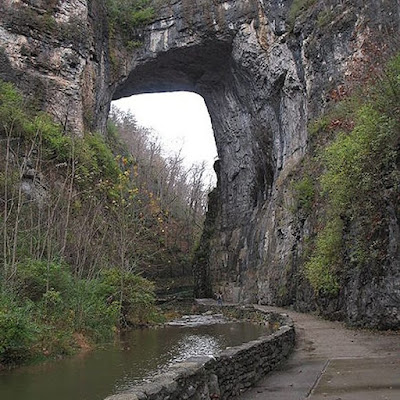
A Bridge Not Made By Hands
To assist him in the survey of this great scenic wonder, the future president hired Hanchrist to be his foreman. One day, George chiseled 'G. Washington' in capital letters 23 feet up the Southwest wall of the canyon. Hanchrist chiseled 'H. Carlock' about 12 feet below and 10 feet to the right of Washington's. Both signatures are still visible today.
Hanchrist's son, Job, migrated to Overton County, Tennessee sometime around 1805 and married Sarah McDonald. Their daughter, Nancy, married Presbyterian minister Clemens Means, son of irish immigrants, about 1820. Clemens' brother, Benjamin, was the great-great grandfather of my grandmother, Dimple.
In his own biographical sketch, Clemens Means wrote, "It is for me to remember that the Lord is a stronghold in the day of trouble." I thought about how many times George Washington, John Marshal and even Henry Clay might have turned to God for help as they were helping form this great country of ours. I imagine Hanchrist Carlock needed a higher power as he left his homeland for America, and so did his son, Job, as he migrated west from Virginia to Tennessee.
It really is a small world, sometimes hard to live in. But, just like the characters in this story, it is a whole lot easier to live in when we realize that we are connected by a 'bridge not made by hands.'
Thursday, January 20, 2022
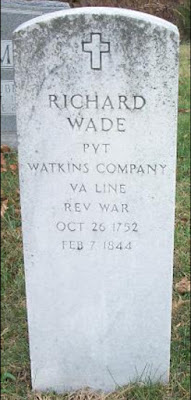
Richard Wade, A Local Man, Served Under Daniel Boone
Richard helped bury the dead soldiers following the Battle of Blue Licks, in Robertson County, Kentucky, on August 19, 1782. A force of about 50 Loyalists al with 300 American Indians had ambushed and routed 182 Kentucky militiamen. Richard was up for court martial for refusing to fight, but was excused by General George Rogers Clark. It would be one of the last battles of the American Revolutionary War.
After the war ended, Richard remained at Boonesborough for several years. His son, John, was born there in 1781. His older son, Elisha, who had been born in Virginia, served with the Kentucky Militia and fought in the War of 1812. In 1801, Richard moved his family to a part of Wayne County that later became Clinton County. He died on February 7, 1844, at the age of 92, and is buried at Cartwright Cemetery with his wife and sons.
Following the war of 1812, Adam Vickery of Wayne County, who had been with Captain Micah Taul's company in the first northern campaign during the war, was appointed captain to lead a company of around 80 Wayne Countians to join Andrew Jackson at New Orleans. Included in the group were John and Elisha Wade. They reached New Orleans just four days before the battle on January 8, 1815. Even though they were outnumbered, the American forces defeated the British in slightly more than 30 minutes, suffering just 71 casualties, while the British suffered over 2,000, including the deaths of the commanding general and his second-in-command.
Check out Richard Wade and his sons, John and Elisha Wade, on Findagrave.com by clicking here.
Friday, October 12, 2018
William Christian Shearer Was Well Respected
William settled in what became Wilkes County, N.C., where, according to Geni.com, his son, William Christian Shearer, served with the 16th Regiment during the American Revolution. It says after migrating to Wayne County, KY around 1812, he and his son, Jacob, ran a freight line that transported household goods, machinery and merchandise between Monticello and Louisville. It said that he was educated and well liked in the community and that he set up and conducted the first Bible study class in Wayne County.
William was married twice, first to Hannah Hoover, who died in North Carolina, then to Sallie Walters. He reportedly had numerous children with both wives. His son, Daniel, was the father of Margaret Shearer Huffaker. Her daughter, Hettie, married U.S. "Grant" Frost. They were the parents of my grandmother, Vada Boles. Christian and his son, Jacob, and Christian's wife, Sallie, are all buried at Bethesda Cemetery. Christian's granddaughter, Margaret, and her husband, Henry Clay Huffaker, my great, great-grandparents, are also buried at Bethesda Cemetery.
Chapter five of the book, "A Century of Wayne County, Kentucky, 1800 -1900," tells that in 1828, Christian Shearer's son, Daniel, my 3rd great-grandfather helped to build a church at Pleasant Bend, now Cooper. In the book, author Augusta Phillips Johnson wrote that Daniel's son, Adam Napolean Shearer, then a lad of nine, remembered going with his father to do this. They called it the Church of Christ. In 1852, they organized and planned to build a church in Shearer Valley. The Civil War came on and this house was not completed until the war was over, but enough was done that the soldiers camped in it during the war. This house stands yet, and members of the Church of Christ meet there for worship. Jenkins Shearer, and later Daniel Shearer, preached in this church. Daniel B. Shearer was born on May 12, 1791 and died on April 21, 1865, at the age of 73. He and his wife, Margaret Vickery Shearer, are buried at Shearer Valley Cemetery.
Sunday, July 15, 2018
"The Cause For Which We Stand"
I often write stories about the Civil War. I love the history behind it all, especially the local history from Wayne County down to Overton County and all points in between. There is much to be learned about the Civil War here in our own backyards. Like all of you, several of my ancestors fought in the war, and like many, I had family on both sides, and in the weirdest corners, too.
My 3rd great uncle was the notorious guerrilla Tinker Dave Beaty, who fought strongly for the Union cause. My 2nd and 3rd great-grandfathers, George and John Boles, were part of his Independent Scouts. On the other side, My 4th cousin, Fountain Frost, rode with Beaty's arch nemesis, the notorious Confederate guerrilla, Champ Ferguson, who fought just as strongly for states rights and 'the southern way of life.' My dad's side of the family in Overton County was mostly aligned to the Confederacy. My mom's side of the family in Fentress and Wayne counties were mostly aligned with Abe Lincoln, who felt it was his sacred duty as President to preserve the Union at all costs.
Very ironically, George Boles, although not yet officially my 2nd great-grandfather at the time, is believed to have killed Frost in a skirmish near Gilreath's Mill, not too far from Holbert Creek, and halfway between Chanute in Pickett County and Pall Mall in Fentress County, Tennessee.
It was sort of like that in the American Revolution, family on both sides, except...it was the same guy.
We all know the story of Benedict Arnold, the American soldier who switched sides and fought for the British during the Revolutionary War. But, have you met Ed Wade? He was 8th great-grandfather born on my dad's maternal side. To be exact, he was Edward C. Wade, Sr., born in York County, Virginia on April 21, 1727, and whose father, Colonel Robert Wade had fought in the French and Indian War. Yeah, that guy.
Edward was a Captain in the British Army at the beginning of the American Revolution, but in 1777, he and one of his brothers, so the story goes, decided to switch sides and join the Virginia Militia. It was a strong commitment to freedom for the Wade family, because two of Edward's sons, Richard and James, were killed while serving with the 6th Virginia Continental Line in 1776. After the war, Edward migrated to Georgia. He died on Nov. 4, 1790 and is buried at Little Creek Church Cemetery in Greshamville.
Switching sides was perhaps by conviction, perhaps it was because of personal belief, or perhaps it was to align oneself with their friends and families. Perhaps it was about wanting to please God. Each side believed God was on their side, but both prayed to the same God and read from the same Bible. So, whose side was the Lord on? During the Civil War, President Lincoln suggested neither side could claim God’s special favor. “The Almighty has His own purposes,” he said. It wasn't 'whose side is the Lord on,' but rather, 'who is on the Lord's side.'
An interesting side note locally: Edward Wade's second cousin, Richard Wade, left Virginia in 1777, the year Edward's father died, and moved to Boonesboro, Ky to help Daniel Boone defend the frontier. In 1801, he moved his family to a part of Wayne County that later became Clinton County. Richard is buried at Cartwright Cemetery. Also after the war, Edward's first cousin, Elizabeth and her husband, Samuel Denney, migrated to Wayne County and they lived on Beaver Creek.
Monday, May 1, 2017
Philburd Wright Left a Proud Legacy
According to "Indiana Magazine of History," by Emsley Wright Johnson, among the early settlers of the Territory of Indiana was a large family of Wrights, who emigrated from Randolph County, North Carolina, and settled in Union County in 1813. From Union County a portion of them went to Wayne and some to Washington County. Later, four of the sons went to Marion County. Philburd Wright took up his residence in Union County near Brownsville. He had served as Justice of the Peace for almost forty years in Randolph County, North Carolina.
Philburd Wright died in Indianapolis on Feb. 18, 1833 and is buried at Mars Hill Cemetery in Marion County. The inscription on his tombstone reads: "Husband to Elizabeth Reagan. Father of Caroline D., Filbert, Joshua, Mattie, Sarah, Mary, Noah, Eli, Levi, Joel, Jessie, Elizabeth, Aaron Wright. Left a proud legacy."
Philburd married Elizabeth (1754-1830) about 1824 in what is now Clinton County, Kentucky. Their granddaughter, Susan (Joshua's daughter), married Azel Means about 1824 in what is now Clinton County, KY. Azel's family had moved from Randolph County, N.C. to Overton County, TN in 1807 and then settled near Sulphur Creek in Clinton County about 1820.
Southern Campaign American Revolution Pension Statements & Rosters Pension Application of Dennis Hopkins
State of Kentucky, Clinton County: County Court, January Term 1843.
"On this the 2nd day of January A.D. 1843 personally appeared in open court, Dennis Hopkins a resident citizen of the County aforesaid aged eighty-two years the 13th day of July last, having a record of the same being born on the 13th day of July 1760, being born in Orange County North Carolina, and raised in Randolph County said State, where he lived in time of the Revolutionary war, and after being duly sworn for that purpose on his oath makes the following Declaration in order to obtain the Benefit of the act of Congress passed 7th of June 1832. That he entered the service of the United States a drafted light horse soldier in Randolph County North Carolina in the fall of 1780, believed to be in October cannot give the day of the month with precise certainty, entered for three months under Captain William York, and Major Thomas Dogin [Thomas Dugan?] and served three months Ralph Low Lieutenant, has now forgotten the name of the Ensign, and served with John Aldred, Christian Morris, John Julin, Jacob Staley, Archibald Hopper & Ezekiel Craft and others, he was drafted at the house of Billy Coal [Billy Cole?] and marched down deep River ranging and ranged through the County of Randolph and Chatham, and stationed some considerable time at the barracks in Chatham County on the plantation of Colonel Littrell [John Luttrell], and a portion of the times stayed at Bell's Mills in Randolph, where was our head quarters, and marched Chatham and continued traversing the Counties of Guilford, Orange, Guilford and Chatham had a skirmish with the Tories in Randolph was fired on by them, and served out the full Term of three months and had a written discharge from Captain William York having served out the time, believed to and sometime in January 1781, as near as he can recollect was discharged at the Barracks in Chatham County North Carolina. Declarant again volunteered about the first of April as near as he now recollects, and in the ensuing spring for three months under said officers, the time word so difficult, that he felt more safe in service, that otherwise. Served as before a horseman being in 1781, marched down Sandy Creek continued down the River and stationed again at Bell's Mills, and again at the Barracks on Colonel Luttrell's plantation and continued to range through the Counties of Chatham, Randolph and Guilford, and caught many of the Tories, whipped, killed and hung many of the Tories, and helped to disperse and drive the Tories out of the Country and having served out the full term of three months marched to Randolph Courthouse and there again had a written discharge from said Captain William York, discharged as he believes in July sometime cannot state the precise time with further certainty than herein stated. Declarant moved in about four years after in Randolph County said State and lived there next after his marriage thirteen years, and moved to Clark County State of Georgia lived there ten years, thence to Wayne County Kentucky where he has lived about thirty-two years, is now stricken off into Clinton County Kentucky, Declarant has no written or documentary evidence of his service and knows of no person by whom he can prove his service, that has a positive knowledge of the same, but he has no doubt, but he can prove by many of his old acquaintance that he is and has been so reputed by them that has been acquainted with him for about 30 years last past he will name Reuben Owens, Esquire and Benjamin Hancock Esquire of the same church with him, he will mention others George Delaney, a revolutionary man of this County, he will mention Vachel Lessly and Robert A. Dabney of his acquaintance, and believes many others would depose that they have a full belief of his service from the tradition of the country founded on a long acquaintance. He hereby relinquishes every claim to a pension except the present. Declarant has delayed making an application for a Pension principally because he knew of no person by whom he could prove his service, and not needing the benefit of said law some years past as much as he does now. He states his name is not on the Pension Roll of the agency of any State. Declarant lost both discharges in Kentucky some years past. Sworn to & subscribed in open court January term 1843 S/ Rice Maxey, Clk S/ Dennis Hopkins. [Westley Owens, John Wade and Jacob Holsapple gave the standard supporting affidavit.]"
On February 7, 1845, at age 84, Dennis Hopkins filed another complete application in Clinton County Court, however both applications were denied for lack of proof of service.
Dennis Hopkins died in Clinton County on June 26, 1850, leaving his surviving children: Dennis, Thomas, Joshua, Nancy Newkirk, Martha Ledford, Sally Leslie and Epsy Long. His son, Dennis, was administrator of his estate.
Tuesday, July 7, 2015
Deacon Willis and the Meetinghouse by the Brook
"There's a little valley you reach going westward as High street curves and dips beyond Winthrop square. Just before it goes up Marm Simonds' hill the road passes over a brook -- the brook of all the brooks of Medford. Did you ever stand here on a June morning and look across the meadow to the north and watch this brook come sparkling from out the distant foliage like a silver line through billowy grasses and nodding daisy blossoms? And turning to look southward follow its course through the marshes and to the river; then you notice on a near-by tree a tablet that marks the site of the second meetinghouse. You may have passed this spot many times in the modern electric car, but only by the ‘old-fashioned’ way of walking and loitering along here will a picture of the early years of Medford's history present itself. You will even need to get acquainted with the brook itself - see it in its varied moods, inquire into its mysteries, follow it as though you walked with a friend, and then it will tell you that the old meetinghouse and this brook were companions for many years; that no one is now living of all who loved the sacred spot; that the name lives forever in ‘Meetinghouse brook.'
But what of the brook? Whence does it come? Two miles or so to the north from out what was once known as Turkey Swamp, but now the Winchester Reservoir, it finds its way southerly down the woodlands past old gray rocks that throw dark shadows in its pools; sometimes it gurgles over the stones and then is silent among clumps of brake and fern and masses of jewel-weed. The Canada lilies swing their bells along its course. It winds down a narrow dell where its waters once, held at flood, turned the wheel of Captain Marble's mill (formerly it was called Marble brook). A high bank and heap of stones mark the spot, and there the fringed orchid waves its plume. It flows under bridges shaded by willows, through beds of mint; and the monkey-flower in midsummer and the flaming cardinal flower in August love the cool water. Then it swings around and passes southeasterly under a stone wall out into the orchard of General Lawrence's farm. Here it forms three levels, being dammed with large blocks of granite, making a miniature sea - a delight to the children - for here they wade and sail their boats. Now it quickens pace and passes under a small stone bridge at Winthrop street, where the white flowers of the turtle-head guard the archway; swings around past the place where John Albree once held its waters back to run his gristmill, and like an arrow crosses the meadow, flows under the roadway near site of the second meetinghouse, and wends its way to the river."
Thomas Willis, who wrote his last name as Willows, was a housewright (builder of homes) and a selectman (councilman), but he is most remembered as one of the founders of the church of Medford, which was constituted Feb. 11, 1713. He was also the first deacon of the church. The first meetinghouse accommodated the people for twenty years, when in June of 1716, it was considered inadequate to meet the needs of the increasing population. Seven prominent citizens headed by Deacon Willis were chosen to ascertain ‘whether it was best to build a new meetinghouse or to enlarge the old.’ The committee reported that a new meetinghouse should be built, to be 50 feet long, 38 feet broad and 27 feet stud, and to cost 450 pounds. Nearly three years elapsed before action was taken on this committee's report and it was voted down. Other attempts to build a second meeting house also failed to obtain the blessings of the townsfolk, and it wasn't until January of 1726 that the town agreed to purchase one acre adjoining Marble brook for 55 pounds to build a new meetinghouse on. It was decided that it would be proper to build the meetinghouse 52 feet large, 38 feet wide, 33 feet posts.
By 1770, a third meetinghouse had been built some distance away to the east on the northerly side of the same road, larger and better suited to the needs of that day, and when Paul Revere rode through Medford some five years later, he passed by the third meetinghouse, tall and imposing in the moonlight, and pressing westward along High street, crossed the wooden bridge over Meetinghouse brook. The hurrying hoofs awoke no echoes from the old meetinghouse, for long ago it had been removed.
Thomas Willis served as deacon for seven years, resigning on March 9, 1720 on account of his age. He died in 1725 and is buried in plot 148 at Salem Street Burying Ground in Medford, Massachusetts. The inscription on his tombstone reads:
ye Body of Deacon Thomas Willis
Who Dec'd August the 14th
Anno Domi 1725
in ye 85th Year of his Age."
Deacon Thomas Willis was my 11th great-grandfather. One of his granddaughters, Susanna Clements, migrated from Massachusetts to Virginia, where my ancestors from this line remained until four generations later, when Joshua Wright migrated to Fentress County, Tennessee. His grandson, Caleb Means, was my great-great-grandfather.
Saturday, July 4, 2015
Saturday, May 23, 2015
The Battle of Camden: A Memorial Day Tribute To My Ancestor, Jacob Speck
During the American Revolutionary War, almost every able-bodied man, who was not a part of the Continental Army, joined their local Militia to help protect the settlement in which they lived. Such was the case for Jacob Speck. On July 21, 1780, General Horatio Gates was at Camden, South Carolina commanding a force of 3,200 troops of which Jacob was a part of. The British general, Lord Charles Cornwallis, was also there with an army of 2,100. Even though Gates had Cornwallis outnumbered, most of the Americans lacked experience and training. The North Carlina Militia had never been tried. Gates was advised NOT to go into battle under the circumstances. But, he ignored the warning.
Just before dawn on August 16th, the British troops opened the battle as the right flank fired volley's into the militia regiments, causing a significant number of casualties. When the remaining militia looked up, they saw British troops advancing toward them with their bayonets drawn. The militia realized they did not have bayonets to counter the attack. Panic began to spread and most of the militia fled before the British regiments reached them. General Gates was among the first to run from the field, leaving his remaining troops on the field alone. Within a matter of minutes, the whole rebel left wing had evaporated.
Five years earlier, Jacob and Catherine Speck had gotten married. She was 16 at the time. Jacob Jr. was now four, Michael had just turned two and a third son, George, my 6th great-grandfather, was less than two months old. It is hard to imagine what Catherine must have thought or felt as she watched her husband leave home to defend their new settlement. It is even harder to imagine what she must have felt later. For you see...in that pre-dawn hour on that warm August 16, 1780 morning, when the smoke and dust from the cannon volley's had finally cleared, Jacob Speck lay dead on the battlefield.
God never closes one door without opening another. Before his death, He allowed Jacob to plant the seeds that would produce many future generations of Speck family members, including me.
Wednesday, November 12, 2014
Dennis Hopkins, Light Horse Soldier
Dennis filed his Revolutionary War Pension Application in Clinton County on Jan. 2, 1843, at the age of 82. Born on July 13, 1760, in Orange Co., North Carolina, he was raised in Randolph Co., where he lived during the Revolutionary War. He entered the service as a light horse soldier in Randolph County for three months, beginning in October of 1780, under Capt. Wm York and Maj. Thomas Dogin. He was drafted at the house of Betty Cole and marched down Deep River ranging throughout Randolph and Chatham counties and was stationed some considerable time at the barracks in Chatham county on the Plantation of Col. Littrell. A portion of the time he also stayed at Bell’s Hill in Randolph County, where the company's headquarters were located. He also participated in marches through Guilford and Orange counties. He was shot in his foot during a skirmish with the Tories in Randolph County but still served out the full term of three months before receiving a written discharge from Capt. York sometime in January of 1781.
Dennis volunteered for another three months on April 1, 1781 and marched down Sandy Creek to his previous station at Col. Littrell’s Plantation at Bell's Mill. During his time at war, he said he caught, whipped, killed and hung many Tories or helped drive them out of the country. Sometime around July, he marched to the Randolph County Court House, where he received his final discharge as a revolutionary war soldier.
Dennis Hopkins married in Randolph County and lived there thirteen more years before moving to Clark County, Georgia, where he lived ten years before moving to Wayne County. Kentucky, where lived some 32 years. That portion of Wayne County where he lived later became part of Clinton County.
Dennis Hopkins died on June 26, 1850 at the age of 90. He is buried at Hopkins Cemetery in Clinton County, Kentucky.
Wednesday, July 2, 2008
Soldiers of Stockton Valley
It was the fall of the year when the call for volunteers went out at the outbreak of the War of 1812. There was no question that residents of Stockton Valley would be first in line. They were, after all, veterans, or sons of veterans, who had fought the British in the American Revolution, and would eagerly take up arms to defend their country once again. In the latter part of July, Kentucky Governor Isaac Shelby issued a proclamation calling for 2,000 mounted riflemen to meet him at Newport within thirty days. The soldiers would march to Lake Erie to assist General William H. Harrison in a fight with British troops and their Indian allies, including the great Shawnee Chief, Tecumseh. On August 31st, Company 53, led by William Wood of Stockton Valley, reached Newport, and the company's 47 men, including 36 rank and file, 11 commissioned officers and nine rifles, prepared for battle.
On the appointed day, 4,000 men, double the number Governor Shelby had asked for, assembled at Newport. With the Governor leading the way, the Kentuckians crossed the Ohio River at Cincinnati, and headed for Lake Erie. On October 5, 1813, General Harrison and his forces crossed over into Canada where they fought and won the decisive Battle of the Thames. It is said William Wood was present when Richard M. Johnson killed Tecumseh.
The soldiers of Stockton Valley returned to their settlement on November 13th. They had left their home and families to defend their country, and had returned as heroes.
Thursday, June 26, 2008
William Wood....Man of Honor

Samuel Wood came to America by way of England in 1755. Though only eighteen, he soon enlisted in the Virginia Militia, a company commanded by Col. George Washington, and was with Braddock when he met defeat at Ft. Duquesne in the French and Indian War. During the Revolutionary War, Samuel Wood did his part to aid his adopted country in its fight for freedom.
His son, William, who was born on June 13, 1773 near the Great Falls of the Potomac River in Loudon County, Virginia, was seven years old when the family moved across the mountains into western North Carolina and settled along Little Limestone Creek, in an area later known as Washington County, Tennessee. When he turned 18, William also joined the State Militia and fought in the American Revolutionary War. In 1791, he obtained the rank of Lieutenant.
Four years later, the 24-year-old Lt. Wood was the third settler to arrive at Stockton Valley, taking up 200 acres on Lick Branch of Spring Creek. At Stockton Valley, William would wear many hats. For instance, he surveyed virtually all of the land of the earliest settlers. Later, Surveyor Wood served as Sheriff and Justice of the Peace. In 1808, Sheriff Wood was elected as State Representative to the Kentucky Legislature from the 38th District, and five years later, State Representative Wood was elected State Senator. He went on to serve a total of 24 years in state government.
Senator Wood was promoted to the rank of Captain of a company of mounted volunteer riflemen in Governor Shelby's campaign to Canada during the War of 1812. The rank of Brevet Major was bestowed to Captain Wood during the advance through Ohio as the group of mostly Stockton Valley men rode to join General Harrison's forces in the vicinity of Detroit. He was reportedly present when Tecumseh was killed. From the War of 1812, Major Wood rode on to the Battle of New Orleans.
Major Wood was known as a formidable competitor in a race before the people because of his good practical sense, proverbial honesty and plain blunt manner; and although he made no pretensions to the character of orator, his influence was always felt and appreciated. He was remembered as a man of no mean qualifications, of great moral worth and strict integrity. Amid the frontier hardships and limitations, Major Wood was a man of honor and influence in the growing settlement at Stockton Valley, and quickly assumed a position of leadership. Not only was William Wood a founding member of Clear Fork Baptist Church, but he also served 47 years, until his death, as the church clerk.
Even though he was a man who wore a lot of different hats - Lieutenant, Captain, Major, Surveyor, Sheriff, Justice of the Peace, State Representative, State Senator -I would venture to say the title he was most proud of was Christian. And, the second most title he was probably proud of was - member of the Church of Jesus Christ at Clear Fork Creek, Clear Fork Baptist Church.
William Wood died January 11, 1851, at the age of 78. He and his wife, Elinor Ryan Wood, are buried in the Clear Fork Burying Ground.
As we celebrate america's freedom this Independence Day, I hope you will join me in saluting William Wood, who's entire life was about freedom. He helped fight for it and he helped win it, and then he bravely put that newfound freedom to the test by moving into a strange new world, where one of the first things he did was help establish a Church, which he served faithfully, and freely, the rest of his days.
The Story of Reuben Coffey, an American Revolutionary War Soldier
In Augusta Phillips Johnson's book, "A Century of Wayne County Kentucky 1800-1900," originally published in 1939, she used W...
-
The Roanoke Colony was an enterprise financed and organized by Sir Walter Raleigh in the late 16th century to establish a permanent English ...
-
When I think of the 70's, I think of the greatest rock and roll music ever. It is now included in a music genre that is known today a...