Thomas Edison invented the phonograph in 1877. No one knows for sure who the very first recording artist was. Here is a look at an early recording artist I have in my collection.
In the October 1904 edition of the Edison Phonograph Monthly, there was an announcement of a new recording that was being released....
"Blue Bell" is something new in the way of a phonograph record. It is a bells and xylophone duet by Albert Benzler and Frederick W. Hager, with orchestra accompaniment. This is a most excellent Record of one of the most popular airs published in some time. The tune is carried by the bells, the xylophone plays a variation of the air and back of this is a fine orchestra accompaniment. We predict that this record will sell as well as the vocal record of the same selection, the demand for which has exhausted our capacity to manufacture it ever since it was listed.”
Multi-talented musician and composer Frederick W. Hager (xylophone) was a prominent figure in the early recording industry. He was a widely recorded bandleader for several record companies. His Hager's Band and Hager's Orchestra appeared on many dozens of Zonophone disk recordings. For a time, according to the October 1903 Edison Phonograph Monthly, he directed the Edison Concert Band. In this recording of Blue Bell, we get a rare hearing of Hager as a soloist.
To listen to recordings by Frederick W. Hager, or other early recording artists, visit the Cylinder Preservation and Digitization Project at the University of California at Santa Barbara.
Showing posts with label Phonograph.. Show all posts
Saturday, July 28, 2012
The Edison Files: Helen Clark
Thomas Edison invented the phonograph in 1877. No one knows for sure who the very first recording artist was. Here is a look at an early recording artist I have in my collection.
Helen Clark. The New York-born contralto made many popular recordings between 1910-1930, as a soloist, in duets, and as a member of Victor Light Opera Company. Her collaboration with Billy Murray, "Come On Over Here" (Victor 17441, 1913), was a major hit. "Sympathy" (Victor 17270), a duet with Walter Van Brunt, was a top seller in early 1913.
To listen to recordings of Helen Clark, or other early recording artists, visit the Cylinder Preservation and Digitization Project at the University of California at Santa Barbara.
The Edison Files: Fred J. Bacon
Thomas Edison invented the phonograph in 1877. No one knows for sure who the very first recording artist was. Here is a look at an early recording artist I have in my collection.
Fred J. Bacon was born in Holyoke, Massachusetts in 1871. He studied five-string classic-style banjo under Alfred A. Farland and by the late 1890's, he had established himself as a celebrity for his banjo performances. He made numerous recordings for different record companies, such as Edison and Victor.
Bacon started the Bacon Banjo Company in 1906 in Forest Dale, Vermont, where Bacon lived. “The banjo is the greatest of musical instruments when it is played well,” he said. “In tone quality it is very much like the harp, and its flexibility of playing is unexcelled, for in the hands of a skilled player it is as good for classical music as for dance tunes. It is the only original American instrument, and is coming into its own as the greatest of them all.”
The Bacon Banjo Company was widely regarded as one of greatest of the classic pre-war banjo manufacturers. At first, the company sold banjos made in Bacons own workshop at Forest Dale. In 1920 the company moved to Groton, Connecticut. Later, the company changed name to The Bacon Co., Inc.
In 1922 David L. Day joined the company and after that several of the banjo models were sold under the Bacon & Day or B & D brand names. In 1938 the Bacon factory was destroyed in a fire and production was taken over by Gretsch who bought the company two years later. Gretsch kept making banjos under the Bacon brand until mid-1960s. Today Gretsch is owned by Fender who presumably still owns the rights to the Bacon brand name although no instruments have been sold under it since 1970.
To listen to recordings by Fred J. Bacon, or other early recording artists, visit the Cylinder Preservation and Digitization Project at the University of California at Santa Barbara.
The Edison Files: Andre Benoist
Thomas Edison invented the phonograph in 1877. No one knows for sure who the very first recording artist was. Here is a look at an early recording artist I have in my collection.
The French pianist, Andre Benoist, was born on April 4, 1879 in Paris. He studied at the Paris Conservatoire and then later toured Europe and America as accompanist to Pablo Casals, Albert Spalding and other celebrated artists. He made several recordings for Edison Records and Victor. Benoist died June 19, 1953 in New Jersey.
To listen to recordings of Andre Benoist, or other early recording artists, visit the Cylinder Preservation and Digitization Project at the University of California at Santa Barbara.
To listen to recordings of Andre Benoist, or other early recording artists, visit the Cylinder Preservation and Digitization Project at the University of California and Santa Barbara.
The French pianist, Andre Benoist, was born on April 4, 1879 in Paris. He studied at the Paris Conservatoire and then later toured Europe and America as accompanist to Pablo Casals, Albert Spalding and other celebrated artists. He made several recordings for Edison Records and Victor. Benoist died June 19, 1953 in New Jersey.
To listen to recordings of Andre Benoist, or other early recording artists, visit the Cylinder Preservation and Digitization Project at the University of California at Santa Barbara.
To listen to recordings of Andre Benoist, or other early recording artists, visit the Cylinder Preservation and Digitization Project at the University of California and Santa Barbara.
The Edison Files: The Orpheus Male Chorus
Thomas Edison invented the phonograph in 1877. No one knows for sure who the very first recording artist was. Here is a look at an early recording artist I have in my collection.
Orpheus Male Chorus. One of the most important figures in pre-jazz African-American music, Will Marion Cook is also one of its better known personalities. As a composer, conductor, performer, teacher, and producer, he had his hand in nearly every aspect of the black music of his time and worked with nearly every other important musician in his fields. Uncompromising and difficult to work with, he still commanded respect from his peers for his abilities and accomplishments. In 1881 he was sent to Chattanooga, Tennessee, to live with his grandfather where he heard black folk music for the first time. However, Cook's early career remained focused on classical music and violin performance, which he began at age 13. When he was 15, Cook studied violin at Oberlin College. Cook was sent to Europe to study and as a result, he studied with Joseph Joachim, the famous violinist and associate of Brahms. Upon his return to the U.S. in 1890, however, his classical career went nowhere. Since he was unable to find employment at any musical institution, he began to teach music privately. Among his students was Clarence Cameron White, who later became famous as a violinist and composer. Cook's earliest composition was Scenes from the Opera of Uncle Tom's Cabin--intended for the Chicago World's Fair of 1893, but which was not performed. Cook turned to popular music as his classical career was not successful. He began writing songs. Cook was well represented on disc and cylinder. In 1914, he conducted a group, the Afro-American Folk Song Singers, in a Columbia recording of Cook’s black folk-anthem entitled, “Swing Along,” which was sung by the Orpheus Male Chorus on Edison. Cook remained an important figure in the new century. He wrote and published many songs, was prominent as a conductor and music director. A historic concert on May 2, 1912, at Carnegie Hall featured his 150-voice chorus in a performance of Swing Along! Cook died of cancer in New York in 1944. As mentor and teacher, Cook influenced a generation of young African-American musicians, including jazz composer and performer Duke Ellington, who studied with Cook.
To listen to recordings by the Orpheus Male Chorus, or other early recording stars, visit the Cylinder Preservation and Digitization Project at the University of California at Santa Barbara.
The Edison Files: Vernon Archibald
Thomas Edison invented the phonograph in 1877. No one knows for sure who the very first recording artist was. Here is a look at an early recording artist I have in my collection.
Vernon Archibald. Popular tenor ballad singer Charles Harrison formed the American Singers Quartet around 1927, with tenor Redferne Hollinshead, bass Frank Croxton and baritone Vernon Archibald. Archibald recorded several solo and duet songs for many different companies, but he mostly recorded for Edison Records.
From the New York Times, March 26, 1920:
Vernon Archibald, a baritone from Chicago, gave a matinee of songs and airs in Italian, French and English yesterday at Aeolian Hall, his first in public here, though he sang once in private last year. A dramatic air of Verdi’s “Simon Boccanegra,” was hardly contrasted in performance with that of Handel which preceded it, or the ensuing “Legend of the Sage” from Massenet’s “Jongleur.” There was sensitive appreciation in his delivery of lyrics, such as Cornelius’ “Monotone,” Mrs. Maley’s “In a Garden,” a poem of the Christ-child, and Miss Brown’s “Sunset,” an unpublished air, with “A Ballynure Ballad” and others in conclusion.
To listen to recordings by Vernon Archibald, or other early recording artists, visit the Cylinder Preservation and Digitization Project at the University of California Santa Barbara.
The Edison Files: John Young
Thomas Edison invented the phonograph in 1877. No one knows for sure who the very first recording artist was. Here is a look at an early recording artist I have in my collection.
Tenor John Young, also known as Harry Anthony, recording a cylinder in the early 1900s, showing the cramped conditions and other concessions necessitated by the acoustic recording process at the Edison recording studio. Eugene Jaudas is conducting the studio orchestra. Using the name, Harry Anthony, Young had numerous recordings of hymns with partner Frederick J. Wheeler that reportedly led comedian Billy Murray to dub them the 'Come-To-Jesus Twins.'
In mid-1915, Young replaced Robert D. Armour with the American Quartet. He also sang in, and managed, the Criterion Quartet. The new edition of the American Quartet enjoyed great success, beginning with its first Victor release, "War Song Medley." The American Quartet recorded for several companies--not only Victor and Edison but Columbia, Okeh, Emerson, Pathe, and Vocalion.
To listen to recordings by John Young, or other early recording artists, visit the Cylinder Preservation and Digitization Project at the University of California at Santa Barbara.
The Edison Files: Metropolitan Quartet
Thomas Edison invented the phonograph in 1877. No one knows for sure who the very first recording artist was. Here is a look at an early recording artist I have in my collection.
The Metropolitan Quartet was a vocal quartet of men who performed in the New York City area in the years 1890 until about 1902. The group consisted of Robert J. Webb (first tenor), Peter J. Collins (second tenor), James J. Byrne (baritone), and Richard Schumm (bass). For several years they appeared at amateur light opera presentations, in minstrel shows and frequently as choir singers. The group became professional in 1895.
To listen to recordings of the Metropolitan Quartet, or other early recording artists, visit the Cylinder Preservation and Digitization Project at the University of California at Santa Barbara.
The Edison Files: Jaudus Society Orchestra
Thomas Edison invented the phonograph in 1877. No one knows for sure who the very first recording artist was. Here is a look at an early recording artist I have in my collection.
Jaudus Society Orchestra
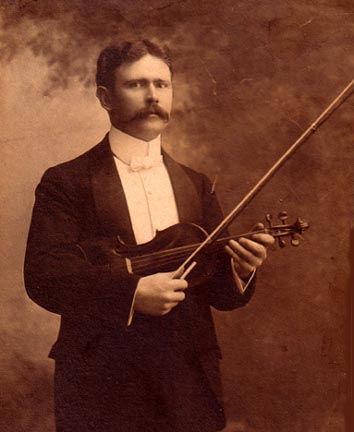
The ensemble was headed by violinist Eugene A. Jaudas, for many years Edison's orchestra leader. Its hits included "Missouri Waltz" (Edison Blue Amberol 2950, 1916) and "The Darktown Strutters' Ball" (Edison 50469, 1918).To listen to recordings by Jaudus Society Orchestra, or other early recording artists, visit the Cylinder Preservation and Digitization Project at the University of California at Santa Barbara.
The Edison Files: American Symphony Orchestra
Thomas Edison invented the phonograph in 1877. No one knows for sure who the very first recording artist was. Here is a look at an early recording artist I have in my collection.
American Symphony Orchestra. Edison's National Phonograph Company "symphony" recordings began in 1898 under the Edison Symphony Orchestra. In October 1908, Edison renamed the orchestra the American Symphony Orchestra (the same month the Edison Military Band was renamed the New York Military Band).
Listen to recordings by American Symphony Orchestra or Edison Symphony Orchestra, or other early recording artists, by visiting the Cylinder Preservation and Digitization Project at the University of California at Santa Barbara.
The Edison Files: Frederick J. Wheeler
Thomas Edison invented the phonograph in 1877. No one knows for sure who the very first recording artist was. Here is a look at an early recording artist I have in my collection.
Frederick J. Wheeler, also known as James F. Harrison, rose to prominence as part of the gospel duo, James F. Harrison and Harry Anthony, and enjoyed a string of hits as a soloist, paired with James Reed (real name: Reed Miller), and as a member of the Knickerbocker Quartet. The baritone balladeer's top- selling recordings included "Keep the Home Fires Burning" (Victor 17881, 1915/16), "My Little Dream Girl" (with Reed, Victor 17789, 1915), and "There's A Long, Long Trail" (with Reed, Victor 17882, 1915/16).
The Knickerbocker Quartet was formed in 1908 to replace the Edison Male Quartet. Original members were John Young, George M. Stricklett, Frederick Wheeler and Gus Reed. Personnel changed around 1912. Young and Wheeler were joined by Walter Van Brunt and William F. Hooley.
To listen to recordings made by Frederick J. Wheeler/James F. Harrison, or other early recording artists, visit the Cylinder Preservation and Digitization Project at the University of California at Santa Barbara.
Frederick J. Wheeler, also known as James F. Harrison, rose to prominence as part of the gospel duo, James F. Harrison and Harry Anthony, and enjoyed a string of hits as a soloist, paired with James Reed (real name: Reed Miller), and as a member of the Knickerbocker Quartet. The baritone balladeer's top- selling recordings included "Keep the Home Fires Burning" (Victor 17881, 1915/16), "My Little Dream Girl" (with Reed, Victor 17789, 1915), and "There's A Long, Long Trail" (with Reed, Victor 17882, 1915/16).
The Knickerbocker Quartet was formed in 1908 to replace the Edison Male Quartet. Original members were John Young, George M. Stricklett, Frederick Wheeler and Gus Reed. Personnel changed around 1912. Young and Wheeler were joined by Walter Van Brunt and William F. Hooley.
To listen to recordings made by Frederick J. Wheeler/James F. Harrison, or other early recording artists, visit the Cylinder Preservation and Digitization Project at the University of California at Santa Barbara.
Friday, July 27, 2012
The Edison Files: George Wilton Ballard
Thomas Edison invented the phonograph in 1877. No one knows for sure who the very first recording artist was. Here is a look at an early recording artist I have in my collection.
George Wilton Ballard (1887-1950) was one of Edison's most popular tenors. He began recording in 1910 on US Everlasting cylinders. His first performance for Edison was released in 1914 on Blue Amberol cyliner #2150. Subsequent performances were released on about 70 cylinders and a similar number of Diamond Discs. He retired from studio work in 1923. His last Edison recording released in 1926 was recorded several years before its release. Ballard teamed up with singer Helen Clark to record some very memorable duets.
To listen to recordings by George Wilton Ballard, or other early recording artists, visit the Cylinder Preservation and Digitization Project at the University of California at Santa Barbara.
The Edison Files: Lyric Male Quartet (Shannon Four)
Thomas Edison invented the phonograph in 1877. No one knows for sure who the very first recording artist was. Here is a look at an early recording artist I have in my collection.
Lyric Male Quartet. Victor's popular Shannon Four, which began recording in mid-1917 and consisted of Charles Hart, Harvey Hindermyer, Elliott Shaw, and Wilfred Glenn. The first Shannon Four disc was issued in September 1917: "I May Be Gone For A Long, Long Time," followed in October by "Wake Up, Virginia." Some discs were credited to "Charles Hart and the Shannon Four," such as two titles issued in May 1918: "A Little Bit of Sunshine" and "The Last Long Mile." The quartet also recorded for Edison Records, sometimes being called Lyric Male Quartet.
To listen to recordings by the Lyric Male Quartet (Shannon Four), or other early recording artists, visit the Cylinder Preservation and Digitization Project at the University of California at Santa Barbara.
The Edison Files: Sibyl Sanderson
Thomas Edison invented the phonograph in 1877. No one knows for sure who the very first recording artist was. Here is a look at an early recording artist I have in my collection.
Sibyl Sanderson was a famous American operatic soprano during the Parisian Belle Epoque. She was born on December 7, 1864 in Sacramento, California. Her father, Silas Sanderson, was once Chief Justice of the Supreme Court of California. After his death in 1886, Sibyl and her mother moved to Paris and became transplanted socialites. Sanderson proved to be a remarkably gifted singer and began to appear on stage. She was Jules Massenet's favorite soprano and appeared in the premieres of a number of his operas. Sanderson was also admired by Camille Saint-Saens, who wrote the title role in Phryne' for her. Success outside of Paris was elusive for Sanderson; she appeared at Covent Garden and the Metropolitan Opera (debut in title role of Manon on January 16, 1895, the last performance as Juliette in Romeo et Juliette on December 31, 1901) to lackluster reviews. In 1896 she married a Cuban millionaire and sugar heir, Antonio Terry, after which she temporarily halted her operatic activity, making an unsuccessful comeback two years later. Her last years were marred by depression, alcoholism and illness and she died from pneumonia on May 16, 1903 at the age of 38.
To listen to recordings by Sibyl Sanderson, or other early recording artists, visit the Cylinder Preservation and Digitization Project at the University of California and Santa Barbara.
The Edison Files: Ford Hawaiians
Thomas Edison invented the phonograph in 1877. No one knows for sure who the very first recording artist was. Here is a look at the early recording artists I have in my collection.
Ford Hawaiians Henry Kailimai, was a virtuoso ukelele player and composer who came from Hawaii in 1915 to perform at the Pan Pacific International Exposition in San Francisco. The performances by him and other Hawaiian musicians exposed the public to Hawaiian music for the first time, fueling the exploding popularity of Hawaiian music on the mainland. Attending the exposition was Henry Ford, and he was so impressed with Henry Kailimai that he persuaded him and four other Hawaiian musicians to move to Detroit, Michigan to be artists in residence for the Ford Motor Company. Because of Henry Ford’s friendship with Thomas Edison, the group traveled to New York and made several recordings at The Edison Recording Studio, using Edison’s new phonograph invention, which he was perfecting at the time. Kailimai was a professional pianist by night, and an engineer by day. His career was curtailed due to the wishes of his wife, who didn’t want him to go on the road.
To listen to recordings of Ford Hawaiians, or other early recording artists, visit the Cylinder Preservation and Digitization Project at the University of California at Santa Barbara.
The Edison Files: Váša PÅ™Ãhoda
Thomas Edison invented the phonograph in 1877. No one knows for sure who the very first recording artist was. Here is a look at the early recording artists I have in my collection.
Váša PÅ™Ãhoda, born August 22, 1900, was a famous Czech violinist known for the perfection of his technique and the beauty of his tone. He was considered a Paganini specialist, and his recording of the Violin Concerto in A minor by Dvorak is still very highly praised. His artistry was controversial, and tended to polarise listeners. His first public performance was at age 13. At age 19 a tour of Italy proved unsuccessful; poverty-stricken, he joined the orchestra of the Café Grand’Italia in Milan to earn money. There he was heard by chance by Arturo Toscanini, who arranged a benefit concert for him. He then resumed his Italian tour, this time to great success. He was said to have been given Niccolo Paganini's own violin on which to play. He toured Brazil and the United States in 1920 and the USA again in 1921. He once shared the stage of the Royal Albert Hall with Pablo Casals. PÅ™Ãhoda concertized extensively all over the world and made a number of recordings when the industry was in its infancy. Unfortunately, some of his recordings were not well-produced so the sound quality is poor. But, he was greatly admired for his style, dazzling technique, and finesse. He appeared in two films in 1936: Between Two Worlds and Die Liebe des Maharadscha. During World War II, he taught at the Mozarteum in Salzburg. Because he continued to perform in Germany and German-occupied territories after the Nazi invasion of Czechoslovakia, he was briefly charged with collaboration after the war, and censured by the Czech government. He later taught at the Academy of Music and Dramatic Arts in Vienna. In later years, he dedicated most of his time to teaching and composing small chamber works. His last concert was in April 1960. He died on July 26, 1960.
To listen to recordings made by Vasa Prihoda, or other early recording artists, visit the Cylinder Preservation and Digitization Project at the University of California at Santa Barbara.
The Edison Files: The American Quartet
Thomas Edison invented the phonograph in 1877. No one knows for sure who the very first recording artist was. Here is a look at the early recording artists I have in my collection.,
The American Quartet, a highly successful vocal group with 12 number one hits during the 1910’s and ’20’s, was formed in 1909 and recorded together for over 15 years. Its original lineup consisted of tenor Billy Murray (the featured soloist), tenor John Bieling, baritone Steve Porter and bass William F. Hooley. Journalist Jim Walsh wrote in the 1970 February issue of Hobbies magazine that "For several years [Murray] had been singing frequently on Victor records with the assistance of the Haydn Quartet, but now it was decided there was a need for a foursome in which he would star. So John Bieling and Hooley were borrowed from the Haydn Quartet (in which, however, they continued to sing) and Porter was brought in from the Peerless, where he had been singing baritone." Bieling left in 1914 and was replaced by John Young. When Hooley died in late 1918, he was succeeded by Donald Chalmers.
In 1920, a revamped American Quartet featured Murray, Albert Campbell, John Meyer and Frank Croxton. While the individual members, particularly Murray, enjoyed solo success, the quartet is responsible for some of the most successful recordings of its day including the #1 hit songs ‘Casey Jones’ (1910), ‘Call Me Up Some Rainy Afternoon’ (1910 with Ada Jones), ‘Come Josephine in My Flying Machine’ (1911 with Ada Jones), ‘Oh, You Beautiful Doll’ (1911), ‘Moonlight Bay’ (1912), ‘Everybody Two-Step’ (1912), ‘Rebecca of Sunnybrook Farm’ (1914), ‘It’s a Long, Long Way to Tipperary’ (1914), ‘Chinatown, My Chinatown’ (1915), ‘Oh Johnny, Oh Johnny, Oh!’ (1917), ‘Over There’ (1917) and ‘Good-Bye Broadway, Hello France’ (1917). In total, American Quartet had over 65 top ten hits from 1910 through 1924 and is listed as #16 on the list of most #1 singles from 1890-1954.
The group disbanded in 1925.
To listen to recordings by The American Quartet, or other early recording artists, visit the Cylinder Preservation and Digitization Project at the University of California at Santa Barbara.
The Edison Files: Byron Harlan
Thomas Edison invented the phonograph in 1877. No one knows for sure who the very first recording artist was. Here is a look at the early recording artists I have in my collection.
While tenor Byron Harlan enjoyed an extremely successful solo career with over 50 top ten recordings from 1899 through 1919, he became hugely famous as one half of the “Half-ton duo” with baritone Arthur Collins.
As a solo artist, Harlan specialized in sentimental ballads including the #1 hits ‘Tell Me, Pretty Maiden’ (1901), ‘Hello Central, Give Me Heaven’ (1901), ‘The Mansion of Aching Hearts’ (1902), ‘Blue Bell’ (1904), ‘All Aboard for Dreamland’ (1904), ‘Where the Morning Glories Twine Around the Door’ (1905), ‘Wait Till the Sun Shines, Nellie’ (1906), ‘The Good Old U.S.A’ (1906), ‘My Gal Sal’ (1907), ‘School Days (When We Were a Couple of Kids)’ (1907), ‘Nobody’s Little Girl’ (1907) and ‘Tramp! Tramp! Tramp!’ (1910).
In contrast to Harlan’s sentimental ballad style, the Collins-Harlan duo’s emphasis was on ragtime and minstrel humor. Cited as the most popular comedy team in the early 1900’s, Collins-Harlan had #1 hits with ‘Down Where the Wurzburger Flows’ (1902), ‘Hurrah For Baffin’s Bay’ (1903), ‘Camp Meetin’ Time’ (1906), ‘The Right Church, But the Wrong Pew’ (1909), ‘Under the Yum Yum Tree’ (1911), ‘Put Your Arms Around Me, Honey’ (1911), ‘Alexander’s Ragtime Band’ (1911), ‘When the Midnight Choo Choo Leaves for Alabam’’ (1913), ‘I Love the Ladies’ (1914), ‘The Aba Dada Honeymoon’ (1914), ‘Oh How She Could Yacki Hacki Wicki Wachi Woo (That’s Love in Honolulu)’ (1916) and ‘Dark Town Strutters Hall’ (1918).
Byron G. Harlan died on September 11, 1936.
To listen to recordings by Byron Harlan, or other early recording artists, visit the Cylinder Preservation and Digitization Project at the University of California at Santa Barbara.
While tenor Byron Harlan enjoyed an extremely successful solo career with over 50 top ten recordings from 1899 through 1919, he became hugely famous as one half of the “Half-ton duo” with baritone Arthur Collins.
As a solo artist, Harlan specialized in sentimental ballads including the #1 hits ‘Tell Me, Pretty Maiden’ (1901), ‘Hello Central, Give Me Heaven’ (1901), ‘The Mansion of Aching Hearts’ (1902), ‘Blue Bell’ (1904), ‘All Aboard for Dreamland’ (1904), ‘Where the Morning Glories Twine Around the Door’ (1905), ‘Wait Till the Sun Shines, Nellie’ (1906), ‘The Good Old U.S.A’ (1906), ‘My Gal Sal’ (1907), ‘School Days (When We Were a Couple of Kids)’ (1907), ‘Nobody’s Little Girl’ (1907) and ‘Tramp! Tramp! Tramp!’ (1910).
In contrast to Harlan’s sentimental ballad style, the Collins-Harlan duo’s emphasis was on ragtime and minstrel humor. Cited as the most popular comedy team in the early 1900’s, Collins-Harlan had #1 hits with ‘Down Where the Wurzburger Flows’ (1902), ‘Hurrah For Baffin’s Bay’ (1903), ‘Camp Meetin’ Time’ (1906), ‘The Right Church, But the Wrong Pew’ (1909), ‘Under the Yum Yum Tree’ (1911), ‘Put Your Arms Around Me, Honey’ (1911), ‘Alexander’s Ragtime Band’ (1911), ‘When the Midnight Choo Choo Leaves for Alabam’’ (1913), ‘I Love the Ladies’ (1914), ‘The Aba Dada Honeymoon’ (1914), ‘Oh How She Could Yacki Hacki Wicki Wachi Woo (That’s Love in Honolulu)’ (1916) and ‘Dark Town Strutters Hall’ (1918).
Byron G. Harlan died on September 11, 1936.
To listen to recordings by Byron Harlan, or other early recording artists, visit the Cylinder Preservation and Digitization Project at the University of California at Santa Barbara.
The Edison Files: Arthur Collins
Thomas Edison invented the phonograph in 1877. No one knows for sure who the very first recording artist was. Here is a look at the early recording artists I have in my collection.
Baritone Arthur Collins, the leading mintrel-style dialect comedy singer of the early 1900’s was born on February 7, 1864 in Philadelphia, Pennsylvania. His solo hits, led by the famous ‘Preacher and the Bear’ were plentiful with over 40 top ten hits, however he achieved his greatest success in his partnership with tenor Byron Harlan. He was also a member of the Peerless Quartet from 1909 until 1918. In the December 1942 issue of Hobbies magazine, Journalist Jim Walsh attributed Collins’ popularity to these qualities: "There probably has never been a sweeter, more naturally musical baritone voice than his....Then, too, Arthur Collins managed invariably to get into the wax the impression of a warm, lovable personality. The unctuous sound of his chuckles in dialect work is unfailingly charming." His solo hits include the #1 recordings of ‘Kiss Me, Honey, Do’ (1899), ‘When You Ain’t Got No More Money, Well, You Needn’t Come Around’ (1899), ‘I Guess I’ll Have to Telegraph My Baby’ (1899), ‘Hello Ma Baby’ (1899), ‘I’d Leave My Happy Home For You’ (1899), ‘Mandy Lee’ (1900), ‘Ma Tiger Lily’ (1900), ‘Bill Bailey, Won’t You Please Come Home’ (1902), ‘Under the Bamboo Tree’ (1902), ‘Good-Bye, Eliza Jane’ (1903), ‘Any Rags’ (1903) and ‘The Preacher and the Bear’ (1905).
With Harlan’the team nicknamed ‘the Half-ton duo’ because of both their portly stature… Collins collected #1 hits with ‘Down Where the Wurzburger Flows’ (1902), ‘Hurrah For Baffin’s Bay’ (1903), ‘Camp Meetin’ Time’ (1906), ‘The Right Church, But the Wrong Pew’ (1909), ‘Under the Yum Yum Tree’ (1911), ‘Put Your Arms Around Me, Honey’ (1911), ‘Alexander’s Ragtime Band’ (1911), ‘When the Midnight Choo Choo Leaves for Alabam’’ (1913), ‘I Love the Ladies’ (1914), ‘The Aba Dada Honeymoon’ (1914), ‘Oh How She Could Yacki Hacki Wicki Wachi Woo (That’s Love in Honolulu)’ (1916) and ‘Dark Town Strutters Hall’ (1918).
Collins and Harlan recorded the first song to refer to "jazz": "That Funny Jas Band from Dixieland," copyrighted on November 8, 1916, recorded on January 12, 1917, and issued on Victor 18235.
On October 20, 1921, Collins was seriously injured during an Edison Tone Test demonstration. Collins exited the stage in the dark so the audience could guess whether the singing heard came from the singer himself or an Edison Diamond Disc machine, and he fell through a trap-door accidentally left open.
After a recovery period, he made a solo recording for Gennett—"I Ain't Got Enough For To Pass Around" (4866), issued in June 1922—and more recordings with Harlan for Edison, but heart ailments coupled with lingering effects from the fall prompted him to retire to Florida in 1926.
Arthur Collins died on August 3, 1933.
To listen to recordings by Arthur Collins, or other early recording artists, visit the Cylinder Preservation and Digitization Project at the University of California at Santa Barbara.
The Edison Files: Thomas Chalmers
Thomas Edison invented the phonograph in 1877. No one knows for sure who the very first recording artist was. Here is a look at the early recording artists I have in my collection.
Thomas Chalmers was born on October 20, 1884 in NewYork City, the son of Thomas Hardie and Sophia Amanda (De Bann) Chalmers. In 1909, he went to Florence to study singing with Vincenzo Lombardi and made his operatic debut in May 1911 in Fossombrone as Marcello in La boheme. His first appearance in the United States was as Jack Rance in The Girl of the Golden West with Henry Wilson Savage's English Grand Opera Company. Chalmers toured the United States with the company from 1911 to 12. He then sang as the leading baritone with the Boston National Opera Company and the Century Opera Company before making his Metropolitan Opera debut on November 17, 1917 as Valentin in Faust. He went on to appear regularly at the Met until 1922 and sang in the world premiere of Shanewis, the US premiere of Marouf, and the first Met performances of La forza del destino and Crispino e la Comare. His recordings were all made for Edison and covered a wide range of repertoire from folk songs to opera; he recorded both on cylinder and the Edison Disc Record formats. Following a throat operation, Chalmers withdrew from opera and became a stage and film actor. His many stage roles included several Broadway premieres such as Landolfo in Pirandello's The Living Mask (Henry IV), 1924; Doctor Schindler in Schnitzler's The Call of Life (Der Ruf des Lebens), 1925; Captain Adam Brant in O'Neill's Mourning Becomes Electra, 1931; Ben Loman in Miller's Death of a Salesman, 1949; and Richard Bravo in Maxwell Anderson's The Bad Seed, 1954. One of Chalmers's earliest film roles was The Minister in the 1923 silent film Puritan Passions, based on Percy MacKaye's play The Scarecrow, which was in turn based on Feathertop, by Nathaniel Hawthorne. His last film role was The Judge in Martin Ritt's The Outrage, released in 1964. Chalmers also produced and directed several short comedy films. His voice can be heard as the narrator in two documentary films by Pare Lorentz, The Plow That Broke the Plains (1936) and The River (1938), both with scores by Virgil Thomson. In the 1950s and 60s, Chalmers appeared on television as an actor in several drama anthology series including Westinghouse Studio One, CBS Television Workshop, Kraft Television Theatre, The DuPont Show of the Month and Play of the Week. He also appeared in single episodes of The Further Adventures of Ellery Queen, The Defenders, Mister Peepers, and several other weekly series. Thomas Hardie Chalmers died on June 11, 1966 at the Laurelton Nursing Home in Greenwich, Connecticut. He was survived by his wife and his daughter, Vilma Hayes.
To listen to recordings made by Thomas Chalmers, or other early recording artists, visit the Cylinder Preservation and Digitization Project at the University of California at Santa Barbara.
Subscribe to:
Posts (Atom)
The Story of Reuben Coffey, an American Revolutionary War Soldier
In Augusta Phillips Johnson's book, "A Century of Wayne County Kentucky 1800-1900," originally published in 1939, she used W...
-
The Roanoke Colony was an enterprise financed and organized by Sir Walter Raleigh in the late 16th century to establish a permanent English ...
-
When I think of the 70's, I think of the greatest rock and roll music ever. It is now included in a music genre that is known today a...