We all love that great hymn, but do you know the story behind how it came to be? The words were written by Judson Van DeVenter of Dundee, Michigan around 1890 and were later put to music by Winfield S. Weeden and published in 1896. Van DenVenter was an accomplished musician who started out as an art teacher. He taught in Sharon, Pennsylvania for 15 years, and during that time, was active in the Methodist Episcopal Church doing evangelistic work. Soon his friends began encouraging him to leave teaching to become an evangelist.
“I was conducting a meeting at East Palestine, Ohio… For some time I had struggled between developing my talents in the field of art and going into full-time evangelistic work. At last the pivotal hour of my life came, and I surrendered all. A new day was ushered into my life. I became an evangelist and discovered down deep in my soul a talent hitherto unknown to me. God had hidden a song in my heart, and touching a tender chord, he caused me to sing.”
"I Surrender All" was first published in Gospel Songs of Grace and Glory, a collection of old and new hymns by various hymnists. It has continued to appear in numerous other hymnals since its publication.
Van DeVenter went on to write more than 60 hymns and songs. In the 1920s, he served as a professor of hymnology at Florida Bible Institute near Tampa, which was later attended by Billy Graham. In “Crusade Hymn Stories,” by crusades singer Cliff Barrows, he writes that the evangelist said students often gathered in Van DeVenter's home for fellowship and singing. Graham was with the hymn writer when he died on July 17, 1939, recounting that Van DeVenter sang “I Surrender All” on his deathbed. Graham regularly used the hymn in his crusades.
All to Jesus I Surrender
All to Him I freely give
I will ever love and trust Him
In His presence daily live
All to Jesus I surrender
Humbly at His feet I bow
Worldly pleasures all forsaken
Take me, Jesus, take me now
All to Jesus I surrender
Make me, Saviour, wholly thine
Let me feel the Holy Spirit
Truly know that Thou art mine
All to Jesus I surrender
Lord, I give myself to Thee
Fill me with Thy love and power
Let Thy blessing fall on me
All to Jesus I surrender
Now I feel the sacred flame
Oh, the joy of full salvation
Glory, glory, to His name
Refrain:
I surrender all
I surrender all
All to Thee, my blessed Savior
I surrender all
Thanks to Kelly Reneau for allowing me to use her beautiful photo.
Showing posts with label Michigan. Show all posts
Tuesday, July 8, 2025
Thursday, January 20, 2022
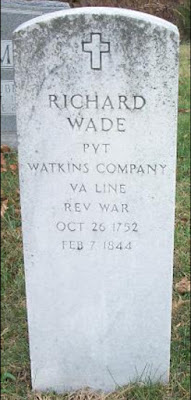
Richard Wade, A Local Man, Served Under Daniel Boone
In 1777 Richard Wade, who had already served one term as a revolutionary war soldier, re-enlisted in the Bedford County, Virginia militia to defend the frontier. Soon afterwards he was sent to Boonesboro, Kentucky to serve under Daniel Boone. When the fort ran low on salt, Boone took Richard and twenty-seven others to gather more at Blue Licks at Carlisle, where they were surrounded by Indians and taken to Detroit and sold to the English. Seven of the prisoners escaped and made their way back to the Ohio River only to be recaptured and taken back to Detroit and then on to Montreal, Canada. After two years in prison, Richard and a few others managed to escape. He made his way to Pittsburgh and then down the Ohio River to Boonesboro, where he stayed.
Richard helped bury the dead soldiers following the Battle of Blue Licks, in Robertson County, Kentucky, on August 19, 1782. A force of about 50 Loyalists al with 300 American Indians had ambushed and routed 182 Kentucky militiamen. Richard was up for court martial for refusing to fight, but was excused by General George Rogers Clark. It would be one of the last battles of the American Revolutionary War.
After the war ended, Richard remained at Boonesborough for several years. His son, John, was born there in 1781. His older son, Elisha, who had been born in Virginia, served with the Kentucky Militia and fought in the War of 1812. In 1801, Richard moved his family to a part of Wayne County that later became Clinton County. He died on February 7, 1844, at the age of 92, and is buried at Cartwright Cemetery with his wife and sons.
Following the war of 1812, Adam Vickery of Wayne County, who had been with Captain Micah Taul's company in the first northern campaign during the war, was appointed captain to lead a company of around 80 Wayne Countians to join Andrew Jackson at New Orleans. Included in the group were John and Elisha Wade. They reached New Orleans just four days before the battle on January 8, 1815. Even though they were outnumbered, the American forces defeated the British in slightly more than 30 minutes, suffering just 71 casualties, while the British suffered over 2,000, including the deaths of the commanding general and his second-in-command.
Check out Richard Wade and his sons, John and Elisha Wade, on Findagrave.com by clicking here.
Richard helped bury the dead soldiers following the Battle of Blue Licks, in Robertson County, Kentucky, on August 19, 1782. A force of about 50 Loyalists al with 300 American Indians had ambushed and routed 182 Kentucky militiamen. Richard was up for court martial for refusing to fight, but was excused by General George Rogers Clark. It would be one of the last battles of the American Revolutionary War.
After the war ended, Richard remained at Boonesborough for several years. His son, John, was born there in 1781. His older son, Elisha, who had been born in Virginia, served with the Kentucky Militia and fought in the War of 1812. In 1801, Richard moved his family to a part of Wayne County that later became Clinton County. He died on February 7, 1844, at the age of 92, and is buried at Cartwright Cemetery with his wife and sons.
Following the war of 1812, Adam Vickery of Wayne County, who had been with Captain Micah Taul's company in the first northern campaign during the war, was appointed captain to lead a company of around 80 Wayne Countians to join Andrew Jackson at New Orleans. Included in the group were John and Elisha Wade. They reached New Orleans just four days before the battle on January 8, 1815. Even though they were outnumbered, the American forces defeated the British in slightly more than 30 minutes, suffering just 71 casualties, while the British suffered over 2,000, including the deaths of the commanding general and his second-in-command.
Check out Richard Wade and his sons, John and Elisha Wade, on Findagrave.com by clicking here.
Thursday, April 29, 2021
Tecumseh's Great Earthquake Prediction
Prior to the War of 1812, white settlers were increasingly taking over Native American lands, cutting and clearing trees and building villages. The British capitalized on the resentment felt by many tribes. In an effort to get them to join their side, Shawnee leader, Chief Tecumseh, was given guns and ammo to fight the Americans. The chief then went a step further by travelling from tribe to tribe with his Tenskwatawa, known as 'The Prophet,' trying to unite the Indians into a fight against the white settlers.
He told the Red Stick Creeks that the Great Spirit was angry with their enemies. "He speaks in thunder, and the earth swallows up villages, and drinks up the Mississippi. The Great Spirit will sweep those who escape to the hills from the earth with his terrible breath, he said.”
Tecumseh said he would give them proof that the Great Spirit had sent him. "I leave Tuckabatchee (on the Tallapossa River in what is today Alabama) and shall go to Detroit. When I arrive there, I will stamp on the ground with my foot and shake down every house in Tuckabatchee.”
His message didn’t go over well. His audience was skeptical, but imagine their surprise when on December 16, 1811, exactly when he arrived in Detroit, that the first of three strong earthquakes shook the ground. The first one on December 16, 1811, produced a magnitude of 8.1 on the Richter scale; the second on January 23, 1812, registered 7.8; and the third on February 7, 1812, registered an 8.8 magnitude.The epicenter was around what is today, New Madrid, Missouri and were felt as far away as Boston, Massachusetts, where it is said that church bells rang on their own. The earthquakes altered the landscape so severely, that the Mississippi River momentarily reversed its direction. Two thousand aftershocks occurred in the months following. The earthquakes, also known as the New Madrid earthquakes, were the biggest in American history.
The Red Sticks thought that this was Tecumseh’s signal to start war, to unite in resisting the white intruders intent on claiming their lands, but perhaps there had been a large number of mild or moderate tremors in the region leading up to the earthquakes and, since native peoples are more in tune with nature, that Tecumseh merely knew which natural signs to look for.
Was the Great Comet of 1812 part of Tecumseh’s prediction of a great fire, estimated to have been almost fifty percent larger than the sun, coming across the sky? The earthquakes arriving almost in conjunction with the fiery comet rushing across the horizon must have struck fear into many native peoples hearts.
It was in the fall of the year when the call for volunteers went out at the outbreak of the War of 1812. The soldiers would march to Lake Erie to assist General William H. Harrison in a fight with British troops and their Indian allies, including the great Shawnee Chief, Tecumseh. On October 5, 1813, American forces crossed over into Canada where they fought and won the Battle of the Thames. Tecumseh was killed during the battle.
He told the Red Stick Creeks that the Great Spirit was angry with their enemies. "He speaks in thunder, and the earth swallows up villages, and drinks up the Mississippi. The Great Spirit will sweep those who escape to the hills from the earth with his terrible breath, he said.”
Tecumseh said he would give them proof that the Great Spirit had sent him. "I leave Tuckabatchee (on the Tallapossa River in what is today Alabama) and shall go to Detroit. When I arrive there, I will stamp on the ground with my foot and shake down every house in Tuckabatchee.”
His message didn’t go over well. His audience was skeptical, but imagine their surprise when on December 16, 1811, exactly when he arrived in Detroit, that the first of three strong earthquakes shook the ground. The first one on December 16, 1811, produced a magnitude of 8.1 on the Richter scale; the second on January 23, 1812, registered 7.8; and the third on February 7, 1812, registered an 8.8 magnitude.The epicenter was around what is today, New Madrid, Missouri and were felt as far away as Boston, Massachusetts, where it is said that church bells rang on their own. The earthquakes altered the landscape so severely, that the Mississippi River momentarily reversed its direction. Two thousand aftershocks occurred in the months following. The earthquakes, also known as the New Madrid earthquakes, were the biggest in American history.
The Red Sticks thought that this was Tecumseh’s signal to start war, to unite in resisting the white intruders intent on claiming their lands, but perhaps there had been a large number of mild or moderate tremors in the region leading up to the earthquakes and, since native peoples are more in tune with nature, that Tecumseh merely knew which natural signs to look for.
Was the Great Comet of 1812 part of Tecumseh’s prediction of a great fire, estimated to have been almost fifty percent larger than the sun, coming across the sky? The earthquakes arriving almost in conjunction with the fiery comet rushing across the horizon must have struck fear into many native peoples hearts.
It was in the fall of the year when the call for volunteers went out at the outbreak of the War of 1812. The soldiers would march to Lake Erie to assist General William H. Harrison in a fight with British troops and their Indian allies, including the great Shawnee Chief, Tecumseh. On October 5, 1813, American forces crossed over into Canada where they fought and won the Battle of the Thames. Tecumseh was killed during the battle.
Subscribe to:
Posts (Atom)
The Story of Reuben Coffey, an American Revolutionary War Soldier
In Augusta Phillips Johnson's book, "A Century of Wayne County Kentucky 1800-1900," originally published in 1939, she used W...
-
The Roanoke Colony was an enterprise financed and organized by Sir Walter Raleigh in the late 16th century to establish a permanent English ...
-
When I think of the 70's, I think of the greatest rock and roll music ever. It is now included in a music genre that is known today a...