Showing posts with label Texas. Show all posts

Thursday, February 9, 2023

Bible Mission School and Orphanage

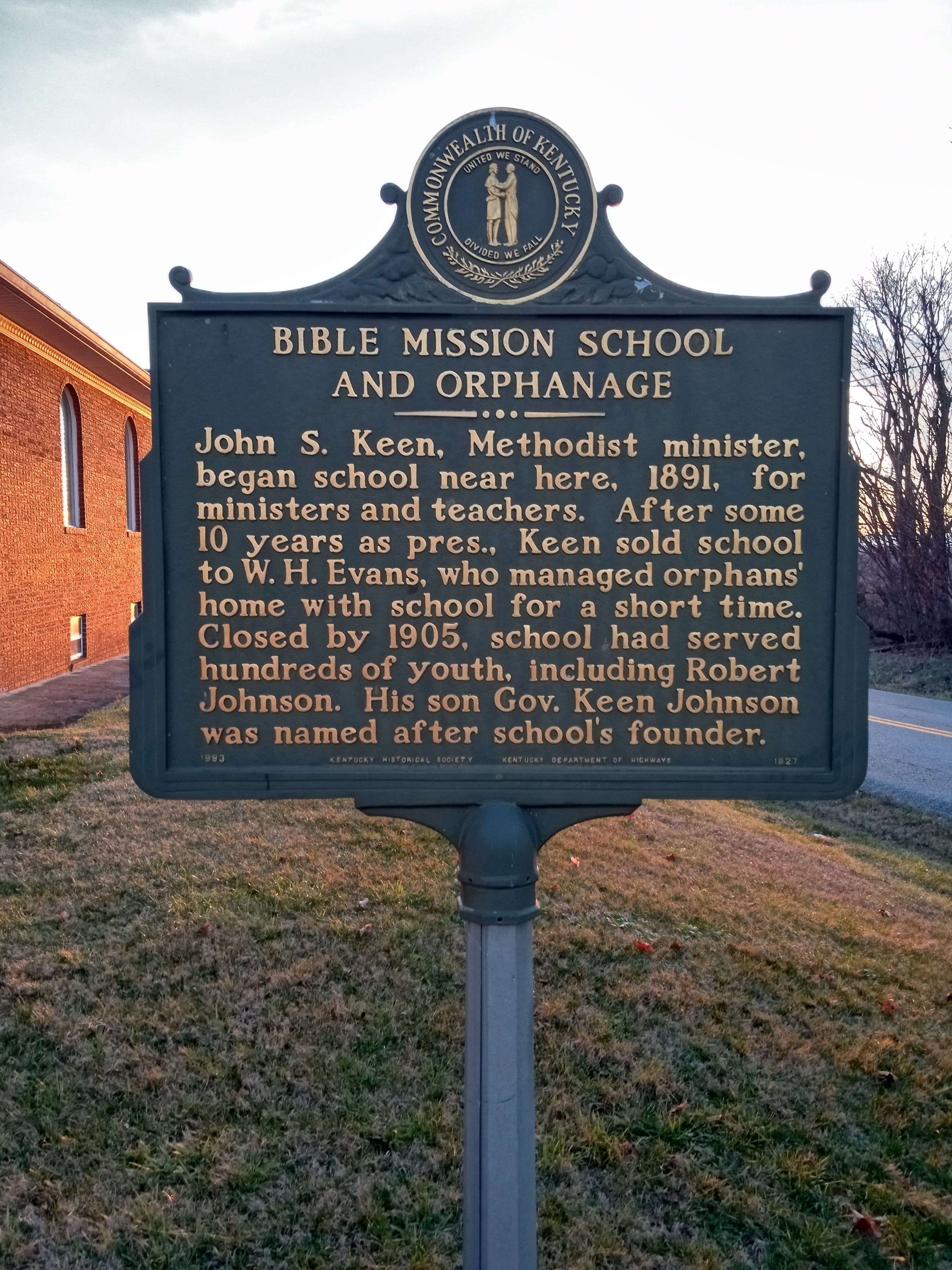
In a Kentucky Historical Society article for Explore KY History, author Tim Talbott, my cousin, wrote that Wayne County native John Samson Keen received the call to preach while a young man and by age twenty was riding a large circuit in southcentral Kentucky. A few years later he received the call to start a school and the place was in the Highway community of Clinton County.

John and Hannah Keen's school grew so much that in 1890, they saw the need for a better building and room for more students. Money was raised from all over the country and in 1894 there was a new and better building. From that point on, Bible Mission School grew at an even more rapid pace. Students were coming in from all over the United States. By comparison, according to Kentucky Public Documents, Vol. 4 of the Kentucky General Assembly, during the 1896-97 school year, Albany High School, now in its tenth year, had 154 students and three teachers, while Bible Mission School, in its third year in the new building, had 187 students and nine teachers.

Around 1900, John S. Keen turned the school over to W. H. Evans and became a minister in Texas. By 1904, Evans had also left for Texas after enrollment at Bible Mission School had started to decline, probably for two main reasons: a health epidemic and a new school that had opened in Columbia,

Bible Mission School closed in 1905, but it would later be celebrated because of a few things, including Dr. Alexander B. Mackey, president of Trevecca Nazarene University in Nashville, and Rev. Robert Johnson, whose son, Keen was Kentucky's forty-fifth governor, were students there.

In 1954, Eula Gamblin Mackey, whose husband, William Hunt Mackey, was a relative of Dr. Mackey, wrote in The New Era newspaper that when the U.S. had 45 states and five territories, each state and territory was represented at the school at Highway.

She also wrote that camp meetings were held each spring and fall in two tabernacles that were located on the grounds and that four or five thousand people attended with singing, praying and shouting taking place all over the school grounds. "People prayed through and were sanctified. Highway [community] was a holy place," she said.

Get this...when the Board of Regents met to decide the location for Lindsey Wilson Junior College, Highway lacked one vote getting it. One vote. "At the time," Mackey wrote, "Highway already had the buildings and Columbia had to build them." Go figure.

A marker erected at Highway Cemetery, submitted by John and Mareeda Gibson in 2006, signifies that location as the burial ground of 25 to 30 orphans who died during an epidemic [probably typhoid fever and/or Tuberculosis] at the orphanage at Highway in the late 1890's. It states that eight of the orphans died in one week and that no names have been found.

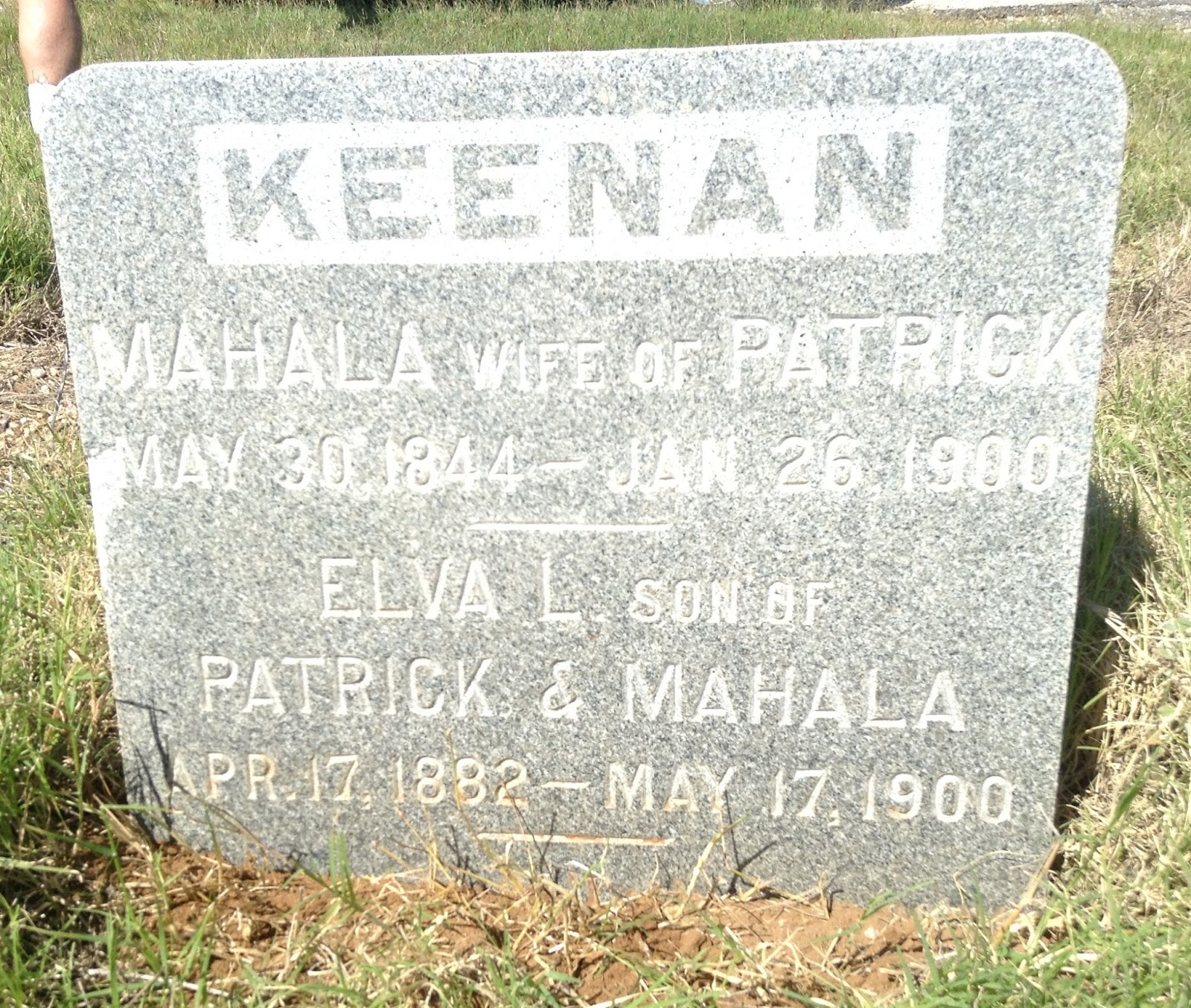
It is known that Mahala Reed Keenan, a revivalist minister who rode a white donkey side saddle through the hills of Kentucky, singing and preaching as she traveled, moved to Highway in 1896, wanting her sons to be educated there. But, she soon became sick with tuberculosis and needed a healthier place to live and breathe. In 1899, she and her son, Elva, who had the same illness, undertook a wagon journey to Floresville, Texas, but Mahala died shortly after her arrival there. Elva died four months later.

Historical Marker #1927 in the yard at Highway Church of the Nazarene tells about Bible Mission School and Orphanage that operated from 1891 to 1905 just past the church on Groce Gibson Road.

Tim Talbott's article

Wednesday, March 10, 2021

A Civil War Massacre in Overton County

The Officer family lived in a rural community in Overton County called Sinking Cane. William Alexander Officer, who had married a Cynthia Holford in that community in 1836, operated a sizable farm with pastures, timberland and a large two-story house. Today, the location is about two miles off Highway 84 on Rock Springs Road, near the foot of Monterey Mountain. The couple produced seven children — four girls and three boys — and dealt primarily in livestock. He favored the Confederacy.

William spent a lot of time driving livestock further into the South. Everyone knew he was away from home a lot and also was successful and financially sound. Therefore, given the ongoing war, the Officer family was subject to harassment by federals who came to the Officer home place and took what they wanted — a common practice on both sides of the conflict.

One of the Officer sons, John, had been born in 1845 and was thus a young man when the Civil War broke out. He enlisted as a private in the Confederate Army. In March 1864, during a period in which Tennessee was seeing a flurry of wartime skirmishes and guerrilla activity in rural areas, John had been granted a leave from Company F, 13th (Dibrell’s) Tennessee Cavalry Regiment to go visit his family. With him had come a handful of fellow Confederate soldiers who had become separated from their command.

He was home with his companions on March 12, 1864. His mother rose early, and with daughter Frances, set to work to make an especially good Saturday breakfast for John and their visitors. The young men were happily eating what was probably the best meal they’d had in weeks when a big band of federal soldiers, some 200 of them, part of Col. William B. Stokes’ command, rode up to the house.

The federals had been sent out by Stokes to hunt down Confederate guerrillas, particularly Champ Ferguson. Upon their arrival, John Officer jumped up in a panic and fled into another room, where a slave of the family, named Abraham, but usually called Uncle Abe, helped him up into a loft or attic area to hide.

The guns of the family’s visitors were not far away, stacked on one another in a hallway, but the federal band was a big one and there appeared to be nothing to gain by dashing to get the weapons to make a hopeless stand. Union troops entered the house and things went bad fast. Shooting began, killing on the spot five of the young Confederates: John P. York, Oliver Shipp, Samuel Garrett, William Slaughter and William Lipscomb.

Slaughter served in Company C, 1st Regiment Texas Rangers. York, Shipp and Garrett were part of the 8th Texas Calvary and Lipscomb was in the 3rd Regiment, Alabama Cavalry. A sixth Confederate there was 2nd Lt. Robert S. Davis, also of the 8th Texas. Davis was wounded but did not die inside the house, as his companions had. The federals hustled the wounded man outside and put him against a gatepost, tying him in place. There he was executed by a hastily formed firing squad (That gatepost is on display in the Overton County Museum).

In 1922, Uncle Abe gave an eyewitness account of the incident before the Tennessee Historical Commission. According to his testimony, Davis spoke to his killers before they shot him, saying, “You ought not do this. I have never done anything but my sworn duty.” Abe also noted that Davis never flinched when the federal soldiers fired and took his life.

The six massacred soldiers are buried at Officer Cemetery, located near the home. This event is referred to locally as the Stokes Atrocity. A state historical marker, describing the event, is posted on the main street in Monterey.

*Written by Cameron Judd, The Greenville Sun (Mar 2, 2019): "A Civil War Massacre At A Place Called Sinking Cane."


Wednesday, June 10, 2020

J.H. McKinley was Bozo Texino


Pleasanton City Cemetery in Atascosa County, Texas is where Clinton County, Kentucky native J.H. McKinley lies buried. Born at Cartwright on March 25, 1893, he was an early-20th-century train man who was also a railroad car graffiti artist, someone who marked up freight cars with pictures and messages in text.

For a long time the identity of Bozo Texino remained at least semi-anonymous. The mythical character McKinley created began leaving his hobo chalk-drawn graffiti/artwork on the sides of boxcars from Maine to California as early as 1919. In the photo you can see his graphic signature and the simple bust of a pipe-smoking character in a peaked hat with an infinity-shaped brim. In 1939, he told a reporter he had adorned a quarter-million or so boxcars since bringing Bozo Texino.

James Herbert McKinley worked for Missouri Pacific, first as a fireman then later as a locomotive engineer. He was known to sometimes wear a checkered shirt, a bow-tie and a derby hat with his denim railroad overalls and is remembered by his peers as one of the wildest engineers who ever worked for Missouri-Pacific.

As I mentioned, Bozo Texino's identity wasn’t exactly a secret. For more than 25 years he wrote a humor column called “Bozo Texino Sez” for Missouri-Pacific magazine and occasionally would write a piece in Albany's New Era newspaper.

"When I was a teenager," he wrote in 1953, "and used to climb the steep grade from the foot of the 76 Falls, I didn't know that some day I'd go to the top of the falls in a boat. When I used to swiim in the 7-foot swimming hole on Ind­ian Creek I didn't know that some day it would be a 77-foot swimming hole. No one could have ever made me believe that some day I'd catch a fish 100-foot above Aunt Ann Ellen Grider's chimney.

Born March 25, 1893, McKinley left Clinton County when he was barely 17 and moved to San Antonio. In 1914 he was hired to work on the San Antonio, Uvaloe and Gulf Railroad, then two years later on the IGN. Both of those railroad companies were eventually bought by Missouri-Pacific. McKinley was promoted to engineer in 1928, but it was his penchant for humor that made him well known and admired through­out that part of the country.

"I remember when very few people trusted a bank and buried their money under the hearth in front of an open fire­place or under a haystack," he wrote in 1954. "Ev­erybody trusted and loved one another and nobody would tell a lie until they started trading coon dogs."

James Herbert McKinley was the son of Charles Ellis and Rachel Neathery McKinkey. He died in Pleasanton, Texas, just outside San Antonio, on February 26, 1967. Several of his relatives live in Clinton County.

Saturday, October 27, 2018

The Cheyenne Social Club


The Cheyenne Social Club is a 1970 western comedy film directed and produced by Gene Kelly and starring James Stewart, Henry Fonda, Shirley Jones and Sue Ane Langdon. Set in 1867, it's about an aging cowboy, John O'Hanlan who inherits a brothel and decides to turn it into a respectable boarding house, against the wishes of both the townspeople and the ladies working there.

O'Hanlan (Stewart) and Harley Sullivan (Fonda) leave their jobs working on open cattle ranges in Texas to make the 1,000 mile trek to Cheyenne. Along the way, they engage in quite an interesting conversation, except it's Sullivan who does most of the talking.

Harley Sullivan: "I remember when I was about twelve years old. My daddy asked me, he says, 'What do you want to be when you grow up, Little Harley?' And like a fool, I said a cowboy. I've been making wrong moves ever since."

Harley Sullivan: "Did I ever tell ya how my Uncle Charlie got stoved up?"
John O'Hanlan: "No, Harley."
Harley Sullivan: "His home set right out in the prarie. One day he went in the outhouse and got caught right in the middle of a stampede. When he went in there wasn't a cow in sight. A few minutes late 365 longhorns ran over him. Broke him up something terrrible. That was nineteen years ago and he's still constipated."

John O'Hanlan: "Harley, did you ever get married?"
Harley Sullivan: "Yes, John, I did."
John O'Hanlan: "Well, I never knew it."
Harley Sullivan: "Well, John, it ain't something I like to talk about, but I was married once. And once is enough for any man. You can't smoke, chew, dip, drink, scratch in the parlor, or cuss. When you leave the house, they ask you where'd you go. And when you come home, they ask you where have you been. And right now with you, it is just like when I was married."
John O'Hanlan: "Why, how is that, Harley?"
Harley Sullivan: "Well, John, when a woman's talking to you, you can be pretty sure that she thinks she's in control. And when she's not talking to you, you can be pretty certain you're in control. Take Helen. She had flame red hair, pitch black eyes, ruby lips and no teeth - but talk about a body! She could straddle two horses at the same time. I went with her until I found out she dipped snuff. There's something awful unfemale about a snuff dipper - don't you think so, John?"

John O'Hanlan: "Harley, I want you to do me a favor. Don't ever tell anyone here in Cheyenne I voted Democratic. You'll do that for me, won't you?"
Harley Sullivan: "If you say so."
John O'Hanlan: "Thank you."
Harley Sullivan: "John, you don't mind if I still vote Democratic, do you?"
John O'Hanlan: "Just so long as you're not seen with me when you do it. Be bad for business."

John O'Hanlan: "What are you lookin' at?"
Harley Sullivan: "You."
John O'Hanlan: "Why?"
Harley Sullivan: "I don't know. You look different some how."
John O'Hanlan: "What do you mean different?"
Harley Sullivan: "John, its kind of hard for me to put my finger on."
John O'Hanlan: "Well, try Harley. Use 'em all."

Harley Sullivan: "Hank Jameson had fourteen brothers and sisters. She only had three toes on her left foot. I remember one day..."
John O'Hanlan: "Harley, who only had three toes on her left foot?
Harley Sullivan: "Hank's sister, Cora B. Cora B. Jameson was her name. Folks used to pay her to take her shoe off."

Harley Sullivan: You just ain't the man you was yesterday. At least ways not from where I stand."
John O'Hanlan: "Well, maybe you're not standin' in the right place Harley! What do you mean I'm not the man today I was yesterday?"
Harley Sullivan: "Just, like you lost yourself when you took a bath!"

Fonda drones on and on as the pair travel across the vast Western landscape, about his family and dogs and heaven knows what all else. Finally...

John O'Hanlan: “You know where we are now, Harley?”
Harley Sullivan: “Not exactly.”
John O'Hanlan: “We’re in the Wyoming Territory and you’ve been talkin’ all the way from Texas.”
Harley Sullivan: “Just been keepin’ you company.”
John O'Hanlan: “I appreciate it, Harley, but if you say another word the rest of the day I’m gonna kill you.”

Tuesday, March 20, 2018

U.S. Rexroat

One early newspaper publisher/editor was a man by the name of Ulysses Sampson Rexroat. U.S. was born in 1869, probably in Russell County, to Sampson and Susan Absher Rexroat. His grandfather was Bro. William Rexroat, a popular Baptist preacher. It is unclear when the family moved to Chapman, Kansas, but when he died, Sampson Rexroat was, according to newspapers, one of oldest settlers in Chapman, which was settled in 1868.

It is also not clear when U.S. moved back to Kentucky, but he married Lula Walker of Columbia in 1892. Their only child, a son, Walker Brice, was born in 1893. Lula likely died either in childbirth or shortly thereafter as Walker Brice was reared by her parents and took their surname.

In 1897, U.S. was the editor of The Liberty Tribune in Liberty, Kentucky. He was also the secretary of the Liberty Fair in 1897. He apparently moved to Russell Springs the following year, because he was listed as a stockholder when the Russell Springs Fair Association was chartered in 1898. He was the groups first Secretary. In 1902, he started a newspaper in Russell Springs known as Kentucky Mountaineer.

March 4, 1903 -- (The Adair County News) "The Journal is the name of the new paper just started in Albany. Mr. U.S. Rexroat is its editor and publisher. Clinton County has a republican majority of about 500, but the editor of the journal states that his paper will be non-political. This announcement leads us to conclude that the readers of Clinton County are Democrats. We hope Mr. Rexroat will give them digestible material and that his venture will meet with success."

Ulysses Stewart Rexroat was born in Russell County in 1869, the first-born child of Sampson Rexroat and his second wife, Susan Absher Rexroat. So, i suppose being a native Russell countian allowed him to publish this commentary in his paper:

March 25, 1903 -- The Adair County News "Running a newspaper is just like shooting fish. All that is necessary is knowing how. The editor of the Albany Journal perhaps did not have on his studying cap when he wrote and published the following: Attorney O.B. Bertram went to Jamestown, Ky. last Sunday where he thinks of locating for the practice of his profession. May the Lord have mercy upon him. We've been there."

Ulysses was listed as a stockholder when the Russell Springs Fair Association was chartered in 1898 and served as its first Secretary. Two months after starting up his newspaper business in Albany, it was discovered that papers weren't the only thing being sold at the concession stand.

May 13, 1903 -- The Adair County News "U.S. Rexroat, who is the editor of the Albany Journal, was arrested last week, charged with selling liquor."

This was the second time Rexroat had been in the clutches of the law, charged with the same offense. En route to Columbia, he gave the police officer the slip and escaped. Learning he was at Russell Springs, Deputy United States Marshall R.E. McCandless and Commissioner F.R. Winfrey, went there and, just as the Commissioner entered the Springs Hotel and inquired about him, Rexroat made his escape out the back way. The Marshall was stationed out back and after a chase of 300 yards and firing at him several times, Rexroat was apprehended.

June 3, 1903 -- The Adair County News "U.S. Rexroat, who is charged with retailing liquor, was arrested at Russell Springs Wednesday night and brought to Columbia and lodged in jail. Thursday afternoon he was tried and held over, his bond being fixed at $200. The prisoner not being prepared to execute bond, the officer immediately started with him to Louisville."

Immediately after his run-in with the law, U.S. left Kentucky and moved out West. He moved around a lot, from job to job, living Arkansas, Kansas, Missouri, Oklahoma and Texas, generally working in the printing trade, oft times as a newspaper editor. But, the newspaper business wasn't Rexroat's only vocation. In between all of those jobs, he also worked in the cafe and grocery business, conducted a ranch and supply store in South Dakota, worked on a wheat farm in Kansas and worked nearly two years at the 1904 World's Fair in St. Louis.

In September of 1905, he married Maud Gravette in Bentonville, Arkansas. In 1915, he married Clara Peck, a native American of South Dakota. They had three daughters. In 1920, they were living in Strike Axe, Oklahoma, and in 1930, in Wynona City, Oklahoma. 

Here are the known newspapers where Rexroat was employed:

1897: The Liberty Tribune - Liberty, Kentucky
1902: Kentucky Mountaineer - R. Springs, Kentucky
1903: Albany Journal - Albany, Ky.
1910: Gravette News Herald - Gravette, Arkansas
1912: Elsmore Leader - Elsmore, Kansas
1913: Interior Journal - Tina, Missouri
1914: The Simpson News - Simpson Kansas
1916: The Advocate - Lakin, Kansas
1917: The Argonia Argosy - Argonia, Kansas
1918: The Rolla News - Rolla, Kansas
1921: The Hustler - Apperson, Okla.

Rexroat fell victim to life's circumstances at the start of the 1930's, as he explained in a letter to the Amarillo Globe-Times on March 9, 1931while living in Perryton, Texas:

"I am just another unfortunate person appealing to you for whatever assistance you may grant through your column of your highly esteemed newspaper. Circumstances over which i had no control have forced me into an unenviable position. I have been out of steady employment for a year, although i have sought work assiduously during that time...an investment with a stock company, daily paper at Seminole, Oklahoma, boom oil town, broke me and the slump in oil, with its attendant depression, "nailed me to the cross," as it were, and I have been trying in vain to find some kind of permanent job in order to keep my three little girls in school...I would appreciate any other work that will enable me to help myself and family."

In late 1940 or early 1941, U.S. became ill and was brought back to Kentucky. He died on February 18, 1941 at the Central State psychiatric facility in Louisville. His death drew no notice in the Russell County News, but the February 26, 1941 edition of the Adair County News carried a brief obituary, which said services were held at the Christian Church in Russell Springs. Burial was at Rexroat Cemetery in Russell County.


Monday, November 6, 2017

Mahala Reed Keenan: The Revivalist


Mahala Reed Keenan was born on May 30, 1844 in Shelby County, Indiana, the daughter of John Overpeck and Elizabeth Ann Rouse Reed. She died on Jan. 26, 1900 and is buried at Keenan Cemetery near Floresville, Texas, 13 miles southwest of where Sunday's (11/5/17) shooting occured at the First Baptist Church in Sutherland, Texas. Where Mahala is buried contains only one grave marker, a very tall marble stone, that signifies the graves of Mahala and her son, Elva. A biblical inscription on the front of the stone reads: "Whatsoever ye shall ask in my name, that will I do. John 14, 13." Mahala, Elva and a few others had undertaken a wagon journey from Kentucky to Texas in 1899 as Mahala sought a healthier place to live and breathe as she was suffering from tuberculosis at the time. But, shortly after her arrival there in 1900, she succumbed to tuberculosis. Elva, who also died from tuberculosis, was buried in the same grave as was his mother.

Mahala was known as a "revivalist" minister. Until she had a church, she preached anywhere that a group could be assembled, mostly to share croppers or poor whites. She was known to ride a white donkey side saddle through the hills of Kentucky singing as she traveled. Her mother died when she was three years old. She traveled to Clay County, Illinois with her father where she eventually met and married Patrick Keenan (1822-1896). They returned to his home near Falls of Rough, Kentucky where, in 1887, they and others built and founded Keenan Chapel at Hickory Lick in Breckinridge County. Patrick died in 1896, and later that year, Mahala moved to the Highway community in Clinton County, Kentucky. Mahala was extremely devoted to Methodism and at Highway, Methodist minister John Samson Keen had organized Bible Mission School and Orphanage, a Methodist academy for young boys that had begun in 1891, and Mahala wanted her sons to be educated there. But, Mahala's health had been poor for several years and she needed warmth to assist her in her recovery. So, in 1899, Mahala, her son and the others headed to Floresville, Texas, which was known to have a number of well respected Methodist ministers living there.

The story goes that when Highway was to be formally organized as a township, the place had no name assigned to it. The preacher at the ceremony said that he would open his Bible and point to a verse and the landing point of his finger would become the name of the community, thus Highway became the name. Which verse was it that the preacher pointed to? That wasn't mentioned in the account of Mahala Keenan, but there are several verses in the bible that mention "highway" or "highways," including Luke 14:23, which says "And the lord said unto the servant, Go out into the highways and hedges, and compel them to come in, that my house may be filled" and Isaiah 35:8, which says, "And an highway shall be there, and a way, and it shall be called The way of holiness; the unclean shall not pass over it; but it shall be for those: the wayfaring men, though fools, shall not err therein."

Sunday, July 31, 2016

Remembering Gentleman Jim Reeves

Country music's Jim Reeves was killed in an airplane crash on July 31, 1964.


August 4, 1964
Panola Watchman, Carthage, Texas)

REEVES DIES IN AIR CRASH By James Smith

"The body of Travis (Jim) Reeves returned to Panola County Tuesday afternoon just before dusk, to be buried in a site that will become a memorial. The site is a two-acre plot located one-half miles east of Carthage on the south side of U.S. Highway 79 near the Liberty Chapel Baptist Church.Double funeral services were held for the well-known country music singer from Panola County and his companion, Dean Manuel at 2 p.m. Tuesday in Nashville, Tennessee.The two men were found dead in the wreckage of a private single engine plane 10 miles south of Nashville. Manuel was Reeves’ piano player and road manager and they were returning to their homes in Nashville from a business trip to Batesville, Arkansas.In an interview with Ray Baker, manager for Reeves, he told the Watchman of the accident as near as possible. The plane in which they were flying was rented from a Nashville airport and piloted by Reeves. He frequently flew on business trips and was a good pilot, related Baker. Less than ten minutes from their destination, Reeves radioed to the airport that they were flying in an extremely heavy thunder and rainstorm. The airport control tower later checked with Reeves—asking if he had passed through the storm. The answer was negative. Further attempts were made to contact the Reeves flight by radio—and all proved negative.The plane was reported down at 5 p.m. Friday, July 31. The light aircraft crashed in a wooded area about 100 feet behind a house just off U.S. Highway 31. A Tennessee highway patrolman reported that residents of the house were away at the time of the crash.More than 700 volunteer searchers, Civil Defense workers and police combed a 20-square-mile area for two days. Many of the searchers were Reeves’ friends and associates in the country music business. They included guitarist Chet Atkins and singer Eddy Arnold, Stonewall Jackson and Ernest Tubb.Marty Robins, a close friend of Reeves and also an entertainer, lived within a short distance of where the plane crashed and heard the roar of an airplane engine Friday evening and then a loud thud…as if it had plunged into the ground. When he heard of the accident and searching operations, he notified authorities of what he heard and informed them the direction in which he thought the wreckage might be located.The wreckage was located at 1 p.m. Sunday and the engine of the plane was partly buried and it was reported by Tennessee highway patrolmen that it looked as if someone had gone out and dumped some debris and trash. Reeves’ body was identified from a driver’s license taken from the wreckage.The governor of Tennessee, Frank Clements was a personal friend of Jim Reeves and provided a four-engine U.S. Air Force Strato-Cruiser plane from the National Guard to transport his body, family and associates from Nashville to Shreveport. Hawthorn Funeral Home ambulance transferred the body from Shreveport to Carthage Tuesday evening.Baker said that Reeves had experienced a phenomenal growth in popularity in the United States and Europe during the past ten years. Several polls had recently been taken in England, Holland and other European countries that placed Jim Reeves as the number one favorite singer of country music. The big friendly smile and rich baritone voice of Jim Reeves will be a memory in the hearts of several million people for a long time. Panola County will always cherish his memory as one of her finest gentlemen."


August 6, 1964
Shreveport Times, Shreveport, LA)

HUNDREDS ATTEND FUNERAL SERVICE HELD IN ETEX FOR JIM REEVES by Tommy Yates

"CARTHAGE, TEX -- Country music singer Jim Reeves was returned to the red hills of his permanent home yesterday and the velvet-voiced singer drew his last packed house as some of the greats and near greats of the hillbilly field wiped tears from their eyes. Silent hundreds filed past his casket in the Hawthorn Funeral Home of Carthage all morning prior to the 3 p.m. funeral services for the singer who was killed last Friday in an airplane crash near Nashville, Tenn.Burial was in a private cemetery near Carthage where the 39-year-old singer once roamed the red hills of East Texas. The grave and memorial site is located just off the highway between Carthage and Shreveport.Gentleman Jim’s friends from throughout Texas and the musical world were here for the services and burial of the farm boy who sang and strummed his way to the top of the nation’s country and popular record lists in 11 tuneful years.The 400-seat Central Baptist Church, extra rooms and hallways were filled for the services. Extra chairs were placed in the aisles and halls, and those who could not find seats stood in the rear of the auditorium or outside the building.The estimated audience of 800 was silent throughout the 20-minute service. No songs were sung and only two organ selections were played: “The Old Rugged Cross,” and “What a Friend We Have in Jesus.”The casket was surrounded by huge floral wreaths, one shaped like a harp, another like a guitar, one like a baseball and several like a musical note.Another wreath made of orchid asters and orchid doty mums was placed behind the casket in memory of his 1942 graduation class at Carthage High School. A color photograph of the smooth-voiced singer rested at the head of the casket, which was covered with yellow carnations and bronze mums.Dr. V. L. McKee, pastor of the church, paid tribute to the sophisticated styled country singer, who picked up the nickname of “Gentleman Jim” as a boy.Dr. McKee said, “His good name did not begin with his fame. It began when he was a small boy growing up here in this community…. He was a gentleman as a boy and a gentleman as a man. That is about as fine a tribute that could be paid to any citizen.”His nickname followed him throughout his career because, “He always had a minute to stop and talk,” said Bill Deaton of San Antonio, who handled Reeves’ engagements in Texas.Deaton was among hundreds of Reeves’ business associates and relatives who attended the services.Reeves’ widow, whom he has been married to for 16 years was present along with his brothers and sisters. The Reeves had no children. Reeves’ mother of DeBerry was not able to attend because of illness.Also present was Dick O’Shoughnessy, one of the supporting stars in Jim’s hit movie, “Kimberly Jim” which was recently filmed in South Africa and scheduled to be released soon.Other musicians present were Dewey Groom of Dallas, Ed McLemore of the Big D Jamboree, Horace Logan, who was in charge of the Louisiana Hayride when Jim first rose to fame, Bobby Garrett, a former member of Reeves’ band, Ray Baker, his business manager, and Cindy Walker, who wrote many of Jim’s songs.Reeves’ popularity was not limited to the United States. His song, “I Love You Because,” currently ranked in the top five songs in Scandinavian countries and Ireland. His songs have made the top of the hit list for the past five years in South Africa, where he learned to sing to the people in their own language.Considered a standout as far as an individual is concerned to those close to him, Reeves and his wife were recently in San Antonio looking for a ranch to buy. He flew to San Antonio in the same plane in which he died only days later.


*from johnrexreeves.com

Monday, November 30, 2015

John Mulkey Reneau (1844-1910)

"Bear up all you can, the hardest stroke falls to me..." John Mulkey Reneau was born in Clinton County, KY on June 25, 1844. The son of Rev. Isaac Tipton Reneau, John married Eleanor Ann "Nelly" Means, daughter of my 3rd great-grandparents, Azel and Susan Wright Means, on January 10, 1867.

Nelly had been born a week after John, on July 2, 1844. To them were born 3 children: Alice, born in 1867, Susan, born in 1869 and Azel Tipton, born in 1871. On August 18, 1873, Nelly died giving birth to twins. Both babies died two days later.

A few hours after his wife's death, John wrote the following to his father:

"Dearest Father:
It falls to my lot to record to you the death of my loving companion and your affectionate daughter, Nelly. She died about sunrise this morning, praising her God and maker. She was not delivered. She flooded to death. I would be proud if you could be here, but you could not get here in time, and I thought you would not wish to be gone so long and know nothing about it. Bear up all you can, the hardest stroke falls to me, my little motherless babes, for whom I crave your earnest prayers.

Your bereaved son,
John Mulkey"


Of their children, Alice never married. In 1920, at age 47, she was living in Union County, New Mexico with her brother, Azel. Susan married Dr. Richard Claborn of Clinton County in 1890. They moved to Knox County, Texas.

Eleven months after Nelly's death, John married Mary Dillon Mullins of Fentress County. They had seven children:

Elmore (1875-1940), Thomas (1877-1947), John (1879-1954), James (1882-1960), Margaret (1885-1889), Elizabeth (1888-1889) and William (1890-1951). Most of them moved to areas in and around Texas.

John Mulkey Reneau servd two terms as Surveyor of Clinton County.

On April 6, 1910, at age 65, John Mulkey Reneau died at his home in the Huntersville community after an illness of just three weeks. Mary died four months later.

(John Mulkey's sister, Mariba, is the great, great grandmother of actor Johnny Depp, who was born in Owensboro, Ky in 1963.)

Monday, July 20, 2015

Goebel Reeves: The Texas Drifter


Goebel Reeves was an early American folk singer whose most famous song was "Hobo's Lullaby," which has been covered by a variety of singers, most notably, Woody Guthrie. A 2016 article in the Los Angeles Times said the song is "one of the most disarmingly endearing train songs ever written", and is "inextricably linked with American folk music icon Woody Guthrie." Other notables who recorded the song were Woody's son, Arlo, Pete Seeger and later, David Carradine and Emmylou Harris.

"Go to sleep you weary hobo
Let the towns drift slowly by
Listen to the steel rails hummin'
That's the hobo's lullaby"

Goebel's father, Icil Burchett Reeves, better known as Ice, was born in Clinton County in 1861. His father's first wife, Anna Wright, is buried in the Old Clear Fork Church Cemetery. His grandfather, Edward, died in Clinton County in 1841 and is buried beside his wife at Griffin-Lee Cemetery in the Lee's Chapel area. Geobal's maternal grandfather was Icil Burchett of Cartwright, who was killed by guerillas during the Civil War in 1862. He and his wife, Elizabeth, are buried at Icil Burchett Cemetery at Cartwright.

Goebel's mother, Alice, was a talented musician, who taught both piano and singing. Ice, his father, once a salesman, was elected to the Texas State Legislature, and son Goebel worked there as a page. When the family relocated to Austin, Geobal met a homeless man who made such an impression on the boy and Reeves became fascinated with the “hobo” lifestyle. While spending time around some of these homeless men, he met vaudeville artist Al Wilson who taught him how to yodel. Soon, Goebel moved on from piano and trumpet and began playing guitar and writing and singing cowboy songs. Many of his songs were autobiographical, drawn from his life as a hobo. After going through marriage and divorce in the 1930's, many of his songs recounted stories of loneliness and lack of family life.

Born in Sherman, Texas on Oct. 9, 1899, Goebel enlisted in the United States Army in 1917, where he served as a bugler. He was wounded on the front lines in Europe and, upon returning home, began living the hobo lifestyle that would earn him the nickname the “Texas Drifter." He made his living on street corners singing songs about traveling as a vagabond.

Did the son of a Clinton County, Kentucky Man teach the Father of Country Music how to yodel?

He travelled to Italy as a merchant seaman in the mid-1920s and toured Europe. When he arrived in Galveston in 1929 he heard a Jimmie Rodgers record playing in a store. His musical style resembled that of Rodgers, including his yodeling and his lyrics about life on the road. Now, Goebel was known to make up stories, but some proved to be true. His claim that he had taught Rodgers how to yodel as they traveled together in the 1920s was never disproved. Regardless of whether or not his stories were true or invented, they made him a popular entertainer.

Making records seemed like a good idea, so he swung up on the next fast freight for New York practicing yodels in the boxcar straw. Reeves walked into Long Island recording studio of the Gennett Record Company and told manager George Keats that he was an important recording artist from Texas.

Soon, his recordings began appearing on numerous labels, like Gennett, OKeh, Gennett, Challenge, Conqueror, Vocalion, Oriole, Banner and Perfect, and in the UK and Ireland on Panachord and Irish Rex, thirty-five recordings in all, mixing together yodeling, comedic pieces, romantic ballads and insightful hobo commentaries. He was known to go by other names on a few of his recordings. Names like George Riley (The Yodeling Rustler), The Texas Drifter and Bert Knowles. In New York he played on network radio as the Singing Bum. Reeves wrote most of his songs. Many were autobiographical, drawn from his life as a hobo. Married and divorced in the mid 1930's, many of his later songs recounted stories of loneliness and lack of family life.

He had one movie role; in the 1937 Western film, "The Silver Trail," playing a singer named Hank in an uncredited role, but after WWII, he began living as a recluse in Bell Gardens, a small suburb in Los Angeles and rarely ever performed in public. He died in Long Beach on January 26, 1959. It can be said that the Texas Drifter, Global Reeves, made an important contribution to country music. His style influenced many artists. A sampling of his recordings can be found on the third of a four-CD set released in 2005, entitled "Sounds Like Jimmie Rodgers," on which Reeves sings 19 songs. A 1994 release, entitled "Hobo's Lullaby," has Reeves singing 26 tracks.

DISCOGRAPHY

OKeh (1929-30)
45365 The Drifter, pt. 1 / The Drifter, pt. 2 - 08-29

45381 I Learned About Women From Her / Tramp's Mother - 10-29

45408 Blue Undertakers Blues / When The Clock Struck - 02-30

45427 My Mountain Gal / Blue Undertaker Blues, pt.2 - 05-30 as by Bert Knowles

45449 Fortunes Galore / Texas Drifter's Warning - 08-30

45491 In The Land Of The Never Was / Song Of The Sea - 11-30

Gennett-Champion (1930)
CH-16139 The Hobo's Grave / At The End Of The Hobo Trail – 30 as by Texas Drifter

CH-16189 Station H.O.B.O. / The Hobo's Last Letter – 31 as by Texas Drifter

CH-45194 I Learned About Women From Her / The Hobo's Last Letter - 36 (released on Champion)

ARC (1931)
- Romeo -
5023 Texas Drifter's Warning / The Tramps's Mother – 02-31 as by George Riley (also Oriole 8023, Perfect 12653)

5032 The Grave By The Whispering Pine / The Railroad Bum - 03-31 as by George Riley (also Oriole 8032, Banner 32098, Regal 10304)

5037 The Last Letter / The Cowboy's Dream - 03-31 as by George Riley (also Oriole 8037, Banner 32099, Regal 10305)

539 Hobo's Last Letter / Station Hobo - 04-31 (released on Brunswick)

5051 My Mississippi Home / At The End If The Hobo Trail – 05-31as by George Riley (also Oriole 8051, Banner 32131, Perfect 12694, Regal 10309)

M12214 Little Joe The Wrangler / The Cowboy's Dream – 31 (released on Melotone)

Decca (1934)
5020 Reckless Tex / Yodeling Teacher - 09-34

5021 Cowboy's Lullabye / Meet Me At The Crossroads - 09-34

45181 The Drifter's Lady / Hobo's Lullaby - 36 (released on Champion)

- Panachord (UK) -
25768 The Wayward Son / Reckless Tex

25848 The Drifter’s Buddy / The Cowboy’s Prayer

25991 The Soldier‘s Return / Miss Jackson Tennessee

26018 My Mountain Girl / Cold And Hungry

26042 Meet Me At The Crossroads / Yodeling Teacher

ARC (1934)
- Vocalion -
02806 Hobo And The Cop / The Cowboy's Lullaby - 10-34

02828 Hobo's Lullaby / Cowboy's Prayer - 11-34

- Melotone -
M13276 The Big Rock Candy Mountain / The Cowboy's Dizzy Sweetheart - 02-35 (also on Banner 33309, Romeo 5415, Oriole 8415, Perfect 13099)

M13369 Reckless Tex From Texas / Where The Mississippi Washes – 03-35 (also on Banner 33402,Romeo 5454, Oriole 8454, Perfect 13132)

M350911 The Wandering Boy / It's True I'm Just A Convict – 09-35

- Conquerer -
8442 Cold And Hungry / The Hobo's Prayer - 02-35

8443 Reckless Tex From Texas / The Bar None Ranch - 02-35

8470 The Cowboy's Dizzy Sweetheart / The Big Rock Candy Mountain - 04-35 (reissue of 13276)

8517 Where The Mississippi Washes / Reckless Tex From Texas - 06-35 (reissue of 13369)

8565 The Wandering Boy / It's True I'm Just A Convict - 09-35
The Story of Reuben Coffey, an American Revolutionary War Soldier

In Augusta Phillips Johnson's book, "A Century of Wayne County Kentucky 1800-1900," originally published in 1939, she used W...