Showing posts with label Civil War. Show all posts

Saturday, March 29, 2025

How Firm a Foundation

An original verse in "How Firm a Foundation," goes like this...

"In ev’ry condition, in sickness, in health, in poverty’s vale or abounding in wealth, at home or abroad, on the land, on the sea, as thy days may demand shall thy strength ever be."

Originally published in London, England in 1787, the hymn first appeared in America in 1832, and became much loved and adored. It is good to know that in today's world, no matter the circumstance, no matter where we find ourselves, we can rely on God to provide us with a firm foundation to keep us calm and encouraged. God's love for us is rich and pure, measureless, strong and enduring. The hymn assures believers that God's strength will always be sufficient, regardless of their circumstances.

During the Civil War, both sides could be heard singing it, a testament to how God bridges the gap between all men with a calming realization that the foundation of God is our refuge. Andrew Jackson requested it be sung at his deathbed, and Robert E. Lee and Theodore Roosevelt both requested it be sung at their funerals.

In 1898, during the Spanish-American war, tensions between the North and the South were still high. A divided American army. needed to put aside differences to face a new conflict, but that was easier said than done, and then on Christmas eve of 1898 a sentinel’s call rang out, “twelve o’clock, and all’s well!” It was Christmas morning. With thoughts of home on his mind, suddenly there arose the sound of an old, familiar hymn, ringing out along those moonlit fields: ‘How firm a foundation, ye saints of the Lord!’ One voice, then another and soon another, and another, and in a moment a whole American army corps was singing:

"Fear not, I am with thee, O be not dismayed; For I am thy God, and will still give thee aid; I’ll strengthen thee, help thee and cause thee to stand, Upheld by My righteous, omnipotent hand."

With lyrics like "In ev'ry condition, in sickness, in health, in poverty's vale or abounding in wealth, at home or abroad, on the land, on the sea" believers are assured that God's strength will always be sufficient, regardless of their circumstances. The promise of God's strength applies to all situations, both good and bad. What an amazing comfort.

For 223 years, our church has been a source of strength and comfort for its members; a place for fellowship, spiritual nourishment and support; providing a sense of belonging, connection and opportunities for spiritual growth, prayer and learning about faith; offering comfort and direction during difficult times. We praise God for that.

Wednesday, November 8, 2023

Nelson Harper was known as a Christian Soldier

Nelson Harper was born a slave into the family of William Harper before the civil war, in a cabin near where the Seminary, Kentucky Post Office stood in Cumberland County. Although he was not sure of his actual birthdate, "Uncle Nels" was believed to have been over one hundred years old when he died at War Memorial Hospital on July 18, 1956.

He had suffered a stroke while helping repair the pump to the well at New Hope Church at Highway, where the annual reunion and homecoming was taking place. He lived adjacent to the church and had been a deacon and lay-leader there for a great number of years and was noted for his piety and deep concentration to the cause of Christ.

Uncle Nels would often talk about events that had taken place during and after the Civil War. Older folks who remembered him as a grown man when they were children told how their parents had said Uncle Nels was a good sized boy and able to do small chores on the farm before the war ended.

He first married Mattie Alexander. Their daughter, Pearl Craft, was living in Muncie when Uncle Nels died. After Mattie died, Uncle Nels married Laura Staley and they had four children; David, Clarence, Edgar and Nora. Edgar, his only other surviving child, was living in Cincinnati when his father died. A half brother, Gerald, lived at Highway. Another one, Eugene, lived at Bakerton. He lived to be 101.

Uncle Nels was buried at Harper Cemetery near Seminary, following a funeral at New Hope Church. Both the service and a visitation at Sewell Funeral Home had been attended by a large number of people wishing to pay tribute to the man who was highly esteemed by all who knew him.

He proved to be faithful as a Deacon of his church. He was called a Christian soldier who was ever ready to wage war with the enemy and stand firm until the battle was ended. He loved his church and good preaching and often encouraged the speakers with his amens. The light he left behind lit the path for others who followed.

The burial site for William Harper, who lived between 1815 and 1892, is unknown, but his wife, Mahalia Brown Harper (1814-1888) is buried at Harper Cemetery. There are four graves there: Nelson Harper, Mahalia Brown Harper, Laura Branham Harper (1849-1920) and her mother, Emily Wilson Branham Burchett, a slave brought to Clinton County from Danville, Virginia by Barnabas Branham. Her surname was Wilson. She was sold away from her husband, King Harper, and 3 or 4 of her children. Their whereabouts are unknown.


Monday, March 27, 2023

The Foundation of God is my Refuge

Sunday at church, we sang "How Firm a Foundation," a fitting hymn for the day, seeing how Clear Fork was organized 221 years ago this week.

"In ev’ry condition, in sickness, in health,
In poverty’s vale or abounding in wealth,
At home or abroad, on the land, on the sea
As thy days may demand
Shall thy strength ever be"


That is the second verse of the original lyrics to the hymn that was first published in London, England in 1787 in John Rippon's "A Selection of Hymns." It first appeared in America in Joseph Fund’s 1832 Genuine Church Music.

The hymn became much loved and adored. Just over a decade later, Andrew Jackson requested it be sung at his deathbed. It was sung at Confederate General Robert E. Lee's funeral in 1870. No doubt, though, it comforted people on both sides during the Civil War. It was sung by American troops on Christmas morning in 1898 during the Spanish-American war, and It was sung during the funerals of Presidents Theodore Roosevelt in 1919 and Woodrow Wilson in 1924.

Yet, with all of its notoriety, the author of the hymn is somewhat of a mystery. In the original publication in 1787, it was attributed simply to “K.” That "K" was most likely Robert Keene, who was the song leader in Rippon's church.

Regardless of the author, It is good to know that in today's world, no matter the circumstance, we can rely on God to provide us with a firm foundation to keep us calm and encouraged. God's love for us is rich and pure, measureless, strong and enduring. While I am blessed to be a part of one of the longest continuing church congregations in this region, I am more blessed to know that the foundation of god is my refuge.

Friday, August 19, 2022

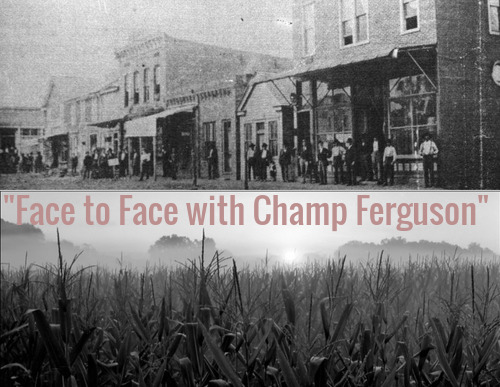
Face to Face With Champ Ferguson

John Garner had only been enrolled in school at Albany, Ky about six months when the civil war broke out, and had just recently left school and en­listed as a Union soldier the day he stood face to face with the infamous Champ Ferguson. It would be an encounter he would never forget.

After enlisting on New Years Day in 1863, two weeks shy of his 20th birthday, John had become concerned about his younger brother, Henderson, whom he had left behind in Clinton County, which was being terrorized by Confederate guerillas, including Ferguson, whom he described as a notorious human demon. Ferguson's killing spree lasted most of the war, from November 1861 to April 1865. Some of the killings were brutal and all were without mercy, with the victim usually face-to-face with him.

Determined to get his brother out of Clinton County, John dressed in civilian clothes and made his way on foot from Liberty to Somerset, and then to Albany, avoiding all public roads. His aunt, Betsy, lived in town, and his intention was to quietly slip into her home and stay hidden until she could fetch his brother for him. At the end of a wooded area in town, there was a cornfield which led up to his aunts garden. He could see her home from there, and noticed a few people were walking further down the street, but no one was near the home. Quietly, he ventured into the cornfield. Once he reached the garden, he stopped again to survey of the town. Seeing no danger, he crossed a fence and stepped into the back door of the house.

Upon seeing her nephew, Betsy threw up both hands and exclaimed, “The Lord have mercy, John what are you doing here?” He replied, "I am after Henderson. Where is he?” ‘'Gone and joined the army long ago,” she replied. “Which army?” he asked. “The Union Army,” she said. As Betsy John something to eat, suddenly there was gunfire and the clatter of horses feet, which seemed to be within very close range. John ran out on the porch, intending to get the house between him and town so he could make his getaway back into the cornfield. Suddenly, he was standing face to face with Champ Ferguson, whose pistol was drawn and pointed at him.

Champ: “What are you running for?"
John: ‘I am not run­ning, sir.”
Champ: “Where were you going?”
John: “I heard the clatter of horses feet and stepp­ed out here to see what was going on."
Champ: “Let me catch you running and you're a dead man."
John: “All right, if you catch me running, fire away.”

Betsy watched from inside the house as Ferguson whisked his horse and dashed back up the street. Both she and John were shaken up by what had just taken place, but now wasn't the time to talk about it. As Champ turned out of sight, John said goodbye to his aunt and began making his way through the tall green corn and into the woods. He remembered seeing at least a half dozen of Ferguson's men waiting in the street as he spoke to their captain. He realized any one of them might have recognized him as being a member of Col. Frank Wolford's Calvary had they come in­to the yard. He also realized how close he came to having his life taken from him, because he had heard that Ferguson took no prisoners, but cruelly murdered them.

After reaching the woods, John stopped and looked back toward town. He saw several people dashing about. Some were firing shots into the air. Feeling that he was now safe, he made his way to Rowena, where he boarded a steamboat bound for Burnside. A year later, John found his brother, Freeman, serving with the 6th Kentucky Cavalry.

When the war ended, John W. Garner became a minister in the Church of Christ faith and married Mary Freels of Wartburg, TN, a second cousin to Abraham Lincoln's mother, Nancy. They moved to Beloit, Kansas, but by 1895 were living in Perkins, Oklahoma, where John established a church and pastored there a few years before becoming an evangelist. John died in 1937 when he was 94 years old. His brother, Henderson, had also migrated west after the war. He died in Washington State in 1926. They were the sons of Freeman and Rachel Garner, who are buried at Tateville Baptist Church Cemetery in Pulaski County, Ky.

Wednesday, June 1, 2022

Edison Records: Battle Hymn of the Republic


My 105-year-old recording of "Battle Hymn of the Republic," by singer Thomas Chalmers, was recorded May 29, 1917 at Thomas Edison's recording studio in Manhattan. The recording is registered with the Library of Congress.

"Battle Hymn of the Republic" first gained popularity around Charleston, South Carolina. It became known as "John Brown's Body," following the insurrection at Harper's Ferry, led by Abolitionist John Brown, whose actions, trial and subsequent execution made him a martyr.

"John Brown's body
lies a-mouldering in the grave
His soul is marching on"

By the time of the Civil War, the song had become a popular marching song with Union Army regiments. It was when Julia Ward Howe visited Washington, DC on November 18, 1861 that "Battle Hymn of the Republic" was first born. Howe and her husband were active abolitionists, who had experienced first-hand a skirmish between Confederate and Union troops in nearby Virginia, and heard the troops go into battle singing "John Brown's Body." That evening in the nation's capital, Howe was inspired to write a poem that better fit the music. It began "Mine eyes have seen the glory of the coming of the Lord."

This photo of Julia Ward Howe was taken in 1908.

Wednesday, May 26, 2021

The Killing of Joseph Beck

Around 9:00 a.m. on or about August 27, 1862, Champ Ferguson and his men returned to the home of my third great-grandfather, Elisha Koger, whom they had brutally murdered almost thirteen weeks earlier, on June 1st. Ferguson called out from beyond the fence that surrounded the home. No doubt, hearing his voice terrified Elisha's widow, Nancy. After all, Ferguson and his men had shot her husband more than thirty times. His body was a bloody mess by the time the shooting stopped. He took his last breath lying in the arms of his daughter, Sarah, who was covered in his blood.

Nancy sent her sister, Jane, to the door. Ferguson wanted to know if any other armed men had passed by that way that morning. Jane replied she had seen no one. As he turned to leave, Ferguson told her he and his band had killed a man near there. "I don't know him myself, but some of the men say it is Joe Beck," he said. Ferguson told her that Beck's hat and coat were lying in a little drain beside the road and his body was lying about thirty yards from there. He also said he had taken a Colt rifle from Beck after his death. The location was about a mile from the Koger home in the Oak Grove Community of Clinton County, Ky near the top of Poplar Mountain. Nancy, Jane and a young man who was at the Koger home, Marion Purcell, walked up the road and found the body just as Ferguson had described. Nancy would soon deliver the news to his wife, Elizabeth.

During Ferguson's trial at the end of the Civil War, both Nancy and Jane recounted what they saw when they found Beck's body, but no one outside the victim, Ferguson and his men witnessed the event. Even after his conviction, in interviews with reporters where he gave details about all of his killings, reporters forgot to ask about the killing of Joseph Beck, and Ferguson did not offer any details.

In his book, "Cumberland Blood: Champ Ferguson's Civil War" (2008), Thomas D. Mays claims that Beck had been a daring Union soldier who had dogged Colonel John Hunt Morgan's command and showed no fear of Ferguson or his men, who were part of the forces under Morgan, but that his luck had run out when he was surprised on the road that day. I wonder about that because there is nothing known about his military stance or activities (at least I haven't seen anything), except that the army ruled that Joseph was killed in the line of duty, which qualified his widow, Elizabeth, for a pension. Beck, who was born in Wayne County in 1817, had enlisted at Camp Hoskins in Pulaski County on Oct. 15, 1861 and was assigned to Capt. Payne's company G, 12th regiment of the Kentucky Infantry.

Joseph Beck's brother-in-law, Jesse Rector, and his wife, Nancy, were the parents of Daniel Webster Clay Rector, whose wife, Laura, was the sister of my great grandmother, Hettie Huffaker Frost.

Wednesday, March 10, 2021

A Civil War Massacre in Overton County

The Officer family lived in a rural community in Overton County called Sinking Cane. William Alexander Officer, who had married a Cynthia Holford in that community in 1836, operated a sizable farm with pastures, timberland and a large two-story house. Today, the location is about two miles off Highway 84 on Rock Springs Road, near the foot of Monterey Mountain. The couple produced seven children — four girls and three boys — and dealt primarily in livestock. He favored the Confederacy.

William spent a lot of time driving livestock further into the South. Everyone knew he was away from home a lot and also was successful and financially sound. Therefore, given the ongoing war, the Officer family was subject to harassment by federals who came to the Officer home place and took what they wanted — a common practice on both sides of the conflict.

One of the Officer sons, John, had been born in 1845 and was thus a young man when the Civil War broke out. He enlisted as a private in the Confederate Army. In March 1864, during a period in which Tennessee was seeing a flurry of wartime skirmishes and guerrilla activity in rural areas, John had been granted a leave from Company F, 13th (Dibrell’s) Tennessee Cavalry Regiment to go visit his family. With him had come a handful of fellow Confederate soldiers who had become separated from their command.

He was home with his companions on March 12, 1864. His mother rose early, and with daughter Frances, set to work to make an especially good Saturday breakfast for John and their visitors. The young men were happily eating what was probably the best meal they’d had in weeks when a big band of federal soldiers, some 200 of them, part of Col. William B. Stokes’ command, rode up to the house.

The federals had been sent out by Stokes to hunt down Confederate guerrillas, particularly Champ Ferguson. Upon their arrival, John Officer jumped up in a panic and fled into another room, where a slave of the family, named Abraham, but usually called Uncle Abe, helped him up into a loft or attic area to hide.

The guns of the family’s visitors were not far away, stacked on one another in a hallway, but the federal band was a big one and there appeared to be nothing to gain by dashing to get the weapons to make a hopeless stand. Union troops entered the house and things went bad fast. Shooting began, killing on the spot five of the young Confederates: John P. York, Oliver Shipp, Samuel Garrett, William Slaughter and William Lipscomb.

Slaughter served in Company C, 1st Regiment Texas Rangers. York, Shipp and Garrett were part of the 8th Texas Calvary and Lipscomb was in the 3rd Regiment, Alabama Cavalry. A sixth Confederate there was 2nd Lt. Robert S. Davis, also of the 8th Texas. Davis was wounded but did not die inside the house, as his companions had. The federals hustled the wounded man outside and put him against a gatepost, tying him in place. There he was executed by a hastily formed firing squad (That gatepost is on display in the Overton County Museum).

In 1922, Uncle Abe gave an eyewitness account of the incident before the Tennessee Historical Commission. According to his testimony, Davis spoke to his killers before they shot him, saying, “You ought not do this. I have never done anything but my sworn duty.” Abe also noted that Davis never flinched when the federal soldiers fired and took his life.

The six massacred soldiers are buried at Officer Cemetery, located near the home. This event is referred to locally as the Stokes Atrocity. A state historical marker, describing the event, is posted on the main street in Monterey.

*Written by Cameron Judd, The Greenville Sun (Mar 2, 2019): "A Civil War Massacre At A Place Called Sinking Cane."


Thursday, April 2, 2020

Hymns of Hope: He Leadeth Me


It was a Wednesday evening and Joseph Gilmore, the son of New Hampshire governor Joseph A. Gilmore, was preaching at a mid-week prayer service. “I set out to give an exposition of the 23rd Psalm," he would later write, "but I got no further than the words ‘He leadeth me.’ Those words took hold of me as they had never done before. I saw in them a significance and beauty of which I had never dreamed. At the close of the meeting a few of us kept on talking about the thoughts which I had emphasized; and then and there, on a back page of my sermon notes, I penciled the hymn just as it stands today, handed it to my wife, and thought no more of it."

Without his knowledge, and using a pseudonym, Gilmore's wife sent the lyrics to the Watchman and Reflector magazine. The magazine first printed it on Dec. 4, 1862.

Three years later, Gilmore went to preach at Rochester, New York. "Upon entering the chapel," he said, "I took up a hymnbook, thinking, ‘I wonder what they sing.’ The book opened up at “’He Leadeth Me" and that was the first time I knew that my hymn had found a place among the songs of the church.”

Musician William Bradbury saw the lyrics the magazine had printed and wrote the melody for it. He added the last line of the refrain to fit his tune. When Ira Sankey, the musician for evangelist Dwight Moody heard Bradbury’s version of the hymn, he included it in several editions of 'Sacred Songs and Solos,' thus assuring its fame.

He leadeth me, O blessed thought
O words with heavenly comfort fraught
Whate'er I do, where'er I be
Still 'tis God's hand that leadeth me

He leadeth me, He leadeth me
By His own hand He leadeth me
His faithful follower I would be
For by His hand He leadeth me

Sometimes mid scenes Of deepest gloom
Sometimes where Edens flowers bloom
By waters calm o'er troubled sea
Still 'tis God's hand that leadeth me

Lord I would clasp Thy hand in mine
Nor ever murmur nor repine
Content, whatever lot I see
Since 'tis my God that leadeth me

And when my task on earth is done
when by Thy grace the victory's won
E'en death's cold wave I will not flee
Since God through Jordan leadeth me


Wednesday, January 15, 2020

I Know Whom I Have Believed


"But I know Whom I have believed
And am persuaded that He is able
To keep that which I’ve committed
Unto Him against that day"

This great hymn published in 1883 and written by Major Daniel Webster Whittle has been in my head pretty strong the past couple of days. Usually that happens it means it is something that I need to hear. I want to believe this is God's way of speaking to me. Is this something that happens to you?

Major Whittle wrote over 200 hymns in his lifetime, including "There Shall Be Showers of Blessings." Born in Chicopee Falls, Massachusetts on November 22, 1840, he worked as a cashier for Wells Fargo bank beginning in his teenage years and in 1861 joined the Union Army, where he was commissioned 2nd Lieutenant and later rose to the rank of Major.

In the summer of 1862, as the Civil War began to intensify, his unit was called to go South. At his departure, his mother placed a New Testament in a pocket of the haversack she'd arranged for him. A haversack is similar to a backpack, but with one shoulder strap. The New Testament would have a vital role in his life.

Wounded in battle, he was captured and sent to a prisoner of war camp, where one of his arms was amputated. It was while in this POW camp that he began of to read his New Testament. One night a nurse informed him that a dying soldier from his unit was begging for someone to pray for him.

"I dropped to my knees and held the boys hand in mine," he wrote. In a few broken words I confessed my sins and asked Christ to forgive me. I believed right there that He did forgive me. I then prayed earnestly for the boy. He became quiet and pressed my hand as I prayed and pleaded God's promises. When I arose from my knees, he was dead. A look of peace had come over his troubled face, and I cannot but believe that God who used him to bring me to the Savior, used me to lead him to trust Christ's precious blood and find pardon. I hope to meet him in heaven."

Years later, Major Whittle began to write lyrics and, at the encouragement of D.L. Moody, entered into music evangelism. It was during this time that he wrote the words to "I Know Whom I Have Believed." The refrain is a direct quotation from II Timothy 1:12: "...for I know whom I have believed, and am persuaded that he is able to keep that which I have committed unto him against that day."

"I Know Whom I Have Believed" is about many things, such as faith and how the Lord paid the price for our redemption. Most folk, including me, identify with verse four's theme of assurance. Assurance that, no matter what the days may hold, in heaven, I will eventually see God in all His glory.

"I know not what of good or ill
May be reserved for me
Of weary ways or golden days
Before His face I see

But I know Whom I have believed
And am persuaded that He is able
To keep that which I’ve committed
Unto Him against that day"


Tuesday, August 13, 2019

Clear Fork: The Civil War Years


"There being a war broke out in our government and dissention amongst the people, the Association never met and the church is doing no business and seldom met." - James Harvey Wood, Clear Fork Baptist Church Clerk, August 24, 1861.

During the Civil War years, 1861 to 1865, the members of my church, Clear Fork, rarely met. Business meetings were held only three times in 1861. On July 27th, clerk James Harvey Wood wrote: "At the time of the July meeting there was no business done because of a 'publick' speaking at town."

That event was a Union-sponsored rally led by 6th Judicial District Judge Thomas Bramlette, a Clinton County native who, during the Civil War, served as colonel of the 3rd Kentucky Regiment Infantry, leading his regiment in the Siege of Corinth and the Battles of Shiloh, Perryville, and Stones River, then resigning his military commission in 1862 to serve as U.S. district attorney before being elected governor on August 3, 1863 and guiding the state through the latter part of the Civil War and the onset of Reconstruction.

Literally hundreds of people showed up for the rally on the 27th, as testified to in Captain John W. Tuttle's Civil War diary. "We arrived at Albany about 10. The first thing we saw upon arriving at the top of the hill overlooking the town were the Stars and Stripes gaily fluttering to the breeze above the tops of the houses. On entering town we met a procession with 34 ladies in front on horseback, one of whom carried a National Banner followed by about 60 cavalry and 500 infantry. They presented quite an imposing appearance. About two thousand persons were in town. After dinner a procession was formed which marched out about a half a mile from town where they were addressed by the Hon. Thos. E. Bramlette in a speech of something more than three hours duration. He made a most thrilling appeal in behalf of the Union and called upon the loyal citizens of Clinton County to join a regiment he is raising for the purpose of aiding the Union men of East Tennessee."

Tuttle, who was from Wayne County, served in Company H of Col. Bramlette's division. In his diary he goes on to write: "About 30 enlisted in the service under him and 87 cavalry, to compose a part of a regiment destined for the same service, now being raised by Frank Woolford of Casey County. The feeling for the Union here is very strong and the most intense enthusiasm prevails. A Secessionist is not allowed to open his mouth. The people of this county are apprehensive of an invasion by Tennesseans. They have picket guards stationed out at every pass. The alarm was spread about an hour by sun yesterday evening, and from three to five hundred armed men gathered from various parts of the county and stayed in town last night."

And so the war began. Back at Clear Fork, a month later, in August, clerk Wood made this entry in the church minutes: "There being a war broke out in our government and dissention amongst the people, the Association never met and the church is doing no business and seldom met." The church did meet once in 1862, but ten months later Wood noted: "Up to March of 1863 the Church is doing nothing." No minutes were recorded during the remainder of 1863 or in all of 1864.

The next entry in the church minutes came on June 24, 1865, two months after the Battle of Appomattox Courthouse and the surrender of Confederate General Robert E. Lee, which set the stage for the end of the war. "The Church having for a long time been deprived of meeting together on account of the war," Wood wrote, "met at the schoolhouse on Clearfork.

The reason for meeting at the school is because sometime during the year 1864 Clear Fork Baptist Church became a direct victim of the Civil War when Confederate guerillas burned the meeting house to the ground. Luckily, the church's business meeting records from it's organization up to the Civil War had been kept in the clerk's homes. Clinton County's courthouse also burned, it is thought, on the same day as the church. "Guerillas believed that destroying places like churches and courthouses, where records were kept, helped add to the disorder of the war," writes historian Tim Talbott at explorekyhistory.ky.gov. Although he wasn't a member of Clear Fork, Confederate guerilla Champ Ferguson, who was born and raised in Clinton County, did attend services there with members of his family.

In his book, "A Lighthouse in the Wilderness," former Clear Fork pastor Morris Gaskins wrote that after the war church members not only met at Clear Fork School, but in other school houses and even other church houses in communities across the county for the convenience of it's members who lived in the different communities, and the good news is there was a season of revival. In 1866, for example, ninety-seven new additions were added to the church, most on professions of faith. The greatest of the meetings that were held while Clear Fork was without a meeting house took place at Beech Bottom, before that church was constituted, and at Locust Grove. Revival was spontaneous, usually starting with the regular monthly meeting when several people would respond, and continuing for eight to ten days.

Clear Fork church was no stranger to religious upheaval. First pastor Isaac Denton arrived at Spring Creek between 1798 and 1799 just as the Second Great Awakening was getting underway. Soon, he brought the early settlers together and began preaching to them. The meetings were directly responsible for the organizing the church on April 1, 1802. The Denton family was also no stranger to religious upheaval as they had experienced the First Great Awakening in the mid 1700's at Sandy Creek, North Carolina with the great preacher Shubal Stearns.

Following the wars end, Clear Fork Baptist Church continued to meet in other church houses and school houses until July of 1869 when members voted to build a new church. As for the courthouse, it was rebuilt in the 1870's. Historical Marker #597 on the courthouse lawn in Albany notes the burning of the courthouse by guerrillas during the Civil War.

Sunday, July 21, 2019

Hige Boles Proved To Be An Excellent and Efficient Official, who had the Respect of all Law-Abiding Citizens


From: The New Era newspaper, Albany KY
Date: March 3, 1926

"Our Sheriff"

Sheriff A.H. Boles is a native of Fentress County Tennessee, but at the age of ten years his parents moved to Clinton County, where he has resided since that time. For a number of years he lived at Hobart, but about 12 years ago he moved to Albany where he now lives. Most of his life has been spent on a farm and he now owns a fine farm in the Albany graded school district. He is now forty four years of age and is married and has an excellent family. He is a member of the Methodist Church here, a Mason, a progressive citizen and a staunch Republican. In the August 1925 primary election, Mr. Boles received a plurality of 407 votes and was elected in the final election by a majority of 735 votes. Although he has been in office only a short while, he has proven himself to be an excellent and efficient official, who has the respect of all law abiding citizens.

The above article was reprinted in the Clinton County News in 1965 under the headline "A.H. Boles Sheriff in 1926." By that time, Hige was 83-years old and was very active in the real estate business. During a twenty year period between 1914 and 1933, Hige was either sheriff or deputy sheriff for sixteen of those years. He was sheriff from 1926 to 1929, and he served as deputy sheriff during Sheriff Charles P. Huff's term from 1914 to 1917, during Sheriff Billy Felkins' term from 1922 to 1925, and during his cousin Sheriff Willie Winningham's term from 1930 to 1933.

Ahijah "Hige" Boles was born at Bolestown in Fentress County, TN on March 19, 1882, one of ten children born to George and Deborah Smith Boles. He died on March 22, 1975 at Sparta, TN. He is buried at Cedar Hill Cemetery in Clinton County. Hige followed in the footsteps of his grandfather, John Boles, who was the first post-Civil War Sheriff of Overton County, TN from 1865 to 1867.

Thursday, December 13, 2018

"Saviour, Like a Shepherd Lead Us"


It was Christmas Eve 1876 and Ira D. Sankey, the famous singer and songwriter, was traveling on a steamboat up the Delaware River. Travelers on such a holiday, seemingly cut adrift in a world where everyone else is celebrating with loved ones, often seem to cling together making a circle of warmth in a waiting room, in a plane or in an almost deserted restaurant.

This was such a journey. On the deck were gathered a number of passengers, looking out at the calm, starlit night. Someone said, "Mr. Sankey is aboard!" and immediately there were cries of "Let him sing for us! Let's ask Mr. Sankey to sing!"

He was leaning against one of the great funnels of the boat. Before he began, he stood for a moment as if in prayer, deciding what to sing. He wanted to sing a Christmas song, but somehow the words of the shepherd song were what came to his heart.

"Saviour, like a shepherd lead us
Much we need Thy tender care
In Thy pleasant pastures feed us
For our use Thy folds prepare"

"Blessed Jesus, blessed Jesus
Thou hast bought us, Thine we are
Blessed Jesus, blessed Jesus
Thou hast bought us, Thine we are"


There was a deep stillness throughout the crowd. The words, telling the sweet story of God's love for wandering men, and the beautiful melody floated out across the deck, across the water and into the night. Every heart was stirred.

At the end of the song, a rough-looking man stepped forward. To Sankey, he asked, "Did you ever serve in the Union Army?" "Yes," answered Sankey. "Can you remember if you were doing picket duty on a bright moonlight night in 1862?" "Yes, I do," answered Sankey, with surprise. "Were you...?"

"I did, too, but I was serving in the Confederate Army. When I saw you standing at your post, I said to myself, 'that fellow will never get away from here alive.' I was in the shadow, completely hidden, while you walked in full moonlight."

"I raised my rifle and took aim. At that instant, you began to sing, just like a moment ago. The song was 'Saviour, like a shepherd lead us...'

"The music touched my heart and I took my finger off the trigger. 'I'll wait until the end of the song,' I said to myself. 'I can't miss him, and I can shoot him afterwards.'

"We are Thine, Thou dost befriend us
Be the Guardian of our way
Keep Thy flock, from sin defend us
Seek us when we go astray"

"Blessed Jesus, blessed Jesus
Hear, O hear us when we pray
Blessed Jesus, blessed Jesus
Hear, O hear us when we pray"


"As you sang, you reached the place where it says," 'We are thine, do thou befriend us, be the guardian of our way...'

"I could hear every word perfectly, and how the memories came to my heart! I began to think of my childhood and my mother. She loved God and had sung that song to me many times. But she died all too soon, otherwise I think my life might have been different.

"At the end of the song, I found it impossible for me to take aim, though you still stood in the bright moonlight, a perfect target."

"Then I thought of the Lord. I looked at you and thought, 'the Lord who was able to save that man from certain death must surely be great and mighty.' My arm dropped to my side and I cannot tell you all the things I thought at that time. My heart was smitten, but I didn't know what to do.

"Just now, when you were about to sing and stood quietly as if praying, I recognized you. I've wandered far and wide, since that other occasion. I have never found that Shepherd. Please help me now find a cure for my sick soul."

Deeply moved, Sankey threw his arms about the man who had been his enemy. A man who could have ended his life. That Christmas Eve night, a former soldier found the great and tender Shepherd as his Saviour.

"Early let us seek Thy favor
Early let us do Thy will
Blessed Lord and only Saviour
With Thy love our bosoms fill"

"Blessed Jesus, blessed Jesus
Thou hast loved us, love us still
Blessed Jesus, blessed Jesus
Thou hast loved us, love us still"


Saturday, December 1, 2018

George W. Burchette: Guard of Honor

In the Manuscripts & Folklife Archives section of the Department of Library Special Collections at Western Kentucky University in Bowling Green, Kentucky is a letter addressed to George W. Burchette, a civil war soldier born in Clinton County, Kentucky, who was in the service of one our nation's greatest presidents and recognized by another.

George Washington Burchette was born on August 27, 1843 to John Calvin Burchette and Polly Branham. He was the grandson of Icil Burchett. On September 29, 1861, soon after the Civil War began, George enlisted in the Union Army's 12th Kentucky Cavalry, where he became a 1st Sergeant. He served until July 24, 1865. Although he fought in battles at Mill Springs, Fort Henry, Perryville and elsewhere, it is what he did at the war's end that he became known for.


The story begins just after the assassination of President Abraham Lincoln, which occured on April 14, 1865, less than a week after the Civil War ended. A funeral train, known as The Lincoln Special, was set up to transport the president's remains from Washington D.C. to his hometown of Springfield, Illinois, where he was to be buried. There were no television cameras or radio broadcasts in those days, only newspaper and telegraph. The Lincoln Special brought the slain president to the people. It allowed the nation to mourn together in a way that neither telegraph nor newspapers could do.


The train left Washington, D.C. on April 21 and traveled 1,654 miles through Washington, Maryland, Pennsylvania, New York, Ohio, Indiana and Illinois, never exceeding 20 mph, to the final stop at Springfield, arriving there on May 3. Following his assassination on April 14th, over the course of 20 days, the president's coffin made 14 stops between Washington DC. and Springfield, Illinois, retracing the route Lincoln had traveled to Washington as the president-elect on his way to his first inauguration, more than four years earlier. Millions of Americans came to view the train along the route and to participate in ceremonies and processions that were held at each stop. The normal routine of everyday living stopped; work, stores, businesses, schools...everything came to a standstill. At each train depot,.and along the streets, tens of thousands of people came and stood in silence, waiting patiently for the Great Emancipator. Most wept.


The Lincoln Special sojourned from Washington, D.C. through Baltimore Maryland, Harrisburg and Philadelphia Pennsylvania, New York City, Albany and Buffalo New York, Cleveland and Columbus Ohio, Indianapolis and Michigan City Indiana, and finally to Chicago, where George Washington Burchette had been chosen as one of 24 men who would serve as funeral guards (Guard of Honor) and for Lincoln's body as it was taken from the train depot to Cook County Courthouse to lie in state.

When the funeral train arrived at Chicago's Park Place, a signal gun was fired, and the tolling of the bell on the courthouse announced the news to the citizens, but there were already thousands and thousands of people congregated in the vicinity of the funeral arch. The vast multitude stood in profound silence and reverently uncovered their heads as the coffin was borne to the dais beneath the grand arch, while the great Western Light Guard Band performed the "Lincoln Requiem," composed for the occasion. Thirty-six young lady pupils of the high school, dressed in white and banded with crape, then walked around the bier and each deposited an immortelle on the coffin as she passed. The coffin was then placed in the hearse, prepared expressly for the occasion, and the funeral cortege passed out of the Park Place into Michigan avenue, and fell into procession.”


“He comes back to us, his work finished, the republic vindicated, its enemies overthrown and suing for peace,” editorialized the Chicago Tribune. “He left us, asking that the payers of the people might be offered to Almighty God for wisdom and help to see the right path and pursue it. Those prayers were answered. He accomplished his work, and now the prayers of the people ascend for help, to bear the great affliction which has fallen upon them. Slain as no other man has been slain, cut down while interposing his great charity and mercy between the wrath of the people and guilty traitors, the people of Chicago tenderly receive the sacred ashes, with bowed heads and streaming eyes.”

  John Carroll Power, an historian who served as the first custodian of the tomb of Abraham Lincoln, described the funeral procession: “It was a wilderness of banners and flags, with their mottoes and inscriptions. The estimated number of persons in line was 37,000 and there were three times as many more who witnessed the procession by crowding into the streets bordering on the line of march, making about one hundred and fifty thousand who were on the streets of Chicago that day, to add their tribute of respect to the memory of Abraham Lincoln.”


The viewing itself at the courthouse lasted for 28 hours, ending on May 2 at 8 P.M.. Power wrote: “The coffin was then closed and carried to the hearaw. The Light Guard Band performed a requiem as the remains were being transferred. An immense procession, bearing about three thousand torches, was already in line, to escort the remains to the depot. At a quarter before nine o’clock, it moved to the time of numerous bands of music. While the preparations for starting were in progress, the choir continued to sing funeral dirges, and twenty-five Sergeants of the Veteran Reserve Corps stood around the funeral car with draw swords. At half-past nine o’clock, the funeral cortege moved slowly out of the depot to the strains of a funeral march by the band, while the bells of the city tolled a solemn farewell to all that was mortal of Abraham Lincoln.”

U.S. Sanitary Commission activist Mary A. Livermore recalled: “There was none of the hum of business; none of the rush and whirl and hot haste that characterize Chicago, – but closed stores, silent streets, and sadness resting on all faces. Flags bound with crape floated mournfully at half-mast. Black draperies shrouded the buildings. All talk was low and brief. Many wept as they walked, and on the breast or arm of all were mourning badges. All nationalities, creeds, and sects were ranged along the route to be taken by the funeral cortége, or stood amid the solemn pageantry and funeral splendor of the great procession.”


The train left Chicago to the sound to tolling bells. As it crossed through Illinois towards Lincoln’s home town, it passed large bonfires, large crowds and banners that read, “Come Home" and “Go To Thy Rest.” At Springfield, the coffin was loaded into an elaborate hearse pulled by six black horses in feathers and mourning blankets and bearing a silver plaque engraved with “A. L.” and taken to the state house. There, in the Hall of Representatives, where Lincoln gave his famous “House Divided” speech, approximately 75,000 people filed silently by the coffin as a band played hymns sung by a choir of 30 vocalists. The next morning, Abraham Lincoln was laid to rest at Oak Ridge Cemetery.


George Washington Burchette was 22 years old when President Lincoln was assassinated. Being a member of the funeral guard brought him much notoriety back home in Cumberland and Clinton counties in Kentucky. After the war, he was appointed to oversee a group of 40 men who assisted the sheriff's of both counties in getting rid of bushwackers. He went on to become one of the Burkesville community's outstanding citizens and was elected state senator of Clinton and Cumberland counties.


When he died in 1935, just four months shy of his 92nd birthday, Burchette was Cumberland County's last surviving Union soldier and the last surviving member of the 24 men who had been chosen as guards for President Lincoln's while it as in Chicago and subsequent trip to Springfield. A few weeks before his death, Burchette received a letter from President Franklin D. Roosevelt. In the letter, dated March 8, 1935, the president wrote "My dear Mr. Burchette, I am informed that you were a member of the funeral guard of Abraham Lincoln in Chicago and I am glad to send you this note to extend to you my personal greetings and my best wishes for your welfare. Very sincerely yours, President Franklin D. Roosevelt."

George Washington Burchette died at noon on April 18, 1935, one month and 10 days after receiving that letter. A funeral was held the following day at his residence and he was buried at Burkesville Cemetery. After his death, the letter was placed in the Department of Library Special Collections at WKU, where it can be seen today.

Burchette's grandfather, Icil Burchett, was killed by civil war guerrillas at his home in Clinton County. His great-grandfather, John Burchett, was a revolutionary war soldier in Virginia.


The photocopy of the letter from President Franklin D. Roosevelt to George Burchette is courtesy of Library Special Collections, WKU.

Friday, October 12, 2018

William Christian Shearer Was Well Respected

My 4th great-grandfather, William Christian Shearer's, roots can be traced back to Northern Ireland. According to the 1938 book, "A Century of Wayne County, Kentucky, 1800 -1900," by Augusta Phillips Johnson, sometime around 1740, four brothers: George, John, William, James, and their families came to America from near Ulster, Ireland.

William settled in what became Wilkes County, N.C., where, according to Geni.com, his son, William Christian Shearer, served with the 16th Regiment during the American Revolution. It says after migrating to Wayne County, KY around 1812, he and his son, Jacob, ran a freight line that transported household goods, machinery and merchandise between Monticello and Louisville. It said that he was educated and well liked in the community and that he set up and conducted the first Bible study class in Wayne County.


William was married twice, first to Hannah Hoover, who died in North Carolina, then to Sallie Walters. He reportedly had numerous children with both wives. His son, Daniel, was the father of Margaret Shearer Huffaker. Her daughter, Hettie, married U.S. "Grant" Frost. They were the parents of my grandmother, Vada Boles. Christian and his son, Jacob, and Christian's wife, Sallie, are all buried at Bethesda Cemetery. Christian's granddaughter, Margaret, and her husband, Henry Clay Huffaker, my great, great-grandparents, are also buried at Bethesda Cemetery.

Chapter five of the book, "A Century of Wayne County, Kentucky, 1800 -1900," tells that in 1828, Christian Shearer's son, Daniel, my 3rd great-grandfather helped to build a church at Pleasant Bend, now Cooper. In the book, author Augusta Phillips Johnson wrote that Daniel's son, Adam Napolean Shearer, then a lad of nine, remembered going with his father to do this. They called it the Church of Christ. In 1852, they organized and planned to build a church in Shearer Valley. The Civil War came on and this house was not completed until the war was over, but enough was done that the soldiers camped in it during the war. This house stands yet, and members of the Church of Christ meet there for worship. Jenkins Shearer, and later Daniel Shearer, preached in this church. Daniel B. Shearer was born on May 12, 1791 and died on April 21, 1865, at the age of 73. He and his wife, Margaret Vickery Shearer, are buried at Shearer Valley Cemetery.


Sunday, July 15, 2018

"The Cause For Which We Stand"


I often write stories about the Civil War. I love the history behind it all, especially the local history from Wayne County down to Overton County and all points in between. There is much to be learned about the Civil War here in our own backyards. Like all of you, several of my ancestors fought in the war, and like many, I had family on both sides, and in the weirdest corners, too.

My 3rd great uncle was the notorious guerrilla Tinker Dave Beaty, who fought strongly for the Union cause. My 2nd and 3rd great-grandfathers, George and John Boles, were part of his Independent Scouts. On the other side, My 4th cousin, Fountain Frost, rode with Beaty's arch nemesis, the notorious Confederate guerrilla, Champ Ferguson, who fought just as strongly for states rights and 'the southern way of life.' My dad's side of the family in Overton County was mostly aligned to the Confederacy. My mom's side of the family in Fentress and Wayne counties were mostly aligned with Abe Lincoln, who felt it was his sacred duty as President to preserve the Union at all costs.

Very ironically, George Boles, although not yet officially my 2nd great-grandfather at the time, is believed to have killed Frost in a skirmish near Gilreath's Mill, not too far from Holbert Creek, and halfway between Chanute in Pickett County and Pall Mall in Fentress County, Tennessee.

It was sort of like that in the American Revolution, family on both sides, except...it was the same guy.

We all know the story of Benedict Arnold, the American soldier who switched sides and fought for the British during the Revolutionary War. But, have you met Ed Wade? He was 8th great-grandfather born on my dad's maternal side. To be exact, he was Edward C. Wade, Sr., born in York County, Virginia on April 21, 1727, and whose father, Colonel Robert Wade had fought in the French and Indian War. Yeah, that guy.

Edward was a Captain in the British Army at the beginning of the American Revolution, but in 1777, he and one of his brothers, so the story goes, decided to switch sides and join the Virginia Militia. It was a strong commitment to freedom for the Wade family, because two of Edward's sons, Richard and James, were killed while serving with the 6th Virginia Continental Line in 1776. After the war, Edward migrated to Georgia. He died on Nov. 4, 1790 and is buried at Little Creek Church Cemetery in Greshamville.

Switching sides was perhaps by conviction, perhaps it was because of personal belief, or perhaps it was to align oneself with their friends and families. Perhaps it was about wanting to please God. Each side believed God was on their side, but both prayed to the same God and read from the same Bible. So, whose side was the Lord on? During the Civil War, President Lincoln suggested neither side could claim God’s special favor. “The Almighty has His own purposes,” he said. It wasn't 'whose side is the Lord on,' but rather, 'who is on the Lord's side.'

An interesting side note locally: Edward Wade's second cousin, Richard Wade, left Virginia in 1777, the year Edward's father died, and moved to Boonesboro, Ky to help Daniel Boone defend the frontier. In 1801, he moved his family to a part of Wayne County that later became Clinton County. Richard is buried at Cartwright Cemetery. Also after the war, Edward's first cousin, Elizabeth and her husband, Samuel Denney, migrated to Wayne County and they lived on Beaver Creek.

Wednesday, March 28, 2018

Medal of Honor Recipient: Oliver Hughes

Harry Truman once declared he’d rather have a Medal of Honor than be president. The area i live in is blessed to have had three Medal of Honor recipients so far: Sgt. Alvin C. York during WWI, Lt. Murl Conner during WWII and Cpl. Oliver Hughes during the Civil War.

Most people may not know about the heroics of Cpl. Hughes. The first soldier from this area to receive the citation, he was born in Fentress County, TN in 1844 and lived in the Static area, close to where Conner lived and not far from York's place at Pall Mall, TN. Cpl. Hughes was awarded the Medal of Honor for an act of extraordinary heroism which he performed on February 20, 1865, while serving with the Union army's 12th Kentucky Infantry at Town Creek, North Carolina.

The Union army had came up on Confederate lines along the road from Wilmington to Fort Fisher. Finding themselves in a comparatively open country with only a few pine trees, the federal troops were exposed to a merciless fire from the rebel artillery. Seeing that desperate measures were necessary, Lieutenant-Colonel L.H. Rassieur ordered an attack on the rebel lines. When it began, Cpl. Hughes saw the color-sergeant carrying the flag of the 11th South Carolina Infantry Regiment. The flag, in those days, was used to signal advances and retreats. Determined to capture it, he made a rush toward the color-sergeant, who retreated to within a short distance of his company. Still, Hughes persisted and within 3 feet of the mouth of one of their cannon, killed him and captured the colors. In the disray, the union was able to counter because with the Confederate flag gone so were the communications it provided.

Cpl. Hughes saved thousands of lives that day Town Creek, North Carolina. After the war, he returned home to farm, but a few years later moved to Macon County, Missouri. He died there in 1911 at the age of 69.

The flag of the 11th South Carolina regiment was returned by the U.S. War Department to the state of South Carolina on March 25, 1905.

Tuesday, November 7, 2017

John Tuttle's Diary: The Civil War Comes To Clinton County, Kentucky


Monday, June 17, 1861:
"Went with 15 or 20 to Parmleysville, where I was gladdened by sight of the Star Spangled Banner floating on the breeze. Hon. S. Williams, Secessionist, and Hon. E. L. Van Winkle, Unionist, spoke. I could not rid myself of the idea that those whose views do not coincide with mine on the great question are either fools or traitors.

Saturday, July 27, 1861:
"We arrived at Albany about 10. The first thing we saw upon arriving at the top of the hill overlooking the town were the Stars and Stripes gaily fluttering to the breeze above the tops of the houses. On entering town we met a procession with 34 ladies in front on horseback, one of whom carried a National Banner followed by about 60 cavalry and 500 infantry. They presented quite an imposing appearance. About two thousand persons were in town. After dinner a procession was formed which marched out about a half a mile from town where they were addressed by the Hon. Thos. E. Bramlette in a speech of something more than three hours duration. He made a most thrilling appeal in behalf of the Union and called upon the loyal citizens of Clinton County to join a regiment he is raising for the purpose of aiding the Union men of East Tennessee.

About 30 enlisted in the service under him and 87 cavalry, to compose a part of a regiment destined for the same service, now being raised by Frank Woolford of Casey County. The feeling for the Union here is very strong and the most intense enthusiasm prevails. A Secessionist is not allowed to open his mouth. The people of this county are apprehensive of an invasion by Tennesseans. They have picket guards stationed out at every pass. The alarm was spread about an hour by sun yesterday evening, and from three to five hundred armed men gathered from various parts of the county and stayed in town last night."


Captain John W. Tuttle's diary is on file at the University of Kentucky. It spans Captain Tuttle's social and family life before the Civil War, his time serving in Company H of the 3rd Kentucky Volunteer Infantry, where he saw action at the battles of Shiloh, Lookout Mountain and Atlanta, and the post-war when he returned home to his legal practice in Monticello, where he presided over the bankruptcy court for almost 50 years. Tuttle (1837-1927) and his wife, Mollie, had several children. He is buried at Elk Spring Cemetery in Monticello.

Monday, October 30, 2017

John Tuttle's Diary: Judgement Day 1860


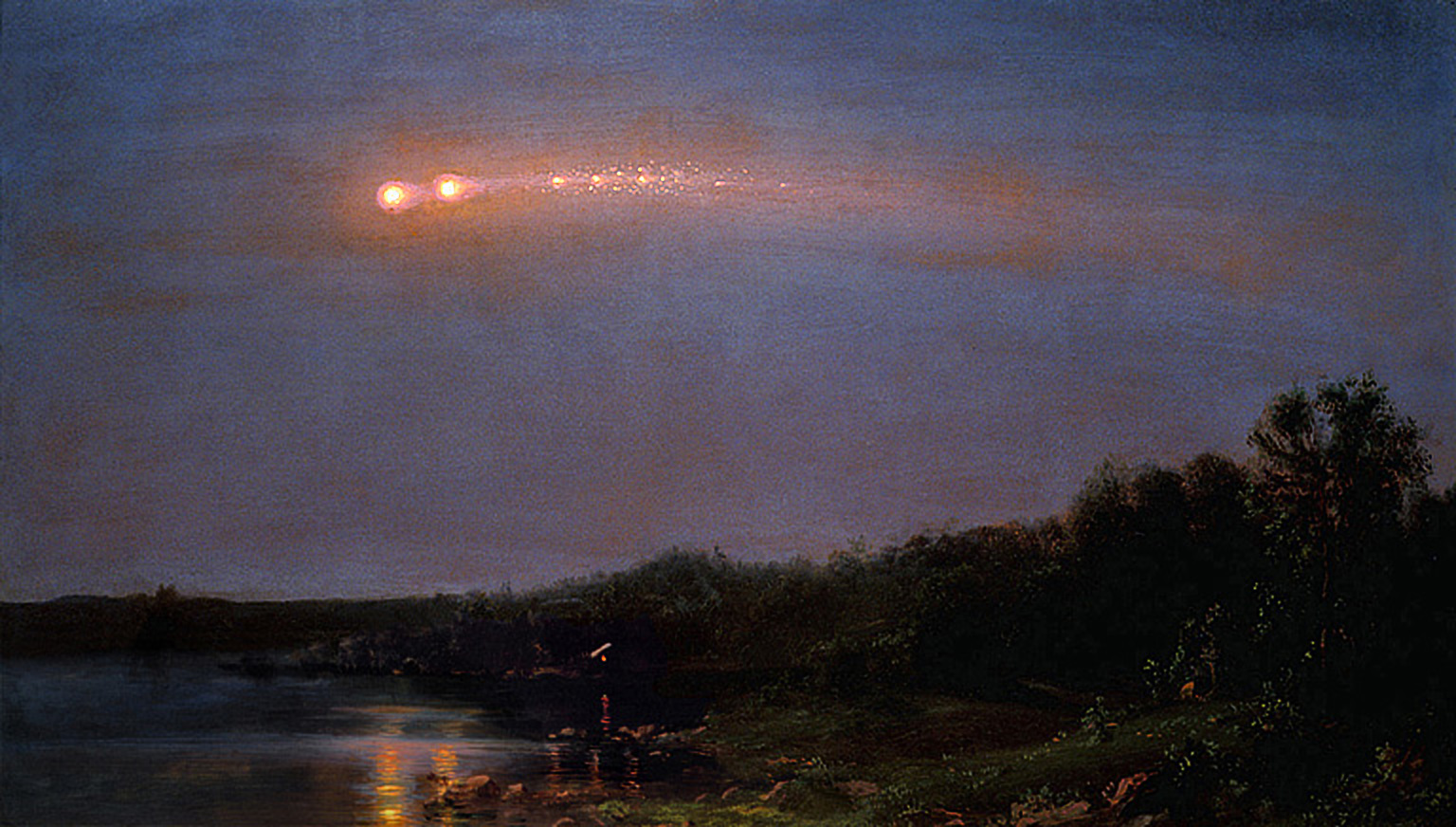
1860 was the year of comets and meteors in the United States. Four comets were discovered, one of which was to the naked eye from mid-June through July. The first meteor fell on May 1st near New Concord, Ohio.

A very rare event occurred on July 20th when an earth-grazing meteor, a meteor that moves nearly horizontally through the Earth's atmosphere, nearly parallel to the earth's surface, passed from Lake Huron near Buffalo, New York across Greenwich, Connecticut and out over the Atlantic. Meteor processions are so rare most people have never heard of them. There have only been four: 1783, 1860, 1876, 1913.

And then on August 2nd, a magnificent meteor appeared from Pittsburgh to New Orleans, and from Charleston to St. Louis, an area of 900 miles in diameter. Several observers described it as being larger than the full moon, and just before it's disappearance, it broke into several fragments. A few minutes after the flash of the meteor, there was heard throughout several counties in Kentucky and Tennessee a tremendous explosion like the sound of a distant cannon. Immediately, another noise was heard, not quite so loud, and the sounds were re-echoed with the prolonged roar of thunder.

From a comparison of a large number of observations, it was computed that this meteor first became visible of northeastern Georgia, about 82 miles above the earth's surface and that it exploded over the southern boundary line of Kentucky at an elevation of 28 miles. The length of its visible path was about 240 miles and the time of flight eight seconds, showing a velocity relative to the earth of 30 miles per second, and was this computed that it's velocity relative to the sun was 24 miles per second.


John W. Tuttle of Wayne County (1837-1927) wrote about the meteor in "Diary of John W. Tuttle, 1860-1867," which is on file at the University of Kentucky.

"Thursday, August 2, 1860:  Dr. J. B. S. Frisbie, W. A. Haskins and myself were sitting in the porch when all at once a meteor of the most intensely brilliant character arose in the Southeast, rising in its course at an angle of about 20 degrees, and moved with an apparently slow motion towards the Northwest.  Its light was of a peculiarly white character more brilliant perhaps than that of the sun. It completely blinded, for a moment, all who beheld it.

After the meteor had disappeared, I walked down town to learn the sentiments of the people generally with respect to the strange visitor. The matter was being discussed freely and many opinions expressed with regard to it. The savants differing among themselves displayed a depth of research into the hidden mysteries of physical science truly astounding. Illustrious examples shining forth from the page of history should have taught them the folly of attempting to tamper with the staid orthodoxy of the common mind to popular opinion.

The theory finding favor with the greater number was that the "last day" of the existence of this little ball of dirt had most certainly arrived. Some minutes after the disappearance of the meteor a sound, deep and unnatural, not unlike the rumbling of heavy thunder, in the distance, when near the earth but partaking of the roaring nature more like the roaring of a whirlwind. The sound continued for several minutes and gradually died away, greatly to the relief of those regarding the sound as the herald of an earthquake or judgment day."


In the Aug. 13, 1860 edition of The New York Times, Dr. Alex McCall of Rome, Tennessee said "the sounds were like hundreds of wagons running over bridges. The first sounds came from it when near to us, resembling powder explosions in open space, but the remotest sounds came five to ten minutes afterward. The intensity of the blaze made me spring from bed, supposing a fire had broken out, and on reaching the window, shadows were glancing in every direction.

'Caroline' said the moon had fallen and was burning up; 'Nick' said 'the fire ran into my eyes and woke me up; and 'Isaac,' jumping, asleep, from the ground, insisted the world was on fire. Then came the sounds like a great bass drum pelted by some giant, keeping time. In its rapid flight the meteor cast off thousands of sparks at every explosion, and then flashed bright as the sun, confusing the eye and causing the leaves and grass to appear purple; finally splitting into two meteors as it expired."


Though the meteor procession of 1860 garnered much public attention, it was mostly forgotten by the 20th century, perhaps overshadowed by the tremendous events of the Civil War that followed, but Walt Whitman and the thousands of other people who saw the meteors, and the rare meteor procession witnessed something truly special.

Walt Whitman’s "Leaves of Grass" includes the poem, “Year of Meteors, (1859-60),” in which he includes descriptions of a comet and meteors of 1860:

Nor the comet that came unannounced out of the north, flaring in heaven,

Nor the strange huge meteor procession, dazzling and clear, shooting over our heads,

(A moment, a moment long it sail’d its balls of unearthly light over our heads then departed, dropt in the night and was gone)


John Tuttle's diary spans his social and family life before the Civil War, his time serving in the Union Army's 3rd Ky Vol. Infantry, Co. H during the war, where he saw action at the battles of Shiloh, Lookout Mountain and Atlanta, and the post-war when he returned home to his legal practice in Monticello, where he presided over the bankruptcy court for almost 50 years. Tuttle and his wife, Mollie, had several children. He was born in 1837 and died in 1927 and is buried at Elk Spring Cemetery.

Tuesday, October 17, 2017

Shelby Coffey Had A Good Name Before The Rebellion

Shelby Coffey was born in Wayne County, Kentucky on Dec. 1, 1832, the son of Manerva Alexander Coffey. "The Coffey's were wealthy and influential people," wrote John Allen Brents in his Patriots and Guerrillas book. Coffey was elected to Kentucky Legislature in 1859 and served during the 1860-61 session. He stood very high among the members of that body. Brents wrote that like many other youths in Kentucky, Coffey was misled by political tricksters. "He had a good name before the rebellion, but the curse of the rebellion blighted his character." Specifically, Brents, who was a Union Major for the Kentucky 1st Cavalry during the Civil War, wrote that Coffey was corrupted by Congressman James Chrisman of Wayne County. In 1861, Coffey joined the Confederacy and was Captain of Company H, 6th Ky Volunteer Cavalry. This company was partly organized in Wayne County on January 18, 1862. Organization was completed at Livingston, Tennessee. Records state that Capt. Coffey was wounded in an apparent skirmish that occured in Clinton County, Kentucky on January 16, 1862. He went home to Wayne County, where he died on March 20th. He is buried at Elk Springs Valley Cemetery on Kentucky Highway 92 East in Wayne County, not to be confused with Elk Spring Cemetery in town. It is a small cemetery with mostly Coffey Family and people that married into the Coffey family.


Wednesday, September 6, 2017

Like Father, Like Son...In The Civil War


The Civil War tore many families apart, pitting brother against brother or father against son, as each rallied to the flag of the cause that captured his heart. My family certainly fits into that category. Perhaps you read the recent story I wrote about the four Speck brothers who fought for the Confederacy. One of them was my 3rd great grandfather. This story is about his wife's uncle and three son's, who fought for the Union.

When the Civil War came to Tennessee, David Hill Walker and three of his sons, Stephen, John and George, decided to join the Union Army, enlisting in the same 2nd Tennessee Mounted Cavalry on June 19, 1862 at Cumberland Gap. They were mustered in for a three year enlistment under the command of Colonel Daniel M. Ray. The unit was composed primarily of Southern loyalists from the East Tennessee counties. The Walkers lived in Campbell County. Before that, the family lived in Washington County, Virginia. David rose to the rank of Sergeant in Company D, while his son's remained privates throughout their term of service.

The 2nd Tennessee Mounted Cavalry particpated in the Battle of Stones River at Murfreesboro, which was fought from December 31, 1862 to January 2, 1863, the Tullahoma (or Middle Tennessee) Campaign from June 24 to July 3, 1863 and the Battle of Chickamauga, from September 18–20, 1863.


Following the Battle of Chickamauga, some 1,500 Union troops from the 3rd Brigade, 4th Cavalry Division and the 2nd Tennessee Mounted Infantry moved in and occupied Rogersville, Tennessee, the second-oldest town in Tennessee, and the surrounding area, and began filling warehouses full of winter provisions, attempting to establish a Federal foothold in East Tennessee for future operations. About twice that number of Confederates, made up of Jones' Brigade, 2nd Cavalry Brigade and the 8th Virginia Cavalry, surprised the federal forces on the morning of November 6, 1863 and recaptured the town, along with all of the supplies in the warehouses. The Confederates held the town for the remainder of the war.

Out of 893 soldiers from the 2nd Tennessee who participated in the battle, only five were killed, but 608, including David Walker and all three of his sons, were captured. While the commisoned officers were housed at Libby Prison at Richmond, Virginia, the enlisted men were incarcerated at nearby Belle Island Prison. Those who survived Belle Island were transferred to Andersonville Prison in Macon County, Georgia, when it opened in February of 1864. David Hill Walker and his sons were either paroled or exchanged as the war came to an end.

David and his son, George, are both buried in Pikeville, Tennessee. George died in 1889 and David Hill died in 1892. Stephen died in 1913 and is buried at nearby Crossville. John died in 1910 and is buried at Vera Cruz, Missouri.


The Story of Reuben Coffey, an American Revolutionary War Soldier

In Augusta Phillips Johnson's book, "A Century of Wayne County Kentucky 1800-1900," originally published in 1939, she used W...