Showing posts with label Union. Show all posts

Tuesday, September 26, 2023

Who Were Champ Ferguson's Victims?

Following the Civil War, a military commission met in Nashville on July 11, 1865 for the trial of Champ Ferguson, the most notorious of the many guerilla fighters who fought to control the Upper Cumberland Plateau region during the war.

Two charges were placed against him. The first charge was being a guerilla and organizing and associating with a band of lawless men, and being their leader, without any lawful authority or commission from any military power, and that he continuously carried on a predatory and barbarous guerilla warfare, committing many acts of cruelty and inhumanity, becoming a notorious murderer, robber and freebooter in Clinton County, Kentucky and Fentress County, Tennessee, and in the neighboring counties of these states from the year 1861 to May of 1865.

The second charge was murder. Fifty-three murdered victims were named in the indictment. Who were they and what were the dates and occasions surrounding their murders?

1. Nov. 1, 1861 - William Frogg, age 22, Clinton County, 12th Kentucky Regiment, Co. D (my third great uncle). He was home sick in bed with the measles when Ferguson confronted him about being at the Union Army's training camp, Camp Dick Robinson, near Standford. In Champ's world, many of his once long time friends and neighbors had become his enemies. He despised what the training camp stood for. Regardless of who or what they were, he was compelled to target and eliminate those who had been there. ‘I reckon you caught the measles at Camp Dick Robinson,’ Ferguson said just before he shot him dead. Findagrave 217632875

2. Dec. 4, 1861 - Reuben Wood, age 56, Clinton County. Ferguson shot him twice at his home near Albany on Dec. 1st. He died three days later. Findagrave 69578994

3-5. April 1862 - Joseph Stover, William Johnson and Lewis Pierce, near Henry Johnson's house on Wolf River in Clinton County. Ferguson shot and stabbed Pvt. Stover of 1st Ky Cavalry. He chased Johnson and shot at him, causing him to fall over a steep cliff resulting in his death. He shot Pierce.

6. April 1, 1862 - Fount Zachary, age 18, Fentress County. Fount surrendered the shotgun he was carrying, but Ferguson shot him anyway. Almost as soon as he hit the ground, Ferguson was on him with his Bowie knife, and Fount became the first of four Zachary males to fall to Ferguson. Findagrave 149433579

7. May 2, 1862 - Alexander Huff, Sr., age 51, at Pall Mall. He shot him in the head at the old Conrad Pile home. Findagrave 30015273

8. June 1, 1862 - Elisha Koger, age 32, at Oak Grove (my 3rd great-grandfather). He was shot over 30 times outside his home, not far from the Oak Grove Church Cemetery. Findagrave 59105584

9. June 1, 1862 - James Zachary, age 48, Fentress County. Fount Zachary's uncle. He was a magistrate. Findagrave 110262343

10. Aug. 27, 1862 - Joseph Beck, age 45, Poplar Mountain at Duvall Valley Findagrave 31965322

11-14. Oct. 5, 1862 - John Williams, William David Delk, John Crabtree, unknown African-American girl, near the home of Mrs Piles in Fentress County. They were taken from John Huff's mother's home in Fentress County, tied up, removed about a hundred yards away and found dead in a horse lot at Mrs. Piles' home. Williams was shot in the head. Delk was shot once through his chest, and a bayonet ran through it. Crabtree was cut up all over. The unknown negro girl was cut up into pieces in a barbarous manner.

15. Oct. 28, 1862 - Washington Tabor, age 55, Clinton County. He was taken outside his home near Snow and shot. Findagrave 43940663

16. Nov. 1862 - Dr. William McGlasson, Cumberland Co. He was told to run or be killed. He did but was killed anyway, plus robbed and stripped of his clothes. Ferguson denied this.

17-19. Jan. 1, 1863 - Peter and Allan Zachary of Pickett County and Pvt. Elam Huddleston. It happened at the home of Capt. Rufus Dowdy in Russell County. The home was under construction. The upstairs had but a few planks on the joists. Huddleston was shot from an upstairs window and was believed to be dead when he fell to the ground floor. Ferguson killed Peter Zachary and Allan Zachary was killed by the others under Ferguson's command. Elam Huddleston Findagrave 810673. Huddleston was at the Battle of Mill Springs and is buried at the national cemetery. The Zachary's were from Pickett County.

20-39. Feb. 22 1864 - Nineteen unknown soldiers, TN 5th Cavalry. Operations against guerrillas at Johnson’s Mills and Calfkiller River in White County, TN. During this time frame, Ferguson was accused of murdering (unknown) 19 men of the U.S. 5th TN Cavaly.

40-52. Oct. 4, 1864 - Twelve Federal Army soldiers, plus two colored soldiers, all unknown. The First Battle of Saltville (October 2, 1864) was fought over an important saltworks near that town in Virginia. The participants included one of the few black cavalry units. The murder of captured and wounded black soldiers after the battle has been called the Saltville Massacre.” Champ Ferguson fought in this battle. Two of the charges accused him of murdering surrendered United States Colored Troops after the battle had ended. Thomas Mays’ 1995 book, "The Saltville Massacre," recalls the testimony of Pvt. Harry Shocker, a wounded prisoner who watched Ferguson calmly walk about the battlefield killing both white and black prisoners. Champ denied killing any black troops at Saltville.

53. Oct. 7th, 1864 - Lt. Eliza Smith, a Clinton County resident, lay wounded at Emory and Henry College Hospital at Emory, Virginia, when Ferguson burst into the room, approached his bed and placed his gun a foot from the helpless Smith’s forehead. After three misfires, the gun discharged and Smith lay dead with a bullet through his head. Lt. Smith is buried at Knoxville National Cemetery. His wife, Lucy Staton Smith, is buried at Dr. Smith Cemetery in Clinton County. Findagrave 2972

Even though he was charged with killing fifty-three people, Ferguson boasted of killing over a hundred. He said those he had killed were seeking his life and that he was justified by killing in self defense.

He said, "I am yet and will die a Rebel … I killed a good many men, of course, but I never killed a man who I did not know was seeking my life. … I had always heard that the Federals would not take me prisoner, but would shoot me down wherever they found me. That is what made me kill more than I otherwise would have done. I repeat that I die a Rebel out and out, and my last request is that my body be removed to White County, Tennessee, and be buried in good Rebel soil."

The trial ended with Ferguson's conviction on Sept. 26, 1865. He was hanged on Oct. 20, 1865. Per his request, he was buried at France Cemetery, north of Sparta, TN, off Highway 84.

Thursday, June 29, 2023

Unifying America on Independence Day

On the 4th day of July 1861, nearly a thousand men, women and children met at Dr. Johnathan Hale’s mill, just south of the Kentucky-Tenneessee state line, and celebrated the day as had been the custom in former years. They raised a hickory pole, on which was hoisted the old flag. Dr. Hale’s daughters sang the “Star Spangles Banner.” Mrs. Hale read the Declaration of Independence, and the whole concourse of people partook of a bountiful repast prepared by the women, every one of whom opposed revolution in every shape.

The Civil War had begun twenty-two days earlier. Our ancestors had thought this area was too remote to be included in any war, but it came nearly three months later, on Sept. 29, 1861 in the Affair at Travisville in nearby Pickett County, and then almost four months later at the Battle of Mill Springs on Jan. 19, 1862. The war coming here was inevitable. By its end, over 10,000 battles, engagements and other military actions had occurred in 23 different states, including nearly 50 major battles and about 100 others that had major significance. The remainder were skirmishes, reconnaissances, naval engagements, sieges, bombardments, etc. Over 650,000 deaths resulted. An estimated 814 casualties occurred at Logan's Crossroads, 814 on the Union side and 552 on the Confederate side, including General Felix Zollicoffer.

J.D. Hale, who had been born in Stoddard, MA in 1817, began to erect his two-story mill, store and post office in October of 1845. This 100-acre property on Wolf River was in the area where the Farmhouse Restaurant was located on Highway 111 in Pickett County. Hale served as postmaster. It was said that he also operated a manufacturing facility there, producing wagons and furniture. When the Civil War started, he and his family declared for the Union. As a matter of fact, he was among the first to denounce and expose session. The U. S. Army appointed him Captain and Chief of Scouts of the Army of the Cumberlands under General George Thomas, who had led the Union army at Mill Springs. Not only did Hale report on the activities of Confederate leaders Morgan, Forrest and Wheeler, he also recruited area men for the Union army.

The Consequence...

The massive July 4th celebration that had taken place at Hale's Mill, coupled with Hale's expressions of loyalty to the United States, infuriated Confederate sympathizers. He and his family were forced to flee to Albany for safety. Three days after the July 4th celebration, all of Hale's property was destroyed by fire. $20,000 worth of buildings and materials were burned, including his home and two other houses, a large library in Hale’s house, worker's cabins, a barn, stable, store, still house, kitchen, grist mill and saw mill, 1000 bushels of corn, planning machine, mortising machine, running lathe, circular saws, tolls, lumber, wagons, and furniture. In 1864, a military commission would award him $25,000 in an assessment levied against those accused of burning his property.

When the Civil War officially ended on May 9, 1865, the 4th of July celebrations across America were unlike any other in the nation’s history. An uneasy mix of joy, relief, resentment and unhealed wounds was reported as America sought reasons for celebration after a war that nearly tore the country apart.

Following the assassination of President Lincoln, an untested Andrew Johnson was trying to find his way forward as commander-in-chief. He looked to the 4th of July as a launching point to reunify not just the states, but also the hearts and minds of their inhabitants...

“Of all the anniversaries of the Declaration of Independence, none has been more important and significant than that upon which you assemble,” he proclaimed. “Let us trust that each recurring 4th of July shall find our nation stronger in number, stronger in wealth, stronger in the harmony of the citizens, stronger in its devotion to nationality and freedom.”

For the first time in more than four years, Independence Day 1865 had dawned without Americans on the battlefield trying to kill other Americans. Contemporary accounts and newspaper stories depicted a subdued, at times somber celebration in a country struggling to recover a sense of normalcy. In some places, the holiday was barely observed at all. But, on July 4, 1865, a group once again gathered at the Hale's Mill site to celebrate Independence Day, as well as the outcome of the war. They hoisted the 'old flag' and attendants fired a 34-gun salute. Hale’s daughters again sang the Star Spangled Banner and this time it was Hale who read the Declaration of Independence.

By 1871, the Hale family had left this area for New Hampshire. Jonathan died of old age in 1896. In 2011, Tennessee honored him by erecting a historical marker near the site of Hale's Mill. It is located just before Wolf River Bridge, where the Farmhouse Restaurant stood.

J.D. Hale, left, and Tinker Dave Beaty


Tuesday, April 25, 2023

Capt. Tuttle

In her book, "A Century of Wayne County, Kentucky, 1800-1900, copyright 1939, Augusta Phillips Johnson included extracts from the diary of attorney John William Tuttle of Mill Springs, who served as Captain of the 3rd KY Vol. Inf; Co. G during the Civil War.

Capt. Tuttle was thinking about enlisting in the civil war when he attended a rally on June 17, 1861 at Parmleysville. He said, "I could not rid myself of the idea that those whose views do not coincide with mine on the great question are either fools or traitors."

On Saturday, July 27, 1861, he wrote "We arrived at Albany about 10. The first thing we saw upon arriving at the top of the hill overlooking the town were the Stars and Stripes gaily fluttering to the breeze above the tops of the houses. Upon entering town we met a procession with thirty-four ladies in front on horseback, one of whom carried a National Banner followed by about 60 cavalry and 500 infantry. They presented quite an imposing appearance.

About two thousand people were in town. After dinner a procession was formed which marched out about a half a mile from town where they were addressed by the Hon. Thomas E. Bramlette in a speech of something more than three hours duration. He made a most thrilling appeal on behalf of the Union and called upon the loyal citizens of Clinton County to join a regiment he is raising for the purpose of aiding the Union men of East Tennessee.

About thirty men enlisted in the service under him and 87 cavalry, to compose a part of a regiment destined for the same service, now being raised by Frank Woolford of Casey County. The feeling for the Union here is very strong and the most intense enthusiasm prevails."

At its dedication on April 8, 1923, the Monticello Doughboy was unveiled by a then 86-year-old Capt. Tuttle. His diary is on file at the University of Kentucky. It spans his life before, during and after the war. He and his wife, Mollie, are buried at Elk Spring Cemetery in Monticello.

Wednesday, June 1, 2022

Edison Records: Battle Hymn of the Republic


My 105-year-old recording of "Battle Hymn of the Republic," by singer Thomas Chalmers, was recorded May 29, 1917 at Thomas Edison's recording studio in Manhattan. The recording is registered with the Library of Congress.

"Battle Hymn of the Republic" first gained popularity around Charleston, South Carolina. It became known as "John Brown's Body," following the insurrection at Harper's Ferry, led by Abolitionist John Brown, whose actions, trial and subsequent execution made him a martyr.

"John Brown's body
lies a-mouldering in the grave
His soul is marching on"

By the time of the Civil War, the song had become a popular marching song with Union Army regiments. It was when Julia Ward Howe visited Washington, DC on November 18, 1861 that "Battle Hymn of the Republic" was first born. Howe and her husband were active abolitionists, who had experienced first-hand a skirmish between Confederate and Union troops in nearby Virginia, and heard the troops go into battle singing "John Brown's Body." That evening in the nation's capital, Howe was inspired to write a poem that better fit the music. It began "Mine eyes have seen the glory of the coming of the Lord."

This photo of Julia Ward Howe was taken in 1908.

Wednesday, May 26, 2021

The Killing of Joseph Beck

Around 9:00 a.m. on or about August 27, 1862, Champ Ferguson and his men returned to the home of my third great-grandfather, Elisha Koger, whom they had brutally murdered almost thirteen weeks earlier, on June 1st. Ferguson called out from beyond the fence that surrounded the home. No doubt, hearing his voice terrified Elisha's widow, Nancy. After all, Ferguson and his men had shot her husband more than thirty times. His body was a bloody mess by the time the shooting stopped. He took his last breath lying in the arms of his daughter, Sarah, who was covered in his blood.

Nancy sent her sister, Jane, to the door. Ferguson wanted to know if any other armed men had passed by that way that morning. Jane replied she had seen no one. As he turned to leave, Ferguson told her he and his band had killed a man near there. "I don't know him myself, but some of the men say it is Joe Beck," he said. Ferguson told her that Beck's hat and coat were lying in a little drain beside the road and his body was lying about thirty yards from there. He also said he had taken a Colt rifle from Beck after his death. The location was about a mile from the Koger home in the Oak Grove Community of Clinton County, Ky near the top of Poplar Mountain. Nancy, Jane and a young man who was at the Koger home, Marion Purcell, walked up the road and found the body just as Ferguson had described. Nancy would soon deliver the news to his wife, Elizabeth.

During Ferguson's trial at the end of the Civil War, both Nancy and Jane recounted what they saw when they found Beck's body, but no one outside the victim, Ferguson and his men witnessed the event. Even after his conviction, in interviews with reporters where he gave details about all of his killings, reporters forgot to ask about the killing of Joseph Beck, and Ferguson did not offer any details.

In his book, "Cumberland Blood: Champ Ferguson's Civil War" (2008), Thomas D. Mays claims that Beck had been a daring Union soldier who had dogged Colonel John Hunt Morgan's command and showed no fear of Ferguson or his men, who were part of the forces under Morgan, but that his luck had run out when he was surprised on the road that day. I wonder about that because there is nothing known about his military stance or activities (at least I haven't seen anything), except that the army ruled that Joseph was killed in the line of duty, which qualified his widow, Elizabeth, for a pension. Beck, who was born in Wayne County in 1817, had enlisted at Camp Hoskins in Pulaski County on Oct. 15, 1861 and was assigned to Capt. Payne's company G, 12th regiment of the Kentucky Infantry.

Joseph Beck's brother-in-law, Jesse Rector, and his wife, Nancy, were the parents of Daniel Webster Clay Rector, whose wife, Laura, was the sister of my great grandmother, Hettie Huffaker Frost.

Wednesday, June 3, 2020

The Day the Civil War Came to Albany, pt. 4, "Blessed are the Peacemakers"


It was during the late winter and early spring of 1862, as the civil war was now in full swing, that the Union and Confederate factions of the Upper Cumberland attempted to reach a peaceful compromise in order to prevent the raids that were occuring in Fentress and Overton counties in Tennessee, and Clinton County in Kentucky.

Murder, theft and arson had become commonplace during the absence of regular soldiers who had gone off to fight in the war. It was decided that a peace conference should be held in hopes a solution might be reached that would end the senseless acts of guerilla warfare. It was agreed the meeting would be held at Monroe in Overton County.

The Northern side was represented by men from Fentress and Clinton counties. The Southern side was represented by men from Overton County. Since confederate guerilla Champ Ferguson was committing the largest number of atrocities, he was invited to the conference to represent the Confederate interests of Clinton County. It would prove to be a big mistake.

Even though the parties agreed to stop the raids into adjoining counties, on the way back to Clinton County, Ferguson and his men killed four Overton County men. Before the wars' end, most of the Union men who had participated in the peace conference were killed, while others were pursued but only terrorized. Those killed were James Zachary, Thomas Wood, William Johnson, Robert Martin, Joseph Stover, Louis Pierce, Eli Hatfield, Parson Joseph Dalton, John McDonald and a Mr. Taylor. Another was my third great-grandfather, Elisha Koger.

Elisha had been a member of the home guard in Clinton County. On the morning of Sunday, June 1, 1862, just as the sun was starting to rise, he rose from his bed and headed out to the spring that ran beside his home at Oak Grove, with his wife, Nancy, by his side. Shots rang out as a band of men appeared suddenly out of nowhere. Nancy screamed for him to run, but it was too late as Champ Ferguson overtook him and shot him. Elisha threw up his arms and said something, but Nancy couldn't make out his words because the couple's children were screaming.

As shots continued to ring out, he ran toward a fence some fifty yards away. He reached the fence and tried to cross it, but Ferguson and nine other men rode up to him and continued shooting. By the time Nancy reached the fence, the couple's 11-year-old daughter, Sarah, was holding her daddy in her arms, covered in his blood. Elisha gasped once, but never spoke. He had been shot more than 30 times. Nancy knelt beside her dead husband's body as Ferguson and his outlaw gang ransacked the Koger home.

Seven months earlier, on Nov. 1, 1861, Ferguson had killed Nancy Koger's brother, William Frogge, as his wife Esther, also watched in horror.

On October 20, 1865, Ferguson was hanged for the brutal murder of 53 people. Nancy and Esther were two of those who testified against him at his trial.

The historical significance of the peace conference rests upon the premise of what might have been, a story of reasonable men who searched for solace during unreasonable times.

For the record, I had family members on both sides of the Civil War conflict who were both persecuted and harmed over what they believed in.

Wednesday, April 1, 2020

The Day the Civil War came to Albany, KY, pt. 3 (The Death of Champ Ferguson)


By the spring of 1862 relatively few major military engagements had taken place in Kentucky and Tennessee, yet the Cumberland Mountains, especially along the border, was filled with violence. Roaming bands of outlaws took advantage of the war to steal whatever they wanted with no regard for their victims’ politics. Most of Ferguson family had sided with the Union at the beginning of the war, but Champ, who was known for his rowdyish, fighting ways, as mentioned in part two of this series, went with the Confederacy. Because of that, he moved his family from pro-Union Clinton County to pro-Confederate White County at the onset of the war. Within a few months he had formed his own guerilla band.

Folks were so divided over which side of the war to take that even idle rumors questioning a man’s alignment could lead to his death. Champ had also heard rumors that soldiers and homeguardsmen who had trained at Camp Dick Robinson, the Union army's training center near Stanford, were out to kill him and he swore to get them first. He routinely came back home to kill those who favored the Union. In most instances he would discuss their assocation with the North before killing him.

Some of the killings were legitimate acts of combat, while others were nothing more than cold-blooded murder. His first victim was his neighbor, and my great, great, great-uncle, William Frogge, whom he had heard was planning to kill him. William had enlisted in Company D of the 12th Kentucky Regiment at Camp Dick Robinson, but had been sent home with the measles. His wife, Ester, was peeling apples at the door when Champ rode up on the morning of Nov. 1, 1861. Because she had known him since childhood, she suspected no ill will and allowed him to enter the house. Champ accused William of contracting his illness at the camp. Frogge tried to deny the claim, but Ferguson shot him in the mouth and then through the brain. The last shot, he said, was to "make him die easy.” William, age 26, and his wife, Esther, age 20, had only been married a year and a half. Their son, James, was six months old.

The murder of Frogge and others, including my 3rd great-grandfather Elisha Koger (Frogge's brother-in-law), would lead the entire population of Clinton County to turn against him, so Champ had no choice but to take his family and flee Kentucky.

On February 18, 1864, Union forces took control of Sparta, Tennessee, where Champ had relocated to. But by August his home had been burned, so Ferguson and his comrades headed south, where they joint forces with Major General John Breckinridge in southwest Virginia. It was in Emory, Virginia, that Ferguson committed his most infamous murder. On October 2nd, Confederate forces he was among were attacked by a Federal cavalry at Saltville, Virginia. The Confederates put up a spirited resistance, and after a sharp fight, the Federals withdrew. The next morning, Ferguson and his lieutenant, Raine Philpot, entered a hospital near Emory and Henry College, where Federal wounded and prisoners had been taken. Ferguson shot Lieutenant Elza Smith of the 13th Kentucky Cavalry, along with as many as seven wounded prisoners with the 5th U.S. Colored Cavalry.

Up Highway 84 and left on Plum Creek Road in White County, Tennessee, stands the old Bradley home, where in 1865 Champ Ferguson surrendered to Union troops at the conclusion of the Civil War. The Bradley's were on the side of the Confederacy and sympathized with Champ Ferguson, as did many in White County. J.P. Bradley was killed inside the home while trying to defend his daughter, Dee, from being captured by Union troops during the war. She was a Confederate spy who often rode with Champ. It is said that J.P.'s wife, Nancy, fenced stolen goods for Champ at the home, and that J.P. and Nancy's son, J.P., Jr. also rode with Champ and committed many atrocities with him.

Champ surrendered under a verbal promise of being pardoned for his actions. He was arrested on May 24th and sent to prison in Nashville, but instead of receiving a pardon he was convicted of murdering 53 people, although he claimed at his trial that he had personally killed over one hundred men, all in self-defense.

Champ's high profile trial gained national attention. Esther Frogge and Nancy Koger were two of those who testified against him and then watched as he was hanged on October 20, 1865. Ferguson's last request was that his body be removed to White County to be "buried in good Rebel soil." He is buried at France Cemetery on Highway 84, not far from where his home was.


Friday, December 6, 2019

The Day the Civil War Came to Albany, KY, Pt. 2 (The Making of Champ Ferguson)


When the Civil War finally did come to Albany, word spread quickly throughout the area of Southern Kentucky and Northern Tennessee. Allegiances were soon declared. "Everybody of military capability was expected to go to war," wrote Cordell Hull. "It really did not make so much difference which side he fought for. He had the privilege of selecting his own side, but he could not lie around the community, shirking and dodging. He had to go out and fight."

With the military-capable soldiers gone off to war, the region was left vulnerable to guerilla warfare. Despite the presence of home guards, which were left behind to defend their counties, the area became a gloomy no-man’s land, where bands of armed men from both sides roamed freely, spreading violence and bloodshed, ravaging homes and farms, stealing horses, livestock, food, money and anything else they could get their hands on.

"The land was full of robbery and murder," wrote David Sullins in his book, "Seventy Years in Dixie." "Bands of the worst men seized the opportunity by scouring the country by night, calling quiet old farmers to their doors and shooting them down in cold blood. It was the reign of terror, war at every man’s door, neighbor against neighbor. Neither property nor life was safe by day or night."

An incident involving twin brothers, Alexander and Floyd Evans, and their younger brother, Stokley, of what would eventually become Pickett County, came to play a major role in most of the Confederate guerilla warfare that took place in this area. It just so happened their sister, Amanda, was married to a cousin of Union guerilla Tinker Dave Beaty.

The incident I am speaking of began one day in the fall 1857, when the three brothers made their way from Fentress County across the state line to Clinton County to purchase hogs from Ben, Jim, and their brother...Samuel "Champ" Ferguson. He had been born in 1821 near Elliot's Crossroads, the main road leading into Clinton County from Tennessee (intersection of highways 969 and 1076 at Maupin). Floyd left a note for payment with the Fergusons and arranged a meeting in Albany to complete the transaction. When the Fergusons went to collect the money, Alex told them that Floyd had skipped town with the money. Champ and another man filed a lawsuit against Floyd.

As time went on and Floyd still had not been seen or heard from, the Ferguson's got it in their heads that the Evans’ were pulling an elaborate hoax to get out of debt. They decided that whenever Stokley or Alex were around they would take their horse as payment and eventually caught Alex in Clinton County and stole his horse.

Champ dropped the lawsuit filed in Clinton County Court on July 5, 1858 after Floyd had returned and secured his debt. Around the same time, Alex filed charges against Champ for his horse thievery. Alex and Stokely were said to be furious with Champ for stealing their horses and trying to claim it was a repossession by a creditor, when Floyd was the one who owed the money. They began speaking about it in public, which Ferguson took as threats on his life.

As fate would have it, on August 12, 1858, Ferguson and the Evans brothers all showed up at a camp meeting on Lick Creek in Fentress County. When Ferguson got on his horse to leave, the Evans' began throwing rocks at him. As he rode off, they gave chase. Realizing his young mare could not outrun their horses, Ferguson dismounted and took off on foot. Floyd Evans came up, still throwing rocks, and Ferguson picked them up and threw them back.

About that time, Constable Jim Reed rode up and when he tried to arrest Ferguson for stealing the horse, a fight broke out that resulted in Champ stabbing the constable to death. The story goes that Fentress County Justice of Peace James Zachary charged Champ with killing Reed, but made a deal with him that he would be released if he agreed to help the Confederacy. Champ, of course, agreed. It could also have been that Champ wanted revenge on the Evans' and Taylor's, who had strong Union connections, and chose to fight for the Confederacy for that reason.

After the war, Champ Ferguson became one of only two Rebels to be tried and convicted of war crimes. He was charged with fifty-three counts of murder, although he claimed he killed over 100 soldiers and pro-Union civilians. He was hanged on October 20, 1865 in Nashville.

During the war, rumors abounded that Ferguson commited his atrocities to get revenge against the Union for the raping of his wife, Martha, and daughter, Ann, by Union soldiers, who supposedly then stripped them naked and made them run through the streets of Albany. However, during his testimony, Ferguson dismissed the story as untrue. There was also the rumor that he sought revenge on the Union for the murder of his son, but in reality Ferguson’s only son and his first wife, Eliza Smith, both died from disease in 1845. The tent meeting and subsequent encounters with the Evans brothers is what Ferguson himself testified to in court as being the real reason why he entered the war.

By the way, Stokley Evans was shot and killed by unknown Confederate troops on August 3, 1862. Since his wife had just previously died during childbirth, their orphaned children who remained were sent to live with his sister, Amanda, and her husband, Pleas. On a personal note, just after the war, she became a member of my church, Clear Fork Baptist Church, but in 1968 she and fifty other members left to organize Beech Bottom Baptist Church.

On a more personal note, Pleas Beaty (short for Pleasant) was the nephew of Union guerilla Tinker Dave Beaty's father, George, who was my fourth great grandfather.

Thursday, November 21, 2019

How To Live Long


Between the mid 1800's and early 1900's, sheriffing was a way of life for some in the Boles side of my family. My 3rd great grandfather, John, was sheriff of Overton County, Tn right after the Civil War. His grandson, Hige, who was my great grandfather, was sheriff of Clinton County, Ky from the mid to late 1920's and a deputy sheriff for over 15 years.

In the early 1930's, another of John's grandsons, Savage Garfield Boles, my first cousin three times removed, worked as a deputy sheriff in the Fentress County, Tn coal company town of Wilder, which has long been abandoned. Wilder was the site of a violent coal-miners strike in 1932 that lasted nine months and ended with the killing of United Mine Workers union leader Barney Graham.

Born on Big Piney Creek in 1883, Savage was nicknamed, "Republican," an appropriate title, given the fact that several of the Boles men back in those days were named for Republican presidents, like Garfield, Abraham, Lincoln and Ulysses Grant, and even though he wasn't a Republican, a few were even named after George Washington, like my great, great-grandfather.

Except for Hige, who wasn't born yet, these men all had strong allegiances to the North during the Civil War. After all, John's brother-in-law was Union guerilla Tinker Dave Beaty, and John and his son George, (my great, great-grandfather) and Savage's father, Robert, were all members of Beaty's independent scouts, and so all were very pro-Union and very strong Republicans.

George was 95 years old when he died and his son, Hige, was 93. Savage lived to be 85 and, when asked to account for his long life, he would always say "I never smoked, I walked a lot and I never shook hands with a Democrat, if I could help it."

Savage married the daughter of a preacher man. He is buried at Boles Cemetery on Savage Boles Road at Wilder.

Wednesday, November 20, 2019

The Day the Civil War Came to Albany, Ky, pt. 1


During the Civil War, John W. Tuttle of Wayne County kept a diary while he served in the 3rd Kentucky Volunteer Infantry. This story begins with his trip to Albany, three months after the war had officially begun.

"We arrived at Albany about 10am," he wrote on July 27, 1861. "The first thing we saw upon arriving at the top of the hill overlooking the town were the Stars and Stripes gaily fluttering to the breeze above the tops of the houses. On entering town, we met a procession with 34 ladies in front on horseback, one of whom carried a National Banner followed by about 60 cavalry and 500 infantry. They presented quite an imposing appearance. About two thousand persons were in town. After dinner a procession was formed which marched out about a half a mile from town where they were addressed by the Hon. Thos. E. Bramlette in a speech of something more than three hours duration. He made a most thrilling appeal in behalf of the Union and called upon the loyal citizens of Clinton County to join a regiment he is raising for the purpose of aiding the Union men of East Tennessee."

Bramlette, who was a Clinton County native and future Governor of Kentucky, had put his promising political career on hold to form and then command this regiment as its Colonel. The regiment became known as the Wild Riders.

Several men enlisted as soldiers that day in Albany. Nearly all of the Commissioned Officers were from Albany. John A. Brents served as Major, John Morrison, captain, Jonathan Miller, 1st Lieutenant, Lt. James E. Chilton, Capt. William Perkins and Capt. Delaney R. Carr. Another local resident, Dr. Benjamin Owens, served as hospital steward and physician before being promoted to First Lieutenant. Non-Commissioned Officers from Albany included Company Quartermaster Sergeant William Thrasher, 1st Sgt George D. Thrasher, Sgt. Cornelius Huff, Sgt. Jonathan E. Southerland, Sgt. Jesse F. Thrasher and Farrier Francis M. Cole. There were forty-eight privates. Among the locals were John Burchett, James H. Cumming, William C. Cole, Thomas A. Carr and Josiah Kennedy.

These new recruits formed Company C. Volunteers were not just from Clinton County, but also from across the state line in Fentress and Overton counties. Those who did not wish to enter the Infantry enrolled as Cavalry.

In his book, "The Wild Riders of the First Kentucky Calvary," Eastham Tarrant of Liberty wrote, "The companies that made up the 3rd Kentucky Volunteer Infantry were composed of the best men of their respective sections. There were some lawyers and other professionals and tradesmen among them, but the farmers predominated and some rough or lawless men. While some of the troops who volunteered may not have been the right material to make first-class heroes or soldiers, they were as good as any other soldier who ever fought under the Stars and Stripes. There were many beardless youths, and a large majority were young men. Some were middle-aged, while there were a few whose "sands of life" had nearly run out. There were fathers and sons in the same company.

After organization on July 27, 1861, the men were given time to arrange their business affairs at home and then reassemble in one week to go to a training camp in Garrard County. They were required to furnish their own horse and horse equipment. If they could not, their captains endorsed their obligations, retaining a certain portion of their pay until their obligations were met.

The newly formed troops left for training on Aug. 3rd. Major Brents, in his book, 'Patriots and Guerillas of East Tennessee and Kentucky,' wrote "This was a great day in Albany. The entire population of the county had assembled to bid farewell to eighty-five citizens who had enlisted in the Union army for three years. It was the first company to depart from that section. Some had assembled through curiosity, but many had come to bid farewell to husbands, fathers, sons, brothers, and relatives."

According to Major Brents, the company left for camp amidst the tears and shouts of the citizens. "They traveled a distance of about one hundred miles, through Monticello, Somerset, Crab Orchard and onto Camp Dick Robinson near Lancaster, where they arrived on the 6th of August. The march was one continual ovation as they were welcomed all along the route. The citizens of Monticello and Somerset, where they stayed during the nights of Aug. 3rd and 4th, received and feasted them like lords. Men and horses fared bounteously."

The Wild Riders participated in many battles and skirmishes during the Civil War, including the Siege of Corinth and the Battles of Shiloh, Perryville, and Stones River. Twenty-five of them died during the war, including 1st Lt. Jonathan Peery Miller and Pvt. Isaac Denton Cole, both of Albany, who was killed at the Battle of Mill Springs while fighting with the 12th Ky Infantry. After being wounded in his thigh, Sgt. Chilton and another soldier carried 1st Lt. Miller to a ravine to shield him, but with the enemy drawing near, they were forced to abandon him there. After the battle, his remains were placed inside a coffin and buried near the battle ground. Later, his father removed the body and re-buried his son at Five Springs Cemetery in Clinton County. Pvt. Cole was severely wounded at the Battle of Mill Springs and died the following day. He is buried at Shipley Cemetery in Clinton County.

Sgt. Jonathan Southerland of Clinton County was 19 years old when he enlisted in Company C on July 27th in Albany. Just over two years later, on Oct 20, 1863, he was captured at Philadelphia, TN and imprisoned at the Confederate prison at Andersonville, where he died of dysentery eight months later. An estimated fourteen soldiers from the 3rd KY Infantry died in prison.

By the way, Confederate guerilla Champ Ferguson's brother, James, chose to fight in the Union army. He was a Corporal in Company C, but was killed by a citizen near Stanford, KY on Dec. 18, 1861. He is buried at Camp Nelson National Cemetery.

147 volunteer soldiers belonged to the Company during its service. Fifty-three were present when the troops mustered out.

Tuesday, August 13, 2019

Clear Fork: The Civil War Years


"There being a war broke out in our government and dissention amongst the people, the Association never met and the church is doing no business and seldom met." - James Harvey Wood, Clear Fork Baptist Church Clerk, August 24, 1861.

During the Civil War years, 1861 to 1865, the members of my church, Clear Fork, rarely met. Business meetings were held only three times in 1861. On July 27th, clerk James Harvey Wood wrote: "At the time of the July meeting there was no business done because of a 'publick' speaking at town."

That event was a Union-sponsored rally led by 6th Judicial District Judge Thomas Bramlette, a Clinton County native who, during the Civil War, served as colonel of the 3rd Kentucky Regiment Infantry, leading his regiment in the Siege of Corinth and the Battles of Shiloh, Perryville, and Stones River, then resigning his military commission in 1862 to serve as U.S. district attorney before being elected governor on August 3, 1863 and guiding the state through the latter part of the Civil War and the onset of Reconstruction.

Literally hundreds of people showed up for the rally on the 27th, as testified to in Captain John W. Tuttle's Civil War diary. "We arrived at Albany about 10. The first thing we saw upon arriving at the top of the hill overlooking the town were the Stars and Stripes gaily fluttering to the breeze above the tops of the houses. On entering town we met a procession with 34 ladies in front on horseback, one of whom carried a National Banner followed by about 60 cavalry and 500 infantry. They presented quite an imposing appearance. About two thousand persons were in town. After dinner a procession was formed which marched out about a half a mile from town where they were addressed by the Hon. Thos. E. Bramlette in a speech of something more than three hours duration. He made a most thrilling appeal in behalf of the Union and called upon the loyal citizens of Clinton County to join a regiment he is raising for the purpose of aiding the Union men of East Tennessee."

Tuttle, who was from Wayne County, served in Company H of Col. Bramlette's division. In his diary he goes on to write: "About 30 enlisted in the service under him and 87 cavalry, to compose a part of a regiment destined for the same service, now being raised by Frank Woolford of Casey County. The feeling for the Union here is very strong and the most intense enthusiasm prevails. A Secessionist is not allowed to open his mouth. The people of this county are apprehensive of an invasion by Tennesseans. They have picket guards stationed out at every pass. The alarm was spread about an hour by sun yesterday evening, and from three to five hundred armed men gathered from various parts of the county and stayed in town last night."

And so the war began. Back at Clear Fork, a month later, in August, clerk Wood made this entry in the church minutes: "There being a war broke out in our government and dissention amongst the people, the Association never met and the church is doing no business and seldom met." The church did meet once in 1862, but ten months later Wood noted: "Up to March of 1863 the Church is doing nothing." No minutes were recorded during the remainder of 1863 or in all of 1864.

The next entry in the church minutes came on June 24, 1865, two months after the Battle of Appomattox Courthouse and the surrender of Confederate General Robert E. Lee, which set the stage for the end of the war. "The Church having for a long time been deprived of meeting together on account of the war," Wood wrote, "met at the schoolhouse on Clearfork.

The reason for meeting at the school is because sometime during the year 1864 Clear Fork Baptist Church became a direct victim of the Civil War when Confederate guerillas burned the meeting house to the ground. Luckily, the church's business meeting records from it's organization up to the Civil War had been kept in the clerk's homes. Clinton County's courthouse also burned, it is thought, on the same day as the church. "Guerillas believed that destroying places like churches and courthouses, where records were kept, helped add to the disorder of the war," writes historian Tim Talbott at explorekyhistory.ky.gov. Although he wasn't a member of Clear Fork, Confederate guerilla Champ Ferguson, who was born and raised in Clinton County, did attend services there with members of his family.

In his book, "A Lighthouse in the Wilderness," former Clear Fork pastor Morris Gaskins wrote that after the war church members not only met at Clear Fork School, but in other school houses and even other church houses in communities across the county for the convenience of it's members who lived in the different communities, and the good news is there was a season of revival. In 1866, for example, ninety-seven new additions were added to the church, most on professions of faith. The greatest of the meetings that were held while Clear Fork was without a meeting house took place at Beech Bottom, before that church was constituted, and at Locust Grove. Revival was spontaneous, usually starting with the regular monthly meeting when several people would respond, and continuing for eight to ten days.

Clear Fork church was no stranger to religious upheaval. First pastor Isaac Denton arrived at Spring Creek between 1798 and 1799 just as the Second Great Awakening was getting underway. Soon, he brought the early settlers together and began preaching to them. The meetings were directly responsible for the organizing the church on April 1, 1802. The Denton family was also no stranger to religious upheaval as they had experienced the First Great Awakening in the mid 1700's at Sandy Creek, North Carolina with the great preacher Shubal Stearns.

Following the wars end, Clear Fork Baptist Church continued to meet in other church houses and school houses until July of 1869 when members voted to build a new church. As for the courthouse, it was rebuilt in the 1870's. Historical Marker #597 on the courthouse lawn in Albany notes the burning of the courthouse by guerrillas during the Civil War.

Sunday, July 21, 2019

Sheriff John Boles was a Radical

The Nashville Union
April 22, 1866

Dear Editors:

"State of Affairs in Overton County"

If you should find room and consider the following worth publishing, the writer hereof will be greatly obliged. The writer hereof desires to give to the public some facts transpiring in the notoriously represented county of Overton, that she has been frequently and generously represented for the last six months as being a den of returned Rebel guerrillas, and that only a small number of her citizens were loyal and worthy of any of the rights and immunities of citizens, I have no doubt but by whom these representations have been made.

Have, as a general thing, those who have served in the Federal army and returned home and living quietly within her limits, made these representations? Did Col. Garrett, the late representative from this county, so represent affairs? Did gentlemen who have been engaged in the oil business in this county represent that the county is infested with returned Rebel desperados? I would just say in answer to these questions, "not so far and heard from."

The question, then, very naturally comes up, who are making these representations? I would answer that they are men who, but few of them have ever been in the Federal army, and in all composing a small number known in this county as radicals, but as it happens holds some of the offices in the county, who obtained these offices, not from the choice of citizens but by appointment, and men who believe in furnishing our sheriff (Boles) with a guard of from five to fifteen men and paying them (cost of subsistence and all) $52.50 per month each out of the county treasury; and this too when our revenue collector last year, a discharged Federal soldier, rode through the county without a single man with him, and collected the taxes with better success than usual, and was never molested by these believed to be Rebel guerillas.

This same sheriff also refused to hold the election last March, as by law he should have done, and openly declared that he would arrest and carry to Nashville any magistrate or other person who should presume to open and hold the elections. But however, the election was open and held in all of the districts but one, by law, so far as I was informed, and he has not arrested any person yet; but he went right off to Nashville swearing he would break the elections all up, and accordingly, on last Monday, the first Monday of April, those who were elected made application to be installed into office by the County Court, when Sheriff Boles (Deputy Governor, as he styles himself) rose and produced and read to the Court, a paper writing, purportedly to be an order from Governor Brownlow, by Secretary Fletcher, to the honorable John Boles, sheriff, directing or commanding him to allow no Rebel officers to be sworn into office, or something to that amount, and concluded with a harangue to the court that if one of them voted to install a man who had been elected into office, he would most certainly arrest him and carry him to Nashville, whereupon the court unanimously (except two Magistrates who were, I suppose, afraid to vote against it, and did not vote at all) declared the March elections null and void, and authorized or empowered Sheriff Boles to appoint constables throughout the district; and this, too, when there were men demanding to be installed into office who were Union men.

The court then, upon motion, declared the certificates which had been given to authorized voters by the County Clerk, whom the governor through Sheriff Boles, had appointed some 12 months ago, all null and void; and that voters must get new ones before they could vote again. This same party, sometime since, there being a vacancy in the Legislature, occasioned by the resignation of A.E. Garrett as representative, in convention in the town of Livingston, nominated Sheriff Boles as the radical candidate for that position. John Q. A. Sproul, G.A. Overstreet and Dr. Meadows were also candidates. I suppose of their own will.

The election went off, and the result is that Sheriff Boles is badly beaten, and Mr. Overstreet, a straight out Union man, is elected, while Mr. Sproul, also a Union man, and Dr. Meadows, an ex-rebel, are also beaten far behind - Dr. Meadows being behind all. Now, it looks like this notorious Rebel gang in Overton are not so quite hostile to the government and Union men when they come up to the ballot box; those who are permitted to vote and elect a Union man and reject a Rebel, but yet they are not quite loyal enough to elect a radical. So, Sheriff Boles still presides as Sheriff, etc.

Now in conclusion, I desire to say that I have served in the Federal army; have been residing in this county for the past six months, yet I have not for once seen or heard of a rebel-returned soldier molesting any Union man. I have been through the county some and find the people all friendly and hospitable and engaged in useful pursuits of life. I have, more than once, seen on public days men, professing to be very loyal, some of them, I believe, composing the Sheriff's guard, armed and intoxicated, drive every man who had ever been considered a Rebel out of town, beating them up scandalously, and yet they did not resist this kind of abuse. I have not heard of an instance in which a man who had been a Rebel, attempted to resist the civil law.

As regards to the certificate matter, I have only to say that I suppose the county court clerk complied with the law to the best of his knowledge and ability, and if elections are to be set aside and broken up, and declared illegal, by anyone, I think that some legal cause should be shown for so doing and legal proceedings had; and further, if elections are not to be regarded, at once say there shall be none, and do away with the trouble of holding them, and say to the people that, though they have elected a Union man to the legislature and rejected an ex-rebel: "You are not radical yet enough to be allowed to vote."

But I am ever confident that the present state of affairs will not last long; that those who persist in the idea of further persecuting those lately in rebellion, will discover their error and desist, and that peace and good will yet reign.

Signed by: A Citizen

During the Civil War, John Boles served as Captain in his brother-in-law Tinker Dave Beaty's Independent Scouts. His sons Robert and George (my 3rd great-grandfather) were also members of that guerilla unit. Before the war, John was a politician, serving as state representative for Overton County from 1851 to 1853, and as state senator of Fentress, Morgan, Overton and Scott Counties from 1853 to 1857. He was the first post-Civil War Sherriff of Overton County, from 1865-1867. John was born in Blount County, TN on June 16, 1802 - the son of James Boles and Elizabeth, Jennie Franklin. Elizabeth, aka Be'toc'e," was a full-blooded Cherokee Indian, the granddaughter of Tah Chee "Dutch" - "the Long Warrior" - of The Telico Bird Clan, and  Aisley of The Paint Clan.

John's wife, Matilda, was the sister of Union guerilla Tinker Dave Beaty. John died on March 18, 1869, at the age of 66. He and his wife are buried at Bolestown Cemetery near East Port Marina. The American flag flies nearby.

John Boles


Wednesday, July 3, 2019

Morgan's Kentucky Raid Began at Cumberland County


On July 2, 1863, Confederate General John Hunt Morgan and his troops crossed the Cumberland River at Burkesville, KY, where a skirmish with Union foes took place. Morgan's Rebels were able to drive the Yankees back to the nearby Marrowbone community, but another skirmish occured just beyond the community of Waterview. This time, however, the Union forces used artillery and fresh men to push Morgan back.

Morgan's whole purpose in conducting raids into the north was to create diversion to keep Union troops and resources away from the ongoing Confederate operations at Vicksburg and Gettysburg.

From Kentucky, Morgan's Men raided across southern Indiana and Ohio. At Buffington Island in Meigs County, Ohio on July 19, 1863, Union Maj. Gen. Ambrose Burnside ordered out all available troops for a battle that ended with the capture of over half of the 1,700-man Confederate force, including my grandmother Vada Boles' 3rd cousin, Samuel Washington Frost, who had grown up at Gap Creek in Wayne County and had enlisted in Co. H 7th KY Cavalry at the onset of the Civil War.

Samuel and hundreds of other prisoners who had fought at Buffington Island were sent to Camp Douglas prison camp in Chicago, where he died on March 26, 1864. It has been estimated that more than 6,000 Confederate prisoners died there from things like smallpox, dysentery, pneumonia, starvation and torture.

They are buried in the Confederate Mound at Oak Woods Cemetery, located in the Hyde Park neighborhood of Chicago. It is one of the largest mass graves in North America. Near the southwest corner of the cemetery stands a 30-foot granite monument dedicated to the thousands of Confederate soldiers who died at Camp Douglas. 

As for General Morgan, less than a month after the skirmishes that had taken place in Cumberland County, he surrendered, although, he escaped to fight again, only to be killed about a year later.

Sunday, July 15, 2018

"The Cause For Which We Stand"


I often write stories about the Civil War. I love the history behind it all, especially the local history from Wayne County down to Overton County and all points in between. There is much to be learned about the Civil War here in our own backyards. Like all of you, several of my ancestors fought in the war, and like many, I had family on both sides, and in the weirdest corners, too.

My 3rd great uncle was the notorious guerrilla Tinker Dave Beaty, who fought strongly for the Union cause. My 2nd and 3rd great-grandfathers, George and John Boles, were part of his Independent Scouts. On the other side, My 4th cousin, Fountain Frost, rode with Beaty's arch nemesis, the notorious Confederate guerrilla, Champ Ferguson, who fought just as strongly for states rights and 'the southern way of life.' My dad's side of the family in Overton County was mostly aligned to the Confederacy. My mom's side of the family in Fentress and Wayne counties were mostly aligned with Abe Lincoln, who felt it was his sacred duty as President to preserve the Union at all costs.

Very ironically, George Boles, although not yet officially my 2nd great-grandfather at the time, is believed to have killed Frost in a skirmish near Gilreath's Mill, not too far from Holbert Creek, and halfway between Chanute in Pickett County and Pall Mall in Fentress County, Tennessee.

It was sort of like that in the American Revolution, family on both sides, except...it was the same guy.

We all know the story of Benedict Arnold, the American soldier who switched sides and fought for the British during the Revolutionary War. But, have you met Ed Wade? He was 8th great-grandfather born on my dad's maternal side. To be exact, he was Edward C. Wade, Sr., born in York County, Virginia on April 21, 1727, and whose father, Colonel Robert Wade had fought in the French and Indian War. Yeah, that guy.

Edward was a Captain in the British Army at the beginning of the American Revolution, but in 1777, he and one of his brothers, so the story goes, decided to switch sides and join the Virginia Militia. It was a strong commitment to freedom for the Wade family, because two of Edward's sons, Richard and James, were killed while serving with the 6th Virginia Continental Line in 1776. After the war, Edward migrated to Georgia. He died on Nov. 4, 1790 and is buried at Little Creek Church Cemetery in Greshamville.

Switching sides was perhaps by conviction, perhaps it was because of personal belief, or perhaps it was to align oneself with their friends and families. Perhaps it was about wanting to please God. Each side believed God was on their side, but both prayed to the same God and read from the same Bible. So, whose side was the Lord on? During the Civil War, President Lincoln suggested neither side could claim God’s special favor. “The Almighty has His own purposes,” he said. It wasn't 'whose side is the Lord on,' but rather, 'who is on the Lord's side.'

An interesting side note locally: Edward Wade's second cousin, Richard Wade, left Virginia in 1777, the year Edward's father died, and moved to Boonesboro, Ky to help Daniel Boone defend the frontier. In 1801, he moved his family to a part of Wayne County that later became Clinton County. Richard is buried at Cartwright Cemetery. Also after the war, Edward's first cousin, Elizabeth and her husband, Samuel Denney, migrated to Wayne County and they lived on Beaver Creek.

Tuesday, November 7, 2017

John Tuttle's Diary: The Civil War Comes To Clinton County, Kentucky


Monday, June 17, 1861:
"Went with 15 or 20 to Parmleysville, where I was gladdened by sight of the Star Spangled Banner floating on the breeze. Hon. S. Williams, Secessionist, and Hon. E. L. Van Winkle, Unionist, spoke. I could not rid myself of the idea that those whose views do not coincide with mine on the great question are either fools or traitors.

Saturday, July 27, 1861:
"We arrived at Albany about 10. The first thing we saw upon arriving at the top of the hill overlooking the town were the Stars and Stripes gaily fluttering to the breeze above the tops of the houses. On entering town we met a procession with 34 ladies in front on horseback, one of whom carried a National Banner followed by about 60 cavalry and 500 infantry. They presented quite an imposing appearance. About two thousand persons were in town. After dinner a procession was formed which marched out about a half a mile from town where they were addressed by the Hon. Thos. E. Bramlette in a speech of something more than three hours duration. He made a most thrilling appeal in behalf of the Union and called upon the loyal citizens of Clinton County to join a regiment he is raising for the purpose of aiding the Union men of East Tennessee.

About 30 enlisted in the service under him and 87 cavalry, to compose a part of a regiment destined for the same service, now being raised by Frank Woolford of Casey County. The feeling for the Union here is very strong and the most intense enthusiasm prevails. A Secessionist is not allowed to open his mouth. The people of this county are apprehensive of an invasion by Tennesseans. They have picket guards stationed out at every pass. The alarm was spread about an hour by sun yesterday evening, and from three to five hundred armed men gathered from various parts of the county and stayed in town last night."


Captain John W. Tuttle's diary is on file at the University of Kentucky. It spans Captain Tuttle's social and family life before the Civil War, his time serving in Company H of the 3rd Kentucky Volunteer Infantry, where he saw action at the battles of Shiloh, Lookout Mountain and Atlanta, and the post-war when he returned home to his legal practice in Monticello, where he presided over the bankruptcy court for almost 50 years. Tuttle (1837-1927) and his wife, Mollie, had several children. He is buried at Elk Spring Cemetery in Monticello.

Monday, October 30, 2017

John Tuttle's Diary: Judgement Day 1860


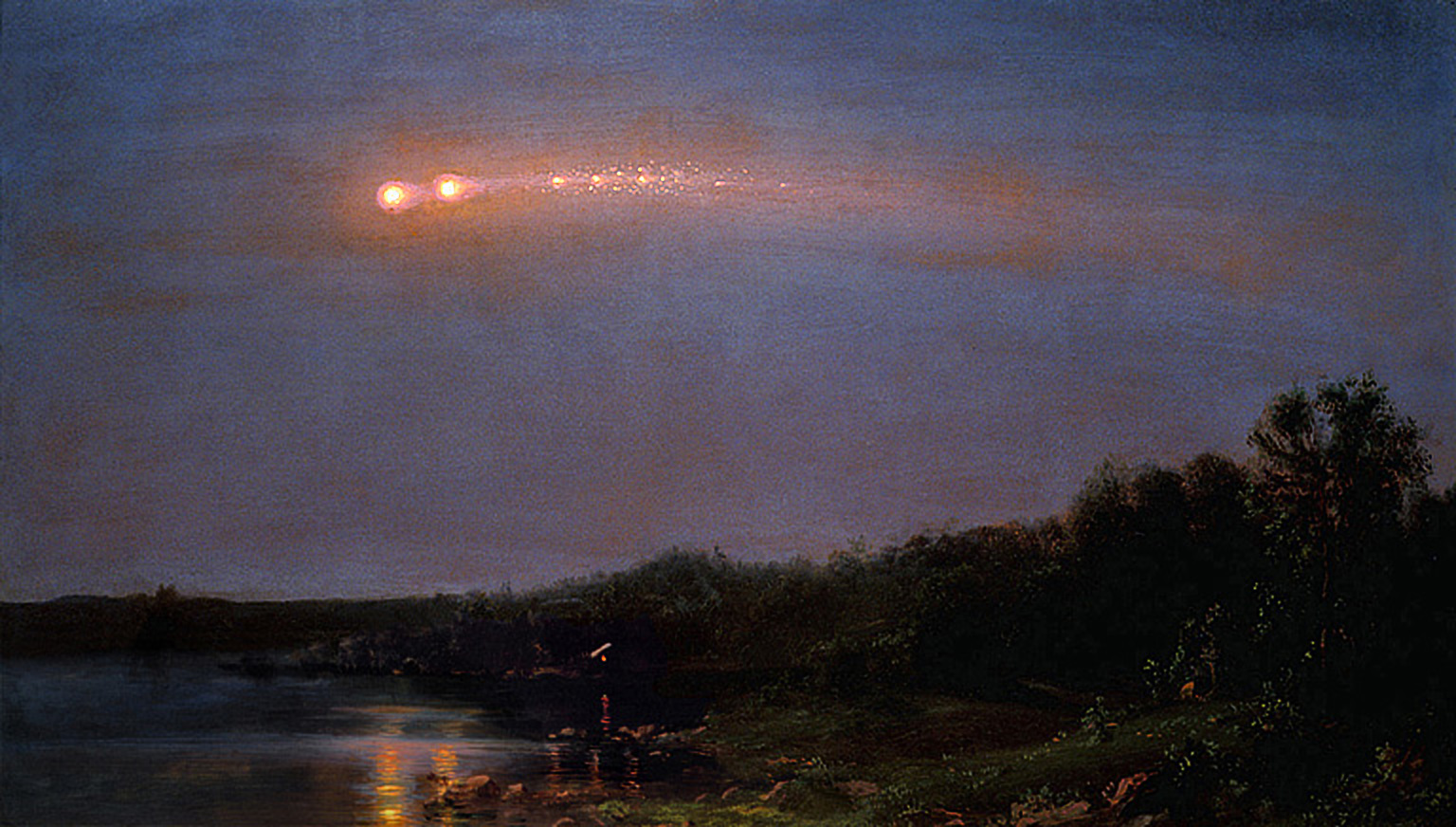
1860 was the year of comets and meteors in the United States. Four comets were discovered, one of which was to the naked eye from mid-June through July. The first meteor fell on May 1st near New Concord, Ohio.

A very rare event occurred on July 20th when an earth-grazing meteor, a meteor that moves nearly horizontally through the Earth's atmosphere, nearly parallel to the earth's surface, passed from Lake Huron near Buffalo, New York across Greenwich, Connecticut and out over the Atlantic. Meteor processions are so rare most people have never heard of them. There have only been four: 1783, 1860, 1876, 1913.

And then on August 2nd, a magnificent meteor appeared from Pittsburgh to New Orleans, and from Charleston to St. Louis, an area of 900 miles in diameter. Several observers described it as being larger than the full moon, and just before it's disappearance, it broke into several fragments. A few minutes after the flash of the meteor, there was heard throughout several counties in Kentucky and Tennessee a tremendous explosion like the sound of a distant cannon. Immediately, another noise was heard, not quite so loud, and the sounds were re-echoed with the prolonged roar of thunder.

From a comparison of a large number of observations, it was computed that this meteor first became visible of northeastern Georgia, about 82 miles above the earth's surface and that it exploded over the southern boundary line of Kentucky at an elevation of 28 miles. The length of its visible path was about 240 miles and the time of flight eight seconds, showing a velocity relative to the earth of 30 miles per second, and was this computed that it's velocity relative to the sun was 24 miles per second.


John W. Tuttle of Wayne County (1837-1927) wrote about the meteor in "Diary of John W. Tuttle, 1860-1867," which is on file at the University of Kentucky.

"Thursday, August 2, 1860:  Dr. J. B. S. Frisbie, W. A. Haskins and myself were sitting in the porch when all at once a meteor of the most intensely brilliant character arose in the Southeast, rising in its course at an angle of about 20 degrees, and moved with an apparently slow motion towards the Northwest.  Its light was of a peculiarly white character more brilliant perhaps than that of the sun. It completely blinded, for a moment, all who beheld it.

After the meteor had disappeared, I walked down town to learn the sentiments of the people generally with respect to the strange visitor. The matter was being discussed freely and many opinions expressed with regard to it. The savants differing among themselves displayed a depth of research into the hidden mysteries of physical science truly astounding. Illustrious examples shining forth from the page of history should have taught them the folly of attempting to tamper with the staid orthodoxy of the common mind to popular opinion.

The theory finding favor with the greater number was that the "last day" of the existence of this little ball of dirt had most certainly arrived. Some minutes after the disappearance of the meteor a sound, deep and unnatural, not unlike the rumbling of heavy thunder, in the distance, when near the earth but partaking of the roaring nature more like the roaring of a whirlwind. The sound continued for several minutes and gradually died away, greatly to the relief of those regarding the sound as the herald of an earthquake or judgment day."


In the Aug. 13, 1860 edition of The New York Times, Dr. Alex McCall of Rome, Tennessee said "the sounds were like hundreds of wagons running over bridges. The first sounds came from it when near to us, resembling powder explosions in open space, but the remotest sounds came five to ten minutes afterward. The intensity of the blaze made me spring from bed, supposing a fire had broken out, and on reaching the window, shadows were glancing in every direction.

'Caroline' said the moon had fallen and was burning up; 'Nick' said 'the fire ran into my eyes and woke me up; and 'Isaac,' jumping, asleep, from the ground, insisted the world was on fire. Then came the sounds like a great bass drum pelted by some giant, keeping time. In its rapid flight the meteor cast off thousands of sparks at every explosion, and then flashed bright as the sun, confusing the eye and causing the leaves and grass to appear purple; finally splitting into two meteors as it expired."


Though the meteor procession of 1860 garnered much public attention, it was mostly forgotten by the 20th century, perhaps overshadowed by the tremendous events of the Civil War that followed, but Walt Whitman and the thousands of other people who saw the meteors, and the rare meteor procession witnessed something truly special.

Walt Whitman’s "Leaves of Grass" includes the poem, “Year of Meteors, (1859-60),” in which he includes descriptions of a comet and meteors of 1860:

Nor the comet that came unannounced out of the north, flaring in heaven,

Nor the strange huge meteor procession, dazzling and clear, shooting over our heads,

(A moment, a moment long it sail’d its balls of unearthly light over our heads then departed, dropt in the night and was gone)


John Tuttle's diary spans his social and family life before the Civil War, his time serving in the Union Army's 3rd Ky Vol. Infantry, Co. H during the war, where he saw action at the battles of Shiloh, Lookout Mountain and Atlanta, and the post-war when he returned home to his legal practice in Monticello, where he presided over the bankruptcy court for almost 50 years. Tuttle and his wife, Mollie, had several children. He was born in 1837 and died in 1927 and is buried at Elk Spring Cemetery.

Wednesday, September 6, 2017

Like Father, Like Son...In The Civil War


The Civil War tore many families apart, pitting brother against brother or father against son, as each rallied to the flag of the cause that captured his heart. My family certainly fits into that category. Perhaps you read the recent story I wrote about the four Speck brothers who fought for the Confederacy. One of them was my 3rd great grandfather. This story is about his wife's uncle and three son's, who fought for the Union.

When the Civil War came to Tennessee, David Hill Walker and three of his sons, Stephen, John and George, decided to join the Union Army, enlisting in the same 2nd Tennessee Mounted Cavalry on June 19, 1862 at Cumberland Gap. They were mustered in for a three year enlistment under the command of Colonel Daniel M. Ray. The unit was composed primarily of Southern loyalists from the East Tennessee counties. The Walkers lived in Campbell County. Before that, the family lived in Washington County, Virginia. David rose to the rank of Sergeant in Company D, while his son's remained privates throughout their term of service.

The 2nd Tennessee Mounted Cavalry particpated in the Battle of Stones River at Murfreesboro, which was fought from December 31, 1862 to January 2, 1863, the Tullahoma (or Middle Tennessee) Campaign from June 24 to July 3, 1863 and the Battle of Chickamauga, from September 18–20, 1863.


Following the Battle of Chickamauga, some 1,500 Union troops from the 3rd Brigade, 4th Cavalry Division and the 2nd Tennessee Mounted Infantry moved in and occupied Rogersville, Tennessee, the second-oldest town in Tennessee, and the surrounding area, and began filling warehouses full of winter provisions, attempting to establish a Federal foothold in East Tennessee for future operations. About twice that number of Confederates, made up of Jones' Brigade, 2nd Cavalry Brigade and the 8th Virginia Cavalry, surprised the federal forces on the morning of November 6, 1863 and recaptured the town, along with all of the supplies in the warehouses. The Confederates held the town for the remainder of the war.

Out of 893 soldiers from the 2nd Tennessee who participated in the battle, only five were killed, but 608, including David Walker and all three of his sons, were captured. While the commisoned officers were housed at Libby Prison at Richmond, Virginia, the enlisted men were incarcerated at nearby Belle Island Prison. Those who survived Belle Island were transferred to Andersonville Prison in Macon County, Georgia, when it opened in February of 1864. David Hill Walker and his sons were either paroled or exchanged as the war came to an end.

David and his son, George, are both buried in Pikeville, Tennessee. George died in 1889 and David Hill died in 1892. Stephen died in 1913 and is buried at nearby Crossville. John died in 1910 and is buried at Vera Cruz, Missouri.


Thursday, August 31, 2017

Alexander Devin: Pioneer Preacher, Master Builder of Baptist Churches in South Carolina, Tennessee, Kentucky and Indiana

William Devin was born in Dublin, Ireland and came to America around 1745. He and his wife, Sarah, settled along Banister River in what is now Pittsylvania County, Virginia, near present-day Danville and Martinsville. Their son, Alexander, my 6th great-grandfather in my grandmother Dimple Means Speck's line, was born there on March 22, 1769.

Alexander was a Baptist preacher who was raised in South Carolina, preaching the gospel up and down the Pee Dee River (the original river in Stephen Foster's song, "Old Folks at Home.") It is written that he was a strong doctrinal preacher, a man of fine talents who exerted a strong influence on society. The "History of the South Carolina Baptist," by Leath Townsend, states that Devin helped John Hightower and Joseph Logan organize several churches there in the early to mid 1790's before migrating west to Kentucky in 1798.

According to J. H. Spencer's "History of Kentucky Baptists, Vol. 1," The Kentucky Legislature had passed an act in 1795, by which a preemption right to two hundred acres of land was secured to each settler in the Green River country. This induced a large influx of immigrants from the southeast to settle in that region. Most of the early settlers along the southern border of the State were from the Carolinas. A settlement by people from these states was made on the waters of Drake's Creek, in what are now Allen and Warren counties, as early as 1795. Among these, according to Spencer, were "a number of Baptists, including Hightower, Devin and Logan."


They organized Union Church near the West Fork of Drake's Creek in Warren County. Today, Old Union Missionary Baptist Church is considered to be the oldest, continuous congregation in Warren County, having been constituted in 1795.

Sulphur Springs Church was founded by the three preachers around 1797 or 1798. It was the first church of any denomination in Allen County.

They constituted Bethlehem Church (originally called Upper Difficult Church) in 1801. Logan was the first pastor, Hightower the second and Devin the third. Today, it is the oldest existing church in Allen County. These three ministers worked both together and separately throughout the region. There is a record of Devin and Hightower dedicating The Baptist Church of Jesus Christ in Smith County, Tennessee in 1802.

In his book, Spencer referred to Hightower, Logan and Devin as “the master builders” of Baptist churches who often taking turns serving the pulpit in churches they helped constitute.

(Alexander Devin House, 412 West State Street, Princeton, Indiana) )

Devin moved his family to the Indiana Territory in the spring of 1808. He was one of the first Baptist preachers in Southwestern Indiana. He bought the first lot sold in Princeton. Alexander and his son, Joseph, operated a pork packing and shipping business. They had large packing houses and ran an extensive business for many years, loading pork in flatboats and sending them down the river to New Orleans.

Alexander was one of three Gibson County, Indiana men who were delegates to the Indiana Constitutional Convention in 1816. The other two were David Robb and James Smith. In all, forty-three delegates from 13 counties across the southern part of the state met in Corydon (the original state capital) to vote whether or not Indiana should be declared a state. The vote passed 34-8 and Indiana became the 19th state on December 11th of that year. During Indiana's bicentennial celebration in 2016, all 43 delegates were honored. Devin’s stone at Warnock Cemetery was re-set before the ceremony took place.

After moving to the Indiana territory, Devin continued organizing churches. He collected the first churches of the Wabash Association, which was formed from five churches in 1809. He also organized Providence Church in 1822 and Harvey's Creek Church in 1823.

Alexander and his wife, Susan Nowlin, whom he married in 1793, had thirteen children. Alexander died on January 3, 1827 and is buried at Warnock Cemetery in Gibson County, along with his wife and most of their children.


Monday, May 30, 2016

A Soldier's Childhood Prayer

The following was found in the knapsack of a soldier of the Civil War, after he had been slain in battle.

~~~

Near the camp fire's flickering light
In my blanket bed I lie
Gazing through the shades of night
And the twinkling stars on high
O'er me spirits in the air 
Silent vigils seem to keep
As I breathe my childhood's prayer


"Now I lay me down to sleep"

Sadly sings the whip-poor-will
In the boughs of yonder tree
Laughingly the dancing rill 
Swells the midnight melody
Foemen may be lurking near
In the canyon dark and deep
Low I breathe in Jesus' ear


"I pray Thee, Lord, my soul to keep" 

'Mid those stars one face I see
One the Saviour turned away
Mother, who, in Infancy
Taught my baby lips to pray
Her sweet spirit hovers near
In this lonely mountain-brake
Take me to her, Saviour, dear


"If I should die before I wake" 

Fainter grows the flickering light
As each ember slowly dies
Plaintively the birds of night
Fill the air with saddening cries
Over me they seem to cry
"You may never more awake" 
Low I lisp, If I should die


I pray Thee, Lord, my soul to take"

Saturday, October 10, 2015

A Resting Place


Today, I visited Mill Springs National Cemetery at Nancy, Kentucky. My mother's uncle, who served with the U.S. Army during World War I, is buried there. There are over 4,000 graves at Mill Springs, including many of the Union soldiers killed in the battle that took place just across the way on January 19, 1862 during the American Civil War. It was a somber experience standing among all of those graves. It was a day full of proud emotion and respect for our soldiers. Red roses mark the grave of my loved one.

Jesus, Saviour of my soul
Let me to thy bosom fly
While the waves of trouble roll
While the tempest still is high

Hide me, O my Savior, hide
Till the storm of life is past
Safe into the haven guide
O receive my soul at last

(Charles Wesley, 1740 - from "Prayers Suitable For The Times In Which We Live," Charleston: Evans & Cogswell, No. 3 Broad Street, 1861)


The Story of Reuben Coffey, an American Revolutionary War Soldier

In Augusta Phillips Johnson's book, "A Century of Wayne County Kentucky 1800-1900," originally published in 1939, she used W...