Showing posts with label Champ Ferguson. Show all posts

Wednesday, July 26, 2023

Some Hopkins Family History

Jimmy Boles, the great grandson of Cyrus Booher Parrigin, and my second cousin once removed, who was born in New Castle, Indiana but raised in Clinton County, Kentucky, once wrote that his great aunt, Elizabeth Jane Mackey Hopkins, was a woman of great fortitude and courage, undaunted when faced with superior forces. During the Civil War, with her husband, George Wash­ington Hopkins away from home serving with the home guard, Champ Fer­guson and his men rode up to the Hopkins homestead, which was located near Mountain View Park. Already known for robbing and looting at will, Champ was in the process of stealing a horse and was unhitching it from a plow when Elizabeth, came out of the house with a gun and fired one shot, which hit the beam of the plow. She then ordered Champ Ferguson and his men to leave the property. Overwhel­med by a brave and determined woman, Champ retreated as ordered, without the horse or any other property belonging to the Hopkins family. Washington's tombstone says he was a member of Seventy Six Church for 58 years. His grandfather, Elijah, was the first deacon there.

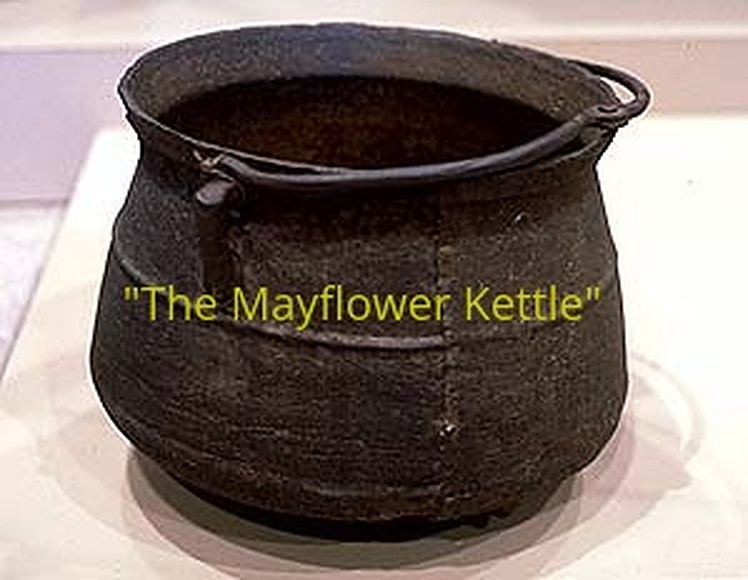
"THE MAYFLOWER KETTLE"

Speaking of property belonging to the Hopkins family, both Ella Nunn, in her book, "Things I Remember About Clinton County," and Jack Ferguson, in his book, "Early Times in Clinton County," both wrote that a Hopkins ancestor, Stephen Hopkins, was a passenger on the Mayflower when it departed for the new world in 1620. When it landed in America, Stephen carried with him an iron kettle that had been used as a churn on the voyage to America. When the Pilgrims celebrated their Thanksgiving it was used to help cook the first Thanksgiving dinner in America.

Supposedly, the kettle remained in the Hopkins family and was handed down to the oldest son from generation to generation and was eventually inherited by John R. Hopkins, who lived in Clinton County and is buried at Albany Cemetery. It is said that Scott W. Dowell, clerk at Clear Fork Baptist Church, certified on paper that he knew John R. Hopkins when he was a member of the church, and had heard him talk about the kettle. Boles wrote that when John died the kettle was passed on to a Bob Hopkins, who lived in Texas and that Ammazoo Hopkins of Midwest City, Oklahoma had relayed this story to him. Another story Boles said was that an old kettle that sat in the old Albany Bank in the 1920's was the kettle that came from the Mayflower.

The photo is only a representation of a kettle brought over on the Mayflower.

Friday, August 19, 2022

Face to Face With Champ Ferguson

John Garner had only been enrolled in school at Albany, Ky about six months when the civil war broke out, and had just recently left school and en­listed as a Union soldier the day he stood face to face with the infamous Champ Ferguson. It would be an encounter he would never forget.

After enlisting on New Years Day in 1863, two weeks shy of his 20th birthday, John had become concerned about his younger brother, Henderson, whom he had left behind in Clinton County, which was being terrorized by Confederate guerillas, including Ferguson, whom he described as a notorious human demon. Ferguson's killing spree lasted most of the war, from November 1861 to April 1865. Some of the killings were brutal and all were without mercy, with the victim usually face-to-face with him.

Determined to get his brother out of Clinton County, John dressed in civilian clothes and made his way on foot from Liberty to Somerset, and then to Albany, avoiding all public roads. His aunt, Betsy, lived in town, and his intention was to quietly slip into her home and stay hidden until she could fetch his brother for him. At the end of a wooded area in town, there was a cornfield which led up to his aunts garden. He could see her home from there, and noticed a few people were walking further down the street, but no one was near the home. Quietly, he ventured into the cornfield. Once he reached the garden, he stopped again to survey of the town. Seeing no danger, he crossed a fence and stepped into the back door of the house.

Upon seeing her nephew, Betsy threw up both hands and exclaimed, “The Lord have mercy, John what are you doing here?” He replied, "I am after Henderson. Where is he?” ‘'Gone and joined the army long ago,” she replied. “Which army?” he asked. “The Union Army,” she said. As Betsy John something to eat, suddenly there was gunfire and the clatter of horses feet, which seemed to be within very close range. John ran out on the porch, intending to get the house between him and town so he could make his getaway back into the cornfield. Suddenly, he was standing face to face with Champ Ferguson, whose pistol was drawn and pointed at him.

Champ: “What are you running for?"
John: ‘I am not run­ning, sir.”
Champ: “Where were you going?”
John: “I heard the clatter of horses feet and stepp­ed out here to see what was going on."
Champ: “Let me catch you running and you're a dead man."
John: “All right, if you catch me running, fire away.”

Betsy watched from inside the house as Ferguson whisked his horse and dashed back up the street. Both she and John were shaken up by what had just taken place, but now wasn't the time to talk about it. As Champ turned out of sight, John said goodbye to his aunt and began making his way through the tall green corn and into the woods. He remembered seeing at least a half dozen of Ferguson's men waiting in the street as he spoke to their captain. He realized any one of them might have recognized him as being a member of Col. Frank Wolford's Calvary had they come in­to the yard. He also realized how close he came to having his life taken from him, because he had heard that Ferguson took no prisoners, but cruelly murdered them.

After reaching the woods, John stopped and looked back toward town. He saw several people dashing about. Some were firing shots into the air. Feeling that he was now safe, he made his way to Rowena, where he boarded a steamboat bound for Burnside. A year later, John found his brother, Freeman, serving with the 6th Kentucky Cavalry.

When the war ended, John W. Garner became a minister in the Church of Christ faith and married Mary Freels of Wartburg, TN, a second cousin to Abraham Lincoln's mother, Nancy. They moved to Beloit, Kansas, but by 1895 were living in Perkins, Oklahoma, where John established a church and pastored there a few years before becoming an evangelist. John died in 1937 when he was 94 years old. His brother, Henderson, had also migrated west after the war. He died in Washington State in 1926. They were the sons of Freeman and Rachel Garner, who are buried at Tateville Baptist Church Cemetery in Pulaski County, Ky.

Wednesday, March 10, 2021

A Civil War Massacre in Overton County

The Officer family lived in a rural community in Overton County called Sinking Cane. William Alexander Officer, who had married a Cynthia Holford in that community in 1836, operated a sizable farm with pastures, timberland and a large two-story house. Today, the location is about two miles off Highway 84 on Rock Springs Road, near the foot of Monterey Mountain. The couple produced seven children — four girls and three boys — and dealt primarily in livestock. He favored the Confederacy.

William spent a lot of time driving livestock further into the South. Everyone knew he was away from home a lot and also was successful and financially sound. Therefore, given the ongoing war, the Officer family was subject to harassment by federals who came to the Officer home place and took what they wanted — a common practice on both sides of the conflict.

One of the Officer sons, John, had been born in 1845 and was thus a young man when the Civil War broke out. He enlisted as a private in the Confederate Army. In March 1864, during a period in which Tennessee was seeing a flurry of wartime skirmishes and guerrilla activity in rural areas, John had been granted a leave from Company F, 13th (Dibrell’s) Tennessee Cavalry Regiment to go visit his family. With him had come a handful of fellow Confederate soldiers who had become separated from their command.

He was home with his companions on March 12, 1864. His mother rose early, and with daughter Frances, set to work to make an especially good Saturday breakfast for John and their visitors. The young men were happily eating what was probably the best meal they’d had in weeks when a big band of federal soldiers, some 200 of them, part of Col. William B. Stokes’ command, rode up to the house.

The federals had been sent out by Stokes to hunt down Confederate guerrillas, particularly Champ Ferguson. Upon their arrival, John Officer jumped up in a panic and fled into another room, where a slave of the family, named Abraham, but usually called Uncle Abe, helped him up into a loft or attic area to hide.

The guns of the family’s visitors were not far away, stacked on one another in a hallway, but the federal band was a big one and there appeared to be nothing to gain by dashing to get the weapons to make a hopeless stand. Union troops entered the house and things went bad fast. Shooting began, killing on the spot five of the young Confederates: John P. York, Oliver Shipp, Samuel Garrett, William Slaughter and William Lipscomb.

Slaughter served in Company C, 1st Regiment Texas Rangers. York, Shipp and Garrett were part of the 8th Texas Calvary and Lipscomb was in the 3rd Regiment, Alabama Cavalry. A sixth Confederate there was 2nd Lt. Robert S. Davis, also of the 8th Texas. Davis was wounded but did not die inside the house, as his companions had. The federals hustled the wounded man outside and put him against a gatepost, tying him in place. There he was executed by a hastily formed firing squad (That gatepost is on display in the Overton County Museum).

In 1922, Uncle Abe gave an eyewitness account of the incident before the Tennessee Historical Commission. According to his testimony, Davis spoke to his killers before they shot him, saying, “You ought not do this. I have never done anything but my sworn duty.” Abe also noted that Davis never flinched when the federal soldiers fired and took his life.

The six massacred soldiers are buried at Officer Cemetery, located near the home. This event is referred to locally as the Stokes Atrocity. A state historical marker, describing the event, is posted on the main street in Monterey.

*Written by Cameron Judd, The Greenville Sun (Mar 2, 2019): "A Civil War Massacre At A Place Called Sinking Cane."


Sunday, July 15, 2018

"The Cause For Which We Stand"


I often write stories about the Civil War. I love the history behind it all, especially the local history from Wayne County down to Overton County and all points in between. There is much to be learned about the Civil War here in our own backyards. Like all of you, several of my ancestors fought in the war, and like many, I had family on both sides, and in the weirdest corners, too.

My 3rd great uncle was the notorious guerrilla Tinker Dave Beaty, who fought strongly for the Union cause. My 2nd and 3rd great-grandfathers, George and John Boles, were part of his Independent Scouts. On the other side, My 4th cousin, Fountain Frost, rode with Beaty's arch nemesis, the notorious Confederate guerrilla, Champ Ferguson, who fought just as strongly for states rights and 'the southern way of life.' My dad's side of the family in Overton County was mostly aligned to the Confederacy. My mom's side of the family in Fentress and Wayne counties were mostly aligned with Abe Lincoln, who felt it was his sacred duty as President to preserve the Union at all costs.

Very ironically, George Boles, although not yet officially my 2nd great-grandfather at the time, is believed to have killed Frost in a skirmish near Gilreath's Mill, not too far from Holbert Creek, and halfway between Chanute in Pickett County and Pall Mall in Fentress County, Tennessee.

It was sort of like that in the American Revolution, family on both sides, except...it was the same guy.

We all know the story of Benedict Arnold, the American soldier who switched sides and fought for the British during the Revolutionary War. But, have you met Ed Wade? He was 8th great-grandfather born on my dad's maternal side. To be exact, he was Edward C. Wade, Sr., born in York County, Virginia on April 21, 1727, and whose father, Colonel Robert Wade had fought in the French and Indian War. Yeah, that guy.

Edward was a Captain in the British Army at the beginning of the American Revolution, but in 1777, he and one of his brothers, so the story goes, decided to switch sides and join the Virginia Militia. It was a strong commitment to freedom for the Wade family, because two of Edward's sons, Richard and James, were killed while serving with the 6th Virginia Continental Line in 1776. After the war, Edward migrated to Georgia. He died on Nov. 4, 1790 and is buried at Little Creek Church Cemetery in Greshamville.

Switching sides was perhaps by conviction, perhaps it was because of personal belief, or perhaps it was to align oneself with their friends and families. Perhaps it was about wanting to please God. Each side believed God was on their side, but both prayed to the same God and read from the same Bible. So, whose side was the Lord on? During the Civil War, President Lincoln suggested neither side could claim God’s special favor. “The Almighty has His own purposes,” he said. It wasn't 'whose side is the Lord on,' but rather, 'who is on the Lord's side.'

An interesting side note locally: Edward Wade's second cousin, Richard Wade, left Virginia in 1777, the year Edward's father died, and moved to Boonesboro, Ky to help Daniel Boone defend the frontier. In 1801, he moved his family to a part of Wayne County that later became Clinton County. Richard is buried at Cartwright Cemetery. Also after the war, Edward's first cousin, Elizabeth and her husband, Samuel Denney, migrated to Wayne County and they lived on Beaver Creek.

Tuesday, June 27, 2017

The Guerrilla Hunters: Irregular Conflicts during the Civil War


A new book was published this past April entitled, "The Guerrilla Hunters: Irregular Conflicts during the Civil War" by Brian D. McKnight, Barton A. Myers and others. The subject of the book is explained in its title.

One chapter, entitled "Who is Tinker Dave Beaty, Hunting Guerilla Social Networks" (author Aaron Astor) gives great insight into why men joined Union Guerilla David Beaty's Independent Scouts.

The title of the chapter is a reference to a letter written on March 21, 1863 from Brigadier General George Crook to General James A. Garfield, Chief of Staff, Army of the Cumberland, Murfreesboro, where Crook asks the question, "Who is Tinker Dave Beaty?” (See the letter below) In the book, the authors present two reasons why men joined the independent scouts: kinship and revenge. This book is well worth reading. It is available at Amazon and Barnes & Noble.

Why would men want to join the independent scouts? David Beaty of Fentress County, Tennessee organized the unit early in 1862 in Fentress County. It was apparently never mustered into the regular U.S. Service, but Major General Ambrose E. Burnside authorized it to act as scouts, and operate in the regions of Overton and Fentress Counties in combating Confederate guerrillas. Members never drew any pay, but were supplied with arms and ammunition by the Federal authorities. It was first mentioned in the Official Records in a letter from Brigadier General George Crook, at Carthage, dated March 21, 1863, admitting his inability to establish a line of couriers due to the numerous bands of Confederate cavalry and guerrillas operating in his area. He inquired “Who is Tinker Dave Beatty?”

Confederate reports spoke of skirmishes with “Beatty’s band of robbers” and Pickett County's J. D. Hale, writing from Albany, on December 5, 1864 about the presence of “rebels” in the area, stated “Beatty knows of none in Fentress County.”

'Revenge'
Beaty, the Union guerilla, and Champ Ferguson, a Confederate guerilla, waged a bitter guerrilla warfare in the mountainous regions of the Upper Cumberland country throughout the war. Many residents, members of home guards in Clinton, Fentress and Overton counties, were murdered by guerillas on both sides. Ferguson and Beaty both claimed it was kill or be killed. Naturally, those residents that remained wanted to see the guerilla activity stopped. My maternal third great-grandfather, Elijah Koger, was one of the residents who tried to stop the guerilla warfare by arranging a peace agreement between both sides. While an agreement was reached, it was quickly broken by Ferguson. Koger's involvement in trying to bring peace to the region cost him his life, as he was murdered by Ferguson and his men at his home in the Oak Grove community of Clinton County.

'Kinship'
Tinker Dave Beaty was my maternal third great-uncle. His sister, Matilda, and her husband, John Boles, were my third great-grandparents. "The Guerrilla Hunters: Irregular Conflicts during the Civil War" mentions this and also refers to other relatives of mine who were members of the independent scouts.

My great, great-grandfather, George Boles, who after the war moved from the East Fork of Fentress County to Clinton County, was an independent scout, as was his brother, John Boles, Jr., who married his first cousin, Matilda Beaty, daughter of Tinker Dave Beaty's brother, Fleming. George and John Jr.'s sister, Mary Ann, married Thomas Allred, who was also an independent scout.

Tinker Dave's son, James, married Elendor Jane Smith, George Boles' sister-in-law, whose father, David, and brother, Ahijah, were murdered by Confederate guerillas, possibly Champ Ferguson's men. David, Ahijah and another son, Asa, were also members of the independent scouts.

~0~

At the conclusion of the war, Ferguson was arrested for the murders of 53 people. He was found guilty and was hung on October 20, 1865.

"I am yet and will die a Rebel … I killed a good many men, of course, but I never killed a man who I did not know was seeking my life. … I had always heard that the Federals would not take me prisoner, but would shoot me down wherever they found me. That is what made me kill more than I otherwise would have done." - Champ Ferguson, after being found guilty.

Tinker Dave Beaty testified at Ferguson's trial and admitted to killing 25 people himself. But, his side won the war and he was never charged.

Carthage, Tenn., March 21, 1863

Gen. James A. Garfield, Chief of Staff, Army of the Cumberland, Murfreesborough:

I cannot send daily reports, as I have only a few horses, and it takes all of them to escort the mail down one day and back the next. I cannot establish a courier line unless I have cavalry to keep the enemy from coming on this of the river. The rebels taken all the horses from this section of the country, except old brood-mares, fillies, &c. Were my men mounted on these, in any movement requiring expedition, I would have to dismount and go afoot. I was never completely beat out before, but I have to acknowledge that I can do nothing against this cavalry with my infantry. I cannot entrap them in any possible way, for they have their spies and scouts all over this country, and I can make no movement without their being apprised of it before I can get to them with my infantry, and then, if it is not to their advantage to fight me, they get out of the way. They have no baggage or trains to detain them from making rapid movements.

I have seventy days' complete rations here, 150 rounds of ammunition for small-arms, and 200 rounds for battery.

I sent boat up the river yesterday, 43 miles; returned this evening, bringing some 500 bushels of corn and 600 bushels of wheat. The boats were attacked last night or this morning by several hundred cavalry. They did no damage. There are no supplies on the south side of the river amounting to anything.

Who is "Tinker Dave" Beatty?

What amount of supplies shall I accumulate here? I can get no answers to my dispatches to you. The boats leave in the morning for Nashville.

Respectfully,
George Crook, Brig.-Gen.


Tinker Dave Beaty, left, and Brig. Gen. George Crook


Thursday, May 18, 2017

A Kentucky Family On Both Sides


Just before he died on Feb. 5, 1941, my great, great-grandfather, George Boles, looked at my grandmother, Vada Frost Boles, and said, "I killed your uncle." What was he talking about? Who did he kill?

Because of Abraham Lincoln's stance against slavery, South Carolina, Georgia, Florida, Alabama, Mississippi, Louisiana and Texas seceded from the Union between December 1860 and February 1861. After South Carolina’s April 1861 attack on Fort Sumter and President Lincoln’s Call to Arms to put down the rebellion, four more states - Arkansas, North Carolina, Tennessee and Virginia - also seceded. The Civil War was on.


But, while Tennessee voted for succession, most of the counties in the Upper Cumberland area voted against it. The Fentress County vote was 128 for and 651 against, however, the vote in neighboring Overton County, which included the area that is now Pickett County, was 1,471 for and 364 against. While a succession vote never took place in Kentucky, 100,000 Kentuckians served in the Union Army and between 25,000 and 40,000 answered the call for the Confederacy.

Many communities and families were torn on the slavery issue. My grandmother Vada's Frost family is one example. It was literally brother against brother in her great-uncle Fletcher's family. Fletcher was the older brother of Vada's grandfather, Cord Frost. Fletcher and Cord married the Owens sisters, Cyrena and Almira.

RIDING WITH CHAMP FERGUSON


Three of Fletcher and Cyrena's sons fought in the war. Alexander served in the Union army, but two of his brothers joined the Confederacy.

The 11th KY Cavalry of Kentucky Volunteers, B.W. Duke's Brigade, was organized on Aug. 10, 1862 and mustered into Confederate service on Sept. 10th for three years. Fountain Frost was a member of this Company K from its beginning. He was elected 1st Lieutenant on Sept. 1, 1862 and commissioned 2nd Lieutenant on March 10, 1863. He also rode with notorious guerilla Champ Ferguson. At Ferguson's trial after the war, he was specifically mentioned as being with him in March and October of 1862. Alvin Piles testified he saw Ferguson in the fall of 1862 driving out cattle, horses and mules on the South Fork in Wayne County. Over twenty men were with him, including Fount Frost.

Two days before he was hung on Oct. 20, 1865, part of Champ Ferguson's confession to a Nashville Dispatch reporter included this..."I killed Joseph Stover after he had shot at me twice. He was taking a third aim when I shot him in the mouth, and Fount Frost shot him in the side at the same time." This happened in April of 1862.


GILREATH'S MILL, FENTRESS COUNTY

In September of 1863, a skirmish between Ferguson's company and Tinker Dave Beaty's Independent Scouts took place at Gilreath's Mill off present day Highway 325 in Fentress County. Fountain Frost was killed by Beaty's men. He was buried in an unmarked grave in what is now called Red Hill Methodist Cemetary next to mill.

GEORGE BOLES' CONFESSION

Did George Boles kill Fount Frost? It's not conclusive, but Fount is probably who George was talking about when on his death bed he told Vada Boles that he had killed one of her relatives. The actual account says Fount was killed by Beaty's men. George Boles was a member of Tinker Dave Beaty's Independent Scouts. His mother, Matilda, was Tinker Dave's sister. Fount Frost wasn't my grandmother's uncle, as he stated on his death bed. He was her second cousin, the son of her great uncle. Still, it makes sense that George was talking about Fount Frost.

GUERILLA WARFARE


Guerilla activities were hard on the citizens of Fentress and Clinton counties. My ancestors rode with both Champ Ferguson and Tinker Dave Beaty. Tinker Dave became Champ's greatest enemy during the Civil War. Beaty was as ruthless and vicious in his defense of the Union as Ferguson was of the Confederacy. The Nashville Dispatch noted that Beaty ‘fought Champ Ferguson from the beginning to the end of his career. "They have shot at each other innumerable times, and each has received ugly wounds. They were deadly enemies, and hunted each other down with savage ferocity," wrote the newspaper. Beaty testified against Ferguson at his trial, which began on July 11, 1865. After Beaty's testimony, a reporter asked Ferguson what he thought of Beaty. ‘Well, there are meaner men than Tinker Dave,’ Ferguson responded. ‘He fought me bravely and gave me some heavy licks, but I always gave him as good as he sent. I have nothing against Tinker Dave. We both tried to get each other during the War, but we always proved too cunning for each other.’ He noted that he was a skilled shooter who always hit his mark, except when the mark was Beaty.'


MORGAN'S RAID

Fount Frost's brother, Samuel, was with Co. H 7th KY Cavalry during the Civil War and saw his life come to a tragic end following his capture during Morgan's Raid, a highly publicized incursion that purposely coincided with the Vicksburg and Gettysburg campains, meant to draw tens of thousands of U.S. troops away from those events.


The raid headed north from Sparta, TN on June 11, 1863. Brig. Gen. John Hunt Morgan and 2,460 handpicked Rebels routed local militia at the Battle of Corydon in Indiana and headed east across southern Ohio. It was there that Union Maj. Gen. Ambrose Burnside ordered out all available troops and a battle at Buffington Island in Meigs County, Ohio on July 19, 1863 ended in the capture of over half of the 1,700-man Confederate force. General Morgan and some 700 men escaped, only to surrender a week later, on July 26th, at the Battle of Salineville at New Lisbon.

CAMP DOUGLAS PRISON CAMP


Samuel Frost was sent to Camp Douglas Prison in Chicago. He died there eight months later on March 26, 1864. The official cause of death was listed as 'general debility,' a broad term referring to a loss of strength in the body, which in his case was no doubt highly degenerative considering the conditions at the camp. The official death toll at Camp Douglas was 4,454, but it has been estimated that more than 6,000 Confederate prisoners died there during the Civil War, not from battle wounds, but from diseases like smallpox, dysentery and pneumonia, plus starvation and torture. 4,275 known Confederates, including Samuel Frost, are buried in the Confederate Mound at Oak Woods Cemetery in Chicago, one of the largest mass graves in North America. There could be as many as 1,500 more who were reported as unaccounted for.


Fount and Samuel's brother, Alexander, who served in the Union Army, didn't die in the Civil War. He married Lizzie Rains on Sept. 23, 1888 in Carroll County, Arkansas. Alexander died around 1899. Their uncle, Cord Frost, my great, great-grandfather, was a Private in Co. H, 13th Kentucky Calvary from Dec. 1, 1863 to June 10, 1865. He named my great-grandfather, Ulysses Simpson Frost. His nickname was "Grant."

Vada Frost Boles, her husband, Elmer Boles, George Boles' grandson, and my mother.


Saturday, February 11, 2017

Protecting and Preserving The Peace During The Civil War Was A Family Affair


"Tinker Dave Beaty was born 200 years ago this Feb. 19th, in 1817. During the civil war, he formed a company, known as Independent Scouts, to protect the residents of Poplar and Buffalo coves in Fentress County, then Overton County, from Confederate Guerillas and troops, who were raiding the local population. This company, which sometimes consisted of as many as one hundred men, was officially recognized by the federal government and received into the service of the Union army on January 5, 1862.

The Independent Scouts' job was to act as scouts and combat Confederate guerrillas who came through their area. They were not paid, which by definition made them guerillas, but were supplied with arms and ammunition by the Federal authorities. Each man was required to furnish his own horse and equipment.

For me, David Beaty's Independent Scouts was a family affair. Tinker Dave's father, George, was my 4th great-grandfather. His sister, Matilda, married John Boles, a former state representative and state senator, who became captain of the independent scouts. They were my 3rd great-grandparents. Their son, George Boles, my 2nd great-grandfather, was also a member of the Independent scouts, as was his father-in-law, David Smith, my 3rd great-grandfather, along his sons, Asa and Ahijah Smith.

In 1863, a skirmish between the independent scouts and Confederates under Captain Hutchinson reportedly happened near George Boles' place in what is now Pickett County. Captain Hutchinson was killed and three of his men were wounded.

In 1864, the Independent scouts engaged Confederate Colonel John Hughes' company and Champ Ferguson in a skirmish as they came into Fentress on a foraging expedition. It reportedly happened in the Buffalo Cove Area near the home of John Boles. The independent scouts, being greatly outnumbered, were forced to retreat, causing them to fall behind some of their men. Thomas Culver, Jop Moody and Tinker Dave's young son, Thomas, were captured. Culver and Moody were killed and Thomas would also have been killed had it not been for two Boles women, who begged for his life. Several Confederates were wounded.

On February 1, 1863, Confederate guerillas rode up to David Smith's home on the East fork of Big Indian creek looking for his son, Asa, who was not at home. David and another son, Ahijah, were both killed. They are buried at Doogan Smith Cemetery, which is across from the house where they were killed. Asa Smith died in 1920. He is buried at Elias Bowden Cemetery in Fentress County.

John Boles died in 1869. Matilda died in 1903. They are buried at Bolestown Cemetery, near Boatland. George Boles died in 1941 and is buried at Cedar Hill Cemetery in Clinton County.

It has been written that Tinker Dave Beaty was as ruthless and vicious in his defense of the Union as Champ Ferguson was of the Confederacy. Beaty and his Independent Scouts probably killed as many men as Ferguson and his men did, if not more, but because the Confederacy lost the war, Ferguson became the monstrous criminal and was hanged for his actions, while Beaty became ‘the celebrated Union scout.’ The same deeds that made a man a criminal could have made him a hero if his side won.

Tinker Dave Beaty died on Aug. 22, 1876. He and his father, George, are buried at Beaty-Lacy Cemetery on Tinker Dave's farm at Boatland.

I like to think that George Boles was acquainted with Elijah Koger, but there no account of that. Elijah lived at Oak Grove in Clinton County and George lived at Poplar Cove in Fentress County (Overton). After the war, they would be connected by marriage. While members of the Boles family were bust protecting the citizens of Fentress County (Overton County), Elijah Koger was busy doing the same as a member of the Clinton County home guard, a group of residents who had been trained in warfare at Camp Dick Robinson in Garrard County but were not officially brought into the service of the Union army. Koger went a step further with his commitment and it eventually cost him his life.

Elijah Koger was my 3rd great-grandfather. Fifty years after the Civil War, in 1915, his granddaughter, Nannie, married George Boles' son, Ahijha (Hige) Boles.

The guerilla warfare that took place along the Kentucky-Tennessee border, which Tinker Dave Beaty, Champ Ferguson and others were responsible for, was taking its toll on the citizens who lived in the Upper Cumberland area along the Tennessee-Kentucky border. Murder, theft and arson were commonplace.

In 1862, Union and Confederate factions of the Upper Cumberlands attempted to reach a peaceful compromise. A peace conference was held at Monroe in Overton County. The parties agreed not to raid into the adjoining counties. However, the compromise was dead before it began. Within hours, Ferguson and his men killed four Overton County men on the way back to Clinton County, and Confederate J. W. McHenry raided into Clinton County. They blamed it on a lack of communication by the peace officals, but many of those men who attended the conference were later murdered.

Elijah Koger was part of a group of home guardsmen who kept watch over Clinton County and he was one of the men who were chosen to repesent the Union at the Monroe Compromise.

On the morning of Sunday, June 1, 1862, Koger arose from his bed and headed out to the spring with his wife, Nancy, beside him. Shots rang out as a band of men appeared suddenly out of nowhere. Nancy screamed fo Elijah to run. As he tried to flee, Ferguson overtook him and shot him. Koger threw up his arms and said something, but Nancy could not make out his words because the couple's children were screaming. Shots continued to ring out as Elijah ran toward a fence some fifty yards from the home in the Oak Grove community. With Ferguson and nine other men following him, Elijah reached the fence and when he tried to cross it, Ferguson rode up close to him and shot him one more time. By the time Nancy reached the fence, the couple's 11-year-old daughter, Sarah, was holding her daddy in her arms. She was covered in blood. When Nancy reached Elijah, he gasped once, but never spoke. He had been shot more than 30 times. Nancy knelt beside her slain husband's body as Ferguson and his outlaw gang ransacked the Koger home.

The reason Elijah Koger was so involved in peace-keeping efforts during the civil war begins with his wife's brother, William Frogge, my 3rd great-uncle. He has the distinction of officially being the first person murdered by Champ Ferguson during the war. It happened on Nov. 1, 1861.

When he rode up to the Frogge cabin, Esther Frogge suspected no ill will. After all, she had known Ferguson since childhood. She offered him a seat and an apple. He refused both and sought out her husband, who lay ill in his bed. Champ asked William about his health. Frogge responded, “I am very sick. I had the measles and have had a relapse.”

Champ accused Frogge of having contracted the measles while visiting Camp Dick Robinson. Frogge vehemently denied that, but Ferguson drew his pistol anyway and shot Frogge twice, killing him. He then ransacked the cabin.

Ironically, the next to last person murdered by Champ Ferguson during the civil war was my 4th great-uncle, Martin Van Buren Duvall. Van was the uncle of Elijah Koger's wife, Nancy. It happened on April 26, 1865, seventeen days after Lee surrendered to Grant. Duvall was on furlough from the army and was at his brothers home, in sight of Oak Grove Cemetery, when he saw Champ Ferguson riding up to the residence. Van tried to run but Ferguson chased him down and shot him dead. He murdered his last victim, John H. Hurt, the next day."
Monday, July 4, 2016

Celebrating July 4th at Hale's Mill

The possible site of Hale's Mill, downstream from Wolf River Bridge on Highway 111 in Pickett County, TN.

"On the 4th day of July 1861, near a thousand men, women and children of Overton and Fentress Counties, Tennessee, met at Hale’s Mill and celebrated the day, as had been the custom in former years. They raised a hickory pole, on which was hoisted the old flag. Dr. Hale’s daughters and their teacher, sang the “Star Spangles Banner.” Mrs. Hale, read the Declaration of Independence, and the whole concourse of people partook of a bountiful repast prepared by our women, every one of whom opposed revolution in every shape." - J.D. Hale.

The Civil War had begun twenty-two days earlier. Our ancestors thought this area was too remote to be included in any war, but it came nearly three months later to Travisville. The date was September 29,1861. The Affair at Travisville, as it became known, was the first military action of any kind during the Civil War in Tennessee. Not only in shots fired, but also in the first fatalities. Four Confederate soldiers were killed and four others were captured.

Almost four months later, on January 19, 1862, the Battle of Mill Springs was fought at nearby Nancy, Ky in Wayne  and Pulaski counties. The war coming here was inevitable. By its end, 10,500 battles, engagements and other military actions had occured, including nearly 50 major battles and about 100 others that had major significance. The remainder were skirmishes, reconnaissances, naval engagements, sieges, bombardments, etc. The engagements were fought in 23 different states and resulted in a total of over 650,000 deaths.

In October of 1845, Jonathan Hale and John Jouett began to erect grist and saw mills on Wolf River. This 100-acre property was in the area where the Farmhouse Restaurant is located on Highway 111, between Byrdstown and the Tennessee-Kentucky state line. Hale established a two-story mill and store and served as postmaster at Hale's Mill. It was said that he also operated a manufacturing facility there, producing wagons and furniture.

Hale, known as J.D.,  had been born in Stoddard, Massachusetts in the year 1817. He stood five-feet-nine inches high with a heavy build. He was rather stooped, or round at the shoulder. His head was long and narrow. His hair was a sandy color and he was said to have a gray eye. He and his wife, Pheroba Chilton (1826-1905), had seven children.

When the Civil War started in 1861, Hale and his family declared for the Union. As a matter of fact, he was among the first to denounce and expose session. The U. S. Army appointed him a captain and Chief of Scouts of the Army of the Cumberlands. In this capacity he served under General George Thomas. Hale reported on the activities of Confederate leaders Morgan, Forrest, and Wheeler. He also recruited men in Tennessee for the Union army.

The massive July 4th celebration that had taken place at Hale's Mill, coupled with Hale's expressions of loyalty to the United States, infuriated Confederate sympathizers. Hale's family was forced to flee across the state line to Albany, Ky for safety. Three days after the July 4th celebration, all of Hale's property was destroyed by fire. $20,000 worth of buildings and materials were burned, including Hale’s home and two other houses, a large library in Hale’s house, worker's cabins, a barn, stable, store, still house, kitchen, grist and saw mill, 1000 bushels of corn, planning machine, mortising machine, running lathe, circular saws, tolls, lumber, wagons, and furniture. In 1864, a military commission awarded Hale $25,000 in a assessment levied against those accused of burning his property.

The Civil War officially ended on May 9, 1865. The 4th of July celebration across America that year was unlike any other in the nation’s history. An uneasy mix of joy, relief, resentment and unhealed wounds was reported as Americans sought reasons for celebration after a war that nearly tore apart the country.

Three months earlier, Confederate Gen. Robert E. Lee had surrendered to Union Gen. Ulysses S. Grant at a Virginia courthouse and, days later, John Wilkes Booth fatally shot President Lincoln in a Washington theater. Richmond and much of the rest of the South were in ruins, ruled by the U.S. military, while an untested President Andrew Johnson was trying to find his way forward. He looked to the 4th of July as a launching point to reunify not just the states, but also the hearts and minds of their inhabitants. “Of all the anniversaries of the Declaration of Independence, none has been more important and significant than that upon which you assemble,” he proclaimed. “Let us trust that each recurring 4th of July shall find our nation stronger in number, stronger in wealth, stronger in the harmony of the citizens, stronger in its devotion to nationality and freedom.”

For the first time in more than four years, Independence Day 1865 dawned without Americans on the battlefield trying to kill other Americans. Contemporary accounts and newspaper stories depicted a subdued, at times somber celebration in a country struggling to recover a sense of normalcy. In some places, the holiday was barely observed at all.

And so it was that on July 4, 1865, a group once again gathered at the Hale's Mill site to celebrate Independence Day, as well as the outcome of the war. They hoisted the 'old flag' and attendants fired a 34-gun salute. Hale’s daughters again sang the Star Spangled Banner and this time it was Hale who read the Declaration of Independence.

In his book, "The Bloody Shirt," Hale wrote, "In what does freedom consist? What is meant by the expression to be free, which really has no meaning at all in this connection, for the ex-slaves as a mass are not so free to be contented as they were at the commencement [of the war] in which we considered it honorable to destroy one another...what signified to the soldier wisdom, purity, patriotism, while an ounce of lead pierced him and he died in the midst of thousands of other dying men, whose last view was of their homes destroyed by fire and sword, amid the cries of their women and children perishing - all for pretended principles no one knew the merits of?"

By 1871, the Hale family had left this area for New Hampshire. Jonathan died of old age in 1896. In 2011, Tennessee honored him by erecting a historical marker near the site of Hale's Mill on Highway 111 in Pickett County. It is located beside the Farmhouse Restaurant.

Jonathan Hale, left, and Tinker Dave Beaty


Monday, April 11, 2016

Friends, Neighbors and Enemies

In Champ Ferguson's world, many of his once long time friends and neighbors had become his enemies. He despised what the Union army's Camp Dick Robinson stood for. Regardless of who or what they were, he was compelled to target and eliminate those who had been there. That was how he justified murdering William Frogge and Elijah Koger. William was the brother of my great-great-great-grandmother, Nancy Koger. Elijah was her husband.

William had gone to Camp Dick Robinson as a member of the 12th Regiment, Kentucky Volunteer Infantry, Co. D, but contracted the measles during training and was sent home. On November 1, 1861, Ferguson showed up at the Frogge home, eight miles north of Albany. Not suspecting anything, William's wife, Ester, welcomed their friend inside. Because of his illness, William was confined to his bed. ‘I reckon you caught the measles at Camp Dick Robinson,’ Ferguson said just before he shot him dead. He would later claim that he had heard rumors that Frogg was planning to kill him. ‘I told the boys that I would settle the matter by going direct to Frogg’s house and killing him.'

William's brother-in-law, Elijah Koger, had not only also been at Camp Dick Robinson, he had also taken part in a peace conference at Monroe, Tennessee, where both sides from Clinton, Fentress and Overton counties had met to try and end the senseless murder, theft and arson by guerilla gangs that had become commonplace while the regular soldiers were away at war. The peacemakers agreed not to raid in adjoining counties, but the conference was deemed a failure after Ferguson and his men killed four Overton County men on their way back to Albany.

On Sunday morning, June 1, 1862, at Oak Grove, Elijah arose from his bed and headed out to the spring with his wife beside him. Shots rang out as a band of men appeared suddenly out of nowhere. Nancy screamed fo Elijah to run. As he started to flee, Champ Ferguson overtook him and shot him. Elijah continued to run as more shots rang out. By the time he reached a fence fifty yards away, Elijah had been shot more than thirty times. When Nancy reached the fence, the couple's 11-year-old daughter, Sarah, was holding her daddy in her arms. She was covered in blood. He gasped once, but never spoke.

President Abraham Lincoln summarized Ferguson's way of thinking when he wrote, “Each man feels an impulse to kill his neighbor lest he be first killed by him.”

On October 20, 1865, Champ Ferguson was hanged for the murders of William Frogge, Elijah Koger and 51 others. Esther Frogge and Nancy Koger testified at his trial.


Thursday, December 24, 2015

The Deaf Taxi Driver

George A. Guinn was a deaf taxi driver, who transported people between Albany and Monticello. Born on August 4, 1868, he was the grandson of Reuben Bayless Wood, who was murdered by Champ Ferguson during the civil war.

(From Albany's New Era newspaper...)
"Mr. George A, Gwinn, successful farmer and influential citizen of near town, died in a Nashville hospital, Sunday, June 16, where he had been following a stroke of paralysis at his home Friday. His death removes one of the county's most prominent citizens. He was seventy-two years of age, and is survived by his wife, formerly Mrs. Ida Mae Armstrong, and one brother, Mr. R. W. Gwinn of Danville. Funeral services were held at the Baptist church here Tuesday morning at 10:00 a. m., and were conducted by Rev. G. H. Lawrence through Sewell Funeral Home. The burial was in the Albany cemetery following the services at the church."


Monday, August 31, 2015

Tinker Dave Beaty: A Rough, Uneducated Mountain Man Who Never Forsook The Flag Of His Country

Along about the 1st of February, 1862, several of Captain Scott Bledsoe's men came to Tinker Dave Beaty's house in the Buffalo Cove area of Fentress County, Tennessee and told his wife to tell him that he must take sides in the Civil War or leave the country. They kept returning to the area every few weeks, killing and driving people off. Beaty told his sons that before he would leave home or run away, he would fight the enemy until Doomsday and if they killed him, let them kill him. Beaty raised a company of men, sometimes as many as 60, sometime as low as five. Included were his brother-in-law and nephews, my third great-grandfather, John Boles, and his sons, John Jr. and my great, great-grandfather, George Boles. The independent scouts also included my great, great uncles, Asa and Ahijah Smith. Beaty's Independent Scouts received no pay, but the government furnished them with all the ammunition they needed. At Champ Ferguson's trial, Beaty said, "I don't know how many men we bushwhacked and killed but I suppose we killed 25 or more." Some say more, many more. Major John Allen Brents of Albany would later write that Tinker Dave Beaty was a rough, uneducated mountain man, who never forsook the flag of his country.


Tuesday, May 12, 2015

Blessed Are The Peacemakers


"Blessed are the peacemakers: for they shall be called the children of God."

It was during the late winter and early spring of 1862, as the civil war was now in full swing, that the Union and Confederate factions of the Upper Cumberland attempted to reach a peaceful compromise in order to prevent the raids that were occuring in Fentress and Overton counties in Tennessee, and Clinton County in Kentucky. Murder, theft and arson had become commonplace during the absence of regular soldiers who had gone off to fight in the war. A peace conference was held at Monroe in Overton County. The Northern side was represented by men from Fentress and Clinton counties. The southern side was represented by men from Overton County. Since confederate guerilla Champ Ferguson was committing the largest number of atrocities, he was invited to the conference to represent the Confederate interests of Clinton County. That was a big mistake.

Although the parties agreed not to raid into adjoining counties, the Monroe Compromise was dead from the start. Within hours Ferguson and his men killed four Overton County men on his way back to Clinton County. Ferguson, among others, would carry on a murderous rampage throughout the war against all who were in support of the Union.

"Blessed are they which are persecuted for righteousness' sake: for theirs is the kingdom of heaven."

Before the war's end, most of the Union men who had participated in the Monroe Compromise were killed, most within the first year: James Zachary, Thomas Wood, William Johnson, Robert Martin, Joseph Stover, Louis Pierce, Eli Hatfield, Parson Joseph Dalton, a Mr. Taylor and John McDonald. Another who was murdered was my third great-grandfather.

"Blessed are ye, when men shall revile you, and persecute you, and shall say all manner of evil against you falsely, for my sake."

On the morning of Sunday, June 1, 1862, 32-year-old Elisha or "Elijah" Koger arose from his bed and headed out to the spring with his wife, Nancy, beside him. Shots rang out as a band of men appeared suddenly out of nowhere. Nancy screamed fo Elijah to run. As he tried to flee, Ferguson overtook him and shot him. Koger threw up his arms and said something, but Nancy could not make out his words because the couple's children were screaming. Shots continued to ring out as Elijah ran toward a fence some fifty yards from the home in the Oak Grove community. With Ferguson and nine other men following him, Elijah reached the fence and when he tried to cross it, Ferguson rode up close to him and shot him one more time. By the time Nancy reached the fence, the couple's 11-year-old daughter, Sarah, was holding her daddy in her arms. She was covered in blood. When Nancy reached Elisha, he gasped once, but never spoke. He had been shot more than 30 times. Nancy knelt beside her slain husband's body as Ferguson and his outlaw gang ransacked the Koger home.

"Rejoice, and be exceeding glad: for great is your reward in heaven."

Even though he was violently killed for his efforts, I am very proud that my ancestor, a leader in his community, had it in his heart to arrange a peace agreement that would have stopped the senseless acts of violence that overshadowed the civil war conflict in Clinton, Fentress and Overton counties. Even though he and the others were part of their communities' home guard, they should have received a medal of honor, or some other great recognition for the peacemakers that they were. I want to also mention that there were other Union men who were at the Monroe Compromise meeting who were pursued and terrorized throughout the war, but not killed.

As for Champ Ferguson, on October 20, 1865, he was hanged for the brutal murder of Elijah Koger and 52 others he had been convicted of murdering during the war.

~~~

The historical significance of the Monroe Compromise rests upon the premise of what might have been. It is a story of reasonable men searching for solace in unreasonable times. It is the story of lives lost and families destroyed. I am at least honored to count my ancestor as being part of that brave group of men.

For the record, I had family members on both sides of the Civil War conflict, who were both persecuted and harmed over what they believed in.


Elijah Koger was the grandfather of my great-grandmother, Nannie Koger Boles.


Thursday, December 4, 2014

A Short Bio Of Thomas Wood


Thomas Wood was born on Aug. 5, 1779. He grew up on his fathers farm in Washington County, North Carolina (later Tennessee). At age 18. he served in the state militia. Afterwards, he accompanied his brothers, William, Samuel, John and George to a new life in Kentucky. He recorded 200 acres on Spring Creek, near present-day Albany, on December 18, 1798. He worked as a chain carrier on important surveys done by his brother, William. When his father died in 1800, Thomas returned to Washington County to take care of family matters. While there, he met his future bride, Mary Bayless. After marriage, they joined Thomas' brothers in Kentucky.


Thomas and Mary joined Clear Fork Baptist Church by letter in February of 1804. Thomas took an active part and filled in as church clerk when his brother, William, was in Frankfort serving in the State Legislature. Thomas was appointed deacon in July of 1811. Over the next two decades, Thomas faithfully served in his church. Then, in 1834, he went to Illinois to visit his brothers, James and Samuel. While there, he bought 160 acres intending to relocate. But, upon returning to Kentucky his boot rubbed a blister on his foot, resulting in blood poisoning that caused his death eight days after returning home.


Thomas' daughter, Mary, was the wife of well-known preacher, Isaac Tipton Reneau. Before he became a preacher in 1835, Reneau taught school at Clear Fork. He started doing that in 1830.


Thomas' son, Reuben Wood, was murdered by Champ Ferguson during the civil war. It happened on December 1, 1861 at Wood's home. Ferguson shot Reuben in his stomach, but Reuben was able to go inside his house, where he grabbed a hatchet. The two men scuffled for several minutes. At one point, Ferguson dropped his pistol onto a bed, where it got lost in the covers. Ferguson ran from the house leaving the wounded a wounded man behind. Reuben Wood died three days later on December 4, 1861.

Friday, May 23, 2008

Tinker Dave Beaty "...He did not choose the war so much as the war came to him."


During the civil
war, Tinker Dave
Beaty was a
man of peace
who proved
to be a
worthy adversary
at war. He did not
choose to be
in the war
so much as
the war
eventually
came to him.


He said,
“About ten or twelve days after the Mills Springs fight, several of Scott Bledoe’s men came to my house and told my wife to tell me I must take sides in the war or leave the country. They took some of my property, some saddles and other things belonging to me, when they left and as they were going down to cross the creek I fired on them, wounding one man and a horse. After this they kept running in on us every few weeks. I told my boys that before I would leave home or run away that I would fight them to Doomsday and if they killed me, let them kill me. So I took my sons and raised a company of men to fight them.”
Knowing every road and path in the county, it was almost impossible to catch him, and whenever an opportunity was presented, he pounced upon a party of Rebels or guerillas, cutting them to pieces, capturing arms, ammunition, and provisions for his scouts. Becoming the perfect terror to his enemies, there is no question that he was a guerrilla warfare expert of considerable ability.

Tinker Dave's Independent Scouts supported the union's cause but were never mustered into the regular service. They received no pay, no clothes, no camp equipage, rations, nor military stores if any kind. Major John Brents said they were of no expense to the government, yet rendered as valuable service as the same number of men anywhere.

Tinker Dave's sister, Matilda, married John Boles, Sr., my great-great-great-grandfather. Of course, he was a member of the independent scouts, as was his son, John Jr.

Another son, George Washington Boles, my great-great-grandfather (and my very own G.W.), officially joined the independent scouts on July 1, 1862. "Uncle George, as he was affectionately known in his latter years, was born in 1845, so that would have made him 17-years-old when he entered the service against the rebels. Two of George's fingers on his left hand were shot off during a skirmish with Confederate partisan ranger and guerilla fighter Champ Ferguson's men. George always claimed it was Champ himself that shot his fingers off, but several men, on both sides, were involved in that particular scuffle, so who's to say. George said he "always made the rebels run." He also was quoted as saying he can remember voting for Abraham Lincoln.

Tinker Dave testified against Champ Ferguson, who was captured just after the close of the civil war. He was tried in Nashville and, upon being found guilty, was ordered to be hung by the neck. Apparently because his side won, Tinker Dave was never prosecuted.

In Times Like These

Ruth Caye Jones was a pastor’s wife and a mother of five living in Pennsylvania. Late in 1943, the realities of the war were weighing heavil...