Friday, July 27, 2012

The Edison Files: Maggie Teyte

Thomas Edison invented the phonograph in 1877. No one knows for sure who the very first recording artist was. Here is a look at the early recording artists I have in my collection.


Dame Maggie Teyte was born on April 17, 1888, in Wolfverhampton, England. In March 1906, she made her debut in a series of Mozart concerts conducted by Reynaldo Hahn and in 1907 became a member of the Paris Opéra-Comique. After a few small parts, she was cast as Mélisande. To prepare for Pelléas et Mélisande, Teyte was sent to study with Debussy himself. In 1910, she conquered London audiences with her portrayals of Cherubino in Marriage of Figaro, Blonde in Abduction from the Seraglio, and Mélisande. Despite her early successes, Teyte had a difficult time finding a place for herself in the main opera houses of the world. She developed a following in Chicago, Boston, and Philadelphia, and sang in America through the end of World War I, but did not appear in New York. She married in 1921 and went into a period of semi-retirement. Upon the disruption of her marriage in the early 1930s, Teyte faced difficulties of resuming her career after an absence of nearly a decade. An Australian tour was a financial fiasco. Twice she attempted an American comeback but it seemed that the public had forgotten her. Teyte’s career was revived in 1936 by a set of recordings she made for EMI of Debussy songs accompanied by Alfred Cortot. Though the outbreak of the Second World War interrupted the progress of her “second career,” her recordings established her reputation in England and the United States as the leading French art singer of her time. In 1948, she made her first New York appearances: a Town Hall recital, followed by a series of performances of Pelléas at the City Center Opera. Teyte continued performing in opera until 1951 and on the concert stage until her retirement in 1955, at age 67. In 1958 she was made a Dame Commander of the Order of the British Empire. She died in London on May 26, 1976.

To listen to recordings by Maggie Teyte and other early recording artists, visit the Cylinder Preservation and Digitization Project at the University of California at Santa Barbara.

The Edison Files: Chester Gaylord

Thomas Edison invented the phonograph in 1877. No one knows for sure who the very first recording artist was. Here is a look at the early recording artists I have in my collection.


Chester Gaylord was a vocalist and among the most active of recording artists in the United States during the late 1920s through the early 1930s. Born on February 24, 1899, he was known as The Whispering Serenader on radio and on his records. He began his career as a singer and announcer for radio station WTAG in Worcester, Massachusetts in the early 1920s. Chester Gaylord's first recordings (in 1920) were saxophone solos for Thomas Edison, whom he had personally met. In 1923, he signed with Columbia records and made a number of vocal records for them. His popularity spread rapidly leading Brunswick Records (the second largest record company in the United States in the 1920s) to offer him an exclusive contract. He became one of the labels most prolific vocalists during the late 1920s. After the Warner Brothers bought out the Brunswick Record company in April 1930 a reorganization occurred and Chester Gaylord's contact was one of numerous artists whose contract was not renewed. Chester Gaylord continued to be popular on radio throughout the early 1930s until the introduction of swing music, in 1935, a type of music that was unsuitable to his style of singing. From 1929 to 1931, he was a featured vocalist on NBC radio on the Top Notchers Coca Cola Radio Program with Leonard Joy and his All String Orchestra. Gaylord moved to WBZ in Boston in the late 40s. He retired in the mid-1960s. During his retirement years he lived in Sterling, Massachusetts. He regularly played 1920s and 1930s songs on piano at The Old Timer, and Irish Pub in neighboring Clinton, Mass. According to Gaylord's obituary, he was still performing right up until a few weeks before his death on July 1, 1984.

To listen to Chester Gaylord and other early recording artists, visit the Cylinder Preservation and Digitization Project at the University of California at Santa Barbara.

The Edison Files: Waikiki Hawaiian Orchestra

Thomas Edison invented the phonograph in 1877. No one knows for sure who the very first recording artist was. Here is a look at the early recording artists I have in my collection.


Steel guitar virtuoso Frank Ferera, called Palakiko Ferreira on early Edison recordings, was born on June 12, 1885 in Honolulu. Ferera was featured on the cover of the December 1916 issue of Edison Phonograph Monthly, and an article states, "Frank Ferera has the distinction of being the one who first introduced the Hawaiian style of playing the guitar into the United States. It was in 1900 that he brought the first ukelele [sic] here and commenced to charm vaudeville audiences. For quite a while he had the field to himself" His first wife was named Eva Perkins, but they divorced. He married Helen Greenus, who played ukulele as well as guitar. The two performed widely in vaudeville as Helen Louise and Frank Ferera. When Hawaiian records became incredibly popular in 1916 and 1917, Louise and Ferera recorded prolifically, benefitting from the sudden craze for Hawaiian records but also providing fuel for the craze with their many records featuring charming, always polished but never flashy performances. Ferera was a crossover artist from the beginning. In fact, the debut record of Louise and Ferera featured a Stephen Foster song. The duo often recorded songs that had originated in Hawaii but other times recorded songs of other genre. Louise and Ferera made their recording debut in New York City for Columbia in late July 1915. The four songs recorded were "My Old Kentucky Home," "Medley of Hawaiian Waltzes," "Honolulu Rag," and "Kaiwa Waltz." For Edison, Frank Ferera made his recording debut as a solo artist in September 1915 with "Ua Like No Alike and "Medley of Hawaiian Hulas." In 1917 Louise and Ferera made recordings for virtually every company, including Victor, Columbia, Edison and others. Their Edison recording debut was "Medley of Hawaiian Airs--No. 1," issued on Blue Amberol 2917 in July 1916. Ferera managed the Waikiki Hawaiian Orchestra, which often recorded for Edison, but neither Edison literature nor labels credit Ferera for leading the orchestra. Louise and Ferera did not record as often in 1918 as they had in 1917, perhaps partly due to touring engagements, perhaps also due to the demand for war songs far exceeding that for any other type of music. Frank Ferera recorded for most companies in the 1920's. One Edison recording made in May 1924 and issued on Diamond Disc 51361 in August (then issued as Blue Amberol 4898 in September) helped popularize "hillbilly" music: Frank Ferera accompanied Vernon Dalhart as he sang and played harmonica on "The Wreck On The Southern Old 97." Ferera died on June 26, 1951.

To listen to the Waikiki Hawaiian Orchestra, or recordings by Frank Ferera, visit the Cylinder Preservation and Digitization Project at the University of California at Santa Barbara.

The Edison Files: Charles Hart

Thomas Edison invented the phonograph in 1877. No one knows for sure who the very first recording artist was. Here is a look at the early recording artists I have in my collection.


Charles Hart was born on South Halsted Street in Chicago to parents who had emigrated from Germany. His father, Henry, a civil engineer, was an alcoholic and he deserted his family when Charles was four. The tenor took his father's name when he began singing professionally, calling himself Charles Henry Hart, which is why some labels give his name as Charles H. Hart. His mother provided for the family by working as a cook in upper class homes. The young Charles sang in choirs and later attended the Chicago Musical College, where he performed in amateur productions in 1902. Not especially successful in his early years, he sometimes earned small amounts by singing illustrated songs in nickelodeons. By 1912 or 1913 he enjoyed moderate success on the stage, playing a supporting role in the popular The Spring Maiden. Hart had his first recording session with a major company on April 23, 1917, when he cut two songs for Victor: "Thou Shalt Not Steal (a Heart Away)" and "It's Time for Every Boy to be a Soldier." He sometimes recorded under the pseudonym, Henry Jordan. Hart was an original member of Victor's popular Shannon Four, which began recording in mid 1917 and consisted of Hart, Harvey Hindermyer, Elliott Shaw, and Wilfred Glenn. He was also a member of the Crescent Trio, which usually consisted of Hart, Shaw, and Lewis James, who was a Hart's duet partner at many sessions, and until late 1923 Elliott Shaw was another.
Hart began recording for Edison in 1917 as a member of the Shannon Four, later called the Lyric Male Quartet. The first Edison record to list the name Hart was a duet with Arthur Middleton, who is given the pseudonym Edward Allen. "Life's Railway to Heaven," sung by Hart and Allen, was issued in April 1918. The first Edison recording featuring Hart as a solo artist was Mollie Darling, issued in March 1919. As an Edison artist, he recorded several duets with Elizabeth Spencer. Hart was married to soprano Esther Nelson. They were members of Edison's Metropolitan Quartet, which also included (at different times) Amy Ellerman, Vernon Archibald, Marie De Kyzer, and Donald Chalmers. The Harts had three children--all girls. In late 1923 Hart left the Shannon Quartet because he had begun training his voice for opera. Hart had several Columbia sessions in 1925. He then studied operatic singing in Germany and made records for Electrola, the German branch of His Master's Voice. When he returned to the United States, he made his first electrical recordings. His first Columbia session after he returned from Europe was on September 22, 1926, when he added a vocal refrain to a Radiolites session. His final Edison record was issued in August 1928. It featured hymns by organist-composer Sir John Stainer: "King Ever Glorious" and "My Hope Is In The Everlasting." In 1929 he returned to Germany to sing in small opera houses, which ended his American recording career. He returned to the U.S. in October 1934 and sang often on stage in opera and musical comedy. Later, his singing career essentially over, Hart worked as a dramatic actor. In his later years, Hart lived in an actors' home in New Jersey. 

L to R: Charles Hart, Elliot Shaw, Lewis James.

To listen to recordings by Charles Hart and other early recording artists check out the Cylinder Preservation and Digitization Project at the University of California at Santa Barbara.

The Edison Files: Billy Murray

Thomas Edison invented the phonograph in 1877. No one knows for sure who the very first recording artist was. Here is a look at the early recording artists I have in my collection.

William Thomas Murray, Billy Murray, was born in Philadelphia on May 25, 1877. His parents had migrated to the US from County Kerry, Ireland as young adults and in 1883 the family relocated to Denver, Colorado. Murray joined the Harry Leaviitt’s High Rollers troupe as an actor in 1893 and spent the next ten years honing his skills as an MC and song and dance man for a succession of minstrel shows and vaudeville troupes. In 1897, Murray traveled to San Francisco with aims at securing a job as a phonograph artist for Edison cylinders. He began recording songs for Edison in a variety of styles including sentimental ballads, religious standards and other popular styles. In 1889, he joined the Al G. Field Minstrels as a blackface singer and eccentric dancer traveling to the East Coast. Arriving in New York, Murray and songwriter Paul Dresser began plugging songs to phonograph companies. He quickly distinguished himself as a versatile interpreter of many genres. Journalist Jim Walsh would later write in the Hobbies magazine that ‘Billy Murray’s records were the only ones so clear you could catch every word on first hearing. This was partly because there was a certain ‘ping’ to his voice that cut sharp into the wax and he was smart enough to nasalize certain syllables to make important words and phrases stand out.’ Murray secured solo recording deals with Edison and Victor Records and from 1903 to the mid 1920’s released a string of recordings that hit #1 on the charts including Bedelia, Navajo, Meet Me In St. Louis Louis, Alexander, Come Take a Trip in My Air-Ship, Yankee Doodle Boy, Give My Regards to Broadway, In My Merry Oldsmobile and Everybody Works But Father, The Grand Old Rag, HarriganUnder Any Old Flag At All, Carrie (Carrie Marry Harry), I Love a Piano, Pretty Baby, and That Old Gang of Mine.
To avoid a saturation of solo recordings, Murray was teamed with other best selling artists including Bob Roberts and Len Spencer. His most success pairing, however, was with the premier female singer of the day, Ada Jones. He also collaborated with vocal groups including Haydn Quartet, the American Quartet, Peerless Quartet, the Heidelberg Quintet, and the Eight Famous Victor Artists. With his collaborators, Murray had #1 hits with Take Me Out to the Ball Game (1908), By the Light of the Silvery Moon (1910), Let’s Take an Old Fashioned Walk (1907), Wouldn’t You Like to Have Me For A Sweetheart and When We are M-A-Double-R-I-E-D (1908), Shine on Harvest Moon (1909), Be My Little Baby Bumble Bee (1912), You’re the Flower of My Heart, Sweet Adeline (1904), Let Me Call You Sweetheart (1911), I Didn’t Raise My Boy to Be A Soldier (1915), My Bird of Paradise and The Lights of My Home Town (1916), I Don’t Know Where I’m Going But I’m On My Way (1918), Because (1900), In the Good Old Summer Time (1903), Toyland (1904), Blue Bell (1904), Dearie (1905), How’d You Like to Spoon With Me (1906), Sun bonnet Sue (1908), Put On Your Old Gray Bonnet (1909), Casey Jones (1910), Call Me Up Some Rainy Afternoon (1910), Oh You Beautiful Doll (1911), Moonlight Bay (1912), Everybody Two Step (1912), Rebecca of Sunnybrook Farm (1914), It’s a Long, Long Way To Tipperary (1914), Chinatown, My Chinatown (1915), Oh Johnny, Oh Johnny, Oh! (1917), Over There (1917), Goodbye Broadway, Hello France (1917) and Waiting for the Robert E. Lee (1912).
By the 1920’s, Murray was still successful despite the changing style and sound in American popular music. He continued recording for the major record labels of the time as a solo artist and in new duet pairings with Ed Smalle and Aileen Stanley and Walter Scanlan. In the 1930’s, Jim Walsh noted “He sang old-time popular songs for the movies in such productions as the ‘Bouncing Ball’ comedies. He even imitated animals for the talking and became well known as a radio actor, playing character parts in the Parket Family series and other popular shows. Murray continued recording into the 1940’s with his last recording, the comic dialogue ‘Casey and Cohen in the Army’ being released in 1943.

Murry was a devoted baseball fan and he is said to have played with the New York Highlanders (Yankees) in exhibition games. He also supposedly sometimes called in sick to recording sessions in order to go to the ballpark.

With the onset of heart trouble, Murray retired in 1944. He died on August 7, 1954.

To listen to great recordings by Billy Murray and other early recording artists visit the Cylinder Preservation and Digitization Project at the University of California at Santa Barbara.

Friday, July 20, 2012

A Psalm of Life


Tell me not, in mournful numbers
Life is but an empty dream
For the soul is dead that slumbers
And things are not what they seem

Life is real! Life is earnest
And the grave is not its goal
Dust thou art, to dust returnest
Was not spoken of the soul

Not enjoyment, and not sorrow
Is our destined end or way
But to act, that each tomorrow
Find us farther than today

Art is long, and time is fleeting
And our hearts, though stout and brave
Still, like muffled drums, are beating
Funeral marches to the grave

In the world’s broad field of battle
In the bivouac of life
Be not like dumb, driven cattle
Be a hero in the strife

Trust no future, howe’er pleasant
Let the dead past bury its dead
Act, act in the living Present
Heart within, and God o’erhead

Lives of great men all remind us
We can make our lives sublime
And, departing, leave behind us
Footprints on the sands of time

Footprints, that perhaps another
Sailing o’er life’s solemn main
A forlorn and shipwrecked brother
Seeing, shall take heart again

Let us, then, be up and doing
With a heart for any fate
Still achieving, still pursuing
Learn to labor and to wait


Henry Wadsworth Longfellow, 1838


Friday, June 15, 2012

Why Do Bad Things Happen To Good People?


Why do bad things happen to good people? I have asked myself that question many times, and following yesterday's senseless and tragic murder in Jamestown, Ky., I see many people asking that same question.

I believe that God allows us to suffer so that we will draw closer to him. Why else would God, who is so loving, let us go through things that cause us pain? It is hard to understand why bad things happen to good people, and why good things happen to bad people, why the righteous get what the wicked deserve, and why the wicked get what the righteous deserve.

In Ecclesiastes chapter 8, King Solomon, a very wise man, spoke of these ironies in life. He knew one thing for sure when he said: "Though a sinner do evil an hundred times, and his days be prolonged, yet surely I know that it shall be well with them that fear God, which fear before him:" (Eccles. 8:12)

According to the words of King Solomon, God does not tell us everything about why we go through certain things. He is sovereign and has worked ALL things out in His own way.


We live in a fallen world


Because of what happened in the garden of Eden, we live in a fallen world filled with evil and sin.

So it's not God, but rather mankind that created this problem. God has a much bigger picture than we could ever imagine. So there is no way we can know God's purposes in all instances. There are times when bad things happen to good people, and we will not be able to understand why.

We don't know what God knows. We don't know what is in people's hearts. We don't don't what their future holds. We don't know God's plans. We don't know God's mind and possibly His need to call some people to Himself NOW, and in other cases, discipline them, or help them grow through suffering, or to motivate people to do what needs to be done to accomplish His purpose.


God is righteous and loving and just. His purpose WILL be accomplished


Down through history, many Christians have been martyred, sometimes horribly tortured. But, in almost every story, it is revealed how that person's death served God's purpose. With each martyr, God's kingdom grew and spread. God's purpose CAN be accomplished through bad things that happen to good people.

We are filled with grief when we lose someone we love. We are heartbroken and overcome with sorrow when we see innocent people killed by evil. "It's not right!" we say. "It's not fair!" But, we have to believe that everything is done or allowed by God, and is a part of His plan and purpose.


                                                                       Life is fragile


For some, there will be no tomorrow. When God gives you the opportunity to know Him better, don't turn away. It may be your last chance for salvation.

For Christians, this life we have now is our worst life. Our best life will begin when this life ends. Our time on earth is brief and we can't expect to enjoy the promises of Heaven while here on earth. We should never expect more than this life can deliver. Our time on earth is unimportant compared with our time in heaven. If you are not a christian, this life you have now is your best life. The worst is yet to come - an eternity in hell.

Friend, don't let the latter be where you spend eternity.


Now is the time. Today is the day of salvation!


And Jesus said unto them, I am the bread of life: he that cometh to me shall never hunger; and he that believeth on me shall never thirst. But I said unto you, That ye also have seen me, and believe not. All that the Father giveth me shall come to me; and him that cometh to me I will in no wise cast out. For I came down from heaven, not to do mine own will, but the will of him that sent me. And this is the Father's will which hath sent me, that of all which he hath given me I should lose nothing, but should raise it up again at the last day. And this is the will of him that sent me, that every one which seeth the Son, and believeth on him, may have everlasting life: and I will raise him up at the last day. John 6:35-40


Friday, May 25, 2012

A Great Light In The World


Felix Adler once said, "The hero is one who kindles a great light in the world, who sets up blazing torches in the dark streets of life for men to see by."

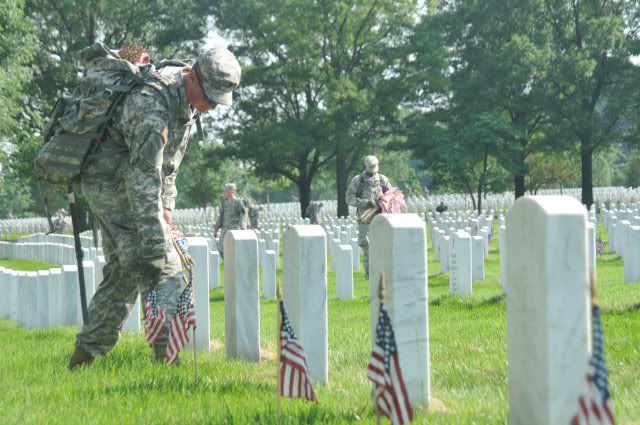
That is a perfect description of what Memorial Day is all about. It is one of my favorite holidays. I like it because it allows me to honor those brave soldiers, who died fighting for our great nation. There are other holiday's that honor ALL soldiers, but this one is special, because of what it represents.

"Oh, tell me not that they are dead, that generous host, that airy army of invisible heroes. They hover as a cloud of witnesses above this nation. Are they dead that yet speak louder than we can speak, and a more universal language? Are they dead that yet act? Are they dead that yet move upon society, and inspire the people with nobler motives, and more heroic patriotism? Ye that mourn, let gladness mingle with your tears. It was your son, but now he is the nation's. He made your household bright: now his example inspires a thousand households. Dear to his brothers and sisters, he is now brother to every generous youth in the land. Before, he was narrowed, appropriated, shut up to you. Now he is augmented, set free, and given to all. Before, he was yours: he is ours. He has died from the family, that he might live to the nation. Not one name shall be forgotten: or neglected : and it shall by and by be confessed of our modern heroes, it is of an ancient hero, that he did more for his country by his death than by his whole life." (Henry Ward Beecher)
There are a few ancestors in my family tree that died while fighting for their country. I have already written about Jacob Speck and John Frogge, Jr.  Another, Elijah Koger , was killed during the Civil War.


"We come, not to mourn our dead soldiers, but to praise them." ~ Francis A. Walker


This weekend, I will visit a couple of cemeteries, where dead soldiers are buried, and I will praise them and the others who died for our country. They deserve our praise and our patronage. We can never forget their sacrifice. I hope you will take the time to remember them, too!


"There is no greater sacrifice than to give one’s life for the good of others.” (Shakespeare)


Happy Memorial Day 2012


Saturday, May 19, 2012

Willie C. Hancock


On August 27, 1895, Willie C. Hancock of Albany, KY received a patent for inventing a new and improved boiler leveling machine. According to Scientific American, the device was

In 1908, Willie C. and his brother, Plato, purchased what would one day be known as one of the oldest landmarks in Albany. According to KyKinFolk.com, people from nearby counties in Kentucky and Tennessee would bring wheat and corn to Albany Mills to be ground into flour and meal which was sold to local merchants, country stores and individuals. The original mill was operated by steam, and in its time was one of the most modern mills in operation.

Willie C. Hancock died in 1913.

Sunday, April 8, 2012

Kicked Off The Bus

I have previously written the following story, but this version, written by my friend Walton Haddix, recently appeard in the local newspaper and is worth repeating here.

Coach Bill Kidd came to Albany in 1954 after serving two years in the U.S. Army at Fort Knox. At 6’10, he had played basketball at the University of Louisville.  

Coach Kidd was a strict disciplinarian who allowed no talking during practice or on the bus traveling to and from basketball and baseball games (At least until the bus had passed a 'point of no return'). Although Coach Kidd lived and coached by the highest principles of human conduct and behavior, on one isolated occasion he followed the advice of Senator Everett Dirksen (Illinois Senator from 1950 to 1969) who said, “In politics you sometimes have to rise above your principles.” This also happens occasionally in athletic contests as demonstrated by Coach Kidd during one of our district tournament baseball games at Tompkinsville in May 1955.

As the story goes, two players who later became noted radio announcers, Sid Scott and my dad, Darrell Speck, were in the back of the bus on the way to a district tournament baseball game in Tompkinsville. They thought the bus had gone past the point of no return after passing Waterview in Cumberland County, so they broke the silence and started singing a country song. They were mistaken in the point of no return because Coach Kidd stopped the bus and kicked both off the bus. J.R. Craig, on his way to the game, noticed Sidney and dad standing by the roadside and stopped to inquire what happened. They hopped into the car with J.R. and got to Tompkinsville before the bus.

Sid and dad were sitting in the stands when our team bus arrived. The baseball game got underway. In the fourth inning, Clinton County was behind one run with two outs but had a runner on first base. However, our weakest batter was at the plate and this is when Coach Kidd decided it was best to rise above his principles (as done in politics) for the good of the baseball team. He called time out, walked over to the bleachers and motioned for Sidney Scott to come down.

Sid nonchalantly ambled down to the batter’s box where Coach Kidd pointed to a bat and then pointed to home plate. Not a word was said or exchange as Sid picked up the bat, then walked to home plate in his street clothes and shoes where he hit a double, scoring the runner to tie the ball game. Louis Dale Latham hit a triple in the sixth inning, bringing in what proved to be the winning run. Two days later, Clinton County won its first ever district baseball championship in school history.

Sunday, April 1, 2012

The Vietnam Verses

My friend, Mike Rogers, was a Sergeant with FMS during the Vietnam War. Recently, he stumbled upon a notebook of poems he wrote between 1969 and 1971. Below are a selected few of those poems.


The city is vacant as I walk through its streets
The area is empty, except for its seats
The taxis have left with their sound so blatant
And empty windows reflect the sun so radiant
Blunt has turned the point of the knife
And these would be the happiest days of my life

~~~

When I wake up, am I really awake?
I am disillusioned by the people's stares
The people to help me
The people to slowly deteriate my thoughts
The end is here to govern all the tranquil
And the obscenity is overpowering
the perceptive imagination
And why is the question to Poe's raven
And why is the question to all mankind

~~~

I walk into the wind to greet the storm
To admire the lightning and praise the thunder
It carries me to eternity and back
I find I had no eyes
My ears awaken to the fact that there is no sound
And I cry helplessly
As darkness is my leader, I stumble through the past
Only to find that the past is also my future
Laughter fills my mind as those who ridicule
For inside their thoughts
diagnoses their own limitations

To walk with the gently pushing wind
Is finding lifes ectasy and appraisal
And yet, I walk into the wind
Meeting what it has to offer head on
There can be no accepting without battle
But there is always disasterious defeat
And I stumble on, still searching

~~~

The inspectors are here again
Everyone is going wild
Hiding in corners and under chairs
The shop isn't taking it mild
Some ran outside, while the rest sat in shock
The inspectors are here again
working around the clock
Checking the floor and digging through files
Setting each book in different piles
They show no mercy and feel no shame
For only the toughest can wear the inspector's name
As the sweat roles from everyones face
They keep inspecting at a blinding pace
Ande then they are gone as fast as they came
Everyone's back to normal but not quite the same
Because in each there's still the hidden fear
Just knowing the inspectors are still near

~~~

Never a day can fight toward tomorrow
For tomorrow is yesterdays eternity
The sun's rays dives to the water
Only to be bounced back and absorbed by matter
Molecules hitting head onin mid-vaccum
Exploding into a million projectiles
This is the cycle's life
In which it is beginning is actually its death
For today the rats are angels and there are none better
Silent demons creep among the hills
and behind whats left of the trees

Flames roar through the heavens
The sound of breaking glass is everywhere
Beings run through the streets
giving no thought for one another

Trampling the life from the innocent
for ignorance is no excuse

Tomorrow will come and will be better
No one will be left

~~~

My legs have run away from me
Kicking in despair
I am trying to gain my senses back
And not pull out my hair
My arms are reaching far below
Tearing at the skies
Never before has such a fate
Stood before my eyes
Dishonesty, lies and deceit
In every breath of air
The right is heavy upon my skull
Far too much to bear
My stomach has moved to my head
My breakfast to the ground
As I listen to the fool
Swearing the earth is round
My blood has turned to water
The people stand and stare
And silently I flow away
Happy to breathe, no more, their air

~~~

From behind this tree I sit
Wondering whom I had met
For now I know that it was not you
That I so dearly knew
Your mind has died its loving way
And there's no truth in what you say
Your eyes once blue have turned to gray
And curse the sun, its blinding ray
Kindness and mercy are obsolete
For all goodness you must delete
You cast away in sickening splendor
Thge tought and need of the dying beggar
Like a spider you sit and wait
To engulf the smaller at a blinding rate
Don't you feaer, the time will come
When your days in this world will be done
Or, will your sould die and decay
With your body that sadly lay
The change in you has come so fast
As I peer from behind this tree of the past
But why must I hide from low to high
Unless the changes was I

~~~

Hear ye, hear ye, to my conception
Come to the great Disaster Auction
Glue your eyes to my vision screen
Things before you have never seen
Now before your very eyes
These items that lived gruesome lives
Firs, we have a liquid, greenish-brown in color
Once known as life's supporting water
Then, these masses of dead and charcoaled wood
Where long ago great forests stood
Debris of concrete and twisted metal
That were called cities and lived in futile
Here we have bones of creatures
that once dominated
This destructed land ladened with hatred
Notice the distinct grayness
to its contaminated atmosphere
Once used as a pure, clean-breathing air
Here I show you the greatest auction
Of a great disaster that can never function
Now I sell you deaths rebirth
Of this fatal planet, once called Earth

~~~

Oh angels can you hear my voice
Calling to you in utmost urgency
My mind no longer in poise
Losing my hopes and fantasy
Oh angels can you see my eyes
Searching in vain for flowers' bloom
Living so many different lives
And finding only hopeless doom
On angels can you read my thoughts
And not destroy my health
Through all my life, I've blindly sought
And disconcerned love is found through wealth
Oh angels can you reach my ear
For never have I heard you speak
Growing in me, the constant fear
Of never growing meek
Oh angels can you clear my head
I know not if I am sane
At times I think that you are dead
For slowly your spirit does wane
Oh angels can you show yourself
For love, faith and accomplishment I do know
Are met through wealth
And I must hate them so

~~~

You smile at me in loving grace
And promise me your lies
As I stare into your radiant face
Noting darkness in your eyes
Your voice has echoed in my ears
Many times before
Telling me your constant fears
Of your present love
I seek no more your way of life
Living as a leech
I know not what I seek in life
It's not within my reach
Let me be to live my way
That only I can understand
Turn your back from me today
And return to your awaiting land
To be alone until I die
The way that it must be
To trust in one that is only I
And at times not even me

~~~

You shook my trembling hand
And pierced my heart
You said you saw the land
That I've searched to never part
Then you walked away from me
Then you walked away
You told me that I did wrong
Living the way I did
You promised to guide and keep me strong
And my evil you would rid
Then you walked away from me
Then you walked away
At times it stormed and I could not see
And your presence before me lied
You grieved only for me
While you volunteered your eyes
Then  you walked away from me
Then you walked away
You heard me ask what life was for
And what life held in my path
You talked to tell me more
Though you only told me half
Then you walked away from me
Then you walked away
I stood afraid before the world
Like a lamb before the lion
And then I saw your eyes that swirled
Vowing your courage would be mine
Then you walked away from me
Then you walked away
I sailed high above the wind
And suddenly fell unrestrained
You told me your wings would land
Though your wings I never obtained
Then you walked away from me
Then you walked away
In the wood I stood lost
When you appeared bearing song
You led me through, free of costd
And I found you led me wrong
Then you walked away from me

Then you walked away
You lay dying upon the ground
Reaching your hand for mine
From your lips came a muttered sound
Asking for help with a despicable whine
Now I walk away from you
Now I walk away

~~~

You say our nation is dying now
But you are wrong, for it's already dead
It is now in the process of decaying
Leaving only faint memories of a sweet homestead
Loyalty has diminished through time
To a dwindling last drop of hope
Bravery has hung itself in shame
While excuses takes its place looking to the Pope
Democracy has flourished with the years
And has lost itself...by the people
Each thinking himself as a god
While the earthquake of minds tumbles the steeple
The dollar has become the almighty
While the needs of others are publicized
By all the wealthy...our leaders
But all the helpless are criticized
To listen to your talk in vain
Of the land that you will cure
Though now the time is much too late
For your deleted country, once so pure


In Times Like These

Ruth Caye Jones was a pastor’s wife and a mother of five living in Pennsylvania. Late in 1943, the realities of the war were weighing heavil...