Tuesday, February 14, 2017
Love's Swift Kick
Teddy Roosevelt once said 'no man is worth his salt who is not ready at all times to risk his body, to risk his well-being, to risk his life, in a great cause.' This is a story of the time Elijah went the distance for love. I can't say it was his first love, but as you will come to realize, it will no doubt forever be one of his most memorable.
As president, Teddy Roosevelt's slogan was'speak softly and carry a big stick.' Perhaps Elijah should have carried a big stick during his first grade year at school. I remember well the day he came home from school and announced that he had a girlfriend. I also remember a few weeks later when he came home and said "I tried to break up her, but she kicked me in the shin, so I decided to stay with her." He pulled up his pant leg and showed me the bruise. I guess he thought 'it is better to be unhappy than have a bruised shin.' So, his first grade courtship with the girl, if you can call it that, continued. Twice more, it happened. He would try to break up with the girl, but always with the same result: a kick to the shin. I was ready to report the incident to the school or even call the girls parents, but he talked me out of it, saying he had a plan. So, being curious as to how he would handle it, I suggested he wear shin guards to school and just decided to let it be.
I think it was Mark Twain who said courage is resistance to fear, mastery of fear - not absence of fear.' It takes a mighty big man to overcome the things he is scared of...even a little girls swift kick to the shin. I didn't hear anything else from Elijah about his predicament until the very last day of school. It was on that day that Elijah walked the girl to her bus and then continued on to his bus, which was parked about 40 feet away. He waited until he was the last person to board and, just before he did, he turned to her screamed, "I'M BREAKING UP WITH YOU!" He hopped on his bus just as the door closed, and, turning to look, saw her standing there stomping the ground with the very same foot she had used to kick him. Elijah's plan had worked. He had broken up with the girl and had escaped without another bruised shin. I said, "What about when you go back to school next fall? She will beat you to a bloody pulp. He was convinced that over the summer she would forget him, which she did.
His successful breakup with the girl who had worn his shins out gave Elijah a new found courage like he had never had before. I think that summer was one of the best he ever had.
Oh, the joys of growing up, the experiences, the unforgettable moments, the memories we make and later come to cherish. I often wonder if looking for love is worth a bruised shin. It's hard to say, really. I guess it all depends on how desperate you are. Maybe a bruised shin is worth forgetting about love. Elijah would say yes, it is worth it.
Saturday, February 11, 2017
Protecting and Preserving The Peace During The Civil War Was A Family Affair
"Tinker Dave Beaty was born 200 years ago this Feb. 19th, in 1817. During the civil war, he formed a company, known as Independent Scouts, to protect the residents of Poplar and Buffalo coves in Fentress County, then Overton County, from Confederate Guerillas and troops, who were raiding the local population. This company, which sometimes consisted of as many as one hundred men, was officially recognized by the federal government and received into the service of the Union army on January 5, 1862.
The Independent Scouts' job was to act as scouts and combat Confederate guerrillas who came through their area. They were not paid, which by definition made them guerillas, but were supplied with arms and ammunition by the Federal authorities. Each man was required to furnish his own horse and equipment.
For me, David Beaty's Independent Scouts was a family affair. Tinker Dave's father, George, was my 4th great-grandfather. His sister, Matilda, married John Boles, a former state representative and state senator, who became captain of the independent scouts. They were my 3rd great-grandparents. Their son, George Boles, my 2nd great-grandfather, was also a member of the Independent scouts, as was his father-in-law, David Smith, my 3rd great-grandfather, along his sons, Asa and Ahijah Smith.
In 1863, a skirmish between the independent scouts and Confederates under Captain Hutchinson reportedly happened near George Boles' place in what is now Pickett County. Captain Hutchinson was killed and three of his men were wounded.
In 1864, the Independent scouts engaged Confederate Colonel John Hughes' company and Champ Ferguson in a skirmish as they came into Fentress on a foraging expedition. It reportedly happened in the Buffalo Cove Area near the home of John Boles. The independent scouts, being greatly outnumbered, were forced to retreat, causing them to fall behind some of their men. Thomas Culver, Jop Moody and Tinker Dave's young son, Thomas, were captured. Culver and Moody were killed and Thomas would also have been killed had it not been for two Boles women, who begged for his life. Several Confederates were wounded.
On February 1, 1863, Confederate guerillas rode up to David Smith's home on the East fork of Big Indian creek looking for his son, Asa, who was not at home. David and another son, Ahijah, were both killed. They are buried at Doogan Smith Cemetery, which is across from the house where they were killed. Asa Smith died in 1920. He is buried at Elias Bowden Cemetery in Fentress County.
John Boles died in 1869. Matilda died in 1903. They are buried at Bolestown Cemetery, near Boatland. George Boles died in 1941 and is buried at Cedar Hill Cemetery in Clinton County.
It has been written that Tinker Dave Beaty was as ruthless and vicious in his defense of the Union as Champ Ferguson was of the Confederacy. Beaty and his Independent Scouts probably killed as many men as Ferguson and his men did, if not more, but because the Confederacy lost the war, Ferguson became the monstrous criminal and was hanged for his actions, while Beaty became ‘the celebrated Union scout.’ The same deeds that made a man a criminal could have made him a hero if his side won.
Tinker Dave Beaty died on Aug. 22, 1876. He and his father, George, are buried at Beaty-Lacy Cemetery on Tinker Dave's farm at Boatland.
I like to think that George Boles was acquainted with Elijah Koger, but there no account of that. Elijah lived at Oak Grove in Clinton County and George lived at Poplar Cove in Fentress County (Overton). After the war, they would be connected by marriage. While members of the Boles family were bust protecting the citizens of Fentress County (Overton County), Elijah Koger was busy doing the same as a member of the Clinton County home guard, a group of residents who had been trained in warfare at Camp Dick Robinson in Garrard County but were not officially brought into the service of the Union army. Koger went a step further with his commitment and it eventually cost him his life.
Elijah Koger was my 3rd great-grandfather. Fifty years after the Civil War, in 1915, his granddaughter, Nannie, married George Boles' son, Ahijha (Hige) Boles.
The guerilla warfare that took place along the Kentucky-Tennessee border, which Tinker Dave Beaty, Champ Ferguson and others were responsible for, was taking its toll on the citizens who lived in the Upper Cumberland area along the Tennessee-Kentucky border. Murder, theft and arson were commonplace.
In 1862, Union and Confederate factions of the Upper Cumberlands attempted to reach a peaceful compromise. A peace conference was held at Monroe in Overton County. The parties agreed not to raid into the adjoining counties. However, the compromise was dead before it began. Within hours, Ferguson and his men killed four Overton County men on the way back to Clinton County, and Confederate J. W. McHenry raided into Clinton County. They blamed it on a lack of communication by the peace officals, but many of those men who attended the conference were later murdered.
Elijah Koger was part of a group of home guardsmen who kept watch over Clinton County and he was one of the men who were chosen to repesent the Union at the Monroe Compromise.
On the morning of Sunday, June 1, 1862, Koger arose from his bed and headed out to the spring with his wife, Nancy, beside him. Shots rang out as a band of men appeared suddenly out of nowhere. Nancy screamed fo Elijah to run. As he tried to flee, Ferguson overtook him and shot him. Koger threw up his arms and said something, but Nancy could not make out his words because the couple's children were screaming. Shots continued to ring out as Elijah ran toward a fence some fifty yards from the home in the Oak Grove community. With Ferguson and nine other men following him, Elijah reached the fence and when he tried to cross it, Ferguson rode up close to him and shot him one more time. By the time Nancy reached the fence, the couple's 11-year-old daughter, Sarah, was holding her daddy in her arms. She was covered in blood. When Nancy reached Elijah, he gasped once, but never spoke. He had been shot more than 30 times. Nancy knelt beside her slain husband's body as Ferguson and his outlaw gang ransacked the Koger home.
The reason Elijah Koger was so involved in peace-keeping efforts during the civil war begins with his wife's brother, William Frogge, my 3rd great-uncle. He has the distinction of officially being the first person murdered by Champ Ferguson during the war. It happened on Nov. 1, 1861.
When he rode up to the Frogge cabin, Esther Frogge suspected no ill will. After all, she had known Ferguson since childhood. She offered him a seat and an apple. He refused both and sought out her husband, who lay ill in his bed. Champ asked William about his health. Frogge responded, “I am very sick. I had the measles and have had a relapse.”
Champ accused Frogge of having contracted the measles while visiting Camp Dick Robinson. Frogge vehemently denied that, but Ferguson drew his pistol anyway and shot Frogge twice, killing him. He then ransacked the cabin.
Ironically, the next to last person murdered by Champ Ferguson during the civil war was my 4th great-uncle, Martin Van Buren Duvall. Van was the uncle of Elijah Koger's wife, Nancy. It happened on April 26, 1865, seventeen days after Lee surrendered to Grant. Duvall was on furlough from the army and was at his brothers home, in sight of Oak Grove Cemetery, when he saw Champ Ferguson riding up to the residence. Van tried to run but Ferguson chased him down and shot him dead. He murdered his last victim, John H. Hurt, the next day."
Monday, January 16, 2017
"God is Able" by MLK, Jr.
"Life is hard, at times as hard as crucible steel. It has its bleak and difficult moments. Like the ever-flowing waters of the river, life has its moments of drought and its moments of flood. Like the ever-changing cycle of the seasons, life has the soothing warmth of its summers and the piercing chill of its winters. And if one will hold on, he will discover that God walks with him and that GOD IS ABLE to lift you from the fatigue of despair to the buoyancy of hope, and transform dark and desolate valleys into sunlit paths of inner peace."
(From "Eulogy of the Martyred Children, September 18, 1963)
Sunday, January 8, 2017
The Cornfield Princess: Bullet in the Dark
Selah Elizabeth "Bessie" Jones was the daughter of Nesbit Hert and Jane (Upchurch) Jones. Sometime after her death, the family moved to Crowell, Texas. Bessie is buried at Cartwright Cemetery.
Selah E. Jones
Born May 3, 1886
Assassinated Sep 17, 1900
Her busy hands are folded
Her work on earth is done
Her trials are all ended
Her heavenly crown is won
Monday, January 2, 2017
Battle Hymn of the Republic Recording is 100 Years Old
of the coming of the Lord
He is trampling out the vintage
where the grapes of wrath are stored
He has loosed the fateful lightening
of His terrible swift sword
His truth is marching on
Thomas Chalmers' recording of "Battle Hymn Of The Republic" is 100-years-old this year. He recorded his version on May 29, 1917 (Edison Records, 82133-R).
According to the Library of Congress, "The Battle Hymn of the Republic" went through a number of versions in the years immediately before the Civil War. Its tune and its early lyrics were written by William Steffe about 1856. Its first verse and refrain were:
Say brothers, will you meet us?
On Canaan's happy shore?
Glory, glory hallelujah!
For ever, evermore!
The song first gained popularity around Charleston, South Carolina, where it was sung as a Methodist Camp Meeting song, particularly in churches belonging to free Blacks. By contrast, it was also used early on as a marching song on army posts.
The song gathered new verses following the insurrection at Harper's Ferry, led by John Brown and carried out by a cadre of nineteen men on October 16, 1859. Brown's actions, trial and subsequent execution made him a martyr to Abolitionists and African-Americans and prompted some people to add the following lines to Steffe's by then popular song.
John Brown's body lies a-mouldering in the grave
His soul is marching on!
Some have also theorized that the new verses were written about an inept Army sergeant named John Brown, thus giving the lyrics a kind of humorous double entendre.
By the time of the Civil War "John Brown's Body" had become a very popular marching song with Union Army regiments, particularly among the Colored troops. The Twelfth Massachusetts Regiment, in particular, has been credited with spreading the song's fame on their march to the South, where Confederate soldiers then inverted the meaning of their words and sang, "John Brown's a-hanging on a sour apple tree." The war's rivalry continued to be carried on in music as the northerners then sang in turn, "They will hang Jeff Davis to a sour apple tree."
But it was when Julia Ward Howe visited Washington, DC in 1861 that the tune properly came to be called "The Battle Hymn of the Republic." Howe and her husband, both of whom were active abolitionists, experienced first-hand a skirmish between Confederate and Union troops in nearby Virginia, and heard the troops go into battle singing "John Brown's Body." That evening, November 18, 1861, Ward was inspired to write a poem that better fit the music. It began "Mine eyes have seen the glory of the coming of the Lord."
As Howe explained it, the verses came to her in a single night:
"I went to bed and slept as usual, but awoke the next morning in the gray of the early dawn, and to my astonishment found that the wished-for lines were arranging themselves in my brain. I lay quite still until the last verse had completed itself in my thoughts, then hastily arose, saying to myself, I shall lose this if I don't write it down immediately. I searched for an old sheet of paper and an old stub of a pen which I had had the night before, and began to scrawl the lines almost without looking, as I learned to do by often scratching down verses in the darkened room when my little children were sleeping. Having completed this, I lay down again and fell asleep, but not before feeling that something of importance had happened to me."
"Battle Hymn of the Republic" was first published in The Atlantic Monthly on February 1862.
Glory! Glory! Hallelujah!
His truth is marching on
Saturday, December 24, 2016
Peace On Earth...May Christmas Hasten That Day
The first months of World War I had seen an initial German attack through Belgium into France, which had been repulsed outside Paris by French and British troops at the Battle of the Marne in early September 1914. The Germans fell back to the Aisne Valley and in the subsequent Battle of the Aisne, the Allied forces were unable to push through the German line, and the fighting quickly degenerated into a static stalemate with neither side willing to give ground. To the north, on the right of the German army, there had been no defined front line and both sides quickly began to try to use this gap to outflank one another. In the ensuing "race to the sea", the two sides repeatedly clashed, each trying to push forward and threaten the end of the other's line. By November, there was a continuous front line running from the North Sea to the Swiss frontier. The action was swift and both sides were determined.
But, in December something unexpected happened: An unofficial truce involving about 100,000 British and German troops along the length of that front. The reason? Christmas. It began on Christmas Eve when German troops began decorating the area around their trenches in the region of Ypres, Belgium. The Germans began by placing candles on their trenches and on Christmas trees, then continued the celebration by singing Christmas carols. The British responded by singing carols of their own. The two sides continued by shouting Christmas greetings to each other. Soon thereafter, there were excursions across the 'No Man's Land, where small gifts were exchanged, such as food, tobacco and alcohol, and souvenirs such as buttons and hats. The artillery in the region fell silent that night. The truce also allowed a breathing spell where recently-fallen soldiers could be brought back behind their lines by burial parties. Joint services were held. In many sectors, the truce lasted through Christmas night, but it continued until New Year's Day in others.
Ironically, just days before Christmas a group of 101 British women suffragists wrote a letter to the women of Germany and Austria. Under the heading "On Earth Peace, Goodwill towards Men, the letter said, "The Christmas message sounds like mockery to a world at war. Is it not our mission to preserve life?
The next Christmas, the two sides again observed an unofficial cease fire at the front but it was not as successful, thanks to strongly-worded orders from the high commands of both sides prohibiting such fraternization.
My prayer is that one day we will have peace on earth...
"May Christmas hasten that day."
But, in December something unexpected happened: An unofficial truce involving about 100,000 British and German troops along the length of that front. The reason? Christmas. It began on Christmas Eve when German troops began decorating the area around their trenches in the region of Ypres, Belgium. The Germans began by placing candles on their trenches and on Christmas trees, then continued the celebration by singing Christmas carols. The British responded by singing carols of their own. The two sides continued by shouting Christmas greetings to each other. Soon thereafter, there were excursions across the 'No Man's Land, where small gifts were exchanged, such as food, tobacco and alcohol, and souvenirs such as buttons and hats. The artillery in the region fell silent that night. The truce also allowed a breathing spell where recently-fallen soldiers could be brought back behind their lines by burial parties. Joint services were held. In many sectors, the truce lasted through Christmas night, but it continued until New Year's Day in others.
Ironically, just days before Christmas a group of 101 British women suffragists wrote a letter to the women of Germany and Austria. Under the heading "On Earth Peace, Goodwill towards Men, the letter said, "The Christmas message sounds like mockery to a world at war. Is it not our mission to preserve life?
The next Christmas, the two sides again observed an unofficial cease fire at the front but it was not as successful, thanks to strongly-worded orders from the high commands of both sides prohibiting such fraternization.
My prayer is that one day we will have peace on earth...
"May Christmas hasten that day."
Saturday, December 10, 2016
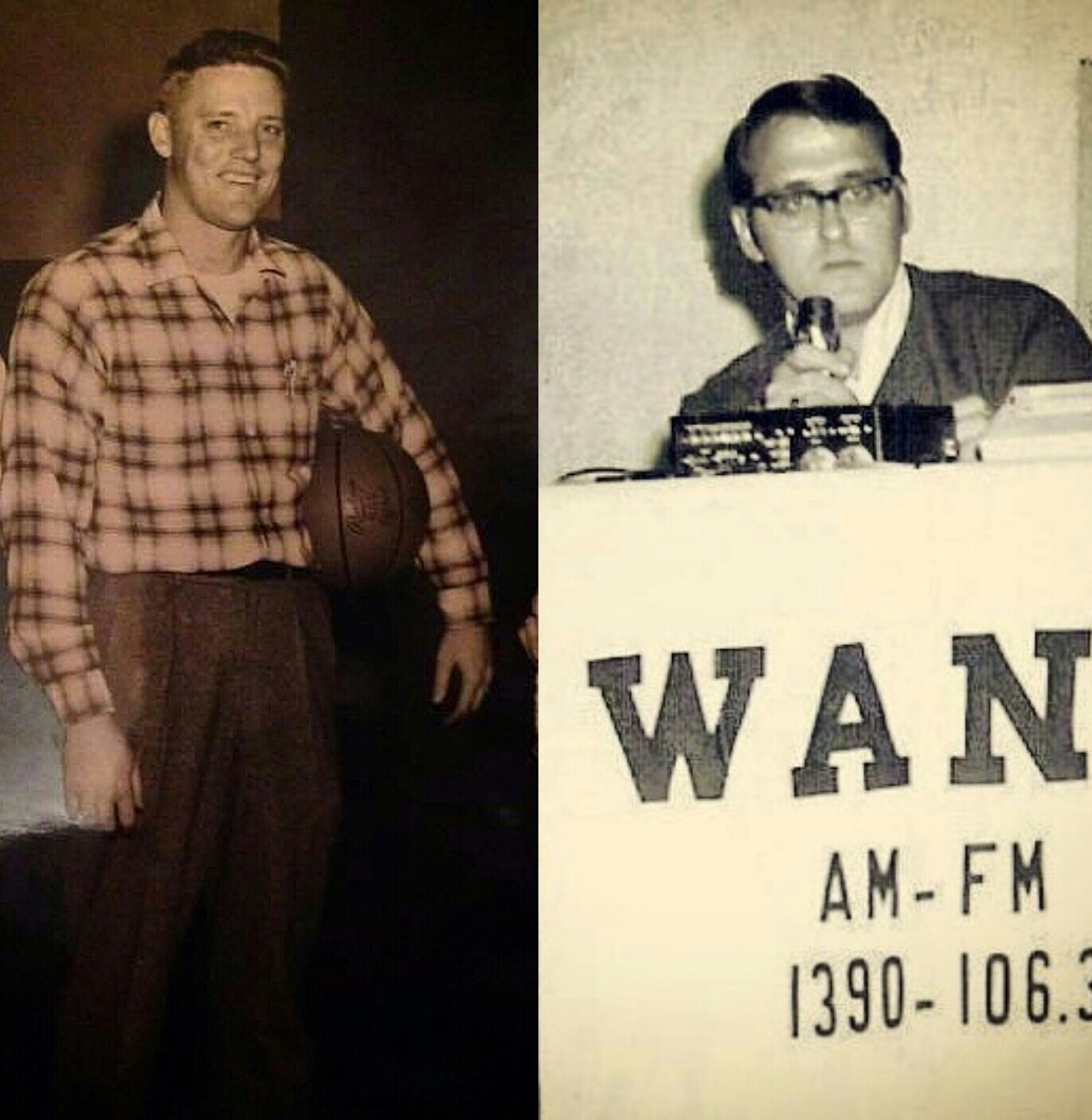
A Season of Legends: Lindle Castle and Sid Scott
The summer before my senior year in high school, I was confronted with a choice: sit on a bleacher beside a legendary broadcster or sit on a bleacher beside a legendary coach. While that might seem like a hard decision to you, radio was in my blood. I had just gotten my Radiotelephone Third Class license with Broadcast Endorsement on August 4, 1976. I knew that my destiny wasn't to play for the Kentucky Wildcats or star in the NBA. It was to be a radio disc jockey. I was, after all, born into it. I explained to the coach that my heart was in radio. 40 years later, it still is.
I was blessed to have grown up in an era that included both Lindle Castle and Sid Scott. Before starring at Morehead State University, Castle had started on a University of Kentucky freshman team that included future NBA hall of famers, Cliff Hagan and Frank Ramsey, and future NBAer, Lou Tsioropoulos. A few short years later, Scott made a name for himself as one of the all-time great pivot players at Clinton County High School.
When I was born in November of 1959, both were just beginning their careers. Lindle Castle began coaching at Clinton County at the start of the 1957-58 season. Sid Scott began doing play-play-play at the start of the 1958-59 season. This is the environment I grew up around. I would sit on the stage in the old gym and watch the coach, while up in the balcony the broadcaster did the play-by-play.
I was there the night Coach Castle went out on the floor to speak to a refree, who informed coach that he was going to give him a technical foul for every step it took to get back to the bench. I watched as two players picked him up and carried him to the bench.
I was there the night referee Wilson Sears stopped the game and ordered Sid to move up a few bleachers away from court because of something Sid said to him. I was there the night Sid, who was mayor, ordered a city police officer to arrest referee Phil Burkeen if we lost the game. Thankfully, we won.
I was there the night coach accidentally broke Sid's little finger. He had come to our booth to bang his fist on the desk. I saw him coming and leaned back with my clipboard. Sid didn't see him coming. The pencil he was holding disappeared in the air. I was able to turn Sid's microphone down so listeners didn't hear what he said when he screamed.
By the time I had grown into my early teens, both Castle and Scott were starting to achieve their legendary status. Life was great.
And, we know that all good things must come to an end. Things we enjoy, things we find comforting, things we love, things we embrace; even a legendary basketball coach and a legendary radio broadcaster.
"To everything there is a season..."
I spent a good long season enjoying those two. I wanted it to last my entire lifetime, but God had other plans.
Sometimes when one chapter closes, it really closes. Lindle Castle died 50 weeks after Sid Scott died.
"Legends"
Meanwhile, back at CCHS, the first one has his name on the gym and the second one has his name on the floor.
WE ARE BULLDOGS!
I was blessed to have grown up in an era that included both Lindle Castle and Sid Scott. Before starring at Morehead State University, Castle had started on a University of Kentucky freshman team that included future NBA hall of famers, Cliff Hagan and Frank Ramsey, and future NBAer, Lou Tsioropoulos. A few short years later, Scott made a name for himself as one of the all-time great pivot players at Clinton County High School.
When I was born in November of 1959, both were just beginning their careers. Lindle Castle began coaching at Clinton County at the start of the 1957-58 season. Sid Scott began doing play-play-play at the start of the 1958-59 season. This is the environment I grew up around. I would sit on the stage in the old gym and watch the coach, while up in the balcony the broadcaster did the play-by-play.
I was there the night Coach Castle went out on the floor to speak to a refree, who informed coach that he was going to give him a technical foul for every step it took to get back to the bench. I watched as two players picked him up and carried him to the bench.
I was there the night referee Wilson Sears stopped the game and ordered Sid to move up a few bleachers away from court because of something Sid said to him. I was there the night Sid, who was mayor, ordered a city police officer to arrest referee Phil Burkeen if we lost the game. Thankfully, we won.
I was there the night coach accidentally broke Sid's little finger. He had come to our booth to bang his fist on the desk. I saw him coming and leaned back with my clipboard. Sid didn't see him coming. The pencil he was holding disappeared in the air. I was able to turn Sid's microphone down so listeners didn't hear what he said when he screamed.
By the time I had grown into my early teens, both Castle and Scott were starting to achieve their legendary status. Life was great.
And, we know that all good things must come to an end. Things we enjoy, things we find comforting, things we love, things we embrace; even a legendary basketball coach and a legendary radio broadcaster.
"To everything there is a season..."
I spent a good long season enjoying those two. I wanted it to last my entire lifetime, but God had other plans.
Sometimes when one chapter closes, it really closes. Lindle Castle died 50 weeks after Sid Scott died.
"Legends"
Meanwhile, back at CCHS, the first one has his name on the gym and the second one has his name on the floor.
WE ARE BULLDOGS!
Wednesday, November 23, 2016
Ronnie's Apple Cake
For me, Thanksgiving Day is a special time to reflect on the many things I am thankful for. Ronnie's Apple Cake was more than a dessert...it was a door leading to a time in my life that holds many wonderful memories. Memories of my family, when we were all there...together as one. It was a special time in my life.
Ronnie's Apple Cake was not always known as that. Originally, it was just known as the delicious apple cake that mom baked. I am not sure how many pieces of that cake I ate from the time I was a youngster until I reached the age of 21, but it was a lot. We all loved it, but Ronnie, my brother, loved it more than any of us, and he let it be known that it was his favorite dessert. That was fine by me. I didn't mind who asked her to bake it, as long as she did. Only later did it matter which child asked her to bake it the most. You see, that apple cake was the very last thing Ronnie would ever eat of my mom's cooking and baking as he sat down at the kitchen table on the afternoon of May 6, 1981. At 5:30 a.m. the following morning, we found him dead of a car accident just five-tenths of a mile from home. Not long after Ronnie's death, mom announced that she could no longer bare to bake another apple cake again and that was the end of it. We understood.
Things have never really gotten back to the way they were for us following Ronnie's death in 1981, but one day, a few Thanksgiving Day's ago, one very nice memory came back. I wasn't expecting to see mom's apple cake sitting there on the food bar that day, but there it was. I have to admit, I had forgotten about it, and I was about to find out that I wasn't the only one who had forgotten.
I said, "Wow mom, you baked that apple cake!" She said she had found the recipe, but did not know why she had never baked it. I reminded her it was Ronnie's favorite dessert and that after his death, she had said she could no longer bake it. She just said "Yeah," and that was it. After all the years, it was nice to enjoy something I once enjoyed so much; something I thought I would never eat again. That day, I renamed mom's apple cake, Ronnie's Apple Cake.
For those of you who are curious as to why my brother loved that apple cake so much, here is the recipe. I hope you will enjoy it as much as he did.
Ingredients:
3 cups diced apples
1 1/2 cups of oil
2 cups sugar
3 eggs well beaten
3 cups self-rising flour
1 tp cinnamon
1 tp vanilla
1 cup raisins or nuts (mix well)
optional -1 cup powdered sugar and 1/2 cup of milk for a glaze
Instructions: Bake at 350 degrees for 45 minutes to one hour.
Remembering A President
Eight months before President John F. Kennedy was assassinated (Nov. 22, 1963), he made a visit to Arlington National Cemetery. It is said that he passed beyond the soldiers' graves and walked to the top of a hill. The story goes that as he paused there reflecting on the beauty of the area, he was quoted as saying, "I could stay here forever."
On November 25, 1963, the President was buried on that hill after being shot dead three days earlier.
A Joyous Day of Prayer and Thanksgiving Long Ago
Thanksgiving Day didn't become an official federal holiday until 1863, when President Abraham Lincoln proclaimed a national day of "Thanksgiving and Praise to our beneficent Father who dwelleth in the Heavens."
Both my great-grandparents, Grant and Hettie Frost, were born after the civil war; Grant in 1867 and Hettie in 1870. They were married on this day (November 23rd), four days before Thanksgiving Day in 1890.
That year, President Benjamin Harrison proclaimed November 27th as the date to be observed as a day of prayer and thanksgiving, inviting the people to "cease from their labors on that day, to meet in their accustomed houses of worship, and to join in rendering gratitude and praise to our beneficent Creator for the rich blessings He has granted to us as a nation and in invoking the continuance of His protection and grace for the future."
That protection and grace was extended to Grant ans Hettie as they were married 65 years. God blessed them with eleven children.
Ulysses Simpson "Grant" Frost was the son of Corydon and Almira Owens Frost. Hettie Huffaker Frost was the daughter of Henry and Margaret Shearer Huffaker. They are buried in the Gap Creek Church Cemetery.
Both my great-grandparents, Grant and Hettie Frost, were born after the civil war; Grant in 1867 and Hettie in 1870. They were married on this day (November 23rd), four days before Thanksgiving Day in 1890.
That year, President Benjamin Harrison proclaimed November 27th as the date to be observed as a day of prayer and thanksgiving, inviting the people to "cease from their labors on that day, to meet in their accustomed houses of worship, and to join in rendering gratitude and praise to our beneficent Creator for the rich blessings He has granted to us as a nation and in invoking the continuance of His protection and grace for the future."
That protection and grace was extended to Grant ans Hettie as they were married 65 years. God blessed them with eleven children.
Ulysses Simpson "Grant" Frost was the son of Corydon and Almira Owens Frost. Hettie Huffaker Frost was the daughter of Henry and Margaret Shearer Huffaker. They are buried in the Gap Creek Church Cemetery.
Subscribe to:
Posts (Atom)
Dairy Treat Day in Albany
Thank you, Jesse Collins, for keeping this iconic establishment open an extra 43 years and carrying on the legacy of the famous little scr...
-
(This photo was made in the 1950's as the Goat Man passed through my town) Charles McCartney was born on July 6, 1901. In 1915, at age ...
-
The Roanoke Colony was an enterprise financed and organized by Sir Walter Raleigh in the late 16th century to establish a permanent English ...