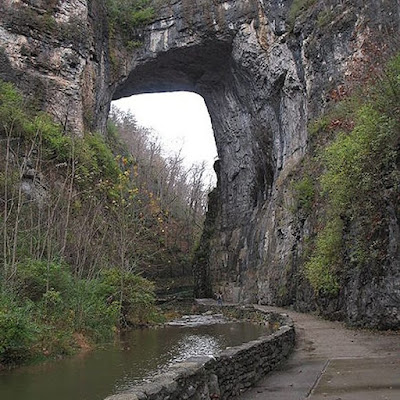
Hanchrist Carlock came to America from Holland around 1725. Before the American Revolution, he was the road foreman in Augusta County, Virginia. About the same time, George Washington was working as a civil engineer in Augusta County. George was given the task of surveying a road from the mouth of the Potomac River to Natural Bridge. One of the wonders of the world, Natural Bridge approaches Niagara Falls in grandeur and exceeds it in height (215 feet) and natural mystery. Natural Bridge is 100 feet wide. Its span is 90 feet. Under its arch men look like small boys, and giant trees like small bushes. Thomas Jefferson was the first owner of the land surrounding Natural Bridge. He spoke of it as yet to be 'a famous place that will draw the attention of the world.' John Marshall, Chief Justice of the United States Supreme Court 1801 to 1835, named it 'God's Greatest Miracle In Stone.' American statesman and orator Henry Clay wrote of 'the Bridge not made with hands.'
To assist him in the survey of this great scenic wonder, the future president hired Hanchrist to be his foreman. One day, George chiseled 'G. Washington' in capital letters 23 feet up the Southwest wall of the canyon. Hanchrist chiseled 'H. Carlock' about 12 feet below and 10 feet to the right of Washington's. Both signatures are still visible today.
Hanchrist's son, Job, migrated to Overton County, Tennessee sometime around 1805 and married Sarah McDonald. Their daughter, Nancy, married Presbyterian minister Clemens Means, son of irish immigrants, about 1820. Clemens' brother, Benjamin, was the great-great grandfather of my grandmother, Dimple.
In his own biographical sketch, Clemens Means wrote, "It is for me to remember that the Lord is a stronghold in the day of trouble." I thought about how many times George Washington, John Marshal and even Henry Clay might have turned to God for help as they were helping form this great country of ours. I imagine Hanchrist Carlock needed a higher power as he left his homeland for America, and so did his son, Job, as he migrated west from Virginia to Tennessee.
It really is a small world, sometimes hard to live in. But, just like the characters in this story, it is a whole lot easier to live in when we realize that we are connected by a 'bridge not made by hands.'
Monday, March 21, 2022
Friday, February 25, 2022
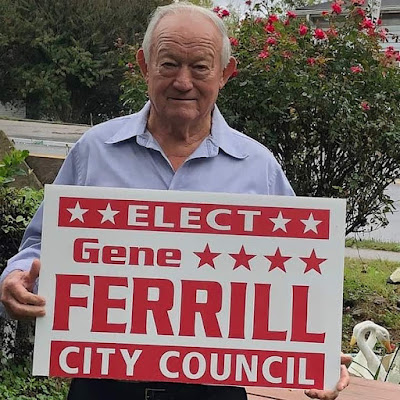
Gene Ferrill
One November day, back several years ago, Jack Bell stopped by the radio station to tell me that his birthday that year was going to be on Thanksgiving Day. I was scheduled to work that day and told him to come by around 12:30 and I would put on a long-playing CD and we would go to Horseshoe Grill, where I would buy him lunch.
Somehow Gene Ferrill found out about it and suggested I bring him to the jail. Since he and his wife would be serving Thanksgiving meals to prisoners that day, we were welcomed to join them, and we did. There was even a birthday cake! Afterwards, we took Jack outside, where he posed for a photograph beside the Clinton County Jail sign. In that photograph he was holding a shotgun, a throwback to the days when Jack worked as a deputy under sheriff Johnny Cummings. Both Gene and I felt good about all that had transpired that day and in the years to come would often reminisce about it. It was, and will always be, my most favorite Thanksgiving Day.
Gene Ferrill was a household name in Clinton County. He was our jailer for five terms, and was currently serving a second term as city councilman. Precisely put, the definition of him was 'someone who possessed a quiet and gentle spirit, one of humility and immense love for other people.' He liked reading my stories, he said, because it was a way for him to keep up with me during stretches when we were unable to see each other to talk about old times. "Good times," he would say, and good times they were.
One of my favorite memories of Gene, when his mother was living, was when he would advertise on the radio, be it a campaign ad for jailer, or a Christmas greeting. He would always end his speech by telling his mom how much he loved her. His devotion to family and friends is worth mentioning, because none of us will be forgetting him anytime soon. His gentleness and tender love towards people spoke volumes.
Somehow Gene Ferrill found out about it and suggested I bring him to the jail. Since he and his wife would be serving Thanksgiving meals to prisoners that day, we were welcomed to join them, and we did. There was even a birthday cake! Afterwards, we took Jack outside, where he posed for a photograph beside the Clinton County Jail sign. In that photograph he was holding a shotgun, a throwback to the days when Jack worked as a deputy under sheriff Johnny Cummings. Both Gene and I felt good about all that had transpired that day and in the years to come would often reminisce about it. It was, and will always be, my most favorite Thanksgiving Day.
Gene Ferrill was a household name in Clinton County. He was our jailer for five terms, and was currently serving a second term as city councilman. Precisely put, the definition of him was 'someone who possessed a quiet and gentle spirit, one of humility and immense love for other people.' He liked reading my stories, he said, because it was a way for him to keep up with me during stretches when we were unable to see each other to talk about old times. "Good times," he would say, and good times they were.
One of my favorite memories of Gene, when his mother was living, was when he would advertise on the radio, be it a campaign ad for jailer, or a Christmas greeting. He would always end his speech by telling his mom how much he loved her. His devotion to family and friends is worth mentioning, because none of us will be forgetting him anytime soon. His gentleness and tender love towards people spoke volumes.
Thursday, January 20, 2022
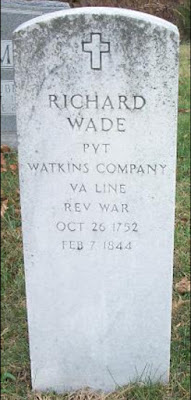
Richard Wade, A Local Man, Served Under Daniel Boone
In 1777 Richard Wade, who had already served one term as a revolutionary war soldier, re-enlisted in the Bedford County, Virginia militia to defend the frontier. Soon afterwards he was sent to Boonesboro, Kentucky to serve under Daniel Boone. When the fort ran low on salt, Boone took Richard and twenty-seven others to gather more at Blue Licks at Carlisle, where they were surrounded by Indians and taken to Detroit and sold to the English. Seven of the prisoners escaped and made their way back to the Ohio River only to be recaptured and taken back to Detroit and then on to Montreal, Canada. After two years in prison, Richard and a few others managed to escape. He made his way to Pittsburgh and then down the Ohio River to Boonesboro, where he stayed.
Richard helped bury the dead soldiers following the Battle of Blue Licks, in Robertson County, Kentucky, on August 19, 1782. A force of about 50 Loyalists al with 300 American Indians had ambushed and routed 182 Kentucky militiamen. Richard was up for court martial for refusing to fight, but was excused by General George Rogers Clark. It would be one of the last battles of the American Revolutionary War.
After the war ended, Richard remained at Boonesborough for several years. His son, John, was born there in 1781. His older son, Elisha, who had been born in Virginia, served with the Kentucky Militia and fought in the War of 1812. In 1801, Richard moved his family to a part of Wayne County that later became Clinton County. He died on February 7, 1844, at the age of 92, and is buried at Cartwright Cemetery with his wife and sons.
Following the war of 1812, Adam Vickery of Wayne County, who had been with Captain Micah Taul's company in the first northern campaign during the war, was appointed captain to lead a company of around 80 Wayne Countians to join Andrew Jackson at New Orleans. Included in the group were John and Elisha Wade. They reached New Orleans just four days before the battle on January 8, 1815. Even though they were outnumbered, the American forces defeated the British in slightly more than 30 minutes, suffering just 71 casualties, while the British suffered over 2,000, including the deaths of the commanding general and his second-in-command.
Check out Richard Wade and his sons, John and Elisha Wade, on Findagrave.com by clicking here.
Richard helped bury the dead soldiers following the Battle of Blue Licks, in Robertson County, Kentucky, on August 19, 1782. A force of about 50 Loyalists al with 300 American Indians had ambushed and routed 182 Kentucky militiamen. Richard was up for court martial for refusing to fight, but was excused by General George Rogers Clark. It would be one of the last battles of the American Revolutionary War.
After the war ended, Richard remained at Boonesborough for several years. His son, John, was born there in 1781. His older son, Elisha, who had been born in Virginia, served with the Kentucky Militia and fought in the War of 1812. In 1801, Richard moved his family to a part of Wayne County that later became Clinton County. He died on February 7, 1844, at the age of 92, and is buried at Cartwright Cemetery with his wife and sons.
Following the war of 1812, Adam Vickery of Wayne County, who had been with Captain Micah Taul's company in the first northern campaign during the war, was appointed captain to lead a company of around 80 Wayne Countians to join Andrew Jackson at New Orleans. Included in the group were John and Elisha Wade. They reached New Orleans just four days before the battle on January 8, 1815. Even though they were outnumbered, the American forces defeated the British in slightly more than 30 minutes, suffering just 71 casualties, while the British suffered over 2,000, including the deaths of the commanding general and his second-in-command.
Check out Richard Wade and his sons, John and Elisha Wade, on Findagrave.com by clicking here.
Thursday, January 6, 2022
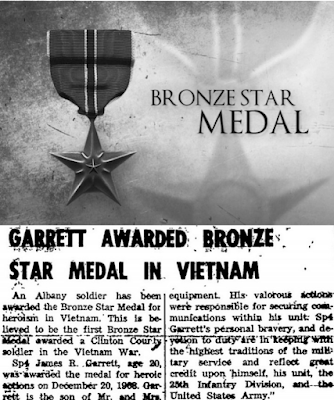
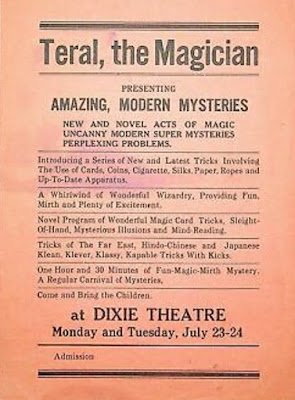
Clinton County's First Bronze Star Recepient in Vietnam was the son of Teral the Mystic
Teral Garrett became interested in magic at the age of twelve and gave his first public performance one day in english class at Albany High School. In the 1930's he performed as "Teral The Mystic" with a variety group called the Rozelle Players and became a well-known act. He was also editor of three magazines, including Psycho-Gizmo, which was in print from 1951 to 1965, and for several years, he also operated a mail order magicians supply house out of Albany, filling orders from all over the world.
Teral broke his neck at an early age, which kept him from jobs that required any exertion of great physical energy. It also exempted him from serving in the armed forces during WWII. While he may have been unable to serve in the military, his son, James, was an Army Specialist Four with the 7th infantry division in Korea and with the 29th infantry in Vietnam, where he became what was believed to be the first Clinton County soldier to be awarded the Bronze Star Medal in the Vietnam war.
On Dec. 20, 1968, while his unit was sweeping through a suspected enemy command post, they came under deadly automatic weapons fire. Seeing the platoon leader had been wounded and the communications equipment destroyed, James left his vehicle and ran through enemy fire to another vehicle for the needed equipment, securing communications within his unit.
Both Teral and James died at a young age. Teral was 56 when he passed away on Nov. 7, 1970, after suffering a heart attack about a week earlier. James was 57 when he died on May 2, 2005. Among their survivors was their son, and brother, Pace Garrett.
Wednesday, December 29, 2021
The First Golf Champion
Sunday, Aug. 2, 1970 was the biggest day ever at Seventy Six Falls Country Club in Albany, KY, wrote the Clinton County News on Aug. 6th that year. It was on that day that a champion was crowned in the country club's first ever club golf tournament.
So who was the first champion? It was Larry Conner, who posted a score of 161 in the 36-hole event. Ozro Pitman placed second with a score of 163, only two under the winner. Third place went to Gayron Wallen, who had tied with N. L. Morgan, Jr., with 165 each. The winner was decided by flipping a coin. Others in the first flight were Jackie Latham 172, Sidney Scott 171 and Gene Latham 176.
A large crowd and 36 golfers braved the 100 plus degree temperature that Sunday. A.B. Gibson, Clinton County News editor, and one of the participants in the tournament, wrote in his "B.A. Nosbig" column that he heard one man say it was so hot that if the course hadn't been so pretty and the water, furnished by Richard Fryman and Eagle Pass Cheese Co., hadn't been so cold he would have thought he was playing in hell. The newspaper reported that the extremely high temperature was the only complaint heard.
At the conclusion of the tournament, directed by club manager, Harvey Aaron, another Clinton County golfer, Conner was presented a set of golf woods and a championship trophy. Pittman received a golf cart and Wallen and Morgan divided the third place prize of a dozen balls.
In the second flight, players qualifying 86 through 93, Louie Smith was the winner with 167, followed by Frankie Sewell with 173 and Carl McWhorter with 176. Others were Larry Jones 177, Mark Shearer 177, Eddie Owens 177, George Hancock 178, Bobby Hughes 178, Jimmy Logan 182 and Charlie Long 185.
In the third flight, J. O. Dicken surged forward in the final round with a 39 and won the flight with a total score of 179. Second place went to Bill Perdue, who posted a score of 184, followed by D. B. Robinson with a 187. Others were Ralph Groce 190, Ed Veazey 192, Ben Dyer 193, Joe Talbott 193, John B. Smith 195, A. B. Gibson 196, R. H. Burke 196, Hugh Groce 198, T. T. Rich 199, L. C. Conner, Jr. 203 and Ralph Keisling 207.
Fourth flight was a squeaker with Kelly Keisling becoming the winner after a two hole sudden death, which still ended in a tie with Horace Brown at 196 each. When it became too dark to play, the winner was decided by a flip of a coin. Ezra Neal was third with 197. Each received golf balls as prizes. Others were Tony Conner 210 and Hank Chilton 216.
Friday, December 24, 2021
The Night Before Christmas at Greg Dalton's House
'Twas the night before Christmas and all over the mountain the only creature a-stirring was ol' Greg Dalton.
The napkins were laid on the table with care in hopes that Majors Pizza would soon be there.
When suddenly what to his wondering eyes did appear, but Lamon Hubbs dressed up like Rudolph the Red Nosed Reindeer.
His furry little paws were stretched out for the tip as the pizza box reeked wildly of pastorelli dip.
His antlers lay crooked at the top of his head, "Must be fake ones," someone said.
His breath smelled like onions, garlic and basil and when he spoke his voice was all gnarly and nasal.
Standing at the door Greg could do nothing but stare, but he was so hungry he did not care.
He paid the guy hurriedly and then closed the door, soon he would be wishing that he had ordered more.
Now nestled all comfy in his warm snuggly bed, Greg drifted off to sleep, but he didn't dream of the fat man in red.
Instead it was Dasher and Tom Guffey and Lester Beaty too, plus Donner and Blitzen, and me and Mike Dalton, just to name a few.
Now Greg is snoring and it's shaking the house, no one else can sleep for that noisy 'ol louse.
But it's December and Santa said to be of good cheer, so...
Merry CHRISTmas to Greg and everyone elfs!
The napkins were laid on the table with care in hopes that Majors Pizza would soon be there.
When suddenly what to his wondering eyes did appear, but Lamon Hubbs dressed up like Rudolph the Red Nosed Reindeer.
His furry little paws were stretched out for the tip as the pizza box reeked wildly of pastorelli dip.
His antlers lay crooked at the top of his head, "Must be fake ones," someone said.
His breath smelled like onions, garlic and basil and when he spoke his voice was all gnarly and nasal.
Standing at the door Greg could do nothing but stare, but he was so hungry he did not care.
He paid the guy hurriedly and then closed the door, soon he would be wishing that he had ordered more.
Now nestled all comfy in his warm snuggly bed, Greg drifted off to sleep, but he didn't dream of the fat man in red.
Instead it was Dasher and Tom Guffey and Lester Beaty too, plus Donner and Blitzen, and me and Mike Dalton, just to name a few.
Now Greg is snoring and it's shaking the house, no one else can sleep for that noisy 'ol louse.
But it's December and Santa said to be of good cheer, so...
Merry CHRISTmas to Greg and everyone elfs!
Tuesday, December 21, 2021
Handel's Messiah
His father tried to discourage his musical interests, preferring that he enter the legal profession, but it was the organ, harpsichord, and violin that captured the heart of young George Frideric Handel.
Soon, this remarkable child, born on February 23, 1685, began composing operas, first in Italy then in London. By his 20’s, he was the talk of England and the best paid composer on earth. Londoners fought for seats at his every performance, and his fame soared around the world.
But all too soon the glory passed. Audiences dwindled. His music became outdated. One project after another failed, and Handel, now bankrupt, grew depressed. The stress brought on a case of paralysis that crippled some of his fingers.
“Handel's great days are over, his inspiration is exhausted, wrote Frederick the Great.
But his troubles also matured him, softened his sharp tongue, his temper mellowed, and his music became more heartfelt. One morning he received a manuscript form Charles Jennens, from the King James Bible, and from the Coverdale Psalter, the version of the Psalms included with the Book of Common Prayer.It was a word for word collection of various Biblical texts about Christ. The opening words from Isaiah 40 moved Handel:
“Comfort ye, comfort ye my people…”
On August 22, 1741 he shut the door of his London home and started composing music for the words. Twenty-three days later "The Messiah" was born!
“Whether I was in the body or out of the body when I wrote it, I know not,” Handel later said.
The Messiah opened in London to enormous crowds on 23rd of March 1743, with Handel leading from his harpsichord. King George II surprised everyone leaping to his feet during the Hallelujah Chorus. The audience followed suit. Nobody knows why his majesty jumped to his feet. Some believe the king, being hard of hearing, might have thought it was the national anthem.
Whatever the case, from that day on audiences everywhere have stood in reverence during the words: “Hallelujah! For He shall reign forever and ever!”
Handel’s fame was rekindled, and even after he lost his eyesight, he continued playing the organ for performances of his oratorios until his death on April 14, 1759.
King of kings, forever and ever!
And Lord of lords, Hallelujah! Hallelujah!
And He shall reign forever and ever!
Hallelujah!
Hallelujah!
Hallelujah!
Hallelujah!
Saturday, December 18, 2021
Beech
My name is Beech. Uncle tells me I was called that because my dad went to the neighborhood store to get Beechnut tobacco when I was born. As far as the story goes, my dad went to the store and never came back. That was 14 years ago. My mom left too, as soon as she could convince my uncle to keep me for a day. Here I am with my uncle. Some days I wonder if I’d be better running off. But where would I go.
You might not understand why I think of running and running hard, so I’ll give you a story that is just a few minutes in a day with Uncle. And I’ve spent 14 years like this. Don’t forget that there’s 365 days in a year. Multiply this story by just over 5 thousand. Wouldn’t you think of running and running hard? Running anywhere, taking a chance, fighting for something beyond the end of the dirt road. Here it is, a glimpse:
Insides of my jaw sit raw and bloody from my uncle Dan’s last blow. I’m certain each one is designed to crush me, my rebellion, my spirit, my ... me.
Every time I feel his fist connect to some part of me, I can feel all the other parts of me say, “walk above the pain in that place you created. I struggle to understand him . My me-ness is the thing that’s most like him in the world –right down to the crooked smile. His rustic, "poor-man" bony hand forced my jaw and lips into my teeth. I taste that, oh so familiar, bloody metallic juice in my mouth. I swallow it because I'll die from blood swallowing before I show I bleed.
Ok. Three breaths I tell myself. I'm taking three breaths. When I exhale my third breath, I will force my anger, my shoulder, all my might into my fist and force his teeth inside his pmouth - like he does mine. I swallowed my blood, but it made me stronger; “he's going to swallow his teeth”, I tell myself. This thought gives me comfort, gives me strength.
Three breaths: One breath. two breaths. three breaths.
I feel the force of my anger, my strength concentrated in my fist as I pull my body up from the last blow. My fist, my shoulder, my strength are ready - ready to fight.
I am fierce.
A second seems like an hour, and my body is aligning to give him a taste of his teeth. Instantly, my eyes meet his. I see me. I see my eyes. I have cried out of those same glassy blue eyes. He gave his eyes to me. He handed them down to me, and I used them to see my first sunset, my first pond, my first dog (smokey), and I use them every day. In fact, I will use those glassy blue eyes to navigate beyond these days and nights and become the lawyer I know I'm going to be. With these eyes, I will see the world, and I will change it.
How can I become a lawyer and save the poor kids if I don't use these eyes he gave me.
I am taking three more breaths and a better road. I’m swallowing the next mouthful of blood and then standing up to take the next one. It ain't that bad. It really doesn't hurt. It's just that he doesn't know who I am.
Someday I’m going to be a lawyer. I’ll help kids. I’ll fight for them. They won’t live like this. The ones that start out living like this won’t for long. I’ll rescue them, all of them. No matter what it takes. No matter the consequences.
You might not understand why I think of running and running hard, so I’ll give you a story that is just a few minutes in a day with Uncle. And I’ve spent 14 years like this. Don’t forget that there’s 365 days in a year. Multiply this story by just over 5 thousand. Wouldn’t you think of running and running hard? Running anywhere, taking a chance, fighting for something beyond the end of the dirt road. Here it is, a glimpse:
Insides of my jaw sit raw and bloody from my uncle Dan’s last blow. I’m certain each one is designed to crush me, my rebellion, my spirit, my ... me.
Every time I feel his fist connect to some part of me, I can feel all the other parts of me say, “walk above the pain in that place you created. I struggle to understand him . My me-ness is the thing that’s most like him in the world –right down to the crooked smile. His rustic, "poor-man" bony hand forced my jaw and lips into my teeth. I taste that, oh so familiar, bloody metallic juice in my mouth. I swallow it because I'll die from blood swallowing before I show I bleed.
Ok. Three breaths I tell myself. I'm taking three breaths. When I exhale my third breath, I will force my anger, my shoulder, all my might into my fist and force his teeth inside his pmouth - like he does mine. I swallowed my blood, but it made me stronger; “he's going to swallow his teeth”, I tell myself. This thought gives me comfort, gives me strength.
Three breaths: One breath. two breaths. three breaths.
I feel the force of my anger, my strength concentrated in my fist as I pull my body up from the last blow. My fist, my shoulder, my strength are ready - ready to fight.
I am fierce.
A second seems like an hour, and my body is aligning to give him a taste of his teeth. Instantly, my eyes meet his. I see me. I see my eyes. I have cried out of those same glassy blue eyes. He gave his eyes to me. He handed them down to me, and I used them to see my first sunset, my first pond, my first dog (smokey), and I use them every day. In fact, I will use those glassy blue eyes to navigate beyond these days and nights and become the lawyer I know I'm going to be. With these eyes, I will see the world, and I will change it.
How can I become a lawyer and save the poor kids if I don't use these eyes he gave me.
I am taking three more breaths and a better road. I’m swallowing the next mouthful of blood and then standing up to take the next one. It ain't that bad. It really doesn't hurt. It's just that he doesn't know who I am.
Someday I’m going to be a lawyer. I’ll help kids. I’ll fight for them. They won’t live like this. The ones that start out living like this won’t for long. I’ll rescue them, all of them. No matter what it takes. No matter the consequences.
Friday, December 3, 2021
Cecil Pryor was my Idol
When I was a young boy my dad tried to teach me how to play guitar, but I told him I wanted to play piano like Cecil Pryor. The son of a 5 string banjo picker and grandson of a church songleader, Cecil started out playing guitar, but his chosen instrument would later become the piano, and in 1960, upon hearing Floyd Cramer’s “Last Date," he decided it was so pretty he just had to play it. That song set Cecil on a course that would last the rest of his life.
"Last Date" wasn't just another song for Cecil Pryor. To him, it was a work of art, as if Rembrandt himself had walked into RCA Victor Studio B and said "where do I sit up my easel?" When Cecil learned how to play the song, he also picked up on Cramer's slip note piano playing style. It was a marriage made in Heaven. "Last Date" became Cecil's signature song and the piano became Cecil's way of life. He played it so well, I had always told him that some guy named Cramer had recorded HIS song, but that Cramer's version was no where near as great as Cecil Pryor's version.
Cecil and my dad, and their drummer, JR Byers, made great records at Norm Atwell's studio at Lafayette Tennessee back in the 1970's. They performed live together in many different places for several years, from the Cow Palace at Chattanooga, fronting Mel Tillis, to the Somerset Holiday Inn, where when Mickey Gilley and his entourage walked in to the lounge one night, the band, taking the cue from Cecil, started playing "Don't The Girls All Get Prettier At Closing Time."
Cecil still holds the record for receiving the most encores at the Lincoln Jamboree in Hodgenville. He and others, including founder Joe Ray Sprowls, were honored during the Jamborees 4000th show on Dec. 4, 2021.
Cecil Pryor was my idol. He was on the air at my family's radio station, WANY in Albany KY, for nearly two decades as Art Pryor. Myself and Cecil's fellow broadcaster, Al Cross, were honored to speak at his funeral service, which also featured Grammy Award winner Mike Farris, gospel and blues artist EmiSunshine and country music singer, songwriter and renowned guitarist, Lee Roy Parnell.(Cecil Pryor at the Lincoln Jamboree, 1966)
"Last Date" wasn't just another song for Cecil Pryor. To him, it was a work of art, as if Rembrandt himself had walked into RCA Victor Studio B and said "where do I sit up my easel?" When Cecil learned how to play the song, he also picked up on Cramer's slip note piano playing style. It was a marriage made in Heaven. "Last Date" became Cecil's signature song and the piano became Cecil's way of life. He played it so well, I had always told him that some guy named Cramer had recorded HIS song, but that Cramer's version was no where near as great as Cecil Pryor's version.
Cecil and my dad, and their drummer, JR Byers, made great records at Norm Atwell's studio at Lafayette Tennessee back in the 1970's. They performed live together in many different places for several years, from the Cow Palace at Chattanooga, fronting Mel Tillis, to the Somerset Holiday Inn, where when Mickey Gilley and his entourage walked in to the lounge one night, the band, taking the cue from Cecil, started playing "Don't The Girls All Get Prettier At Closing Time."
Cecil still holds the record for receiving the most encores at the Lincoln Jamboree in Hodgenville. He and others, including founder Joe Ray Sprowls, were honored during the Jamborees 4000th show on Dec. 4, 2021.
Cecil Pryor was my idol. He was on the air at my family's radio station, WANY in Albany KY, for nearly two decades as Art Pryor. Myself and Cecil's fellow broadcaster, Al Cross, were honored to speak at his funeral service, which also featured Grammy Award winner Mike Farris, gospel and blues artist EmiSunshine and country music singer, songwriter and renowned guitarist, Lee Roy Parnell.
Wednesday, May 26, 2021
The Killing of Joseph Beck
Around 9:00 a.m. on or about August 27, 1862, Champ Ferguson and his men returned to the home of my third great-grandfather, Elisha Koger, whom they had brutally murdered almost thirteen weeks earlier, on June 1st. Ferguson called out from beyond the fence that surrounded the home. No doubt, hearing his voice terrified Elisha's widow, Nancy. After all, Ferguson and his men had shot her husband more than thirty times. His body was a bloody mess by the time the shooting stopped. He took his last breath lying in the arms of his daughter, Sarah, who was covered in his blood.
Nancy sent her sister, Jane, to the door. Ferguson wanted to know if any other armed men had passed by that way that morning. Jane replied she had seen no one. As he turned to leave, Ferguson told her he and his band had killed a man near there. "I don't know him myself, but some of the men say it is Joe Beck," he said. Ferguson told her that Beck's hat and coat were lying in a little drain beside the road and his body was lying about thirty yards from there. He also said he had taken a Colt rifle from Beck after his death. The location was about a mile from the Koger home in the Oak Grove Community of Clinton County, Ky near the top of Poplar Mountain. Nancy, Jane and a young man who was at the Koger home, Marion Purcell, walked up the road and found the body just as Ferguson had described. Nancy would soon deliver the news to his wife, Elizabeth.
During Ferguson's trial at the end of the Civil War, both Nancy and Jane recounted what they saw when they found Beck's body, but no one outside the victim, Ferguson and his men witnessed the event. Even after his conviction, in interviews with reporters where he gave details about all of his killings, reporters forgot to ask about the killing of Joseph Beck, and Ferguson did not offer any details.
In his book, "Cumberland Blood: Champ Ferguson's Civil War" (2008), Thomas D. Mays claims that Beck had been a daring Union soldier who had dogged Colonel John Hunt Morgan's command and showed no fear of Ferguson or his men, who were part of the forces under Morgan, but that his luck had run out when he was surprised on the road that day. I wonder about that because there is nothing known about his military stance or activities (at least I haven't seen anything), except that the army ruled that Joseph was killed in the line of duty, which qualified his widow, Elizabeth, for a pension. Beck, who was born in Wayne County in 1817, had enlisted at Camp Hoskins in Pulaski County on Oct. 15, 1861 and was assigned to Capt. Payne's company G, 12th regiment of the Kentucky Infantry.
Joseph Beck's brother-in-law, Jesse Rector, and his wife, Nancy, were the parents of Daniel Webster Clay Rector, whose wife, Laura, was the sister of my great grandmother, Hettie Huffaker Frost.
Nancy sent her sister, Jane, to the door. Ferguson wanted to know if any other armed men had passed by that way that morning. Jane replied she had seen no one. As he turned to leave, Ferguson told her he and his band had killed a man near there. "I don't know him myself, but some of the men say it is Joe Beck," he said. Ferguson told her that Beck's hat and coat were lying in a little drain beside the road and his body was lying about thirty yards from there. He also said he had taken a Colt rifle from Beck after his death. The location was about a mile from the Koger home in the Oak Grove Community of Clinton County, Ky near the top of Poplar Mountain. Nancy, Jane and a young man who was at the Koger home, Marion Purcell, walked up the road and found the body just as Ferguson had described. Nancy would soon deliver the news to his wife, Elizabeth.
During Ferguson's trial at the end of the Civil War, both Nancy and Jane recounted what they saw when they found Beck's body, but no one outside the victim, Ferguson and his men witnessed the event. Even after his conviction, in interviews with reporters where he gave details about all of his killings, reporters forgot to ask about the killing of Joseph Beck, and Ferguson did not offer any details.
In his book, "Cumberland Blood: Champ Ferguson's Civil War" (2008), Thomas D. Mays claims that Beck had been a daring Union soldier who had dogged Colonel John Hunt Morgan's command and showed no fear of Ferguson or his men, who were part of the forces under Morgan, but that his luck had run out when he was surprised on the road that day. I wonder about that because there is nothing known about his military stance or activities (at least I haven't seen anything), except that the army ruled that Joseph was killed in the line of duty, which qualified his widow, Elizabeth, for a pension. Beck, who was born in Wayne County in 1817, had enlisted at Camp Hoskins in Pulaski County on Oct. 15, 1861 and was assigned to Capt. Payne's company G, 12th regiment of the Kentucky Infantry.
Joseph Beck's brother-in-law, Jesse Rector, and his wife, Nancy, were the parents of Daniel Webster Clay Rector, whose wife, Laura, was the sister of my great grandmother, Hettie Huffaker Frost.
Tuesday, May 11, 2021
Jim Cumming and his Thievin' Deputies
In 1918, the United States Congress passed the temporary Wartime Prohibition Act, which banned the sale of alcoholic beverages having an alcohol content of greater than 2.75%. In 1919, Congress passed the National Prohibition Act and established the legal definition of intoxicating liquor, as well as penalties for producing it. Though the act prohibited the alcohol sales, the federal government did little to enforce it. In 1920, the 18th Amendment to the U.S. Constitution went into effect. It prohibited the manufacture and sale of alcoholic beverages in the United States. In Appalachia, making moonshine and selling liquor was a way of life for many. My own great-grandfather was sheriff between 1926 and 1929. There is a photograph of him sitting in his office window at the courthouse. On the ground below are 24 moonshine stills he and his deputies confiscated during his term in office. Even though manufacturing and selling moonshine and liquor was prohibited, it was still a way of life. When he attempted to run for re-election he was threatened that if he won again he would be killed. Thankfully, he lost the next election. While Prohibition was successful in reducing the amount of liquor consumed, it stimulated the proliferation of rampant illegal liquor sales.
While making moonshine whiskey was a thriving business throughout Appalachia, the federal government's decision to tax whiskey caused moonshiners to go underground to ply their trade by night, especially in the secret confines of mountainous areas with plentiful streams.
Most moonshiners were just plain ordinary citizens carrying on a family tradition and making a little money to supplement otherwise slight incomes. Others fought with revenuers, outsiders and amongst themselves, with some of those scraps ending in deaths. Many went on trial for moonshining and related offenses including murder. Some were acquitted while others went to jail. Local police were often caught up in the trade, accepting protection money to keep their noses out of the business. Some may have themselves profited off confiscated whiskey.
This is a story of how the sale of illegal liquor caused a bad relationship between one family and the sheriff's office in Clinton County, Kentucky, where I live. Sometime prior to March 1920, probably around the time that the 18th Amendment went into effect, Gilbert Gibson and his brother-in-law, Whiz Lee, were indicted on illegal liquor and moonshining charges, but in court they were acquitted. Afterwards, they tried to get some of the confisated whiskey back from Sheriff James Cumming's office, but it had disappeared. The Gibson family was highly upset. Gilbert's father, Steve, went as far as to compose a song that ridiculed the sheriff and his deputies. It was entitled, "Jim Cumming and his Thievin' Deputies." They sang the song in public on several occasions. Obviously, relations between the Gibson family and the sheriff's office became strained.
In the late afternoon hours of March 6, 1920, two members of the Gibson family, along with Lee, were seen purchasing a quantity of gun cartridges at a store on the public square in Albany. A short time later, Marion Gibson and his brother, George, started through the courthouse via the north entrance, they would later claim, for the purpose of going to a barger shop on the southside of the square. The brothers entered the courthouse just as it was closing for the day. Two south doors and one door on the north side were already locked, and as he left, County Clerk John Granville Sloan, closed or locked the remaining north door. As the doors were closed, one of the Gibson boys was heard to remark, "He has locked them up!" Several witnesses testified about hearing a shrill whistle and a peculiar yell and then seing Steve Gibson running around the courthouse trying first one door, then another, before finally entering through a door on the northside. As he did, Whiz Lee and Gilbert Gibson, who had been standing in front of a store across from the courthouse, started in a fast walk or trot in the direction of the courthouse and followed Steve Gibson into the hallway of the courthouse.
At the same time, Deputy Marvin Cumming and two companions were sitting in the sheriff's office. Marion Gibson, who allegedly said he was only walking through the courthouse to get to a barber shop on the south side of the square, stopped in the doorway of the sheriff's ofice and asked to speak to the deputy. Cumming left his companions sitting in the sheriff's office and went with Marion to the south end of the hallway. In just a few short minutes, witnesses heard the depuy say repeatedly, "Don't crowd me!" In the meantime, someone had been ratling the doors and people were heard running through the hallway. The two companions ran into the hallway where they found Deputy Cumming with his back to the balustrade and surrounded by the four Gibson's and Lee, still calling out not to crowd him. Steve Gibson struck at Cumming, who then drew his pistol from his overcoat pocket and struck back at Steve. Both blows fell short of their intended victims. One of the companions from the sheriff's office grabbed Marion Gilbert and the other held Cumming, just as the deputy ordered the Gibsons and Lee out of the courthouse. They turned and started toward the north end of the building, proceeded a short distance, then stopped, and according to one witness, "they seemed to be mixing it up with one another." At that moment, Cumming fired first at Steve Gibson, then at Marion. Because of the darkness and smoke from the two shots, witnesses said it was impossible to tell who was doing the shooting, but in the course of about half a minute, 20-odd shots were fired, eight of which struck the deputy sheriff killing him instantly.
The Gibson clan managed to get away from the courthouse before authorities arrived. The following day, a posse surrounded their home and Steve, Marion and George Gibson, and Whiz Lee eventually surrendered.
Gilbert Gibson managed to get away, but was captured on September 19th at Bakersville, North Carolina. He had been using the aliases, Smith and King. He admitted to being in Kentucky recently but denied any knowledge of the murder.
All were indicted on a charge of murder and were found guilty by Wayne County jury. All were sentenced to 18 years except George Gibson, who was sentenced to two years.
In spite of this incident, and a few others like it, the 18th amendment seemed to work, at least at first as liquor consumption dropped, arrests for drunkenness fell and the price for illegal alcohol rose higher than the average worker could afford. Alcohol consumption dropped by 30 percent and the United States Brewer's Association admitted that the consumption of hard liquor was off 50 percent during Prohibition. However, as time progressed, the statistics would change. Prohibition proved hard to enforce and ultimately failed to have the intended effect of eliminating crime and other social problems. Instead, it led to a rise in organized crime, as the bootlegging of alcohol became an evermore lucrative operation. In 1933, widespread public disillusionment led Congress to ratify the 21st Amendment, which repealed Prohibition. In the over 200 years of the U.S. Constitution, the 18th Amendment remains the only Amendment to ever have been repealed.
Marvin Cumming's cousin, Odell Cumming, eventually ran for sheriff and was elected. He added the letter S to the end of Cumming to, according to family history, distance himself from others in the family which might prevent him from winning the election. His son, Johnny Cummings, would be elected sheriff twice.
The 18th amendment was repealed in 1932.
(Taken from Kentucky Court of Appeals papers reprinted in the Southwestern Reporter, Vol. 224, 1921.)
While making moonshine whiskey was a thriving business throughout Appalachia, the federal government's decision to tax whiskey caused moonshiners to go underground to ply their trade by night, especially in the secret confines of mountainous areas with plentiful streams.
Most moonshiners were just plain ordinary citizens carrying on a family tradition and making a little money to supplement otherwise slight incomes. Others fought with revenuers, outsiders and amongst themselves, with some of those scraps ending in deaths. Many went on trial for moonshining and related offenses including murder. Some were acquitted while others went to jail. Local police were often caught up in the trade, accepting protection money to keep their noses out of the business. Some may have themselves profited off confiscated whiskey.
This is a story of how the sale of illegal liquor caused a bad relationship between one family and the sheriff's office in Clinton County, Kentucky, where I live. Sometime prior to March 1920, probably around the time that the 18th Amendment went into effect, Gilbert Gibson and his brother-in-law, Whiz Lee, were indicted on illegal liquor and moonshining charges, but in court they were acquitted. Afterwards, they tried to get some of the confisated whiskey back from Sheriff James Cumming's office, but it had disappeared. The Gibson family was highly upset. Gilbert's father, Steve, went as far as to compose a song that ridiculed the sheriff and his deputies. It was entitled, "Jim Cumming and his Thievin' Deputies." They sang the song in public on several occasions. Obviously, relations between the Gibson family and the sheriff's office became strained.
In the late afternoon hours of March 6, 1920, two members of the Gibson family, along with Lee, were seen purchasing a quantity of gun cartridges at a store on the public square in Albany. A short time later, Marion Gibson and his brother, George, started through the courthouse via the north entrance, they would later claim, for the purpose of going to a barger shop on the southside of the square. The brothers entered the courthouse just as it was closing for the day. Two south doors and one door on the north side were already locked, and as he left, County Clerk John Granville Sloan, closed or locked the remaining north door. As the doors were closed, one of the Gibson boys was heard to remark, "He has locked them up!" Several witnesses testified about hearing a shrill whistle and a peculiar yell and then seing Steve Gibson running around the courthouse trying first one door, then another, before finally entering through a door on the northside. As he did, Whiz Lee and Gilbert Gibson, who had been standing in front of a store across from the courthouse, started in a fast walk or trot in the direction of the courthouse and followed Steve Gibson into the hallway of the courthouse.
At the same time, Deputy Marvin Cumming and two companions were sitting in the sheriff's office. Marion Gibson, who allegedly said he was only walking through the courthouse to get to a barber shop on the south side of the square, stopped in the doorway of the sheriff's ofice and asked to speak to the deputy. Cumming left his companions sitting in the sheriff's office and went with Marion to the south end of the hallway. In just a few short minutes, witnesses heard the depuy say repeatedly, "Don't crowd me!" In the meantime, someone had been ratling the doors and people were heard running through the hallway. The two companions ran into the hallway where they found Deputy Cumming with his back to the balustrade and surrounded by the four Gibson's and Lee, still calling out not to crowd him. Steve Gibson struck at Cumming, who then drew his pistol from his overcoat pocket and struck back at Steve. Both blows fell short of their intended victims. One of the companions from the sheriff's office grabbed Marion Gilbert and the other held Cumming, just as the deputy ordered the Gibsons and Lee out of the courthouse. They turned and started toward the north end of the building, proceeded a short distance, then stopped, and according to one witness, "they seemed to be mixing it up with one another." At that moment, Cumming fired first at Steve Gibson, then at Marion. Because of the darkness and smoke from the two shots, witnesses said it was impossible to tell who was doing the shooting, but in the course of about half a minute, 20-odd shots were fired, eight of which struck the deputy sheriff killing him instantly.
The Gibson clan managed to get away from the courthouse before authorities arrived. The following day, a posse surrounded their home and Steve, Marion and George Gibson, and Whiz Lee eventually surrendered.
Gilbert Gibson managed to get away, but was captured on September 19th at Bakersville, North Carolina. He had been using the aliases, Smith and King. He admitted to being in Kentucky recently but denied any knowledge of the murder.
All were indicted on a charge of murder and were found guilty by Wayne County jury. All were sentenced to 18 years except George Gibson, who was sentenced to two years.
In spite of this incident, and a few others like it, the 18th amendment seemed to work, at least at first as liquor consumption dropped, arrests for drunkenness fell and the price for illegal alcohol rose higher than the average worker could afford. Alcohol consumption dropped by 30 percent and the United States Brewer's Association admitted that the consumption of hard liquor was off 50 percent during Prohibition. However, as time progressed, the statistics would change. Prohibition proved hard to enforce and ultimately failed to have the intended effect of eliminating crime and other social problems. Instead, it led to a rise in organized crime, as the bootlegging of alcohol became an evermore lucrative operation. In 1933, widespread public disillusionment led Congress to ratify the 21st Amendment, which repealed Prohibition. In the over 200 years of the U.S. Constitution, the 18th Amendment remains the only Amendment to ever have been repealed.
Marvin Cumming's cousin, Odell Cumming, eventually ran for sheriff and was elected. He added the letter S to the end of Cumming to, according to family history, distance himself from others in the family which might prevent him from winning the election. His son, Johnny Cummings, would be elected sheriff twice.
The 18th amendment was repealed in 1932.
(Taken from Kentucky Court of Appeals papers reprinted in the Southwestern Reporter, Vol. 224, 1921.)
Subscribe to:
Posts (Atom)
Near the Cross
The hymn, "Near the Cross," sometimes referred to as "Jesus Keep Me Near the Cross," or, "In the Cross" is c...
-
The Roanoke Colony was an enterprise financed and organized by Sir Walter Raleigh in the late 16th century to establish a permanent English ...
-
When I think of the 70's, I think of the greatest rock and roll music ever. It is now included in a music genre that is known today a...