Friday, August 13, 2010

Eve Of Destruction

Now, I'm not one for protesting, but when I was 10-years-old I witnessed one very big protest.  The date was Thursday, May 28, 1970.  The place was Neyland Stadium in Knoxville, Tennessee.  Two of the most admired men in America were there: Billy Graham and President Richard Nixon.   

The protestors were actually standing next to where my group was. By the time Nixon rose to speak, they were chanting, "One, two, three, four, We don't want your (blank-ing) war!" I remember thinking how disrespectful it was to do that at a Billy Graham Crusade, but Nixon was there and he was the reason the protestors were there.  It was during the Vietnam War and the tragic shootings at Kent State had occured just a few days earlier.  Nixon had gone into seclusion at the white house and he saw the Graham crusade as a chance to be seen in a more positive light.  He did not count on such a major protest occuring.

The chants used by the protestors were frequent and loud, but Nixon seemed to draw strength from it.  Time magazine called his speech that night one of the greatest of his presidency. Not wanting to disrupt the religious part of the service, the protestors eventually filed out of the stadium.  I can remember some of them were singing John Lennon's "Give Peace a Chance" as they left.  It was quite the scene for a 10-year-old boy to witness.

Funny, but it does not take much to update this 1965 Barry McGuire hit to fit today's scene.

Bob Dylan once said, "The times they are a-changing."

Oh really?

The eastern world, it is exploding
Violence flarin', bullets loadin'
You're old enough to kill, but not for votin'
You don't believe in war, but what's that gun you're totin'
And even the Jordan River has bodies floatin'

Don't you understand what I'm tryin' to say
Can't you feel the fears I'm feelin' today
If the button is pushed, there's no runnin' away
There'll be no one to save, with the world in a grave
Take a look around ya boy, it's bound to scare ya boy

Yeah, my blood's so mad feels like coagulatin'
I'm sitting here just contemplatin'
I can't twist the truth, it knows no regulation
Handful of senators don't pass legislation
And marches alone can't bring integration
When human respect is disintegratin'
This whole crazy world is just too frustratin'

Think of all the hate there is in Red China
Then take a look around to Selma, Alabama
You may leave here for four days in space
But when you return, it's the same old place
The poundin' of the drums, the pride and disgrace
You can bury your dead, but don't leave a trace
Hate your next-door neighbor, but don't forget to say grace

And you tell me
Over and over and over again, my friend
You don't believe
We're on the eve of destruction


Peace!


 For a more detailed story on Richard Nixon's appearance at the Billy Graham Crusade, read my Nixon's Night Out.


Wednesday, August 4, 2010

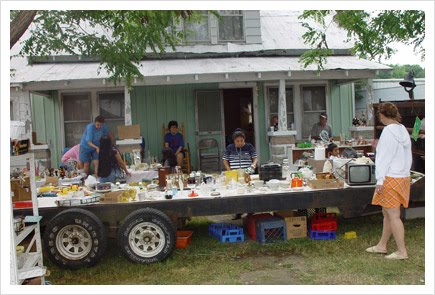
The World's Longest Yard Sale

They say one mans trash is another mans treasure.  If thats the case, you are sure to find lots of treasure this weekend during the the worlds longest yard sale. 

The U.S. 127 Corridor Sale stretches from Hudson, Michigan to Gadsden, Alabama, a distance of  675 miles!  The event is very popular and attracts people from all across the country.  There have even been visitors from several foreign countries.  

The original intent of the sale was to prove the back roads have something to offer, and that the interstate system was not the only mode for travel. There are tons of attractions along the route to provide enjoyment for the family. Whether it be majestic hills, beautiful scenery, river boats, railroads, toe tapping music, arts, crafts, horses, fishing, hiking, bits of Civil War or Indian History, there are many opportunities to enjoy the beauty and culture of the land along the way.


Thousands of people participate in the U.S. 127 Corridor Sale each year as vendors and people will be coming from near and far to view this spectacular event. Folks come from all across the country by car, truck, motor home or plane. Some fly in, rent a car, travel the route and ship the newfound treasures back home. Some pull a trailer behind a truck, park the trailer somewhere and run around in the truck seeking items. U.S. 127 is a two-lane highway so traffic congestion is part of the annual phenomenon to be endured, but the chance of finding a treasure lures them on. Many visitors plan their vacations around the sale event, with some traveling the entire route.  Others may opt to spend their time in a selected area, and venture off the beaten path to discover the history and charm of the land.


If you plan on traveling U.S. 127 this weekend, expect plenty of traffic. In some place, the pace may slow to that of snarled rush hour traffic. In other areas it may be bumper to bumper with everyone stretching their neck to see what is on a seller's table or in the front lawn. There will be sudden stops without warning, so drive carefully and defensively.


You say trash, I say TREASURE!  Come to U.S. 127 this weekend and see what the beaten path has to offer.


The U.S. 127 Corridor Sale has a website and you can get more information by calling 1-800-327-3945.

Wednesday, July 28, 2010

Edwin Young Chilton: The Good Neighbor

Edwin Young Chilton, M.D. was for many years the beloved physician of Howard Lake, Minnesota.  Howard Lake is known as the home of the good neighbor and Dr. Chilton was just that. For over three decades he labored throughout the countryside bringing healing and sympathy and brightness to hundreds of families, and sanctifying his memory to thousands of patients.

Born August 25, 1849 to Josua and Martha Freeman Chilton of Albany, Kentucky, Dr. Chilton received an academy education and then, while still a boy, began to read medicine with prominent physician, Dr. Elza Beckett, at Albany.  He graduated from Miami Medical College at Cincinnati and returned to Albany, where he practiced medicine from 1874 to 1880.  But, Dr. Chilton desired to seek his fortunes in a newer community, so in 1880 he moved to Howard Lake.  His success was assured from the start and he soon became one of the leading physicians in the county.  He kept well abreast of all the latest discoveries in the realms of medicine, philosophy and science, and in 1895, in order to further perfect himself, he took a post graduate course in the School of Surgery in New York City.  His thirty-four years in the village of Howard Lake were ones of great usefulness.  During thirty years of that time he was a leading member of the school board. In 1898, he was elected to the upper house of the Minnesota legislaturek, and did most efficient work as chairman of the committee on the State Hospital for the Insane. Possessed of a fraternal spirit, he was a popular member of the Masons, the Modern Woodman, the Knights of Pythias and the United Workmen.  He was likewise prominent in local affairs and served on numerous committees and delegations.  In 1875, Dr. Chilton married Laura Huddleston of Albany. Together, they had four children: Leo, Jessie, Alice and Freeman. After the passing of Laura, Dr. Chilton married Grace Tromly of Illinois.  They had two children: Walter and Madge. Dr. Chilton died May 25, 1914.  His death was sincerely mourned.

Celebrating the life and times of Edwin Young Chilton, M.D., beloved physician, community and state leader.

As an interesting side note: During the Civil War, Joshua Chilton, who was an industrious and peaceable citizen of Albany, was not permitted to remain at home because of his alignment with the Union. For this he was hated, threatened and even hunted, but nothing could deter him from his duty to his country. He was too old to join the Army, but two of his sons were not and served the Union well. Even though he literally became a refugee driven from his home, Joshua still rendered the Union cause good service. Eventually, Joshua Chilton was killed by General Bragg's soldiers during their visit to Kentucky.

Wednesday, July 21, 2010

Just Like Guinevere

In folklore, Guinevere the legendary queen consort of King Arthur, was safe behind the walls of the castle. Then, Arthur's chief knight, Sir Lancelot, came along. Their affair eventually led to the downfall of Arthur's kingdom. After the affair was exposed, Guinevere was sentenced to burn at the stake, but Lancelot rescued her. She eventually fled to a convent when Arthur declared war against her lover. It was there, behind the walls of the convent, that Guinevere spent the rest of her life. Upon hearing the news of Arthur's death, and after discovering Guinevere had become a nun, Lancelot retired to a hermitage to live out the rest of his life in penitence, just like Guinevere.

The song, Guinevere, by The Eli Young Band says..."forgiveness ain't nothing but a lifeless tire on the shoulder of her soul that never rolls."

Life isn't always fair as we see it, or as we want it to be. We have our mountains and we have our valleys. You seem hard on the outside only because you have taught yourself to be that way because of past experiences. While you may think you need those walls, it is sad that you cannot see that perhaps there is a special someone who has come into your life, who is worth letting your guard down for.

For as much as she stumbled, she's runnin'
For as much as she runs, she's still here
Always hoping to find something quicker than heaven
To make the damage of her days disappear
Just like Guinevere

If there is one thing I have learned over the past few years, it is, just like Lancelot the once-brave knight, never let yourself be called out on strikes. ALWAYS go down swinging. Come what may, act as though it is impossible to fail. If you are going after Moby Dick, take along tarter sauce. And, NEVER give up on anyone or anything. Believe it or not, miracles happen.

Tuesday, July 20, 2010

The Great American Fraud

Founded mainly on fraud and poison, patent-medicine methods were the rage in America between the mid 19th and early 20th centuries. Before it was finally put to an end, gullible America was spending some seventy-five million dollars in the purchase of patent medicines to cure all sorts of ailments. You name it and there a patented medicinal cure for it, but, it was mostly all fraud. Not all, but most. So, the government set out to separate the sheep from the goats, but an honest attempt to do that developed a lamentable lack of qualified candidates for the sheepfold. Some remedies were honest in their claims and effective for their purposes. "None of these "cures" really did cure any serious affection, although a majority of their users recovered. But, a majority, and a very large majority, of the sick would have recovered anyway. Were it not so, were one illness out of fifty fatal, and this earth would soon be depopulated," said Samuel Hopkins in his 1931 book, Great American Frauds.

Newspapers bore a huge chunk of the blame for the popularity of the medicinal frauds. "The ignorant drug-taker, returning to health from some disease which he has overcome by the natural resistant powers of his body, dips his pen in gratitude and writes his testimonial. The man who dies in spite of the patent medicine, or perhaps because of it, doesn't bear witness to what it did for him," said Hopkins. "We see recorded only the favorable results: the unfavorable lie silent. How could it be otherwise when the only avenues of publicity are controlled by the advertisers?" he wrote.
 
I'm the happiest little woman In all this little town
And my merry laugh and singing
Takes the place of sigh and frown
For JOHN HAS QUIT HIS DRINKING
And is like himself once more
And the world is just a paradise
With such happiness in store

One particularly heartless swindle that was operated mostly through newspapers, which also meant the United States Post Office, for over 50 years, finally came to an end in August of 1935, when the Postmaster General declared that the Dr. J.W. Haines Company, The Golden Specific Company, of Cincinnati, Ohio was engaged in conducting a scheme for obtaining money through the mail by means of false and fraudulent pretenses. In this scheme, mothers, wives and sisters were led to believe that they could cure their loved ones of the drink habit by the secret administration of the Haines Golden Treatment. Some 18 years earlier, in 1917, The Journal of the American Medical Association had denounced Haines Golden Treatment as 'a cruel humbug,' claiming that no cases of drunkenness was cured by such means. As it turned out, the Golden Treatment was nothing more than a mixture of milk sugar and starch, capsicum and a minute amount of ipecac.

Sadly, the advertisements did not pray on the alcoholic, but rather the family members, and apparently it was effective. Check out the ad copy below.

Even though Haines Golden Treatment was declared a fraud, most people remained convinced the product was the real deal.  When he died, Dr. Haines was eulogized as one of the people who invented a cure for drunkards.

Friday, July 16, 2010

The Night There Were Zombies In My Backyard

Last night, I dreamed I fought zombies in the backyard of my old home place.  I was killing them left and right with a sling blade that some strange person had given me.  And, then one of the zombies' blood spilled on me and I became one.  Why do things that are going good sometimes go bad? I wish I knew the answer to that.  Suddenly, this feels like a Bob Dylan song.  All I know is there were these zombies in my backyard and I had a sling blade and I was killing them and then I became one.  After I turned into a zombie I woke up.  I guess zombies don't dream.  There were a couple of other people who were helping me kill the zombies.  I don't know who they were or how they got there.  All I know is I am glad they helped.  Killing zombies is hard work. My pastor says dreams like this happen when I eat too much pizza before I go to bed, but have you ever dreamed you fought zombies with a sling blade in your back yard and then became a zombie?  It was downright creepy.

Sunday, July 4, 2010

These Are The Times That Try Men's Souls

Author Thomas Paine was the first person to publicly advocate that America should seek to be an independent nation, free from tyranny.  His ‘how to’ pamphlet, known as Common Sense, sold 100,000 copies, a best-seller among the two-million people in the American British colonies. It challenged the authority of the royal monarchy and inspired the people of America into a revolution.

“The sun never shined on a cause of greater worth,” he said.

While the people in the American British colonies were fed up with King George, Paine wrote: “But where, say some, is the king of America?  I’ll tell you Friend, he reigns above...

...yet that we may not appear to be defective even in earthly honors, let a day be solemnly set apart for proclaiming the charter; let it be brought forth placed on the divine law, the word of God; let a crown be placed thereon, by which the world may know, that so far as we approve of monarchy, that in America the law is king. For as in absolute governments the king is law, so in free countries the law ought to be king; and there ought to be no other.”

“These are the times that try men’s souls,” said Paine in The Crisis. “Tyranny, like hell, is not easily conquered, yet we have this consolation with us, that the harder the conflict, the more glorious the triumph. What we obtain too cheap, we esteem too lightly; it is dearness only that gives every thing its value. Heaven knows how to put a proper price upon its goods; and it would be strange indeed if so celestial an article as freedom should not be highly rated.”

Paine became known as 'Father of the American Revolution.'

AND INDEPENDENCE DAY WAS BORN!

On July 4, 1981, President Ronald Reagan wrote, “Let the Fourth of July always be a reminder that here in this land, for the first time, it was decided that man is born with certain God-given rights; that government is only a convenience created and managed by the people, with no powers of its own except those voluntarily granted to it by the people.”

God Bless America!

Thursday, July 1, 2010

A Penny From Heaven

It was Winston Churchill who said we make a living by what we get, but we make a life by what we give.

This is a story about giving.

How often do we stop to say thank you for the little things in life? We see them every day. We feel them. We touch them. We hear them. We welcome them. They surround us. They help us. They are everywhere. We should thank them more often because, if you stop and think about it, those little things are real treasures beyond compare. Blue skies, new moons and raindrops, mentioned in Bing Crosby's 1936 song, are all pennies from Heaven, but there are so many more. For instance, my cousin, Emily. She is a penny from Heaven. I found this out the other day when she gave up one of her kidneys so that her aunt might live a more enjoyable life. Wow! Talk about a treasure given and received! Emily did it. Her brother said she was his hero. She is mine, too.

Something happened to Emily after she donated her kidney. I am older than she is so I have known her my entire life. She has always been full of joy, but after the transplant Emily came back home with a cup so full it is overflowing. I mean, it really shows big time. God has blessed her beyond measure and I am certain she would tell you He has blessed her even way, way beyond that!

The aunt's fortune fell in the form of a penny from Heaven called Emily. But, Emily's version is that donating the kidney evoked every emotion, above all thankfulness, within herself. In her words, "To the Creator, Healer, and Prayer Answerer, for my family whom I love beyond words and to my friends who are by far more than I deserve!" On Facebook, she quoted lyrics from the Chris Tomlin song:

"I will lift my eyes in the darkest night for I know my Savior reigns; And though the storms may come, I am holding on to the Rock I cling. How can I keep from singing Your praise? I know I am loved by the King, and it makes my heart want to sing!"

Donating a kidney is certainly no little thing. It's huge. It's more than huge, whatever that word is. It has to be one of the reasons why God put Emily on this earth. He knew her before she was born. That is pretty overwhelming. Her brother said Emily gave someone a second chance at enjoying life to its fullest. Buzz and Dolly Dimple would be so proud. She is a treasure, a penny from Heaven.

We all love you, Emily. Very much.

If you want the things you love
You must have showers
So when you hear it thunder
Don't run under a tree
There'll be pennies from heaven for you and me


Wednesday, June 23, 2010

To Honor A Hero


"I just sent one of my officers home. He was my S-2 (Intelligence Officer), Lt. Garlin M. Conner, who is from Aaron, Kentucky. I'm really proud of Lt. Conner. He probably will call you and, if he does, he may not sound like a soldier, will sound like any good old country boy, but, to my way of seeing, he's one of the outstanding soldiers of this war, if not THE outstanding. He was a Sergeant until July and now is a First Lieutenant. He has the D.S.C., which could have been, I believe, a Congressional Medal of Honor but, he was heading home and we wanted to get him what he deserved before he left. He has a Silver Star with 4 clusters, a Bronze Star, Purple Heart with 6 clusters and is in for a French medal. On this last push, within two weeks he earned the D.S.C., a cluster to his Silver Star and a Bronze Star. I've never seen a man with as much courage and ability as he has. I usually don't brag much on my officers but, this is one officer nobody could brag enough about and do him justice; he's a real soldier."

The above was written by former Lt. Col. (later Major General) Lloyd B. Ramsey, while commanding the 3rd. bn., 3rd Div., 7th Inf., 7th Army, a few days after a WWII assault where Murl Conner of Aaron, Kentucky ran 400 yards, through the impact area of an intense concentration of enemy artillery fire near Houssen, France, to direct friendly artillery on a force of six Mark VI tanks and tank destroyers, followed by 600 fanatical German infantrymen, which was assaulting in full fury the spearhead position held by his battalion. Along the way, he unreeled a spool of telephone wire, disregarded shells which exploded 25 yards from him and set up an observation post which he manned for more than three hours during the intense fighting. It was on that date, January 24, 1945 at 0800 hours, that Lt. Garlin Murl Conner was individually credited with stopping more than 150 Germans, destroying all the tanks and completely disintegrating the powerful enemy assault force and preventing heavy loss of life in his own outfit.

Lt. Conner served in the same 3rd Infantry Division as Audie Murphy, who has always been recognized as America's most decorated hero of all wars. That honor should have gone to Conner. The Medal of Honor would have given Conner one more award than Murphy, thus making him America's most decorated hero of all wars. But sadly, Lt. Conner was never awarded the Medal of Honor for his act of heroism. Due to the heat of the battle that day, the commanding officer did not take the time to do the necessary paperwork.

Richard Chilton of Lake Geneva, Wisconsin, served with the 11th Airborne Division in Korea and with Israeli paratroopers during Desert Storm. While researching the war records of his uncle, Gordon Roberts, who was killed shortly after the landing at Anzio Italy, one name kept coming up -- Murl Conner. Gordon Roberts was a member of Murl Conner's platoon. One by one, each of the over 300 veterans of the 7th Infantry Regiment spoke of Lt. Conner's heroic efforts. Chilton was so moved by the many eyewitness accounts of Lt. Conner's courage and sacrifice that he began seeking the Medal of Honor for the Clinton County man, who died in 1998. Lt. Conner's selfless acts of bravery, Chilton insists, should place him in the company of Sgt. Alvin York, who lived just down the road from Murl Conner at Pall Mall, and of Audie Murphy, who served in the same division as Conner but who earned one less Silver Star for gallantry than Lt. Conner's four. York and Murphy both received the Medal of Honor. Murphy received his MOH two days after Lt. Conner's act of heroism.

Many of Lt. Conner's battle records were lost. The records that do exist officially document that Murtl Conner repeatedly risked his life under enemy fire to capture and disable numerous enemy positions with grim ferocity, as one of his commanders wrote. You see, for three hours, Lt. Conner lay in a shallow ditch as "wave after wave of German infantry" surged toward him, at times to within five yards of his position. As the last all-out German assault swept forward, he ordered his artillery to concentrate on his own position, resolved to die if necessary to halt the enemy. Friendly shells exploded within five yards of him, blanketing his position but Lt. Conner continued to direct artillery fire on the assault elements swarming around him until the German attack was shattered and broken.

Lt. Conner was wounded at least seven times during 29 months of nearly continuous combat service, but he refused to accept Purple Hearts for most of the wounds. He was given a battlefield commission to second lieutenant after only three months of fighting. Many of his fellow infantrymen told Chilton they often watched in amazement as Conner repeatedly risked his life to save others. They said Lt. Conner frequently volunteered to take the point on the most dangerous patrols. And one officer remembered that when volunteers were requested for an especially dangerous night mission into enemy territory, Lt. Conner was the only one who reported to the commander's tent. "Where are the rest?" the commander asked. "I'm it," Lt. Conner replied. Murl Conner came home to Clinton County after the war and spent the rest of his life farming and raising a family. He died at age 79.

Because of Chilton's tireless efforts, on January 8, 2003, Kentucky Congressman Ed Whitfield introduced H.R. 327 in the 108th Congress, authorizing the President to award a Medal of Honor posthumously to Lt. Conner. However, it is yet to be done. I realize this story has been written about several times since Chilton began his campaign. I have written of it several times myself and even if I had never known Murl Conner, I would still be pushing for the nation's highest honor to be awarded him and I will gladly write and rewrite this story as long as it takes, because it is the right thing to do. To me, this story will never grow old. I believe what Richard Chilton once said - "I do not have the option to give up as long as someone will listen. Awarding Lt. Garlin Murl Conner the medal of honor is just something that has to be done." He was, after all, one of the great heroes of World War II.

In the photo above, taken on February 10, 1945, Lt. General Alexander M. Patch is seen awarding Lt. Garlin Murl Conner the Distinguished Service Cross for extraordinary heroism for his actions on January 24, 1945 near Houssen, France.

Wednesday, June 2, 2010

Two Wolves

One evening an old Cherokee told his grandson about a battle that goes on inside people.  He said, "My son, the battle is between two wolves inside us all.  One is Evil. It is anger, envy, jealousy, sorrow, regret, greed, arrogance, self-pity, guilt, resentment, inferiority, lies, false pride, superiority, and ego.  The other is Good. It is joy, peace, love, hope, serenity, humility, kindness, benevolence, empathy, generosity, truth, compassion and faith." The grandson thought about it for a minute and then asked his grandfather: "Which wolf wins?"  The old Cherokee simply replied, "The one you feed."

Thursday, May 27, 2010

That First Decoration Day

Memorial Day marks the beginning of the summer vacation season. Where I live, it means lots of tourists from now until Labor Day. When I think of Memorial Day, I think about the men and women who have paid the ultimate price on the battlefield protecting our freedom as americans.  I think about the beautiful and serene Bolestown Cemetery, where lies the remains of many of my ancestors from before and after the civil war.  My great, great, great, great grandfather, James Boles, is buried there. He was a revolutionary war soldier, who fought in the battle of Kings Mountain. His son, my great, great, great grandfather, John Boles, is also buried there beside his wife, Matilda. He was a Union soldier in the service of Tinker Dave Beaty's Independent Scouts. She was Tinker Dave's sister. John's son, George, my great great grandfather, was also a member of Tinker Dave's group, as was his brother Robert. They were not killed during the war, but no doubt witnessed a few skirmishes where soldiers or civilians were killed.


Decoration Day, as it was first known, was first enacted to honor fallen Union soldiers of the civil war. One of the earliest known observances happened after former slaves had converted a mass grave at the former Washington Race Course, now Hampton Park, in Charleston, South Carolina, into a cemetery. The race course had been used as a temporary Confederate prison camp. When the hostilities ended, the former slaves exhumed the bodies and reinterred them properly. They built a fence around the graveyard and declared it a Union graveyard. On May 1, 1865, a crowd of up to ten thousand people, mainly african-americans, marched to the location for sermons, singing, and a picnic. It was the first Decoration Day.

Sleep, comrades, sleep and rest
On this Field of the Grounded Arms
Where foes no more molest
Nor sentry's shot alarms

Ye have slept on the ground before
And started to your feet
At the cannon's sudden roar
Or the drum's redoubling beat

But in this camp of Death
No sound your slumber breaks
Here is no fevered breath
No wound that bleeds and aches

All is repose and peace
Untrampled lies the sod
The shouts of battle cease
It is the Truce of God

Rest, comrades, rest and sleep
The thoughts of men shall be
As sentinels to keep
Your rest from danger free

Your silent tents of green
We deck with fragrant flowers
Yours has the suffering been
The memory shall be ours

Decoration Day - by Henry Wadsworth Longfellow

Thinking about the Pickup Man

Mary Ellis, who writes for the Wayne Weekly, recently forwarded a copy of her recent story, "Remembering Pickup Man: Howard Perdew....