Monday, August 30, 2010

The Means Brothers at Horseshoe Bend

Prior to the War of 1812, Ahijah and Andrew Means, Jr. and a group of other men formed the Overton County Militia to protect their homes. The militia was commanded by Col. Stephen Copeland and was part of the 3rd Regiment, West Tennessee Militia Infantry in General Thomas Johnson’s Brigade.


As the white population increased, the Creek Indians began to divide among themselves into those who held more traditional views and those who were more assimilated through contact with whites. Tecumseh tried to unite the Native Americans in a confederacy against white Americans. Most Upper Creeks, called "Red Sticks" because of their bright red war clubs, wanted to resist white encroachment. Most Lower Creeks, more accustomed to whites, were inclined toward peace. This division led to the Creek War of 1813-14.

With the Creek already on the warpath, a war faction of the "Red Sticks" took part in a general uprising when a party of frontier settlers clashed with some native Americans at Burnt Corn, Alabama about 80 miles north of Pensacola, Florida. 250 people at Ft. Mims, just above Mobile, Alabama, were massacred and many others burned to death. When the news reached Nashville, General Andrew Jackson mobilized the Tennessee militia for a full-scale campaign.

In January 1814 Jackson launched his campaign to drive south into the heart of Red Stick country between the Coosa and Tallapoosa rivers. A deep bend in the Tallapoosa River, known as Horseshoe, enclosed one hundred acres, furrowed with gullies and covered by small timber and brush. Across the narrow neck of the peninsula the Creek had built a log breastwork. At the point was a fleet of canoes to insure an avenue of retreat. On the morning of Sunday, March 27, 1814, Jackson sent 700 mounted militia and 600 Cherokee and Lower Creek allies to cross the Tallapoosa and surround the bend. Jackson and the troops of the Thirty-Ninth U.S. Infantry and Tennessee Militia Infantry, about 2,000 men including brothers Ahijah and Andrew Means, marched into the peninsula of the Horseshoe to confront the 1,000 Red Sticks behind their barricade. Jackson warned, "Any officer or soldier who flies before the enemy without being compelled to do so by superior force...shall suffer death."

"Arrows, and spear, and balls were flying. Swords and tomahawks gleaming in the sun," said Sam Houston. Jackson’s hope was to breach the barricade. "For two hours "a brisk...galling fire" of cannon and musketry, a hail of iron shot and lead balls splintered the bark of the logs, but the "balls passed through the works without shaking the wall... Notwithstanding every shot penetrated...and carried with it death..still such was the strength of the wall that it never shook," Jackson later said.

It was Ahijah and Andrew Means and the rest of the volunteer militia's job to guard the supply wagons, pack horses and wounded. They were located behind the three main positions in front of the breastworks. Records show that some of the regiment were wounded, indicating their position was breached causing the militia men from Overton County to join in the fighting.

During a lull in the battle, a small cloud appeared. The Red Sticks, believing this was the sign they had been waiting for, fired upon the messenger of peace and resumed the battle with fury. The sign of deliverance brought only a quiet shower and the peninsula was strewed with the slain. The battle of Horseshoe Bend was over.

557 Indian dead were counted on the ground and the river held 200 more. All total, nearly 900 warriors are believed to have perished in this decisive battle. Jackson had lost 49 men and another 157 were wounded.

On August 9, 1814, Andrew Jackson forced the Creeks to sign the Treaty of Fort Jackson. Despite protest of the Creek chiefs who had fought alongside Jackson, the Creek Nation ceded 23 million acres, half of Alabama and part of southern Georgia, to the United States government. Even though the Creek War was largely a civil war between the Creeks, Andrew Jackson saw no difference between the Creeks that had fought with him and the Red Sticks that fought against him. Of the 23 million acres Jackson forced the Creeks to cede, 1.9 million acres was claimed by the Cherokee Nation who had allied with the United States. After becoming President, Jackson took the land ceded to his former allies, the Cherokees, together with other Cherokee lands in his removal of the Cherokees to the Oklahoma Territory. Chief Junaluska, the Cherokee Chief who saved the life of Jackson in battle and who led 500 Cherokees in support of Jackson at Horseshoe Bend, stated that "If I had known that Jackson would drive us from our homes, I would have killed him at Horseshoe."

The Pay Roll Records for Col. Copeland’s company showed that for the 4 months and 5 days of service, Ahijah and Andrew Means and others in the Overton County Militia received $8 a month with a $2.86 subsistence, for a total of $36.19. When the militia men returned to Overton County, both Ahijah and Andrew left their home on Obey River and moved to Missouri where they lived the rest of their days.

Ahijah and Andrew Means' brother, Benjamin, was the great-grandfather of William Ezra Means....my great-grandfather.

Friday, August 27, 2010

Threads of Life

President Dwight David Eisenhower once said, "There's no tragedy in life like the death of a child. Things never get back to the way they were." The same can also be said for grandparents.

I know so many things in my life ended with the passing of my grandparents, Cecil and Dimple Speck, in 1986. After he died, she said that she did not want to live without him and two weeks later she passed away. It was a sad time for my family. They were the cornerstone of our lives. Everything was built around them; holiday meals, love, encouragement and solid to the core advice. Suddenly all of that came to end never to be again, only remembered. I loved spending the night with them and sitting at the kitchen table listening to my grandmother tell stories from her childhood and stories of other family members. I think that is where my love for genealogy began. She would also read from the bible and would instruct us. I recall with great sadness the day she asked me why I had stopped coming to see her. You see, I had gotten older and I let things drag me away from her kitchen table. She died before I could go back there and I so sorely regret that.

I believe that no one single event ever occurs; that whenever something happens, if you look around, you will find something else has occurred related to that one event. I believe the people in our lives; our family, friends, neighbors, even strangers we meet, are there for a purpose. I believe as we get older, we are able to retain certain memories and recall certain times in our lives for a reason. Like patchwork, the threads of life are woven together to make us what we are or what we are to become. That is how a friend of mine described it and I think she is right. Life is fragile and the older I get the more aware I am of just how fragile it really is.

I read obituaries for a living and sometimes they are hard to read. The older I get, the more I know the name of the deceased. The very morning my grandfather, Cecil, died I had to read his obituary on the air. Someone commented later that they could not believe how I was able to do that. I just remember that it was hard to do. I grew up in radio and was surrounded by great men and women, who not only taught me everything about radio, but they also taught me a lot about life. I ended up writing and reading all of their obituaries and now I am carrying on without them. It isn't always easy.

Watching them, and others, live and die has taught me to enjoy life more. I want to live my life to its fullest every single day that I have left. I am not interested in when I will die. I am going to enjoy today.

I can't imagine living with someone for 50 years but I can understand why Dimple did not want to go on living after Cecil died. Laying in her hospital bed, with her children gathered around her and unable to speak, she took her finger and wrote B-U-Z-Z in the air. Buzz was my grandpa's nickname. She was telling them she wanted to go be with him. A couple of days later, she did.

After my grandpa's death, my grandma began writing a poem, but she died before she could finish it. My dad finished it for her and read it at her funeral.

Today Lord, I'm leaving my loved ones and my home
But I won't be fearing for I won't be alone
You'll be there beside me when I cross to the other shore
Home Sweet Home eternal, never to die no more

In 1843, Danish philosopher Soren Kierkegaard wrote "It is perfectly true, as philosophers say, that life must be understood backwards, but they forget the other proposition, that is must be lived forwards." So, forward I go...one day at a time, weaving the threads of life as I go. I miss my friends and family who have gone on before me, especially Dolly Dimple Speck. To borrow a line from Kierkegaard, 'Of all the things I inherited from her, the mere recollection of her is more dearest to me.

Tuesday, August 24, 2010

Claiming Fannie Cobb

In 1794, after the destruction of the Cherokee towns of Nickajack and Running Water in the southern part of central Tennessee, a group of Chickamauga Cherokees moved west across the Mississippi River and into southeastern Missouri. In the winter of 1811-1812, the devastation of the great New Madrid Earthquake persuaded them to leave the area and move farther west into north central Arkansas between the White and Arkansas rivers.

The Western Cherokee received formal title to their land by virtue of a treaty between the United States and the Cherokee, where the Cherokee Nation ceded an area in the east Nation equal to that land occupied by the Western Cherokee in Arkansas. Under this same treaty the U.S. government began actively encouraging Native Americans to move west. It became known as the Trail of Tears. The Choctaw were the first in 1831. The Seminole were removed in 1832, the Creek in 1834, then the Chickasaw in 1837. By the early 1830's, more than 4,000 Native Americans were living west of the Mississippi.

Many Native Americans suffered from exposure, disease, and starvation while en route to their destinations, and many died. The Cherokee were the last to be removed. The U.S. Government tried to remove them in 1835, but most resisted, so they were forcibly removed. In the end, some 46,000 Native Americans had been removed from their homelands.

Between 1839 and 1846, the Indian Nation became divided over who owned the land. A third treaty, signed in August of 1846, determined that the lands occupied by the tribe belonged to all the members. At the same time, the Federal Government admitted that it had, among other things, improperly charged the Cherokee against the $5,000,000 they received for their lands back East. Three lawsuits were filed with the United States Court of Claims ruling in favor of the Cherokee. As a result, over one million dollars was awarded to the Eastern Cherokee.

The Department of Interior assigned a Mr. Guion Miller as special agent to identify those who were eligible to receive $133.18 that was given to each person. The Guion Miller Roll was made to distribute the money to all Eastern Cherokee that were alive on May 28, 1906, who could prove that they were members of the tribe at the time of the treaties of 1835, 1836 and 1845, or were descended from members of the tribe. Each applicant was asked for such information as full English and Indian name, residence, age, place of birth, name of husband or wife, names of children, place of birth and date of death of parents and grandparents, names and ages of brothers and sisters, and names of uncles and aunts. Mr. Miller released his report on May 28, 1909. Over 45,000 applications representing 90,000 individuals were filed with only 30,254 individuals being found eligible. 27,051 of those eligible lived west of the Mississippi River, with another 3,203 living east of the Mississippi River.

According to the records of the U.S. Court of Claims, over 250 of the applicants claimed to be a descendant of Fannie Cobb, a full-blooded Cherokee who lived in Fentress County, Tennessee.

Fannie Coker Cobb was my fifth great-grandmother on my mothers side. Her son, Jesse's granddaughter, Deborah, married George Boles, who was my grandfather's grandfather.

According to the book, Extract of the Rejected Applications of the Guion Miller Roll of the Eastern Cherokee, Vol. 3, (2006) by Jo Ann Curls Page, several of the descendants on my mother's side were among those applications which were denied. They included George and Deborah Boles and some of their children, including Barlow, Doll, Hige (my great-grandfather) and George's father, John Boles.

In his claim filed in 1907, Deborah's brother, Asa Smith, wrote that he was applying "for such share as may be due me of the fund appropriated in favor of the Eastern Cherokees through my grandfather Jesse Cobb. His mother was a Coker and she was a Cherokee Indian. She married a Cobb, my mother's maiden name: Fannie Cobb."  The claim was denied.

If Fannie Cobb was a full-blooded Cherokee, then one of three things happened to cause their applications to be rejecrted.  They either failed to fill out the applications correctly, failed to prove their direct relation to Fannie or they failed to prove she was a full-blooded Cherokee.  Fannie Coker Cobb died five years before the U.S. Court of Claims ruling.

Friday, August 13, 2010

Eve Of Destruction

Now, I'm not one for protesting, but when I was 10-years-old I witnessed one very big protest.  The date was Thursday, May 28, 1970.  The place was Neyland Stadium in Knoxville, Tennessee.  Two of the most admired men in America were there: Billy Graham and President Richard Nixon.   

The protestors were actually standing next to where my group was. By the time Nixon rose to speak, they were chanting, "One, two, three, four, We don't want your (blank-ing) war!" I remember thinking how disrespectful it was to do that at a Billy Graham Crusade, but Nixon was there and he was the reason the protestors were there.  It was during the Vietnam War and the tragic shootings at Kent State had occured just a few days earlier.  Nixon had gone into seclusion at the white house and he saw the Graham crusade as a chance to be seen in a more positive light.  He did not count on such a major protest occuring.

The chants used by the protestors were frequent and loud, but Nixon seemed to draw strength from it.  Time magazine called his speech that night one of the greatest of his presidency. Not wanting to disrupt the religious part of the service, the protestors eventually filed out of the stadium.  I can remember some of them were singing John Lennon's "Give Peace a Chance" as they left.  It was quite the scene for a 10-year-old boy to witness.

Funny, but it does not take much to update this 1965 Barry McGuire hit to fit today's scene.

Bob Dylan once said, "The times they are a-changing."

Oh really?

The eastern world, it is exploding
Violence flarin', bullets loadin'
You're old enough to kill, but not for votin'
You don't believe in war, but what's that gun you're totin'
And even the Jordan River has bodies floatin'

Don't you understand what I'm tryin' to say
Can't you feel the fears I'm feelin' today
If the button is pushed, there's no runnin' away
There'll be no one to save, with the world in a grave
Take a look around ya boy, it's bound to scare ya boy

Yeah, my blood's so mad feels like coagulatin'
I'm sitting here just contemplatin'
I can't twist the truth, it knows no regulation
Handful of senators don't pass legislation
And marches alone can't bring integration
When human respect is disintegratin'
This whole crazy world is just too frustratin'

Think of all the hate there is in Red China
Then take a look around to Selma, Alabama
You may leave here for four days in space
But when you return, it's the same old place
The poundin' of the drums, the pride and disgrace
You can bury your dead, but don't leave a trace
Hate your next-door neighbor, but don't forget to say grace

And you tell me
Over and over and over again, my friend
You don't believe
We're on the eve of destruction


Peace!


 For a more detailed story on Richard Nixon's appearance at the Billy Graham Crusade, read my Nixon's Night Out.


Wednesday, August 4, 2010

The World's Longest Yard Sale

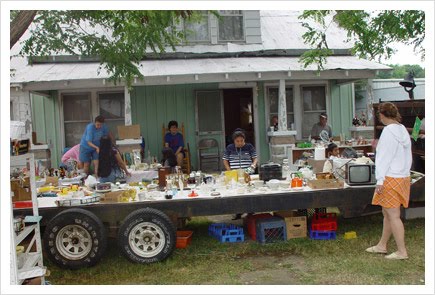
They say one mans trash is another mans treasure.  If thats the case, you are sure to find lots of treasure this weekend during the the worlds longest yard sale. 

The U.S. 127 Corridor Sale stretches from Hudson, Michigan to Gadsden, Alabama, a distance of  675 miles!  The event is very popular and attracts people from all across the country.  There have even been visitors from several foreign countries.  

The original intent of the sale was to prove the back roads have something to offer, and that the interstate system was not the only mode for travel. There are tons of attractions along the route to provide enjoyment for the family. Whether it be majestic hills, beautiful scenery, river boats, railroads, toe tapping music, arts, crafts, horses, fishing, hiking, bits of Civil War or Indian History, there are many opportunities to enjoy the beauty and culture of the land along the way.


Thousands of people participate in the U.S. 127 Corridor Sale each year as vendors and people will be coming from near and far to view this spectacular event. Folks come from all across the country by car, truck, motor home or plane. Some fly in, rent a car, travel the route and ship the newfound treasures back home. Some pull a trailer behind a truck, park the trailer somewhere and run around in the truck seeking items. U.S. 127 is a two-lane highway so traffic congestion is part of the annual phenomenon to be endured, but the chance of finding a treasure lures them on. Many visitors plan their vacations around the sale event, with some traveling the entire route.  Others may opt to spend their time in a selected area, and venture off the beaten path to discover the history and charm of the land.


If you plan on traveling U.S. 127 this weekend, expect plenty of traffic. In some place, the pace may slow to that of snarled rush hour traffic. In other areas it may be bumper to bumper with everyone stretching their neck to see what is on a seller's table or in the front lawn. There will be sudden stops without warning, so drive carefully and defensively.


You say trash, I say TREASURE!  Come to U.S. 127 this weekend and see what the beaten path has to offer.


The U.S. 127 Corridor Sale has a website and you can get more information by calling 1-800-327-3945.

Wednesday, July 28, 2010

Edwin Young Chilton: The Good Neighbor

Edwin Young Chilton, M.D. was for many years the beloved physician of Howard Lake, Minnesota.  Howard Lake is known as the home of the good neighbor and Dr. Chilton was just that. For over three decades he labored throughout the countryside bringing healing and sympathy and brightness to hundreds of families, and sanctifying his memory to thousands of patients.

Born August 25, 1849 to Josua and Martha Freeman Chilton of Albany, Kentucky, Dr. Chilton received an academy education and then, while still a boy, began to read medicine with prominent physician, Dr. Elza Beckett, at Albany.  He graduated from Miami Medical College at Cincinnati and returned to Albany, where he practiced medicine from 1874 to 1880.  But, Dr. Chilton desired to seek his fortunes in a newer community, so in 1880 he moved to Howard Lake.  His success was assured from the start and he soon became one of the leading physicians in the county.  He kept well abreast of all the latest discoveries in the realms of medicine, philosophy and science, and in 1895, in order to further perfect himself, he took a post graduate course in the School of Surgery in New York City.  His thirty-four years in the village of Howard Lake were ones of great usefulness.  During thirty years of that time he was a leading member of the school board. In 1898, he was elected to the upper house of the Minnesota legislaturek, and did most efficient work as chairman of the committee on the State Hospital for the Insane. Possessed of a fraternal spirit, he was a popular member of the Masons, the Modern Woodman, the Knights of Pythias and the United Workmen.  He was likewise prominent in local affairs and served on numerous committees and delegations.  In 1875, Dr. Chilton married Laura Huddleston of Albany. Together, they had four children: Leo, Jessie, Alice and Freeman. After the passing of Laura, Dr. Chilton married Grace Tromly of Illinois.  They had two children: Walter and Madge. Dr. Chilton died May 25, 1914.  His death was sincerely mourned.

Celebrating the life and times of Edwin Young Chilton, M.D., beloved physician, community and state leader.

As an interesting side note: During the Civil War, Joshua Chilton, who was an industrious and peaceable citizen of Albany, was not permitted to remain at home because of his alignment with the Union. For this he was hated, threatened and even hunted, but nothing could deter him from his duty to his country. He was too old to join the Army, but two of his sons were not and served the Union well. Even though he literally became a refugee driven from his home, Joshua still rendered the Union cause good service. Eventually, Joshua Chilton was killed by General Bragg's soldiers during their visit to Kentucky.

Wednesday, July 21, 2010

Just Like Guinevere

In folklore, Guinevere the legendary queen consort of King Arthur, was safe behind the walls of the castle. Then, Arthur's chief knight, Sir Lancelot, came along. Their affair eventually led to the downfall of Arthur's kingdom. After the affair was exposed, Guinevere was sentenced to burn at the stake, but Lancelot rescued her. She eventually fled to a convent when Arthur declared war against her lover. It was there, behind the walls of the convent, that Guinevere spent the rest of her life. Upon hearing the news of Arthur's death, and after discovering Guinevere had become a nun, Lancelot retired to a hermitage to live out the rest of his life in penitence, just like Guinevere.

The song, Guinevere, by The Eli Young Band says..."forgiveness ain't nothing but a lifeless tire on the shoulder of her soul that never rolls."

Life isn't always fair as we see it, or as we want it to be. We have our mountains and we have our valleys. You seem hard on the outside only because you have taught yourself to be that way because of past experiences. While you may think you need those walls, it is sad that you cannot see that perhaps there is a special someone who has come into your life, who is worth letting your guard down for.

For as much as she stumbled, she's runnin'
For as much as she runs, she's still here
Always hoping to find something quicker than heaven
To make the damage of her days disappear
Just like Guinevere

If there is one thing I have learned over the past few years, it is, just like Lancelot the once-brave knight, never let yourself be called out on strikes. ALWAYS go down swinging. Come what may, act as though it is impossible to fail. If you are going after Moby Dick, take along tarter sauce. And, NEVER give up on anyone or anything. Believe it or not, miracles happen.

Tuesday, July 20, 2010

The Great American Fraud

Founded mainly on fraud and poison, patent-medicine methods were the rage in America between the mid 19th and early 20th centuries. Before it was finally put to an end, gullible America was spending some seventy-five million dollars in the purchase of patent medicines to cure all sorts of ailments. You name it and there a patented medicinal cure for it, but, it was mostly all fraud. Not all, but most. So, the government set out to separate the sheep from the goats, but an honest attempt to do that developed a lamentable lack of qualified candidates for the sheepfold. Some remedies were honest in their claims and effective for their purposes. "None of these "cures" really did cure any serious affection, although a majority of their users recovered. But, a majority, and a very large majority, of the sick would have recovered anyway. Were it not so, were one illness out of fifty fatal, and this earth would soon be depopulated," said Samuel Hopkins in his 1931 book, Great American Frauds.

Newspapers bore a huge chunk of the blame for the popularity of the medicinal frauds. "The ignorant drug-taker, returning to health from some disease which he has overcome by the natural resistant powers of his body, dips his pen in gratitude and writes his testimonial. The man who dies in spite of the patent medicine, or perhaps because of it, doesn't bear witness to what it did for him," said Hopkins. "We see recorded only the favorable results: the unfavorable lie silent. How could it be otherwise when the only avenues of publicity are controlled by the advertisers?" he wrote.
 
I'm the happiest little woman In all this little town
And my merry laugh and singing
Takes the place of sigh and frown
For JOHN HAS QUIT HIS DRINKING
And is like himself once more
And the world is just a paradise
With such happiness in store

One particularly heartless swindle that was operated mostly through newspapers, which also meant the United States Post Office, for over 50 years, finally came to an end in August of 1935, when the Postmaster General declared that the Dr. J.W. Haines Company, The Golden Specific Company, of Cincinnati, Ohio was engaged in conducting a scheme for obtaining money through the mail by means of false and fraudulent pretenses. In this scheme, mothers, wives and sisters were led to believe that they could cure their loved ones of the drink habit by the secret administration of the Haines Golden Treatment. Some 18 years earlier, in 1917, The Journal of the American Medical Association had denounced Haines Golden Treatment as 'a cruel humbug,' claiming that no cases of drunkenness was cured by such means. As it turned out, the Golden Treatment was nothing more than a mixture of milk sugar and starch, capsicum and a minute amount of ipecac.

Sadly, the advertisements did not pray on the alcoholic, but rather the family members, and apparently it was effective. Check out the ad copy below.

Even though Haines Golden Treatment was declared a fraud, most people remained convinced the product was the real deal.  When he died, Dr. Haines was eulogized as one of the people who invented a cure for drunkards.

Friday, July 16, 2010

The Night There Were Zombies In My Backyard

Last night, I dreamed I fought zombies in the backyard of my old home place.  I was killing them left and right with a sling blade that some strange person had given me.  And, then one of the zombies' blood spilled on me and I became one.  Why do things that are going good sometimes go bad? I wish I knew the answer to that.  Suddenly, this feels like a Bob Dylan song.  All I know is there were these zombies in my backyard and I had a sling blade and I was killing them and then I became one.  After I turned into a zombie I woke up.  I guess zombies don't dream.  There were a couple of other people who were helping me kill the zombies.  I don't know who they were or how they got there.  All I know is I am glad they helped.  Killing zombies is hard work. My pastor says dreams like this happen when I eat too much pizza before I go to bed, but have you ever dreamed you fought zombies with a sling blade in your back yard and then became a zombie?  It was downright creepy.

Sunday, July 4, 2010

These Are The Times That Try Men's Souls

Author Thomas Paine was the first person to publicly advocate that America should seek to be an independent nation, free from tyranny.  His ‘how to’ pamphlet, known as Common Sense, sold 100,000 copies, a best-seller among the two-million people in the American British colonies. It challenged the authority of the royal monarchy and inspired the people of America into a revolution.

“The sun never shined on a cause of greater worth,” he said.

While the people in the American British colonies were fed up with King George, Paine wrote: “But where, say some, is the king of America?  I’ll tell you Friend, he reigns above...

...yet that we may not appear to be defective even in earthly honors, let a day be solemnly set apart for proclaiming the charter; let it be brought forth placed on the divine law, the word of God; let a crown be placed thereon, by which the world may know, that so far as we approve of monarchy, that in America the law is king. For as in absolute governments the king is law, so in free countries the law ought to be king; and there ought to be no other.”

“These are the times that try men’s souls,” said Paine in The Crisis. “Tyranny, like hell, is not easily conquered, yet we have this consolation with us, that the harder the conflict, the more glorious the triumph. What we obtain too cheap, we esteem too lightly; it is dearness only that gives every thing its value. Heaven knows how to put a proper price upon its goods; and it would be strange indeed if so celestial an article as freedom should not be highly rated.”

Paine became known as 'Father of the American Revolution.'

AND INDEPENDENCE DAY WAS BORN!

On July 4, 1981, President Ronald Reagan wrote, “Let the Fourth of July always be a reminder that here in this land, for the first time, it was decided that man is born with certain God-given rights; that government is only a convenience created and managed by the people, with no powers of its own except those voluntarily granted to it by the people.”

God Bless America!

Thursday, July 1, 2010

A Penny From Heaven

It was Winston Churchill who said we make a living by what we get, but we make a life by what we give.

This is a story about giving.

How often do we stop to say thank you for the little things in life? We see them every day. We feel them. We touch them. We hear them. We welcome them. They surround us. They help us. They are everywhere. We should thank them more often because, if you stop and think about it, those little things are real treasures beyond compare. Blue skies, new moons and raindrops, mentioned in Bing Crosby's 1936 song, are all pennies from Heaven, but there are so many more. For instance, my cousin, Emily. She is a penny from Heaven. I found this out the other day when she gave up one of her kidneys so that her aunt might live a more enjoyable life. Wow! Talk about a treasure given and received! Emily did it. Her brother said she was his hero. She is mine, too.

Something happened to Emily after she donated her kidney. I am older than she is so I have known her my entire life. She has always been full of joy, but after the transplant Emily came back home with a cup so full it is overflowing. I mean, it really shows big time. God has blessed her beyond measure and I am certain she would tell you He has blessed her even way, way beyond that!

The aunt's fortune fell in the form of a penny from Heaven called Emily. But, Emily's version is that donating the kidney evoked every emotion, above all thankfulness, within herself. In her words, "To the Creator, Healer, and Prayer Answerer, for my family whom I love beyond words and to my friends who are by far more than I deserve!" On Facebook, she quoted lyrics from the Chris Tomlin song:

"I will lift my eyes in the darkest night for I know my Savior reigns; And though the storms may come, I am holding on to the Rock I cling. How can I keep from singing Your praise? I know I am loved by the King, and it makes my heart want to sing!"

Donating a kidney is certainly no little thing. It's huge. It's more than huge, whatever that word is. It has to be one of the reasons why God put Emily on this earth. He knew her before she was born. That is pretty overwhelming. Her brother said Emily gave someone a second chance at enjoying life to its fullest. Buzz and Dolly Dimple would be so proud. She is a treasure, a penny from Heaven.

We all love you, Emily. Very much.

If you want the things you love
You must have showers
So when you hear it thunder
Don't run under a tree
There'll be pennies from heaven for you and me


The Story of Reuben Coffey, an American Revolutionary War Soldier

In Augusta Phillips Johnson's book, "A Century of Wayne County Kentucky 1800-1900," originally published in 1939, she used W...