Absalom Barden Wright was born on November 3, 1826 at the headwaters of Wolf River in Fentress County, Tennessee.
At the age of sixteen, he was bitten by a copperhead snake inside his old home place. It was becoming dark in the old house, where Absalom had gone to pick up some oats. When he reached down to pick them up, a snake bit him on his right wrist. He left the oats behind, got on his horse and race the one half mile to his home. His father tried everything he could think of to help his son, but nothing worked. His shoulders, neck, and head became so swollen that it nearly prevented him from breathing, causing people to fear he would die from suffocation. As a last resort, Absalom was given strong whiskey to counteract the snake poison. He drifted off into unconsciousness about midnight. When he awoke about ten o'clock the next morning, he could hardly recognize himself. His right arm was swollen almost as large as his body!
After recovering a little, Absalom felt as though he would rather die than to go through a like suffering again. For the next three spring seasons, Absalom’s arm changed to the color of a serpent and shed off the outside skin. His friends feared that his arm would have to be taken off, but eventually Absalom outgrew it. At the time Absalom was an unsaved boy and he knew it, and it made him shudder to think how near he was to the gate of death in an unsaved state.
Absalom's convictions for sin grew heavier and from early boyhood he had a strong impression of mind that he should do considerable work for the Lord before he died. He would weep bitterly whenever he heard his brother, Edmonson, preach and earnestly appeal to sinners. He wrote, "I would think, if someone would only come and take me by the hand, how readily I would go to the anxious-seat and seek salvation."
In the summer of 1843, someone did take Absalom by the hand. It was August and the Cumberland Presbyterians were holding a camp meeting in the Poplar Cove area. Absalom vowed to the Lord that he would go to that meeting and seek his soul's salvation. But, by the time the meeting came on, Absalom had about overcome all serious impressions he may have had about his needing salvation. He went to the meeting full of life and mischievous fun and, as he had done in the past, he picked out an old man who was shouting aloud God’s praise and make fun of him. On the second night of the camp meeting, Absalom’s heart was melted in deep penitence following the sermon and he went forward to the altar to pray. But, in his words, he ‘got no relief.’ He wrote in his autobiography that it was hard for him to appropriate the precious promises of Christ to his own personal good. A couple of afternoons later, just as the preacher began to preach, there came up a heavy rain, which caused the congregation to retreat to the surrounding campsites with different speakers at each campsite. A man by the name of Tyndall began exhorting in the campsite where Absalom had sought relief from the rain. Directly, he called mourners to come forward. Absalom stood still for a short time before someone took him by the hand and encouraged him to make one more effort. As he started toward the altar, he suddenly fell to the ground crying, "O Lord, here let me die or be saved!" He cried from the very top of his voice, saying “O Lord, save or I perish!" Absalom remained in that condition for some time, when all at once the very same old man that Absalom had made fun of a few nights earlier came and told him to get up. The old man laughed and talked so kindly to Absalom that his faith laid hold on Christ and instantly he arose, shouting “Glory! Glory, Hallelujah! Glory to God in the highest!" As Absalom went through the camps rejoicing, he came upon his father, who at hearing of his son’s salvation, threw himself back in the chair he was sitting in and shouted, “Glory! Glory! Glory,” while clapping his hands together. Absalom continued rejoicing throughout the camps, shouting at the very top of his voice, “Hallelujah! I'm saved! I'm saved! Glory to God and to the Lamb forever!”
And so, at about three o’clock in the afternoon of Monday, August 28, 1843 in the Poplar Cove area of Fentress County, Tennessee, five miles west of Jamestown, the county seat, Absalom Barden Wright was happily converted to God.
Bro. Wright was licensed to preach on July 31, 1848 during a meeting a Five Springs Methodist Church in Clinton County. For nearly 50 years, he boldly traveled throughout Tennessee and Kentucky preaching the Gospel of Jesus Christ.
On November 8, 1893, Absalom was thrown from his horse and killed. He is buried at Wolf River United Methodist Church Cemetery at Pall Mall, Tennessee.
(Taken from A.B. Wright's autobiography published in 1876.)
Tuesday, September 21, 2010


Wednesday, September 8, 2010
J.A. Brents' Banner of Liberty
It is necessary to defend a good and republican government against those who would destroy it. Where it can be, let mind appeal to mind. We are in the midst of a revolution. It is a struggle to maintain the principles of freedom. - J.A. Brents
"As soon as the ordinance of secession was forced upon the people of Tennessee, an army was sent into East Tennessee to look after the loyal citizens (traitors, as the seceders called them). They were imprisoned, their property taken and their families insulted and abused. Many were shot and hung. As soon as this program was adopted, large numbers fled to Kentucky for safety and [they] continued to flee as they could find opportunities for escape. Here [Clinton County], they stopped for a while, and were protected and fed by the citizens of this loyal little county. They were not permitted to remain here long, but were pursued and, together with others who were driven from their homes, fled across Cumberland river."
J.A. Brents of Albany wrote the above in 1863. It is from his book, The Patriots and Guerillas of East Tennessee and Kentucky [the book's title is actually much longer] that I present the following story.
Before the Civil War, John Allen Brents was an attorney. At the start of the campaign, he raised a company of some 85 men in Albany, which became Company C, First Kentucky Volunteer Cavalry, Union Army. He served eleven months, first as a Lieutenant then as Major. He said that his position on the border and in the army gave him an opportunity to obtain much valuable information in regard to the loyal East Tennesseeans, the state of affairs in Kentucky, the progress of the war in the West, what has been done in Kentucky and Tennessee since the rebellion broke out, and the history of men whose hands have been stained with pillage and blood. After the war, he used all the information he had collected and put it into a book. Later, I will tell you how you may purchase a copy of it.
Camp Dick Robinson
Soon after Tennessee seceded from the Union a squadron of cavalry and a body of infantry were sent to Fentress County, Tennessee. The citizens there considered this as a menace, but they were entirely helpless. No United States troops were in Kentucky, nor were any likely to be, as it was said that Kentucky's neutrality would be respected. Realizing they needed to prepare for their own defense in case they were attacked, a public meeting was held in Albany and two companies were organized, one cavalry and one infantry. William Hoskins was elected captain of the cavalry, J. A. Brents first lieutenant, J. P. Pickens second lieutenant and J. A. Morrison third lieutenant. Captain Hoskins was directed to immediately procure arms. He went to Cincinnati, where he obtained one hundred muskets for the infantry but nothing for the calvary. He then went to Washington and, even though he was unable to get the arms he needed, he came back home with something else of great value: Camp Dick Robinson.
Camp Dick Robinson's main purpose was to train fathers and sons sympathetic to the Union cause to be soldiers. J.A. Brents wrote that he was at the camp in Garrard County, Kentucky when those East Tennesseeans arrived. "...and it would have excited the pity of the hardest heart to have witnessed the scene," he said. "They had bid farewell to wives and children, fathers and mothers, brothers and sisters, and their homes, and with broken hearts had taken their squirrel rifles upon their shoulders and started across the mountains for the Union camp, a place where they would be beyond the reach of their persecutors, and where they could prepare to strike a blow for the Union and freedom. Oh, what a bitter cup to them! They suffered and endured all." According to Major Brents, the East Tennesseeans sometimes had to travel several days without food. "What a spectacle to be at Camp Dick Robinson and witness the arrival of these refugees! Their clothes were torn in tatters. Most of them were barefooted [with] their feet bleeding from cuts received on the rocks in the mountains. Some waved little Union flags. Among them were old grayheaded men, midddle-aged men and little boys, who had traveled several hundred miles, and crossed the Cumberland Mountain. Many a stout heart was melted by this sight."
By the 3rd of August, 1861, Brents and Morrison had a full company of cavalry ready to start for camp. "This was a great day in Albany," he said. The entire population of the county assembled to bid farewell to eighty-five citizens who had enlisted in the Union army for three years." All along the route, the one hundred mile march to Camp Dick Robinson was one continual ovation...a one hundred mile parade and celebration. The future soldiers stayed overnight at Monticello and Somerset and were received and feasted like lords. "Men and horses fared bountiously," wrote Brents.
Camp Dick Robinson was alive with hope and renewed vision for a tormented people. Major Brents said, "we had very frequently much amusement, caused by raw soldiers on picket duty getting alarmed, and running into camp and reporting a large force at hand. Then what confusion -- what stirring and moving from point to point -- drums beating -- marching and counter-marching! Excited soldiers would rush to the warehouse, and break open boxes to procure arms and amunition." The cavalry generally got the worst of it. They would often be sent out to hunt the enemy, but were never so fortunate as to find a foe worthy of their steel. Often would they be aroused at the hour of midnight, mount their horses, and ride over hills and down dark valleys, and return to camp just at the break of day. Sometimes the guard at the bridge over the Kentucky river, ten miles distant, would send word to camp that they were about to be attacked. The cavalry would be aroused and sent to their assistance, but on reaching the bridge would find all quiet, the alarm having been caused by a horse running through the woods, or something like that.
Travisville
Meanwhile, back home a real battle was brewing. One-thousand rebel troops had invaded Clinton County from Fentress County and captured several home guard guns. When word spread to Camp Robinson, Colonel Hoskins called upon all home guards in the area to assist him in defending the area and they did; not only from Clinton County, but from Adair, Casey and Russell counties as well. "This was a rich campaign, said Major Brents." A fight was expected every hour, and all were excited, however no attack was made as the rebels became alarmed and moved to the Monroe community in Overton County, where they commenced fortifying. Colonel Hoskins grew impatient at not being attacked, and decided to become the aggressor. The rebels had established a camp at Travisville, and the Colonel ordered Captain Morrison to take his company and attack them. The captain, a gallant and brave officer, being quite anxious for the expedition, proceeded to the camp and made the attack in a fierce and derermined manner. Captain Morrison himself fired upon the enemy with such promptness and precision that they broke and fled, leaving horses, saddles, guns, pistols, papers, etc. behind. Major Brents said, "There were two things connected with this campaign worthy of notice. Number one, the citizens were loyal and willing to repel the invasion, although they were not in any army, and number two, Captain Morrison's company of the 1st regiment of Kentucky Cavalry were the first Union troops on the soil of Tennessee after the commencement of the rebellion; and this, the first expedition to that State, was entirely successful. Today, the battle is known as the Affair at Travisville.
Camp Wildcat
When word came that General Zollicoffer was advancing upon Camp Wildcat in Northern Laurel County, the 3rd Kentucky regiment marched to the area to help. Among the soldiers was J.A. Brents. "We traveled until about ten o'clock p. m., when we halted, dismounted, and turned in for the remainder of the night," he said. "Many lay down upon the cold ground without any fire or covering except one blanket; others built fires before attempting to sleep. Early in the morning we were again on the march -- halted and took breakfast (a cracker and a slice of bacon) about nine o'clock -- resumed the march, and reached Camp Wildcat Sunday evening." On Monday morning, October 21, 1861, all were on alert. Several hours passed away but no attack was made. According to Major Brents, it was concluded that none would be made that day, so the cavalry retired to the rear to get breakfast and feed their horses. The men had just commenced broiling their bacon, when word came that the enemy was advancing. "We had not been in position long before two regiments of rebel troops advanced against us," he said. About three hundred fifty of the 33d Indiana regiment and three hundred fifty of the cavalry were the only forces to repel this attack. But nobly did the Kentuckians and Indianians stand to their post. The latter were trained troops, and fired volleys in quick succession. The Kentuckians were not so well drilled, but made "pretty music" with their rifles, according to Major Brents. This was something more than the rebels expected as they broke and fled in confusion, leaving 53 soldiers dead and a portion of their wounded upon the field. The Union fatalities totaled 25.
A Welcome to Waitsboro
The rebels had established camps in Fentress and Overton counties and were continually making raids into Kentucky as far north as Monticello, taking property, arresting citizens, etc. They had two regiments of infantry and perhaps a thousand cavalry, but no artillery. Captain Morrison proceeded to Albany and drove the rebel advance back into Tennessee. In a few days word came that the enemy, including General Felix Zollicoffer and his entire command of three to six thousand rebels, had marched to Waitsboro, where Col. Hoskins and about eight hundred Union soldiers were stationed. Major Brents was among two hundred men who marched to the area to assist the Colonel. He said, "We started about ten o'clock A.M., and rode the whole day, not stopping till after dark. It rained the entire day. We bivouacked for the night, and next morning started again, not having heard a word from Colonel Hoskins or the enemy. It was still raining. We passed Logan's Fields but saw no enemy. Moving on, we thought perhaps we might meet a rebel force at Fishing Creek. The citizens on the road told us that we could not cross the creek -- that it would swim our horses. We pushed on to the creek, however, finding no enemy. The stream was over the banks, and more like a river than a creek. No delay could be made: if we waited ten minutes, it was certain that we could not cross. It was still raining in torrents, and the creek rising rapidly. We rushed into the boisterous stream, the water nearly reaching the backs of the horses, and swam the low horses; reached the opposite bank, and with a yell announced our relief. We were soon in the streets of Somerset, and, although it was still raining heavily, the men rushed out to welcome us; the women came to the windows, the doors and on the sidewalks, waving their handkerchiefs.
Mill Springs
On January 10, 1862, Major Brents and company began moving to Logan's Cross Roads in preparation for major assault on General Zollicoffer at Mill Springs. Major Brents said the march to Logan's Cross Roads was an extraordinary one. "It was the middle of winter," he said. "The march had to be made over a dirt road in a swampy country. The wagons would sink almost to the axle, sticking nearly every hundred yards and an hour or so was consumed in extricating them." Major Brents' company reached their destination on January 16th. He writes, "On the morning of the 19th, at daylight, our pickets were attacked by the rebel cavalry. Twenty of our cavalry were sent immediately to re-enforce them. On their arrival, the rebel cavalry had retired, and our pickets were confronted by a regiment of infantry, whom they met and kept in check until the arrival of other forces." Realizing the mounted calvary was useless, Colonel Wolford ordered his men to dismount and march to the left of the Indiana regiment, which they did just as the attack was made. It was there that the Calvary and the Indianians stood shoulder to shoulder in open field and fought the entire rebel force for about one hour, before being compelled to draw back. Union forces had not retired far when they met the 4th Kentucky. A new line of battle was formed, this time behind a fence and in a skirt of timber. "The conflict was again renewed, and continued perhaps an hour or more, when the 9th Ohio and 2nd Minnesota arrived and, after pouring several heavy volleys into the enemy's ranks, made as gallant a charge as was ever witnessed," said Major Brents. "The enemy could not stand it, but broke and fled in great confusion, pursued by our victorious troops." By early next morning, the enemy had retired across the river in a steamboat, leaving behind artillery, wagons, tents, camp equipage, trunks, and everything except their small arms and four pieces of artillery. The victory was complete. Four regiments and four companies, and a few pieces of artillery, had completely routed eight regiments of the enemy. Union losses were 39 killed and 207 wounded. Confederate losses were 125 killed, including General Zollicoffer, and 404 wounded or missing
A Call For Help
After Mill Springs, Major Brents turned his thoughts to the guerilla raids that were taking place in Clinton County. In a letter to Col. Wolford, dated Feb. 5, 1862, he wrote, "Last June, Clinton County had nine hundred voters, nearly all of whom were loyal to the Union...Clinton County has about five hundred troops in the Army...they [soldiers] have left wife and children, father and mother, brother and sister, their homes and property, and taken up arms in defence of our common country. The rebels invaded the county, oppressed her citizens at home, put them in fear, abused them, murdered several, and stole their property. Stlll her citizens in the army submitted to it quietly for the good of the cause. But, now the rebels have been whipped and routed and driven back, except a small number of thieves, who are now hanging upon the border, threatening destruction and extermination to everbody. Why cannot a force be sent to the border sufficient to protect that country, and stand between the rebels and the families of those in their country's service, who are bound to suffer greatly if not protected? ...Are a loyal people to be left unprotected, and to be plundered and murdered by two or three hundred thieves after the main army has been routed and driven from this part of Kentucky, when fifteen or twenty thousand troops are within thirty or thirty-five miles? As a citizen of Clinton county, who has suffered at the hands of the rebels, I humbly and earnestly ask that one or two regiments, if not more, be sent to the border, so as to render protection to as loyal people as ever lived."
[After the war, guerilla Champ Ferguson was arrested, convicted and hung for the deaths of 53 people, both soldiers and civilians...many of whom lived in Clinton County.]
A Wonderful, Beautiful Place
I include the following excerpt from J.A. Brents book because in the midst of the bloody Civil War he took the time to reflect on the place he called home...the same place that I, too, call home. A wonderful, beautiful place...
"We must not let the banner of Liberty fall. In the name of all that is sacred, keep the banner of Liberty waving. - J.A. Brents.

To obtain a copy of this book, visit the Clinton County Historical Society's website at:
http://www.albanyclintoncountyky.com/publications.htmlstory
"As soon as the ordinance of secession was forced upon the people of Tennessee, an army was sent into East Tennessee to look after the loyal citizens (traitors, as the seceders called them). They were imprisoned, their property taken and their families insulted and abused. Many were shot and hung. As soon as this program was adopted, large numbers fled to Kentucky for safety and [they] continued to flee as they could find opportunities for escape. Here [Clinton County], they stopped for a while, and were protected and fed by the citizens of this loyal little county. They were not permitted to remain here long, but were pursued and, together with others who were driven from their homes, fled across Cumberland river."
J.A. Brents of Albany wrote the above in 1863. It is from his book, The Patriots and Guerillas of East Tennessee and Kentucky [the book's title is actually much longer] that I present the following story.
Before the Civil War, John Allen Brents was an attorney. At the start of the campaign, he raised a company of some 85 men in Albany, which became Company C, First Kentucky Volunteer Cavalry, Union Army. He served eleven months, first as a Lieutenant then as Major. He said that his position on the border and in the army gave him an opportunity to obtain much valuable information in regard to the loyal East Tennesseeans, the state of affairs in Kentucky, the progress of the war in the West, what has been done in Kentucky and Tennessee since the rebellion broke out, and the history of men whose hands have been stained with pillage and blood. After the war, he used all the information he had collected and put it into a book. Later, I will tell you how you may purchase a copy of it.
Camp Dick Robinson
Soon after Tennessee seceded from the Union a squadron of cavalry and a body of infantry were sent to Fentress County, Tennessee. The citizens there considered this as a menace, but they were entirely helpless. No United States troops were in Kentucky, nor were any likely to be, as it was said that Kentucky's neutrality would be respected. Realizing they needed to prepare for their own defense in case they were attacked, a public meeting was held in Albany and two companies were organized, one cavalry and one infantry. William Hoskins was elected captain of the cavalry, J. A. Brents first lieutenant, J. P. Pickens second lieutenant and J. A. Morrison third lieutenant. Captain Hoskins was directed to immediately procure arms. He went to Cincinnati, where he obtained one hundred muskets for the infantry but nothing for the calvary. He then went to Washington and, even though he was unable to get the arms he needed, he came back home with something else of great value: Camp Dick Robinson.
Camp Dick Robinson's main purpose was to train fathers and sons sympathetic to the Union cause to be soldiers. J.A. Brents wrote that he was at the camp in Garrard County, Kentucky when those East Tennesseeans arrived. "...and it would have excited the pity of the hardest heart to have witnessed the scene," he said. "They had bid farewell to wives and children, fathers and mothers, brothers and sisters, and their homes, and with broken hearts had taken their squirrel rifles upon their shoulders and started across the mountains for the Union camp, a place where they would be beyond the reach of their persecutors, and where they could prepare to strike a blow for the Union and freedom. Oh, what a bitter cup to them! They suffered and endured all." According to Major Brents, the East Tennesseeans sometimes had to travel several days without food. "What a spectacle to be at Camp Dick Robinson and witness the arrival of these refugees! Their clothes were torn in tatters. Most of them were barefooted [with] their feet bleeding from cuts received on the rocks in the mountains. Some waved little Union flags. Among them were old grayheaded men, midddle-aged men and little boys, who had traveled several hundred miles, and crossed the Cumberland Mountain. Many a stout heart was melted by this sight."
By the 3rd of August, 1861, Brents and Morrison had a full company of cavalry ready to start for camp. "This was a great day in Albany," he said. The entire population of the county assembled to bid farewell to eighty-five citizens who had enlisted in the Union army for three years." All along the route, the one hundred mile march to Camp Dick Robinson was one continual ovation...a one hundred mile parade and celebration. The future soldiers stayed overnight at Monticello and Somerset and were received and feasted like lords. "Men and horses fared bountiously," wrote Brents.
Camp Dick Robinson was alive with hope and renewed vision for a tormented people. Major Brents said, "we had very frequently much amusement, caused by raw soldiers on picket duty getting alarmed, and running into camp and reporting a large force at hand. Then what confusion -- what stirring and moving from point to point -- drums beating -- marching and counter-marching! Excited soldiers would rush to the warehouse, and break open boxes to procure arms and amunition." The cavalry generally got the worst of it. They would often be sent out to hunt the enemy, but were never so fortunate as to find a foe worthy of their steel. Often would they be aroused at the hour of midnight, mount their horses, and ride over hills and down dark valleys, and return to camp just at the break of day. Sometimes the guard at the bridge over the Kentucky river, ten miles distant, would send word to camp that they were about to be attacked. The cavalry would be aroused and sent to their assistance, but on reaching the bridge would find all quiet, the alarm having been caused by a horse running through the woods, or something like that.
Travisville
Meanwhile, back home a real battle was brewing. One-thousand rebel troops had invaded Clinton County from Fentress County and captured several home guard guns. When word spread to Camp Robinson, Colonel Hoskins called upon all home guards in the area to assist him in defending the area and they did; not only from Clinton County, but from Adair, Casey and Russell counties as well. "This was a rich campaign, said Major Brents." A fight was expected every hour, and all were excited, however no attack was made as the rebels became alarmed and moved to the Monroe community in Overton County, where they commenced fortifying. Colonel Hoskins grew impatient at not being attacked, and decided to become the aggressor. The rebels had established a camp at Travisville, and the Colonel ordered Captain Morrison to take his company and attack them. The captain, a gallant and brave officer, being quite anxious for the expedition, proceeded to the camp and made the attack in a fierce and derermined manner. Captain Morrison himself fired upon the enemy with such promptness and precision that they broke and fled, leaving horses, saddles, guns, pistols, papers, etc. behind. Major Brents said, "There were two things connected with this campaign worthy of notice. Number one, the citizens were loyal and willing to repel the invasion, although they were not in any army, and number two, Captain Morrison's company of the 1st regiment of Kentucky Cavalry were the first Union troops on the soil of Tennessee after the commencement of the rebellion; and this, the first expedition to that State, was entirely successful. Today, the battle is known as the Affair at Travisville.
Camp Wildcat
When word came that General Zollicoffer was advancing upon Camp Wildcat in Northern Laurel County, the 3rd Kentucky regiment marched to the area to help. Among the soldiers was J.A. Brents. "We traveled until about ten o'clock p. m., when we halted, dismounted, and turned in for the remainder of the night," he said. "Many lay down upon the cold ground without any fire or covering except one blanket; others built fires before attempting to sleep. Early in the morning we were again on the march -- halted and took breakfast (a cracker and a slice of bacon) about nine o'clock -- resumed the march, and reached Camp Wildcat Sunday evening." On Monday morning, October 21, 1861, all were on alert. Several hours passed away but no attack was made. According to Major Brents, it was concluded that none would be made that day, so the cavalry retired to the rear to get breakfast and feed their horses. The men had just commenced broiling their bacon, when word came that the enemy was advancing. "We had not been in position long before two regiments of rebel troops advanced against us," he said. About three hundred fifty of the 33d Indiana regiment and three hundred fifty of the cavalry were the only forces to repel this attack. But nobly did the Kentuckians and Indianians stand to their post. The latter were trained troops, and fired volleys in quick succession. The Kentuckians were not so well drilled, but made "pretty music" with their rifles, according to Major Brents. This was something more than the rebels expected as they broke and fled in confusion, leaving 53 soldiers dead and a portion of their wounded upon the field. The Union fatalities totaled 25.
A Welcome to Waitsboro
The rebels had established camps in Fentress and Overton counties and were continually making raids into Kentucky as far north as Monticello, taking property, arresting citizens, etc. They had two regiments of infantry and perhaps a thousand cavalry, but no artillery. Captain Morrison proceeded to Albany and drove the rebel advance back into Tennessee. In a few days word came that the enemy, including General Felix Zollicoffer and his entire command of three to six thousand rebels, had marched to Waitsboro, where Col. Hoskins and about eight hundred Union soldiers were stationed. Major Brents was among two hundred men who marched to the area to assist the Colonel. He said, "We started about ten o'clock A.M., and rode the whole day, not stopping till after dark. It rained the entire day. We bivouacked for the night, and next morning started again, not having heard a word from Colonel Hoskins or the enemy. It was still raining. We passed Logan's Fields but saw no enemy. Moving on, we thought perhaps we might meet a rebel force at Fishing Creek. The citizens on the road told us that we could not cross the creek -- that it would swim our horses. We pushed on to the creek, however, finding no enemy. The stream was over the banks, and more like a river than a creek. No delay could be made: if we waited ten minutes, it was certain that we could not cross. It was still raining in torrents, and the creek rising rapidly. We rushed into the boisterous stream, the water nearly reaching the backs of the horses, and swam the low horses; reached the opposite bank, and with a yell announced our relief. We were soon in the streets of Somerset, and, although it was still raining heavily, the men rushed out to welcome us; the women came to the windows, the doors and on the sidewalks, waving their handkerchiefs.
Mill Springs
On January 10, 1862, Major Brents and company began moving to Logan's Cross Roads in preparation for major assault on General Zollicoffer at Mill Springs. Major Brents said the march to Logan's Cross Roads was an extraordinary one. "It was the middle of winter," he said. "The march had to be made over a dirt road in a swampy country. The wagons would sink almost to the axle, sticking nearly every hundred yards and an hour or so was consumed in extricating them." Major Brents' company reached their destination on January 16th. He writes, "On the morning of the 19th, at daylight, our pickets were attacked by the rebel cavalry. Twenty of our cavalry were sent immediately to re-enforce them. On their arrival, the rebel cavalry had retired, and our pickets were confronted by a regiment of infantry, whom they met and kept in check until the arrival of other forces." Realizing the mounted calvary was useless, Colonel Wolford ordered his men to dismount and march to the left of the Indiana regiment, which they did just as the attack was made. It was there that the Calvary and the Indianians stood shoulder to shoulder in open field and fought the entire rebel force for about one hour, before being compelled to draw back. Union forces had not retired far when they met the 4th Kentucky. A new line of battle was formed, this time behind a fence and in a skirt of timber. "The conflict was again renewed, and continued perhaps an hour or more, when the 9th Ohio and 2nd Minnesota arrived and, after pouring several heavy volleys into the enemy's ranks, made as gallant a charge as was ever witnessed," said Major Brents. "The enemy could not stand it, but broke and fled in great confusion, pursued by our victorious troops." By early next morning, the enemy had retired across the river in a steamboat, leaving behind artillery, wagons, tents, camp equipage, trunks, and everything except their small arms and four pieces of artillery. The victory was complete. Four regiments and four companies, and a few pieces of artillery, had completely routed eight regiments of the enemy. Union losses were 39 killed and 207 wounded. Confederate losses were 125 killed, including General Zollicoffer, and 404 wounded or missing
A Call For Help
After Mill Springs, Major Brents turned his thoughts to the guerilla raids that were taking place in Clinton County. In a letter to Col. Wolford, dated Feb. 5, 1862, he wrote, "Last June, Clinton County had nine hundred voters, nearly all of whom were loyal to the Union...Clinton County has about five hundred troops in the Army...they [soldiers] have left wife and children, father and mother, brother and sister, their homes and property, and taken up arms in defence of our common country. The rebels invaded the county, oppressed her citizens at home, put them in fear, abused them, murdered several, and stole their property. Stlll her citizens in the army submitted to it quietly for the good of the cause. But, now the rebels have been whipped and routed and driven back, except a small number of thieves, who are now hanging upon the border, threatening destruction and extermination to everbody. Why cannot a force be sent to the border sufficient to protect that country, and stand between the rebels and the families of those in their country's service, who are bound to suffer greatly if not protected? ...Are a loyal people to be left unprotected, and to be plundered and murdered by two or three hundred thieves after the main army has been routed and driven from this part of Kentucky, when fifteen or twenty thousand troops are within thirty or thirty-five miles? As a citizen of Clinton county, who has suffered at the hands of the rebels, I humbly and earnestly ask that one or two regiments, if not more, be sent to the border, so as to render protection to as loyal people as ever lived."
[After the war, guerilla Champ Ferguson was arrested, convicted and hung for the deaths of 53 people, both soldiers and civilians...many of whom lived in Clinton County.]
A Wonderful, Beautiful Place
I include the following excerpt from J.A. Brents book because in the midst of the bloody Civil War he took the time to reflect on the place he called home...the same place that I, too, call home. A wonderful, beautiful place...
In April of 1862, after crossing Obey River at the onset of a march into Tennessee, Major Brents saw what he described as the most picturesque scene he ever witnessed. "About half a mile from the river, on the north side, the road makes a precipitate descent into the river bottom. I stood upon the brink of the hill at this point, and took a view of the surrounding country. There lay the beautiful river at my feet, and a vast plain upon the opposite side, perhaps three miles in width, while a range of hills is presented to the view. Just beyond this range is another, then a third one, and so on to the farther range, which is of great height. These hills approached theriver both to the right and left, thus forming a basin. The timber, which was very heavy upon them, was just getting green; the warm spring days had pushed out the buds and leaves. The soldiers marched down to the river, and, with the waving of hats and banners, rushed into the foaming water, which was nearly over the backs of our horses. It was a beautiful scene. I am no poet nor have I imagination enough to describe the scene as I would wish, yet I have given the outlines, from which a highly wrought fancy can form a beautiful picture."The march into Tennessee was J.A. Brents last involvement in the Civil War. He resigned his commission on July 2, 1862.
"We must not let the banner of Liberty fall. In the name of all that is sacred, keep the banner of Liberty waving. - J.A. Brents.

To obtain a copy of this book, visit the Clinton County Historical Society's website at:
http://www.albanyclintoncountyky.com/publications.htmlstory
Thursday, September 2, 2010
The Innkeeper

James Cole was an innkeeper who came to America in the 1630's with his wife and four children and settled at Plymouth Colony. James was the first settler to live on Cole's Hill. The site is named for his son, John.
According to Pilgrim Hall Museum, America's Museum of Pilgrim Possession, virtually all the historic sites relating to the earliest period of the settlement at Plymouth in 1620 have lost their original character and convey little impression of the colony. One exception is Cole's Hill. The view from the hill of land and harbor and sea conveys a vivid impression of the scene that greeted the Mayflower's weary passengers.
The hill was the traditional burial place of the Plymouth colonists, Pilgrims, and others, who died during the tragic first winter of 1620-21. The dead were reportedly buried at night, and their graves disguised to prevent the Indians from learning the dangerously weakened state of the survivors. In later years, the colonists occasionally mounted cannons on the hill to ward off possible attack from the sea.
Today, Cole's Hill is maintained by the Pilgrim Society as a public park. On its top stands the memorial to the Mayflower Pilgrims. At the foot of the hill is Plymouth Rock, the legendary landing site of the Pilgrims and stepping stone to the New World. Whether or not the Pilgrims actually landed on the rock, it has deep meaning for most Americans. Cole's Hill, the nearby rock, and the curving shores of Plymouth Bay memorably evoke the time more than three centuries past when Englishmen came to the shores of New England to stay.

Just outside my church, Clear Fork Baptist Church, is a burial ground and in the far lefthand corner of that burial ground, near the back of the Church, is where several members of the David Mason Cole family are buried.
David Cole was the great, great, great, great grandson of James Cole.
He was born in 1777 in Washington County, Virgina and died here on March 4, 1861 at the age of 83. Shortly before the year 1800, he married Remember Woolsey of France. They had five children: Martha, Rebecca, James, Sampson and Sarah. Not much is known about Remember, except that just before the War of 1812, she and her family crossed the Cumberland Mountains from Virginia into Kentucky and settled along Clear Fork Creek. Remember died young, at the age of 33. David went on to became a prosperous farmer and stockman. On June 11, 1817, he purchased a 130 acre tract across the creek from Clear Fork Baptist Church from Alexander Beaty. It was there, near the current site of the Church gymnasium, that David built a large house. He eventually became a prominent landowner as the 1837 tax list shows him owning 540 acres on Spring Creek, and other lots elsewhere.
Wednesday, September 1, 2010
Dode Dowell: The Courthouse Killing
Dode Dowell lived from 1858 to 1911 and was one of the most colorful characters ever in these parts. Short in stature with dark hair and leathery skin from the outdoor live he lived, Dode, whose real name was Duard Belmont Dowell, sported a droopy mustache and wore his hair parted low on the side to cover a scar left by brass knucks some long forgotten foe had once hit him with. Dode had a reputation for being a dangerous man in combat but he wasn't a mean man. He didn't look for trouble, but he didn't run from it either.
It is said that Dode Dowell was a good business man, a farmer who dealt in livestock and tobacco, and also a merchant, horse stud farm operator and tavern keeper. But, that wasn't all that Dode Dowell was. He was also a legal moonshiner.
His farm on Adam's Fork Creek, better known as Mell Ridge, was mostly an orchard. The fruit was used in brandy making and neighbors hauled fruit away in five barrel wagons for their own use at no charge. A government employee was always present at the making of the moonshine and also at the withdrawal of whiskey from the bond house. Occasionally, Dode would be arrested for selling whiskey illegally, but nine times out of ten he was found not guilty. He also appeared in court numerous times on firearms charges, disturbing the peace and so on.
There are many stories about the life of Dode Dowell, but the one most told begins with Fannie Buckner, Dode's first wife. She was pregnant with their second child when Deputy Marshall Bill Stotts, entered their home one day threatening to kill Dode. The young Mrs. Dowell was so frightened by his threats that she suffered a miscarriage and then died herself a few days later. Believing his wife's death was entirely the fault of Stotts, Dode sent word that if he ever met him he would kill him.
Dode didn't go looking for Stotts. As a matter of fact it wasn't until four years later that the two met. The date was May 16, 1887. The place was inside the courthouse at Edmonton, Kentucky. Court was in session when Dode spotted Stotts on the courthouse steps. The May 25, 1887 edition of the Hart County News described the ordeal in detail...
2011 will be the 100 year anniversary of the passing of Dode Dowell. His legend will last forever, or at least as long as there is someone to tell the stories and someone to listen. The Colt 44 used to kill Bill Stotts is a highly sought item by collectors.

Pictured above is the old Metcalfe County Courthouse at Edmonton, where Dode Dowell killed Bill Stotts in an upstairs room.
It is said that Dode Dowell was a good business man, a farmer who dealt in livestock and tobacco, and also a merchant, horse stud farm operator and tavern keeper. But, that wasn't all that Dode Dowell was. He was also a legal moonshiner.
His farm on Adam's Fork Creek, better known as Mell Ridge, was mostly an orchard. The fruit was used in brandy making and neighbors hauled fruit away in five barrel wagons for their own use at no charge. A government employee was always present at the making of the moonshine and also at the withdrawal of whiskey from the bond house. Occasionally, Dode would be arrested for selling whiskey illegally, but nine times out of ten he was found not guilty. He also appeared in court numerous times on firearms charges, disturbing the peace and so on.
There are many stories about the life of Dode Dowell, but the one most told begins with Fannie Buckner, Dode's first wife. She was pregnant with their second child when Deputy Marshall Bill Stotts, entered their home one day threatening to kill Dode. The young Mrs. Dowell was so frightened by his threats that she suffered a miscarriage and then died herself a few days later. Believing his wife's death was entirely the fault of Stotts, Dode sent word that if he ever met him he would kill him.
Dode didn't go looking for Stotts. As a matter of fact it wasn't until four years later that the two met. The date was May 16, 1887. The place was inside the courthouse at Edmonton, Kentucky. Court was in session when Dode spotted Stotts on the courthouse steps. The May 25, 1887 edition of the Hart County News described the ordeal in detail...
"Bill Stotts of Three Springs this county, while attending court at Edmonton last Monday, was shot and killed by an unknown person. While circuit court was in session about 3 o'clock in the evening a report of a gun or a pistol was heard and immediately thereafter Bill Stotts was seen falling down the stairs into the courtroom, blood gushing from his mouth and ears. Upon examination it was found that he had been shot in the center of the back, the ball passing entirely through his body. He died within a few moments without speaking a word. Roy Rutledge a young man who was upstairs and who had in his possession a Winchester Rifle and a pistol was arrested and jailed but it is not known whether or not he is guilty. The grand jury began to investigate the case and it is reported that a well known citizen of the county saw the killing and recognized the person who fired the shot. Stotts was on trial at Edmonton for shooting Bill Slinker's eye out some time ago. About 3 o'clock it is said that Dode and Tom Dowell, Rutledge and Hiram and Tom Pendleton were upstairs in the large room immediately over the courtroom and someone who does not seem to be known, came partly down the stairway and beckoned to Stotts and that the latter went up the stairway to the room above. Immediately the noise was heard with the shot, followed by Stotts rushing down the stairway mortally wounded. It is believed that the person in the room above decoyed Stotts upstairs for the purpose of killing him. They are the noted Dowells of Green County and their adherents. It is said the Dowells have been engaged in the manufacture of whiskey illicitly and that Stotts who has been in the Revenue Service, has given them trouble. Stotts seems to have been a bad man, but with all of his faults it looks as if he has been most foully murdered. Two of the Dowells and Rutledge have all been indicted for murder, The Dowells escaped while Rutledge is still in jail....the Dowells are desperate men and justice probably lost the only chance it ever will have of getting it's hands on them when they walked out of the courthouse after killing Stotts."According to the June 1, 1887 of the newspaper...
"The grand jury at Edmonton last week returned indictments against Dode and Tom Dowell, two brothers named Pendleton and Roy Rutledge for conspiring together and killing Bill Stotts of this county in the court house of that place on Monday week. From the latest information received it seems that George Bushong an old gentleman from Rock Bridge, Monroe County, who had been upstairs in the County Judge's Office on the same floor where the tragedy occurred, came out of the judge's door just in time to see one man slap Stott's face, another hit him with his fist, a third kick him and as Stotts ran and was trying to escape down the stairs, still a fourth man shot him. The shot was fired from a pistol and not from a Winchester rifle as first stated. A Winchester was however found upstairs but had it's full complement of loads, 16, in it. Stotts himself had come to town with a goodly supply of arms in his wagon, a small arsenal in fact, but he seemed to have had no weapons with him when killed. Judge George R. Price the County Judge, also saw the shooting. He had been in his office with Mr. Bushong and was just coming out of the door too, when the shot was fired. He says Dode Dowell is the man who fired it, and as he did so and saw Judge Price had witnessed it Dowell shook his head at him. The pistol used was a Colt 44 and the ball passed clear through Stotts body and through several partition walls. Although only the Dowells, Pendletons, and Rutledge have been indicted Slinker and Johnson are suspected of being in the conspiracy to kill Stotts. Rutledge was the only one arrested the others making their escape, and it is said, have sent word to the sheriff of Metcalfe that he need not come after them as he will not get them. Rutledge is now in jail, and there have been rumors afloat that the Dowells and others would make an attempt to rescue him."In the confusion immediately following the shooting Dode descended the courthouse stairs and slipped outside, where he mingled with the crowd and got away. It's not clear whether he voluntarily surrendered or was captured, but according to old newspaper accounts the prosecution of his case began in December of 1887 and continued until 1890, when Dode Dowell was found not guilty.
2011 will be the 100 year anniversary of the passing of Dode Dowell. His legend will last forever, or at least as long as there is someone to tell the stories and someone to listen. The Colt 44 used to kill Bill Stotts is a highly sought item by collectors.

Pictured above is the old Metcalfe County Courthouse at Edmonton, where Dode Dowell killed Bill Stotts in an upstairs room.
Setting The Course On Fire
In golf, I have always heard the phrase, "Setting the course of fire," but I have never ever heard of a player doing that literally until now.
Over the weekend, a golfer's routine swing in the rough at the Shady Canyon Golf Course in Irvine, California struck a rock. The impact caused a spark, and the spark set off a blaze that eventually covered 25 acres and, according to the Associated Press, required the efforts of 150 Orange County firefighters. The blaze required both helicopters and on-the-ground crews.
The conditions were ripe for a blaze waiting for the right spark -- even from metal touching a rock. No charges are being filed and the golfer's name is being withheld.

Monday, August 30, 2010
The Means Brothers at Horseshoe Bend

As the white population increased, the Creek Indians began to divide among themselves into those who held more traditional views and those who were more assimilated through contact with whites. Tecumseh tried to unite the Native Americans in a confederacy against white Americans. Most Upper Creeks, called "Red Sticks" because of their bright red war clubs, wanted to resist white encroachment. Most Lower Creeks, more accustomed to whites, were inclined toward peace. This division led to the Creek War of 1813-14.
With the Creek already on the warpath, a war faction of the "Red Sticks" took part in a general uprising when a party of frontier settlers clashed with some native Americans at Burnt Corn, Alabama about 80 miles north of Pensacola, Florida. 250 people at Ft. Mims, just above Mobile, Alabama, were massacred and many others burned to death. When the news reached Nashville, General Andrew Jackson mobilized the Tennessee militia for a full-scale campaign.
In January 1814 Jackson launched his campaign to drive south into the heart of Red Stick country between the Coosa and Tallapoosa rivers. A deep bend in the Tallapoosa River, known as Horseshoe, enclosed one hundred acres, furrowed with gullies and covered by small timber and brush. Across the narrow neck of the peninsula the Creek had built a log breastwork. At the point was a fleet of canoes to insure an avenue of retreat. On the morning of Sunday, March 27, 1814, Jackson sent 700 mounted militia and 600 Cherokee and Lower Creek allies to cross the Tallapoosa and surround the bend. Jackson and the troops of the Thirty-Ninth U.S. Infantry and Tennessee Militia Infantry, about 2,000 men including brothers Ahijah and Andrew Means, marched into the peninsula of the Horseshoe to confront the 1,000 Red Sticks behind their barricade. Jackson warned, "Any officer or soldier who flies before the enemy without being compelled to do so by superior force...shall suffer death."
"Arrows, and spear, and balls were flying. Swords and tomahawks gleaming in the sun," said Sam Houston. Jackson’s hope was to breach the barricade. "For two hours "a brisk...galling fire" of cannon and musketry, a hail of iron shot and lead balls splintered the bark of the logs, but the "balls passed through the works without shaking the wall... Notwithstanding every shot penetrated...and carried with it death..still such was the strength of the wall that it never shook," Jackson later said.
It was Ahijah and Andrew Means and the rest of the volunteer militia's job to guard the supply wagons, pack horses and wounded. They were located behind the three main positions in front of the breastworks. Records show that some of the regiment were wounded, indicating their position was breached causing the militia men from Overton County to join in the fighting.
During a lull in the battle, a small cloud appeared. The Red Sticks, believing this was the sign they had been waiting for, fired upon the messenger of peace and resumed the battle with fury. The sign of deliverance brought only a quiet shower and the peninsula was strewed with the slain. The battle of Horseshoe Bend was over.
557 Indian dead were counted on the ground and the river held 200 more. All total, nearly 900 warriors are believed to have perished in this decisive battle. Jackson had lost 49 men and another 157 were wounded.
On August 9, 1814, Andrew Jackson forced the Creeks to sign the Treaty of Fort Jackson. Despite protest of the Creek chiefs who had fought alongside Jackson, the Creek Nation ceded 23 million acres, half of Alabama and part of southern Georgia, to the United States government. Even though the Creek War was largely a civil war between the Creeks, Andrew Jackson saw no difference between the Creeks that had fought with him and the Red Sticks that fought against him. Of the 23 million acres Jackson forced the Creeks to cede, 1.9 million acres was claimed by the Cherokee Nation who had allied with the United States. After becoming President, Jackson took the land ceded to his former allies, the Cherokees, together with other Cherokee lands in his removal of the Cherokees to the Oklahoma Territory. Chief Junaluska, the Cherokee Chief who saved the life of Jackson in battle and who led 500 Cherokees in support of Jackson at Horseshoe Bend, stated that "If I had known that Jackson would drive us from our homes, I would have killed him at Horseshoe."
The Pay Roll Records for Col. Copeland’s company showed that for the 4 months and 5 days of service, Ahijah and Andrew Means and others in the Overton County Militia received $8 a month with a $2.86 subsistence, for a total of $36.19. When the militia men returned to Overton County, both Ahijah and Andrew left their home on Obey River and moved to Missouri where they lived the rest of their days.
Ahijah and Andrew Means' brother, Benjamin, was the great-grandfather of William Ezra Means....my great-grandfather.
Friday, August 27, 2010
Threads of Life
President Dwight David Eisenhower once said, "There's no tragedy in life like the death of a child. Things never get back to the way they were." The same can also be said for grandparents.
I know so many things in my life ended with the passing of my grandparents, Cecil and Dimple Speck, in 1986. After he died, she said that she did not want to live without him and two weeks later she passed away. It was a sad time for my family. They were the cornerstone of our lives. Everything was built around them; holiday meals, love, encouragement and solid to the core advice. Suddenly all of that came to end never to be again, only remembered. I loved spending the night with them and sitting at the kitchen table listening to my grandmother tell stories from her childhood and stories of other family members. I think that is where my love for genealogy began. She would also read from the bible and would instruct us. I recall with great sadness the day she asked me why I had stopped coming to see her. You see, I had gotten older and I let things drag me away from her kitchen table. She died before I could go back there and I so sorely regret that.
I believe that no one single event ever occurs; that whenever something happens, if you look around, you will find something else has occurred related to that one event. I believe the people in our lives; our family, friends, neighbors, even strangers we meet, are there for a purpose. I believe as we get older, we are able to retain certain memories and recall certain times in our lives for a reason. Like patchwork, the threads of life are woven together to make us what we are or what we are to become. That is how a friend of mine described it and I think she is right. Life is fragile and the older I get the more aware I am of just how fragile it really is.
I read obituaries for a living and sometimes they are hard to read. The older I get, the more I know the name of the deceased. The very morning my grandfather, Cecil, died I had to read his obituary on the air. Someone commented later that they could not believe how I was able to do that. I just remember that it was hard to do. I grew up in radio and was surrounded by great men and women, who not only taught me everything about radio, but they also taught me a lot about life. I ended up writing and reading all of their obituaries and now I am carrying on without them. It isn't always easy.
Watching them, and others, live and die has taught me to enjoy life more. I want to live my life to its fullest every single day that I have left. I am not interested in when I will die. I am going to enjoy today.
I can't imagine living with someone for 50 years but I can understand why Dimple did not want to go on living after Cecil died. Laying in her hospital bed, with her children gathered around her and unable to speak, she took her finger and wrote B-U-Z-Z in the air. Buzz was my grandpa's nickname. She was telling them she wanted to go be with him. A couple of days later, she did.
After my grandpa's death, my grandma began writing a poem, but she died before she could finish it. My dad finished it for her and read it at her funeral.
In 1843, Danish philosopher Soren Kierkegaard wrote "It is perfectly true, as philosophers say, that life must be understood backwards, but they forget the other proposition, that is must be lived forwards." So, forward I go...one day at a time, weaving the threads of life as I go. I miss my friends and family who have gone on before me, especially Dolly Dimple Speck. To borrow a line from Kierkegaard, 'Of all the things I inherited from her, the mere recollection of her is more dearest to me.
I know so many things in my life ended with the passing of my grandparents, Cecil and Dimple Speck, in 1986. After he died, she said that she did not want to live without him and two weeks later she passed away. It was a sad time for my family. They were the cornerstone of our lives. Everything was built around them; holiday meals, love, encouragement and solid to the core advice. Suddenly all of that came to end never to be again, only remembered. I loved spending the night with them and sitting at the kitchen table listening to my grandmother tell stories from her childhood and stories of other family members. I think that is where my love for genealogy began. She would also read from the bible and would instruct us. I recall with great sadness the day she asked me why I had stopped coming to see her. You see, I had gotten older and I let things drag me away from her kitchen table. She died before I could go back there and I so sorely regret that.
I believe that no one single event ever occurs; that whenever something happens, if you look around, you will find something else has occurred related to that one event. I believe the people in our lives; our family, friends, neighbors, even strangers we meet, are there for a purpose. I believe as we get older, we are able to retain certain memories and recall certain times in our lives for a reason. Like patchwork, the threads of life are woven together to make us what we are or what we are to become. That is how a friend of mine described it and I think she is right. Life is fragile and the older I get the more aware I am of just how fragile it really is.
I read obituaries for a living and sometimes they are hard to read. The older I get, the more I know the name of the deceased. The very morning my grandfather, Cecil, died I had to read his obituary on the air. Someone commented later that they could not believe how I was able to do that. I just remember that it was hard to do. I grew up in radio and was surrounded by great men and women, who not only taught me everything about radio, but they also taught me a lot about life. I ended up writing and reading all of their obituaries and now I am carrying on without them. It isn't always easy.
Watching them, and others, live and die has taught me to enjoy life more. I want to live my life to its fullest every single day that I have left. I am not interested in when I will die. I am going to enjoy today.
I can't imagine living with someone for 50 years but I can understand why Dimple did not want to go on living after Cecil died. Laying in her hospital bed, with her children gathered around her and unable to speak, she took her finger and wrote B-U-Z-Z in the air. Buzz was my grandpa's nickname. She was telling them she wanted to go be with him. A couple of days later, she did.
After my grandpa's death, my grandma began writing a poem, but she died before she could finish it. My dad finished it for her and read it at her funeral.
Today Lord, I'm leaving my loved ones and my home
But I won't be fearing for I won't be alone
You'll be there beside me when I cross to the other shore
Home Sweet Home eternal, never to die no more
In 1843, Danish philosopher Soren Kierkegaard wrote "It is perfectly true, as philosophers say, that life must be understood backwards, but they forget the other proposition, that is must be lived forwards." So, forward I go...one day at a time, weaving the threads of life as I go. I miss my friends and family who have gone on before me, especially Dolly Dimple Speck. To borrow a line from Kierkegaard, 'Of all the things I inherited from her, the mere recollection of her is more dearest to me.
Tuesday, August 24, 2010
Claiming Fannie Cobb

The Western Cherokee received formal title to their land by virtue of a treaty between the United States and the Cherokee, where the Cherokee Nation ceded an area in the east Nation equal to that land occupied by the Western Cherokee in Arkansas. Under this same treaty the U.S. government began actively encouraging Native Americans to move west. It became known as the Trail of Tears. The Choctaw were the first in 1831. The Seminole were removed in 1832, the Creek in 1834, then the Chickasaw in 1837. By the early 1830's, more than 4,000 Native Americans were living west of the Mississippi.
Many Native Americans suffered from exposure, disease, and starvation while en route to their destinations, and many died. The Cherokee were the last to be removed. The U.S. Government tried to remove them in 1835, but most resisted, so they were forcibly removed. In the end, some 46,000 Native Americans had been removed from their homelands.
Between 1839 and 1846, the Indian Nation became divided over who owned the land. A third treaty, signed in August of 1846, determined that the lands occupied by the tribe belonged to all the members. At the same time, the Federal Government admitted that it had, among other things, improperly charged the Cherokee against the $5,000,000 they received for their lands back East. Three lawsuits were filed with the United States Court of Claims ruling in favor of the Cherokee. As a result, over one million dollars was awarded to the Eastern Cherokee.
The Department of Interior assigned a Mr. Guion Miller as special agent to identify those who were eligible to receive $133.18 that was given to each person. The Guion Miller Roll was made to distribute the money to all Eastern Cherokee that were alive on May 28, 1906, who could prove that they were members of the tribe at the time of the treaties of 1835, 1836 and 1845, or were descended from members of the tribe. Each applicant was asked for such information as full English and Indian name, residence, age, place of birth, name of husband or wife, names of children, place of birth and date of death of parents and grandparents, names and ages of brothers and sisters, and names of uncles and aunts. Mr. Miller released his report on May 28, 1909. Over 45,000 applications representing 90,000 individuals were filed with only 30,254 individuals being found eligible. 27,051 of those eligible lived west of the Mississippi River, with another 3,203 living east of the Mississippi River.
According to the records of the U.S. Court of Claims, over 250 of the applicants claimed to be a descendant of Fannie Cobb, a full-blooded Cherokee who lived in Fentress County, Tennessee.
Fannie Coker Cobb was my fifth great-grandmother on my mothers side. Her son, Jesse's granddaughter, Deborah, married George Boles, who was my grandfather's grandfather.
According to the book, Extract of the Rejected Applications of the Guion Miller Roll of the Eastern Cherokee, Vol. 3, (2006) by Jo Ann Curls Page, several of the descendants on my mother's side were among those applications which were denied. They included George and Deborah Boles and some of their children, including Barlow, Doll, Hige (my great-grandfather) and George's father, John Boles.
In his claim filed in 1907, Deborah's brother, Asa Smith, wrote that he was applying "for such share as may be due me of the fund appropriated in favor of the Eastern Cherokees through my grandfather Jesse Cobb. His mother was a Coker and she was a Cherokee Indian. She married a Cobb, my mother's maiden name: Fannie Cobb." The claim was denied.
If Fannie Cobb was a full-blooded Cherokee, then one of three things happened to cause their applications to be rejecrted. They either failed to fill out the applications correctly, failed to prove their direct relation to Fannie or they failed to prove she was a full-blooded Cherokee. Fannie Coker Cobb died five years before the U.S. Court of Claims ruling.
Friday, August 13, 2010
Eve Of Destruction
Now, I'm not one for protesting, but when I was 10-years-old I witnessed one very big protest. The date was Thursday, May 28, 1970. The place was Neyland Stadium in Knoxville, Tennessee. Two of the most admired men in America were there: Billy Graham and President Richard Nixon.
The protestors were actually standing next to where my group was. By the time Nixon rose to speak, they were chanting, "One, two, three, four, We don't want your (blank-ing) war!" I remember thinking how disrespectful it was to do that at a Billy Graham Crusade, but Nixon was there and he was the reason the protestors were there. It was during the Vietnam War and the tragic shootings at Kent State had occured just a few days earlier. Nixon had gone into seclusion at the white house and he saw the Graham crusade as a chance to be seen in a more positive light. He did not count on such a major protest occuring.
The chants used by the protestors were frequent and loud, but Nixon seemed to draw strength from it. Time magazine called his speech that night one of the greatest of his presidency. Not wanting to disrupt the religious part of the service, the protestors eventually filed out of the stadium. I can remember some of them were singing John Lennon's "Give Peace a Chance" as they left. It was quite the scene for a 10-year-old boy to witness.
Funny, but it does not take much to update this 1965 Barry McGuire hit to fit today's scene.
Bob Dylan once said, "The times they are a-changing."
Oh really?
The eastern world, it is exploding
Violence flarin', bullets loadin'
You're old enough to kill, but not for votin'
You don't believe in war, but what's that gun you're totin'
And even the Jordan River has bodies floatin'
Don't you understand what I'm tryin' to say
Can't you feel the fears I'm feelin' today
If the button is pushed, there's no runnin' away
There'll be no one to save, with the world in a grave
Take a look around ya boy, it's bound to scare ya boy
Yeah, my blood's so mad feels like coagulatin'
I'm sitting here just contemplatin'
I can't twist the truth, it knows no regulation
Handful of senators don't pass legislation
And marches alone can't bring integration
When human respect is disintegratin'
This whole crazy world is just too frustratin'
Think of all the hate there is in Red China
Think of all the hate there is in Red China
Then take a look around to Selma, Alabama
You may leave here for four days in space
But when you return, it's the same old place
The poundin' of the drums, the pride and disgrace
You can bury your dead, but don't leave a trace
Hate your next-door neighbor, but don't forget to say grace
And you tell me
And you tell me
Over and over and over again, my friend
You don't believe
We're on the eve of destruction

Peace!
For a more detailed story on Richard Nixon's appearance at the Billy Graham Crusade, read my Nixon's Night Out.
Wednesday, August 4, 2010
The World's Longest Yard Sale

The U.S. 127 Corridor Sale stretches from Hudson, Michigan to Gadsden, Alabama, a distance of 675 miles! The event is very popular and attracts people from all across the country. There have even been visitors from several foreign countries.
The original intent of the sale was to prove the back roads have something to offer, and that the interstate system was not the only mode for travel. There are tons of attractions along the route to provide enjoyment for the family. Whether it be majestic hills, beautiful scenery, river boats, railroads, toe tapping music, arts, crafts, horses, fishing, hiking, bits of Civil War or Indian History, there are many opportunities to enjoy the beauty and culture of the land along the way.

Thousands of people participate in the U.S. 127 Corridor Sale each year as vendors and people will be coming from near and far to view this spectacular event. Folks come from all across the country by car, truck, motor home or plane. Some fly in, rent a car, travel the route and ship the newfound treasures back home. Some pull a trailer behind a truck, park the trailer somewhere and run around in the truck seeking items. U.S. 127 is a two-lane highway so traffic congestion is part of the annual phenomenon to be endured, but the chance of finding a treasure lures them on. Many visitors plan their vacations around the sale event, with some traveling the entire route. Others may opt to spend their time in a selected area, and venture off the beaten path to discover the history and charm of the land.
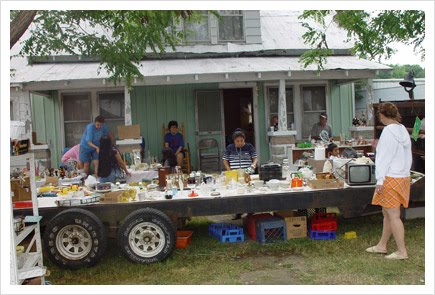
If you plan on traveling U.S. 127 this weekend, expect plenty of traffic. In some place, the pace may slow to that of snarled rush hour traffic. In other areas it may be bumper to bumper with everyone stretching their neck to see what is on a seller's table or in the front lawn. There will be sudden stops without warning, so drive carefully and defensively.


You say trash, I say TREASURE! Come to U.S. 127 this weekend and see what the beaten path has to offer.

The U.S. 127 Corridor Sale has a website and you can get more information by calling 1-800-327-3945.
Wednesday, July 28, 2010
Edwin Young Chilton: The Good Neighbor

Born August 25, 1849 to Josua and Martha Freeman Chilton of Albany, Kentucky, Dr. Chilton received an academy education and then, while still a boy, began to read medicine with prominent physician, Dr. Elza Beckett, at Albany. He graduated from Miami Medical College at Cincinnati and returned to Albany, where he practiced medicine from 1874 to 1880. But, Dr. Chilton desired to seek his fortunes in a newer community, so in 1880 he moved to Howard Lake. His success was assured from the start and he soon became one of the leading physicians in the county. He kept well abreast of all the latest discoveries in the realms of medicine, philosophy and science, and in 1895, in order to further perfect himself, he took a post graduate course in the School of Surgery in New York City. His thirty-four years in the village of Howard Lake were ones of great usefulness. During thirty years of that time he was a leading member of the school board. In 1898, he was elected to the upper house of the Minnesota legislaturek, and did most efficient work as chairman of the committee on the State Hospital for the Insane. Possessed of a fraternal spirit, he was a popular member of the Masons, the Modern Woodman, the Knights of Pythias and the United Workmen. He was likewise prominent in local affairs and served on numerous committees and delegations. In 1875, Dr. Chilton married Laura Huddleston of Albany. Together, they had four children: Leo, Jessie, Alice and Freeman. After the passing of Laura, Dr. Chilton married Grace Tromly of Illinois. They had two children: Walter and Madge. Dr. Chilton died May 25, 1914. His death was sincerely mourned.
Celebrating the life and times of Edwin Young Chilton, M.D., beloved physician, community and state leader.
As an interesting side note: During the Civil War, Joshua Chilton, who was an industrious and peaceable citizen of Albany, was not permitted to remain at home because of his alignment with the Union. For this he was hated, threatened and even hunted, but nothing could deter him from his duty to his country. He was too old to join the Army, but two of his sons were not and served the Union well. Even though he literally became a refugee driven from his home, Joshua still rendered the Union cause good service. Eventually, Joshua Chilton was killed by General Bragg's soldiers during their visit to Kentucky.
Subscribe to:
Posts (Atom)
Thinking about the Pickup Man
Mary Ellis, who writes for the Wayne Weekly, recently forwarded a copy of her recent story, "Remembering Pickup Man: Howard Perdew....

-
 (This photo was made in the 1950's as the Goat Man passed through my town) Charles McCartney was born on July 6, 1901. In 1915, at age ...
-
 The Roanoke Colony was an enterprise financed and organized by Sir Walter Raleigh in the late 16th century to establish a permanent English ...